 Calc
Cyclotron Energy Calculator – Kinetic Energy of the Exit Beam
 Created by Thomas Becker · Physics Writer · Electricity & Magnetism · Last updated: November 2026
Use this free Cyclotron Energy Calculator to find the kinetic energy a particle has when it leaves a cyclotron, KE = q²B²r² ÷ (2m) — set only by the magnet's field, the exit radius and the particle itself, not by the accelerating voltage.
The cyclotron, invented by Ernest Lawrence in 1929, is a particle accelerator built on a beautiful coincidence: a charged particle circling in a magnetic field takes the same time for each revolution no matter how fast it goes, because its orbit grows in exact proportion to its speed. So a modest alternating voltage, flipping at one fixed frequency, can greet the particle at the gap between two hollow electrodes — the "dees" — twice per turn, every turn, and nudge it faster each time. Hundreds of small nudges accumulate into millions of electron-volts. This calculator finds the energy of the particle at the moment its spiral reaches the edge of the dees and it leaves the machine.
Look at what the final energy depends on: the particle's charge and mass, the field B, and the radius r. Nothing else. The exit energy grows with the square of both B and r, which is why cyclotron builders fight for tenths of a tesla and every centimetre of magnet diameter, and why the history of the cyclotron is a history of ever-larger magnets — from Lawrence's 11-inch prototype to machines metres across. It also explains the machine's character: a cyclotron is not a voltage device at all, but a geometry device, and its energy is fixed the day its magnet is built.
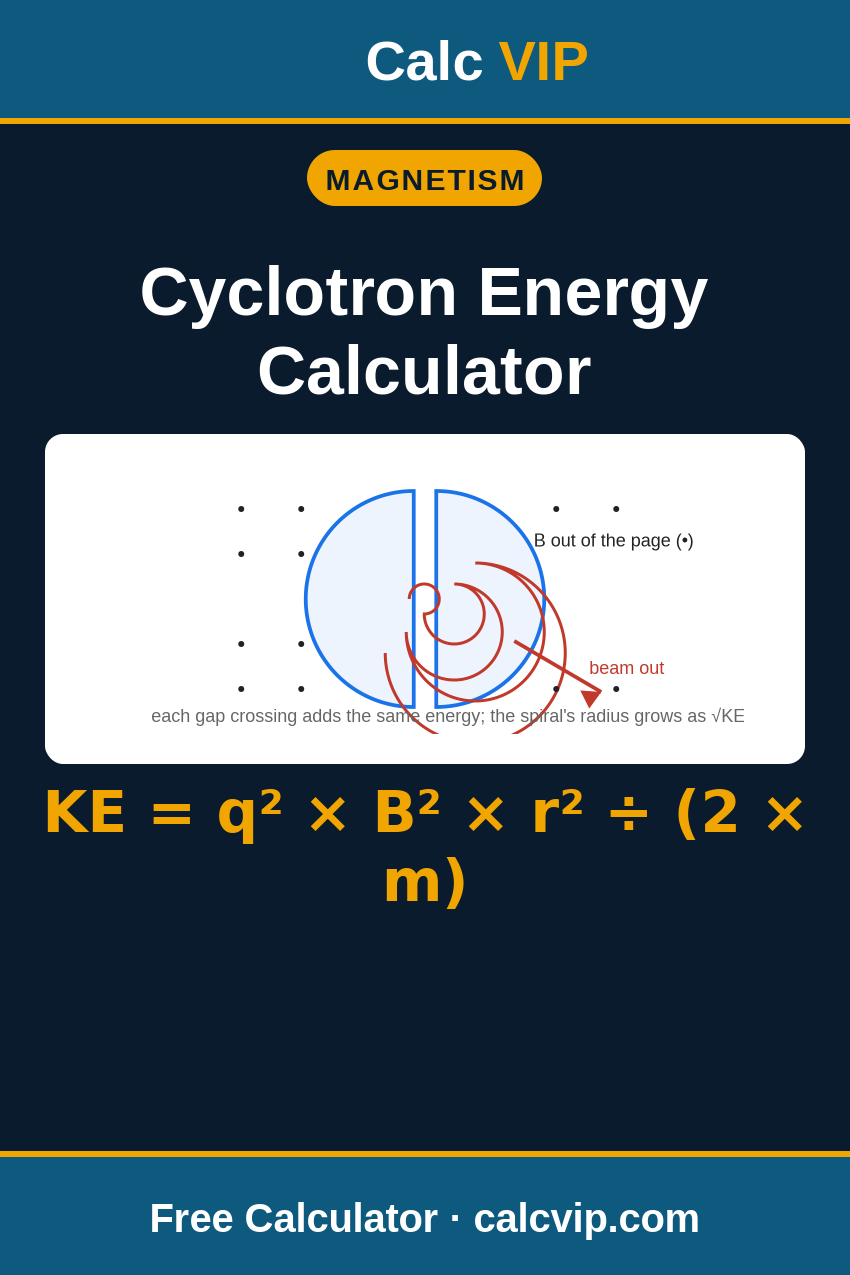
The classical formula on this page carries the seed of its own limit. As the particle's energy becomes a noticeable fraction of its rest energy, relativity makes it effectively heavier, its revolution slows, and it drifts out of step with the fixed-frequency voltage — for protons the classical picture is already about 2% astray at the 17 MeV of Example 1. That ceiling, a few tens of MeV for protons, is why the cyclotron's descendants — the synchrocyclotron and the synchrotron — learned to vary their frequency or their field, and why the classical cyclotron survives where its ceiling does not matter: making medical isotopes, one hospital at a time.
Formula
KE = q² × B² × r² ÷ (2 × m) • KE in joules (J). It comes from combining the exit speed v = qBr/m (from r = mv/qB) with KE = ½mv². Notice what is not in the formula: the accelerating voltage. A higher voltage just means fewer turns to reach the same final energy.
The ingredients rearrange usefully. The exit speed is v = q × B × r ÷ m; the revolution frequency — the frequency the alternating voltage must match — is f = q × B ÷ (2π × m), independent of radius and speed in the classical picture; and solving for the magnet, B = √(2 × m × KE) ÷ (q × r) gives the field a target energy demands at a given size. To convert the answer into the accelerator physicist's currency, divide joules by 1.602 × 10⁻¹⁹ to get electron-volts, then by 10⁶ for MeV — the calculator reports joules and MeV directly.
| Symbol | Meaning | Units |
|---|---|---|
| KE | kinetic energy at exit | joules (J), or MeV |
| q | charge of the particle | coulombs (C) |
| B | magnetic field of the cyclotron magnet | tesla (T) |
| r | exit radius — the radius of the dees | metres (m) |
| m | mass of the particle | kilograms (kg) |
The fixed-frequency miracle — and where it ends
The cyclotron works because of a cancellation. The magnetic force bends the particle into a circle of radius r = mv/(qB): faster particle, bigger circle, in direct proportion. The time for one revolution is the circumference divided by the speed, T = 2πm/(qB) — the speed cancels. A proton in a 1.2 T field circles about 18.3 million times per second whether it is crawling at the centre or leaving at 0.19 c, so one fixed radio frequency, applied to the dees, stays in step with it for all ~hundreds of turns. Lawrence's genius was to see that this made acceleration a matter of patience rather than voltage: a 50 kV dee voltage, crossed twice per turn for a few hundred turns, quietly adds up to tens of MeV.
Relativity spoils the cancellation, gently but fatally. The particle's inertial mass grows by the factor γ, so the true period is 2πγm/(qB): at the 17.24 MeV of Example 1, γ − 1 ≈ 1.8%, and the particle arrives at each gap crossing about 1.8% later per turn than the voltage expects — a slip that accumulates turn by turn until the particle starts meeting the voltage on its wrong half-cycle and gaining nothing. Classical cyclotrons therefore stall around 15–25 MeV for protons. The fixes define the family tree: the synchrocyclotron sweeps its frequency downward to chase the slowing particles (sacrificing beam current), and the synchrotron ramps B as well, holding the radius fixed — the design that scales to the LHC.
How to use
- Choose the particle — proton, deuteron, alpha particle or electron — and its mass and charge are filled in for you.
- Enter the magnet's field strength in tesla and the radius at which the particle leaves the dees, in metres (the dee radius, not the diameter).
- Click "Calculate" to get the exit kinetic energy in joules and in MeV.
- Remember the result is the classical (non-relativistic) energy: trustworthy for protons and heavier ions up to a few tens of MeV, but only a rough guide for electrons, which turn relativistic almost immediately.
Worked examples
Example 1 — a hospital cyclotron. A proton (q = 1.602 × 10⁻¹⁹ C, m = 1.673 × 10⁻²⁷ kg) leaves a cyclotron with B = 1.2 T and dee radius r = 0.5 m.
KE = q²B²r² ÷ (2m) = (1.602 × 10⁻¹⁹)² × 1.2² × 0.5² ÷ (2 × 1.673 × 10⁻²⁷) = 2.76 × 10⁻¹² J.
Converting (1 eV = 1.602 × 10⁻¹⁹ J): KE = 17.24 MeV — a typical energy for a hospital cyclotron making medical isotopes. Doubling the radius would quadruple this energy, which is why cyclotron size matters so much.
Example 2 — deuterons in the same machine. A deuteron has the proton's charge but twice its mass (3.344 × 10⁻²⁷ kg). At B = 1.2 T and r = 0.5 m: KE = 1.381 × 10⁻¹² J = 8.62 MeV — exactly half the proton's energy, because KE ∝ 1/m at fixed q, B and r. Heavier singly-charged ions always leave slower.
Example 3 — alpha particles. An alpha particle doubles both the charge and (roughly) quadruples the mass (q = 3.204 × 10⁻¹⁹ C, m = 6.645 × 10⁻²⁷ kg). The q² wins: KE = 2.781 × 10⁻¹² J = 17.36 MeV, a shade above the proton — the charge-to-mass bookkeeping, q²/m, is what ranks the particles: proton 1.00, alpha 1.01, deuteron 0.50 in relative units.
Example 4 — a stronger field, a smaller magnet. Protons at B = 1.5 T with r = 0.35 m: KE = 2.114 × 10⁻¹² J = 13.20 MeV. The stronger field did not fully compensate for the smaller radius — B enters squared, but so does r, and (1.5 × 0.35)² < (1.2 × 0.5)². The product Br is the machine's true figure of merit.
Example 5 — how fast is the Example 1 proton? v = qBr/m = (1.602 × 10⁻¹⁹ × 1.2 × 0.5) ÷ 1.673 × 10⁻²⁷ = 5.75 × 10⁷ m/s, about 0.19 c — fast enough that its revolution frequency, f = qB/(2πm) = 18.3 MHz, has already slipped about 1.8% from its low-energy value, the relativistic effect that caps the classical design.
Example 6 — a metre-radius research machine. Protons at B = 1.0 T and r = 1.0 m: KE = 7.67 × 10⁻¹² J = 47.9 MeV. Note the trade against Example 1: a weaker field but double the radius wins easily, because the radius is squared — though at 48 MeV the classical formula is itself flattering the machine by several percent, and a real design at this energy would already be a synchrocyclotron.
Cyclotrons in real life
Medical isotope production. The world's supply of fluorine-18 for PET scans is made in hospital cyclotrons of almost exactly Example 1's class — 16–19 MeV protons striking water enriched in oxygen-18. The isotope's 110-minute half-life means it must be made on site, which is why these machines live in hospital basements.
Proton therapy. Cancer treatment with proton beams needs 200–250 MeV — beyond the classical cyclotron, so therapy centres use superconducting synchrocyclotrons whose compact magnets reach the energy at small radius by pushing B up, exactly the B² lever in the formula.
Radioisotope research and dating. Cyclotrons produce the tracer isotopes of chemistry and biology and the beams used to measure rare isotopes in accelerator mass spectrometry, which dates samples far older than radiocarbon alone allows.
Materials and semiconductor work. Ion implantation and radiation-hardness testing use modest cyclotron beams to dope silicon and to simulate years of space radiation in hours.
Neutron sources. A deuteron or proton beam of 10–40 MeV on a suitable target knocks out intense neutron fluxes for imaging and materials science — a job sized precisely by the energies in the table below.
The historical ladder. Lawrence's first working cyclotron (1931) was 11 inches across and reached about 80 keV; within a decade, 60-inch machines reached tens of MeV and were producing the first artificial radioisotopes — the r² law made flesh in a decade of bigger magnets.
Why the voltage really doesn't matter (and what it does instead)
It feels wrong that a 200 kV machine and a 20 kV machine with the same magnet produce identical beam energies, so it is worth seeing where the voltage goes. Each gap crossing adds q × V of energy — with two crossings per turn, the particle gains 2qV per revolution. To reach a fixed final energy it therefore needs (final KE)/(2qV) turns: ten times the voltage, a tenth of the turns. Voltage sets the choreography, not the destination: with low voltage the spiral winds hundreds of tightly spaced turns (and the beam spends longer exposed to residual gas and imperfections), while with high voltage the turns are few and widely spaced, easing extraction at the edge. There is a second, quieter limit: the particle must stay in step with the voltage's phase, and a bigger step per turn means a bigger energy error per slip. Designers pick the dee voltage for beam quality; the magnet alone picks the energy.
Getting the beam out: extraction
Reaching the dee radius is not the same as leaving the machine, and extraction has its own physics. In a classical positive-ion cyclotron an electrostatic deflector — a plate at tens of kilovolts — peels the outermost turn sideways into an exit channel; the turn spacing there is set by the energy gain per turn, which is why high dee voltage, useless for the final energy, is valuable for clean extraction: at 50 kV the Example 1 beam gains 100 keV per turn and makes about 172 turns, each step outward distinct enough to slip a deflector into. The modern hospital machines sidestep the problem with the H⁻ stripping trick described in the FAQ: no deflector at all, just a foil, and the beam walks itself out. Either way, what emerges is a beam whose energy this calculator predicts and whose intensity — microamps to milliamps of average current — is set by the ion source and by how much beam survives the hundreds of turns through the residual gas in the vacuum chamber.
Quick reference: proton exit energy at B = 1.2 T
| Exit radius r | Exit KE (J) | Exit KE (MeV) |
|---|---|---|
| 0.25 m | 6.90 × 10⁻¹³ | 4.31 |
| 0.50 m | 2.76 × 10⁻¹² | 17.24 |
| 0.75 m | 6.21 × 10⁻¹² | 38.78 |
| 1.00 m | 1.10 × 10⁻¹¹ | 68.94 |
Read the table with the relativistic health warning in mind: the first two rows describe real, buildable classical machines; by the last row the formula overstates what a fixed-frequency machine could actually deliver, because the protons would have fallen out of step long before reaching the edge.
Common mistakes
- Entering the diameter instead of the radius. r is the dee radius. Using the diameter quadruples the predicted energy — the most expensive slip this calculator permits.
- Expecting the dee voltage in the answer. It is not there. Voltage sets the number of turns; B, r, q and m set the energy. If your estimate used the voltage, it was the wrong formula.
- Trusting the electron result. The classical formula assumes mass is constant. An electron reaches 10% of light speed at just 2.6 keV, so its "cyclotron energy" here is a formal number, not a buildable machine — real electron machines are betatrons, linacs or microtrons.
- Confusing MeV with MeV per nucleon. The alpha particle's 17.36 MeV is shared among 4 nucleons — about 4.3 MeV per nucleon, which is what governs how far it penetrates matter. Nuclear physicists quote the per-nucleon figure for exactly this reason.
- Forgetting the charge is squared. Doubling q quadruples KE at fixed B, r — but the alpha's mass also quadruples, nearly cancelling the gain. Ranking particles by q/m alone, or by q² alone, both mislead; the formula's q²/m is the ranking.
FAQ
Why doesn't a bigger accelerating voltage give a more energetic beam?
The particle leaves when its orbit reaches the dee radius, and that radius fixes its speed through v = qBr/m. A bigger voltage only gets it to the edge in fewer, bigger steps — the exit energy is unchanged.
Why are electrons rarely accelerated in ordinary cyclotrons?
Electrons are so light that they become relativistic at modest energies; their effective mass grows, their orbit frequency drops, and they fall out of step with the fixed-frequency voltage. The formula above is the classical (non-relativistic) result.
How do real machines reach higher energies?
Synchrotrons ramp the magnetic field and the frequency together as the particles gain energy, keeping them on a fixed-radius ring — the principle behind the LHC's 6.5 TeV protons.
What frequency must the dee voltage have?
The particle's revolution frequency, f = qB/(2πm) — about 18.3 MHz for protons at 1.2 T, in the short-wave radio band. It must hold that frequency (or a harmonic of it) for the whole acceleration.
How many turns does a particle make?
Roughly the final energy divided by the gain per turn, 2qV. A 17 MeV proton in a machine with 50 kV dees gains 100 keV per turn and so makes about 170 turns — each one at exactly the same period, which is the machine's founding trick.
Why do hospital cyclotrons accelerate negative hydrogen ions instead of protons?
An H⁻ ion (a proton with two electrons) can be stripped of its extra electrons by a thin foil at the edge; losing the electrons flips its charge's sign, so the magnetic field bends it out of the machine automatically. It is the neatest extraction trick in the business — the energy formula is unchanged, with the proton's mass and (singly) its charge magnitude.
Does the beam energy depend on where the ions are injected?
No — ions start near the centre at negligible energy and spiral out; the exit energy is set entirely at the rim. Injection energy affects only the first few turns' spacing.
What limits the field B in practice?
Iron saturates around 2 T, so conventional cyclotron magnets live below that; superconducting coils reach 3–5 T in modern compact machines, buying their energy through B² at small radius — at the price of cryogenics.
Can a cyclotron accelerate neutrons or neutral atoms?
No. The magnetic bending and the electric kicks both require charge. Neutral particles are produced as secondaries — by striking a target with the charged beam — never accelerated directly.
How big is the biggest cyclotron?
TRIUMF in Canada accelerates protons to 520 MeV in a machine 18 m across — a synchrocyclotron-style design whose size and energy show both the power of r² and the relativistic ceiling that forced its frequency to be swept.