 Calc
Ohm's Law Calculator – Solve Voltage, Current, Resistance & Power
 Created by Michael Chen · Electronics Specialist · Last updated: November 2026
Use this free Ohm's Law Calculator to find any one of voltage (V), current (I), resistance (R) or power (P) when you know the other values. Just pick what you want to find and enter the two values you have.
Ohm's law is the first rule of electric circuits — the relationship that nearly every other calculation in electronics quietly depends on. It says that the current flowing through a conductor is directly proportional to the voltage across it and inversely proportional to its resistance: push twice as hard and twice the current flows; double the opposition and the current halves. The German physicist Georg Ohm published the relationship in 1827, and it was so poorly received at first that he resigned his teaching post — yet within a generation it had become the foundation on which the whole electrical age was built.
The water analogy makes the three quantities intuitive. Voltage is the pressure pushing the water; current is the flow rate; resistance is a narrowing in the pipe. Raise the pressure and more water flows. Narrow the pipe and the flow falls, even at the same pressure. Electricity behaves the same way: a battery supplies the "pressure", the wires and components resist the flow, and the current that results is simply pressure divided by opposition. That is the whole law — V = IR — and every worked example on this page is that one sentence wearing different clothes.
Its usefulness is hard to overstate. Ohm's law chooses the resistor that protects an LED, predicts whether a fuse will blow, sizes the element inside a kettle, explains why a failing battery can show full voltage yet run nothing, and lets a technician with a multimeter diagnose a circuit they cannot see inside. Because any one of voltage, current and resistance can be found from the other two, the law is also a completeness check on measurements: if your three readings do not satisfy V = IR, one of them is wrong. This calculator handles all four directions of the calculation, and adds the power as a bonus each time.
Formula
Voltage = Current × Resistance → V = IR • I = V / R • R = V / I • P = VI
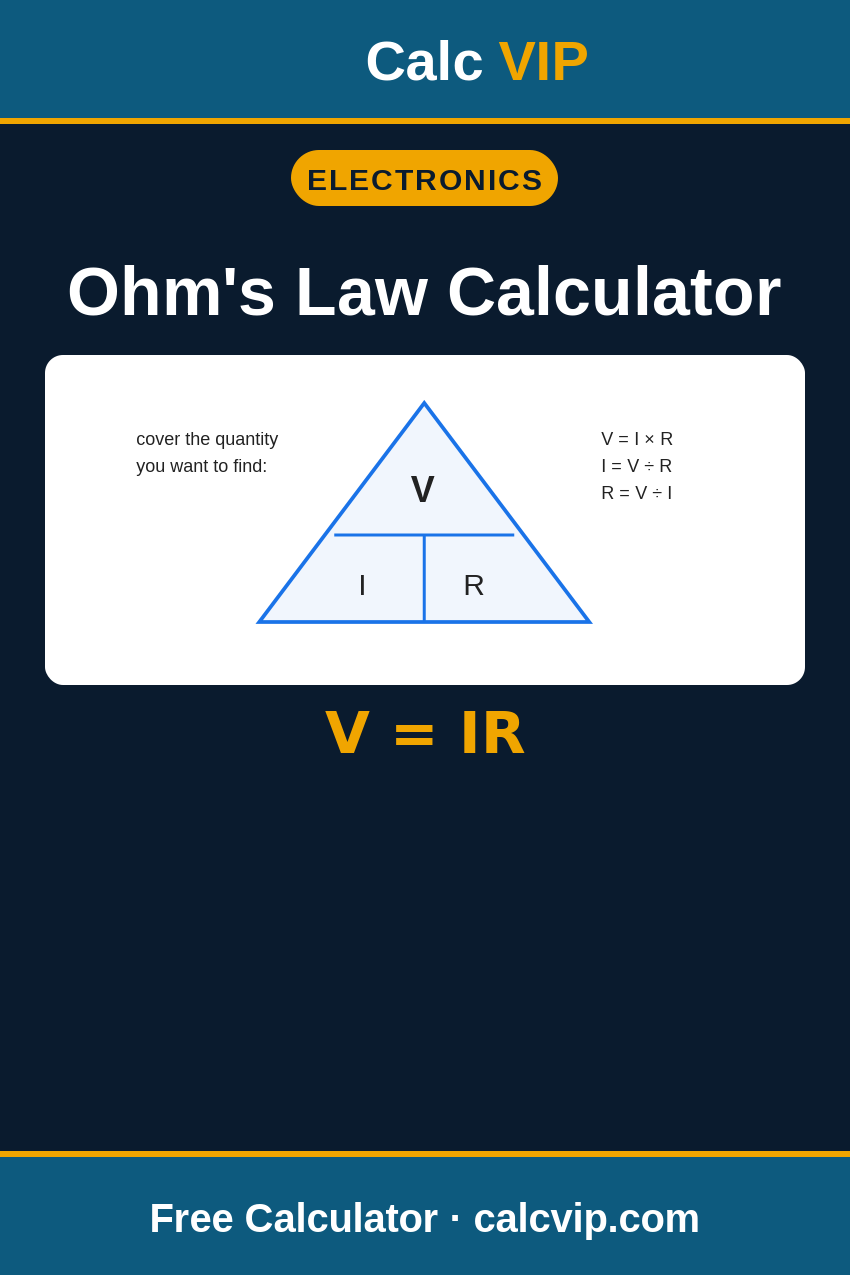
The three forms are one law, not three: cover the quantity you want in the triangle above and the two remaining letters show the arrangement you need. Power joins the family through P = V × I, and substituting Ohm's law into it gives the two other power forms, P = I²R and P = V²/R, which our Electric Power Calculator explores in depth. Unit discipline is what keeps the law honest: voltage in volts, current in amps and resistance in ohms always combine correctly, but milliamps and kilo-ohms must be converted first — 20 mA is 0.02 A, and 4.7 kΩ is 4,700 Ω. Most wrong answers in circuit homework are not wrong physics, just unconverted prefixes.
| Symbol | Meaning | Units |
|---|---|---|
| V | voltage — the electrical pressure across a component | volts (V) |
| I | current — the rate of flow of charge | amps (A) |
| R | resistance — opposition to the current | ohms (Ω) |
| P | power — the rate of using electrical energy | watts (W) |
What resistance really is: a traffic jam of electrons
Current in a metal wire is a slow drift of free electrons, and resistance is everything that gets in their way. As the electrons move, they collide with the vibrating atoms of the material, surrendering energy at each bump — energy that leaves as heat. That is why resistance and heating are inseparable: a component with resistance carrying a current always warms up, gently in a signal resistor, fiercely in a heater element designed for exactly that purpose. Materials differ enormously in how crowded the road is: copper's electrons travel easily, nichrome's collide constantly, and insulators block the road altogether.
The proportionality in Ohm's law — current exactly tracking voltage — holds when the road itself does not change as traffic flows. For a metal resistor at a steady temperature that is true, and its V–I graph is a perfect straight line whose slope is the resistance. But the collisions heat the material, and for many substances heating changes the resistance, bending the line. A lamp filament is the classic case: cold, its resistance is low and a surge of current flows; hot, its resistance rises more than tenfold and the current settles. Ohm's law is not broken by this — at any single moment V = IR still holds — but R must be measured at the operating temperature, not assumed.
How to use
- Choose what you want to find from the dropdown: voltage, current, resistance or power.
- Enter the two values you know — the input labels change to match your choice. Use plain volts, amps and ohms, converting any milliamp or kilo-ohm figures first.
- Click "Calculate" to get the missing value, plus the power as a bonus.
- Sanity-check the result against the story of the circuit: a small resistance across a big voltage should give a big current. If it does not, a prefix has probably gone astray.
Worked examples
Example 1 — finding current. A circuit has a voltage of 12 V across a resistor of 4 Ω.
I = V ÷ R = 12 ÷ 4 = 3 A.
The power used is P = V × I = 12 × 3 = 36 W.
Example 2 — finding voltage. A current of 2 A flows through a 6 Ω resistor. What voltage is across it?
V = I × R = 2 × 6 = 12 V, and the resistor dissipates P = 12 × 2 = 24 W as heat — which is why real resistors carry a power rating as well as a resistance value, and why this one would need to be a chunky part, not a tiny signal resistor.
Example 3 — finding resistance. A torch bulb connected to a 9 V battery draws 0.5 A.
R = V ÷ I = 9 ÷ 0.5 = 18 Ω, using P = 9 × 0.5 = 4.5 W. Notice that this is the filament's hot resistance; measured cold with a multimeter it would read far lower, a puzzle Example 3's owner meets again in the Common mistakes section below.
Example 4 — the LED resistor. An LED needs 2 V across itself and a current of 20 mA, and it is to run from a 5 V supply. The series resistor must swallow the leftover voltage: 5 − 2 = 3 V, at the same 20 mA (0.02 A) that flows through the LED.
R = V ÷ I = 3 ÷ 0.02 = 150 Ω. This exact calculation is performed millions of times a day — nearly every indicator light on Earth is an LED, a resistor chosen by Ohm's law, and a supply.
Example 5 — a kettle element. A kettle's heating element measures 28.75 Ω and runs on 230 V mains.
I = 230 ÷ 28.75 = 8 A, and P = 230 × 8 = 1,840 W — matching the "1.8 kW" printed on the label. Heating appliances are Ohm's law working backwards: the designer picks the power, knows the voltage, and manufactures the element to the resistance the law demands.
Example 6 — a car headlight. A headlight bulb on a 12 V car system draws 5 A.
R = 12 ÷ 5 = 2.4 Ω and P = 12 × 5 = 60 W — the familiar "12 V 60 W" stamped on the bulb. Two such bulbs draw 10 A between them, which is why headlight circuits have their own fuse and why leaving the lights on flattens the battery by morning.
Ohm's law in real life
Protecting LEDs and electronics. An LED connected straight across a battery would draw a destructive current, because its own resistance is tiny once it switches on. The series resistor of Example 4 exists purely to set the current by Ohm's law — it is the most common component choice in all of hobby electronics.
Fuses and circuit breakers. A fuse is a deliberate weak link whose job is to melt when current exceeds a safe value. Whether that value is ever reached is an Ohm's law question: a fault that lowers a circuit's resistance — a crushed cable, a failed motor — lets current climb in exact proportion, and the fuse sacrifices itself before the wiring does.
Designing anything that heats. Kettles, toasters, hair dryers, immersion heaters and the rear-window demister in a car are all resistors chosen so that I = V/R, squared away through P = I²R, delivers a target wattage. The whole product category is applied Ohm's law with a thermostat attached.
Fault-finding with a multimeter. Technicians measure resistance to find broken elements (infinite resistance), short circuits (near zero) and tired components that have drifted from their marked value. A heating element that should read 28.75 Ω but reads open-circuit has failed exactly where Ohm's law says to look.
Why old batteries sag. A real battery has resistance inside itself — internal resistance — which rises as the battery ages or empties. Under load, that hidden resistor drops some of the voltage before it ever reaches your device, which is why a worn battery can measure 1.5 V on a meter yet fail to run a motor: the meter draws almost no current, so almost no voltage is lost inside.
Thick cables for big currents. Wire has resistance too, and at high currents even a fraction of an ohm drops real voltage and wastes real power as heat. That is why starter-motor and jumper cables are thick — more copper cross-section means less resistance — and why long extension leads can make a power tool run weakly at the far end of a garden.
When Ohm's law "fails": non-ohmic devices
Some components refuse to keep a fixed resistance, and their V–I graphs curve instead of running straight. The filament lamp bends because its resistance climbs with temperature. A diode is stranger: it conducts almost nothing until about 0.7 V, then conducts freely, so its "resistance" collapses as voltage rises — behaviour no single R value can describe. Thermistors deliberately change resistance with temperature (that is their job as sensors), and the human body changes with wetness, which matters greatly in the next section. None of this breaks the law itself: V = IR remains true instant by instant, but with R as a moving target the simple proportional predictions no longer apply, and engineers reach for the device's characteristic graph instead. The calculator on this page assumes the steady, constant-R case — the world of ordinary resistors, elements and cables, which is most of everyday practice.
Quick reference: how much current does what to the body?
Ohm's law is also a safety law, because the current through a person is set by the voltage and the body's resistance — roughly 100,000 Ω with dry skin, but as low as 1,000 Ω with wet or broken skin. At 230 V, wet hands could pass I = 230 ÷ 1,000 = 0.23 A, far into the lethal range below. This is why bathrooms have special rules, why RCD devices trip at 30 mA, and why electricians treat "it is only the voltage" as a dangerous half-truth: voltage pushes, but current is what harms.
| Current through the body | Typical effect |
|---|---|
| about 1 mA | just perceptible — a faint tingle |
| about 5 mA | a distinct, unpleasant shock |
| about 10 mA | muscles contract — may be unable to let go |
| 30 mA | the level at which an RCD cuts the power to protect you |
| 100 mA and above | potentially fatal — can stop the heart's rhythm |
Read the table through Ohm's law and the safety rules write themselves: keep voltage away from wet skin (lowers R), insulate conductors (raises R towards infinity), and fit RCDs, because you cannot rely on letting go.
Common mistakes
- Believing current is "used up" by components. Current is the same all the way round a series circuit; what is used up is voltage (energy per charge). A resistor does not consume current — it converts electrical energy to heat while the same current flows out as flowed in.
- Rearranging the formula wrongly. I = V ÷ R, never R ÷ V. The triangle at the top of this page exists precisely to prevent this slip: cover what you want, and read off the arrangement that remains.
- Assuming every component obeys the law. Diodes, LEDs and lamp filaments are non-ohmic — their resistance changes with voltage or temperature. Applying a single measured R to them at a different operating point gives confidently wrong answers.
- Forgetting the prefixes. 20 mA is 0.02 A and 4.7 kΩ is 4,700 Ω. Feeding "20" and "4.7" into the formula produces answers out by a thousand in one direction or the other — the single most common cause of absurd results.
- Trusting a lamp's cold resistance. A multimeter measures a filament cold, when its resistance may be a tenth of its hot working value. Predicting the running current from the cold reading overstates it wildly; the bulb's printed wattage gives the true hot resistance through R = V²/P.
FAQ
What is Ohm's law?
Ohm's law says the current through a resistor is directly proportional to the voltage across it: V = IR. Double the voltage and (for the same resistor) the current doubles too.
What if I only know the power and the resistance?
Use P = I²R, so I = √(P ÷ R), then V = IR. Our Electric Power Calculator covers these combinations.
Does Ohm's law work for every component?
No. It works well for ordinary resistors at a steady temperature. Diodes, LEDs and lamp filaments are "non-ohmic" — their resistance changes as they heat up or as the voltage changes.
Who discovered Ohm's law?
The German physicist Georg Simon Ohm, who published it in 1827 after painstaking experiments with wires of different lengths and materials. The unit of resistance, the ohm, is named in his honour — a recognition that arrived only late in his life.
What exactly is an ohm?
One ohm is the resistance that allows exactly one amp of current to flow under one volt of pressure. It anchors the whole system: a 10 Ω resistor on a 10 V supply passes 1 A by definition of the units themselves.
Why don't birds on a power line get electrocuted?
Because both of the bird's feet are at the same voltage, so there is no voltage difference across its body to drive a current — Ohm's law gives I = 0 ÷ R = 0. The danger appears only if the bird bridges two points at different voltages, as large birds sometimes tragically do between a wire and a pole.
How can I find power if I only know voltage and resistance?
Substitute Ohm's law into P = VI: since I = V/R, the power is P = V²/R. For a 230 V supply across a 28.75 Ω kettle element that gives 230² ÷ 28.75 = 1,840 W, exactly as in Example 5.
What is a short circuit, in Ohm's law terms?
A path of almost zero resistance placed across a supply. With R near zero, I = V/R explodes towards hundreds or thousands of amps, which is why short circuits melt insulation, spark, and trip breakers or blow fuses within milliseconds.
Does Ohm's law apply to AC circuits?
Yes, for purely resistive loads such as heaters and incandescent lamps, using the RMS values of voltage and current. Where coils and capacitors are involved, their extra opposition (reactance) joins resistance to form impedance, and the law generalises to V = IZ — same shape, wider idea.
Why does a battery's voltage fall when it is nearly empty?
Its internal resistance rises as it discharges, so under load more of the voltage is dropped inside the battery itself and less reaches the terminals. The emptier the battery, the bigger the hidden resistor in series with everything it powers.