 Calc
Force Calculator – Newton's Second Law F = ma Solver
 Created by James Carter · Physics Writer · Forces & Motion · Last updated: November 2026
Use this free Force Calculator based on Newton's Second Law (F = ma). You can find the force from mass and acceleration — or work backwards to find the mass or the acceleration instead.
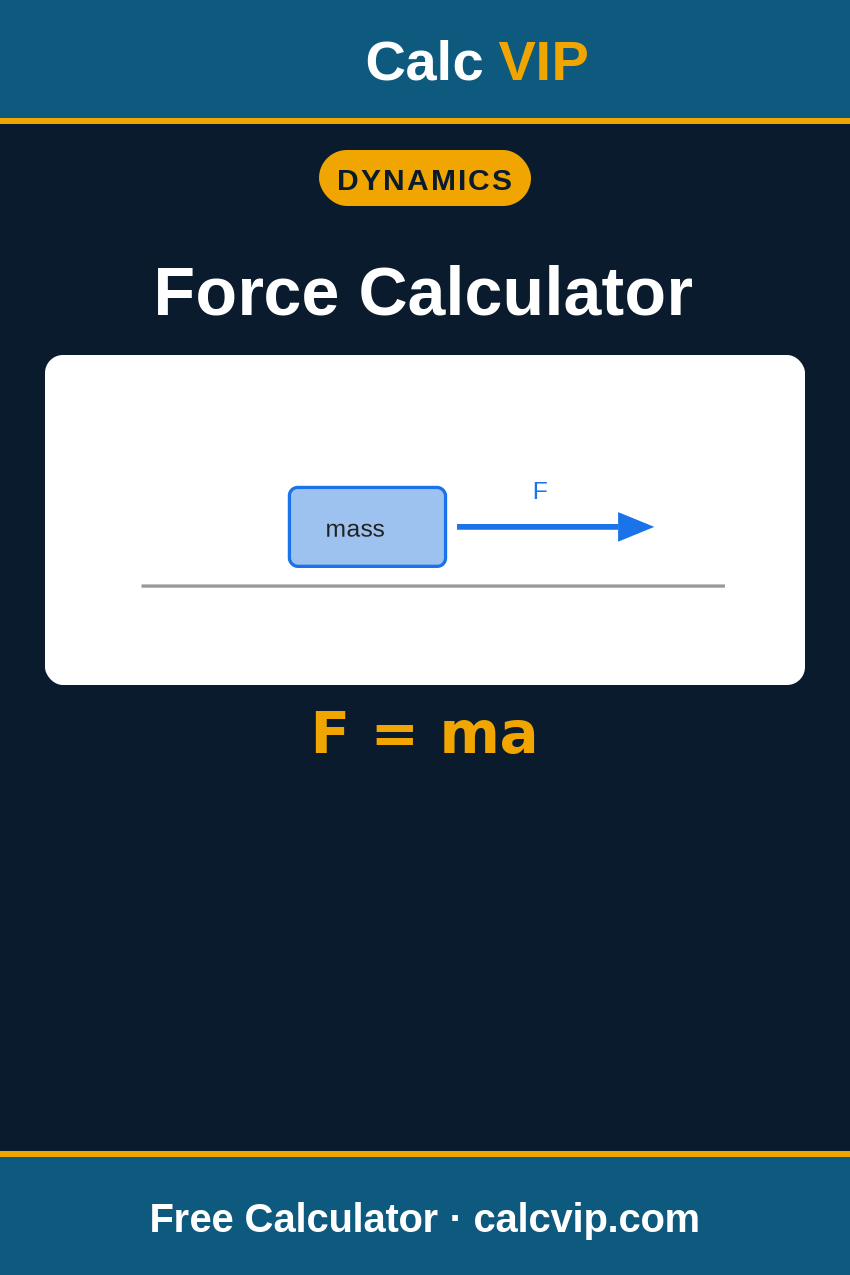
Push an empty shopping trolley and it rolls away easily. Push a loaded one with the same effort and it barely gets moving. That everyday experience is Newton's second law of motion in action: the acceleration a force produces depends not only on the force, but on the mass it has to move. Double the mass and the same push produces half the acceleration. Double the force and you get double the acceleration.
Isaac Newton published this relationship in 1687, and it remains the single most used equation in engineering. Every car, crane, rocket and roller coaster is designed around it. The law is usually written F = ma, and it says that force, mass and acceleration are locked together: know any two and the third is fixed.
One refinement matters in real problems: F is the net (resultant) force — the total left after all the pushes and pulls acting on the object are combined, including friction and air resistance working against the motion. A car needs far more force from its engine than F = ma alone suggests for its acceleration, because much of that force is spent fighting drag and rolling resistance before any is left over to accelerate the car.
Formula
Force = Mass × Acceleration → F = ma • m = F / a • a = F / m
The unit of force, the newton (N), is defined by this equation: one newton is the force that accelerates a mass of one kilogram by one metre per second squared. In symbols, 1 N = 1 kg·m/s². It is roughly the weight of a small apple — fitting, given Newton's famous (if probably mythical) inspiration.
The most familiar force of all is weight: the pull of gravity on a mass, W = mg, where g ≈ 9.81 m/s² near Earth's surface. Weight is just F = ma with the acceleration fixed at g, which is why the same equation that describes pushing a box also tells you what that box weighs.
| Symbol | Meaning | Units |
|---|---|---|
| F | net force | newtons (N) |
| m | mass | kilograms (kg) |
| a | acceleration | m/s² |
| W | weight, W = mg | newtons (N) |
| g | gravitational field strength near Earth | ≈ 9.81 m/s² |
Net force, friction and balanced forces
Forces on an object combine. Push a 10 kg box with 50 N while friction pushes back with 20 N, and the net force is 30 N — so the box accelerates at a = 30 ÷ 10 = 3 m/s², not 5 m/s². This is the same box as Example 1 below, seen honestly, with friction included.
If the forces balance exactly — net force zero — then a = 0 and the object keeps doing what it was already doing: staying still, or moving at a constant velocity. That is Newton's first law, and it is really just the F = ma special case F = 0. A cruising airliner is not force-free; its engine thrust exactly balances drag, so its acceleration is zero.
How to use
- Choose what you want to find: force, mass or acceleration.
- Enter the two values you know — the labels change to match your choice.
- Click "Calculate" to get the missing value. Force is measured in newtons (N).
- Remember the force should be the net force if friction or other forces are also acting.
Worked examples
Example 1 — the box. A box of mass 10 kg accelerates at 3 m/s². F = m × a = 10 × 3 = 30 N. (Working backwards: a force of 100 N on an object accelerating at 4 m/s² means its mass is 100 ÷ 4 = 25 kg.)
Example 2 — a family car. A car of mass 1200 kg accelerates from rest to 100 km/h (27.78 m/s) in 10 seconds, so its acceleration is a = 27.78 ÷ 10 ≈ 2.78 m/s². The net force needed is F = 1200 × 2.78 ≈ 3336 N. The engine must actually provide considerably more than this, because drag and rolling resistance take their share first.
Example 3 — your own weight. A person of mass 70 kg has weight W = mg = 70 × 9.81 = 686.7 N on Earth. On the Moon, where g = 1.62 m/s², the same person weighs 70 × 1.62 = 113.4 N — while their mass is still exactly 70 kg. Mass travels with you; weight depends on where you are standing.
Example 4 — the warehouse crate. A worker pushes a 50 kg crate across a warehouse with a net force of 250 N (after friction has taken its share of a larger push). The crate accelerates at a = F ÷ m = 250 ÷ 50 = 5 m/s² — which is why the push is only sustained for a second or two: at 5 m/s² the crate is soon moving faster than the worker cares to follow.
Example 5 — pushing a car. Two people push a broken-down car with a net force of 600 N. The car's mass is 1000 kg, so a = F ÷ m = 600 ÷ 1000 = 0.6 m/s². Gentle — but after 10 seconds of it the car is moving at 6 m/s, fast enough to bump-start or reach the garage forecourt.
Example 6 — weighing a sled backwards. A training sled accelerates at 1.5 m/s² under a measured push of 450 N. Its mass must be m = F ÷ a = 450 ÷ 1.5 = 300 kg — athlete, sled and plates together. Coaches really do audit loads this way when scales are not handy: measure the push and the acceleration, and the mass confesses.
Force in real life
Rockets. A Falcon 9 rocket produces about 7.6 million newtons (7.6 MN) of thrust at liftoff. That sounds enormous until you divide by its mass of roughly 549,000 kg: the initial acceleration is only about 14 m/s² before subtracting gravity's 9.81 — which is why rockets rise so majestically slowly at first, then accelerate harder as fuel burns off and the mass falls.
Lifts and fairground rides. Standing in a lift of mass-person 70 kg that accelerates upwards at 2 m/s², the floor must push up with F = m(g + a) = 70 × 11.81 ≈ 826.7 N instead of the usual 686.7 N. Your legs feel that extra 140 N as heaviness. Accelerating downwards, the floor pushes less and you feel lighter — F = ma explaining a sensation everyone knows.
Why lorries need big engines. A loaded lorry can mass 40,000 kg. Even a gentle acceleration of 0.5 m/s² needs a net force of 20,000 N, before hills and drag. Cars accelerate briskly with far less force simply because there is so much less of them to move.
Crash forces. In a crash that decelerates a 70 kg occupant at 20 g (a = 196.2 m/s²), the restraining force is F = 70 × 196.2 = 13,734 N — the weight of a small car, delivered through a seatbelt's narrow webbing. Every centimetre of belt stretch and crumple-zone collapse that lowers that peak acceleration lowers this force in direct proportion.
Towing. A tow rope pulling a 1500 kg car up to speed at a modest 0.8 m/s² must supply a net 1500 × 0.8 = 1200 N, plus whatever rolling resistance demands on top. That is why tow ropes are rated in tonnes and why snatching at a slack rope — which spikes the acceleration — snaps them.
Named forces: thrust, tension, lift
Forces encountered in problems usually arrive wearing name tags, but they all obey F = ma. Thrust is the push from an engine or rocket. Tension is the pull along a rope, cable or chain. Lift is the upward force on a wing. None of them is exempt from the second law: the acceleration of the object is always set by the net of all of them together with weight and friction. A crane cable lifting a 50 kg crate with an upward acceleration of 1.5 m/s² must pull with tension T = m(g + a) = 50 × (9.81 + 1.5) = 565.5 N — more than the crate's weight of 490.5 N, because the cable must support the crate and accelerate it upwards. Lowering with the same acceleration reverses the sum: T = m(g − a) = 415.5 N.
Big forces, small forces
Forces span an enormous range, and engineers scale their units accordingly: kilonewtons (1 kN = 1000 N) for vehicles and structures, meganewtons (1 MN = 1,000,000 N) for rockets and ships. The Saturn V rocket's first stage produced about 34.5 MN of thrust. At the gentle end, the force needed to accelerate a 10 g pen by 1 m/s² is 0.01 N — and the weight of that pen is only about 0.098 N. Even the drag of air on a falling sheet of paper is a force of this small order, yet it completely governs how the paper falls, because the paper's mass is so small that a tiny force produces a large acceleration. F = ma cuts both ways: small forces are negligible for lorries and decisive for feathers.
The third law hiding behind the second
F = ma describes what a net force does to one object, but forces themselves always come in pairs — Newton's third law. When you walk, your foot pushes backwards on the ground and the ground pushes forwards on you with an equal force; it is the ground's push, not yours, that accelerates you. When a rifle fires, the expanding gas pushes the bullet forwards and the rifle backwards (the recoil whose momentum the momentum calculator balances). Even the book resting on the table is a pair of pairs: gravity pulls the book down and the Earth is pulled up towards the book by exactly the same force — an acceleration of the Earth so small, thanks to its enormous mass in F = ma, that it could never be measured. Keeping the laws separate matters: the third law's pair acts on two different objects, so paired forces never cancel in one object's F = ma.
F = ma over time: impulse joins the story
Multiply both sides of F = ma by the time the force acts and the second law grows a second face: F × t = m × Δv, the impulse–momentum theorem. A force of 100 N acting for 2 s on a 10 kg object changes its velocity by Δv = 200 ÷ 10 = 20 m/s — the same result as finding a = 10 m/s² and multiplying by 2 s, reached by a different road. The impulse view is the one engineers reach for when the force is brief and violent — hammer blows, collisions, racket strikes — where the acceleration is monstrous for a millisecond and awkward to measure, but the force–time product is well behaved.
It also explains a subtlety of Example 2: the car's engine force is not constant over its 10 seconds, fading as speed builds and gears change. The F = ma answer of 3336 N is therefore the average net force — the constant force that would have delivered the same total impulse in the same time. Averages like this are not evasions; they are exactly what the impulse form of the law guarantees.
Quick reference: forces with familiar faces
Force is invisible until it accelerates something, so anchors help. The gentlest entry — an apple's weight — is the newton's own definition story; the largest is a rocket leaving the pad. Everything human-scale lives between about 1 N and 100,000 N.
| Force | Size |
|---|---|
| weight of a small apple (0.1 kg) | ≈ 0.98 N |
| holding up a 1 kg bag of sugar | 9.81 N |
| pushing the 10 kg box of Example 1 | 30 N |
| family car's net force, 0–100 km/h in 10 s | ≈ 3336 N |
| loaded lorry accelerating at 0.5 m/s² | 20,000 N |
| Falcon 9 thrust at liftoff | ≈ 7,600,000 N |
Friction's ceiling: the force that cannot be exceeded
Friction is the force with a cap. For a box resting on a floor, static friction matches your push exactly — up to a maximum set by the surfaces: roughly μ × the object's weight, where μ (mu) is the coefficient of friction. A 10 kg box (weight 98.1 N) on a surface with μ = 0.4 cannot be budged by less than 0.4 × 98.1 = 39.24 N of horizontal push; below that figure the box's acceleration is exactly zero, however the F = ma arithmetic on your push alone might look.
Push past the ceiling and the box breaks free, usually into the care of a slightly smaller kinetic friction — which is why a sliding box is easier to keep moving than to start, and why a car's wheels must never lock: a rolling tyre works at the static ceiling, a locked, sliding tyre at the lower kinetic rate. Anti-lock brakes are, in the language of this page, machines for keeping the net force near its ceiling.
Common mistakes
- Confusing mass and weight. Mass is measured in kilograms and is the same everywhere. Weight is a force, measured in newtons, and changes with gravity. Bathroom scales quietly measure force and report it as mass, assuming Earth gravity.
- Thinking motion needs a force to sustain it. It doesn't. A net force is needed to change motion. An object moving with balanced forces keeps its velocity forever — which is why spacecraft coast for years with their engines off.
- Forgetting friction. Entering the engine's or the pusher's force as F gives too big an acceleration. F in the formula is what remains after friction and drag are subtracted.
- Dividing the wrong way. Acceleration is F ÷ m, not m ÷ F. A quick unit check helps: newtons divided by kilograms gives m/s², as it should.
- Putting weight where mass belongs. If an object "weighs 686.7 N", its mass is 686.7 ÷ 9.81 = 70 kg. Feeding 686.7 into F = ma as the mass counts gravity twice and inflates every force nearly tenfold.
FAQ
What is a newton?
One newton (1 N) is the force needed to accelerate a 1 kg mass by 1 m/s². It is the SI unit of force.
Is weight a force?
Yes. Weight is the force of gravity on a mass: W = mg. A 10 kg object weighs about 10 × 9.81 = 98.1 N on Earth.
Does F = ma use net force?
Yes. F is the total (resultant) force after all pushes and pulls — including friction — are combined.
Why don't heavier objects fall faster, if gravity pulls them harder?
Because the larger force is exactly cancelled by the larger mass. Gravity's force grows in proportion to m (W = mg), and a = F/m = mg/m = g — the same for every mass. That is why all objects fall together when air resistance is removed.
Can there be a force with no acceleration?
Yes — when forces balance. A book resting on a table has gravity pulling it down and the table pushing it up; the net force is zero, so it does not accelerate. The individual forces are real; they simply cancel.
What force is needed to keep something moving at a constant speed?
Zero net force. In practice, a moving car needs engine force to keep going, but only because that force is busy cancelling friction and air resistance — the net force, and hence the acceleration, stays zero.
How much force is 1 newton in everyday terms?
Roughly the weight of a small apple (about 100 g of mass). Holding up a 1 kg bag of sugar takes about 9.81 N — call it 10 N — which makes a handy mental scale for judging forces.
How much force does it take to lift a 10 kg box at a steady speed?
Exactly its weight: 10 × 9.81 = 98.1 N upward, balancing gravity so the net force is zero and the box rises without accelerating. Lift it with acceleration and you must add ma on top — which is why a sharp heave feels heavier than a smooth lift.
How many newtons is the weight of a 100 kg person?
100 × 9.81 = 981 N, just under a kilonewton. The handy conversion: 1 kN ≈ the weight of 101.9 kg of mass on Earth, so forces quoted in kilonewtons can be pictured as "the weight of about a hundred kilos per kN".
Does F = ma work in space, far from any planet?
Yes — it is the same law everywhere. Astronauts pushing cargo on the space station use it daily: a 100 kg crate given a gentle 10 N push accelerates at 0.1 m/s², weightless but not massless, and just as hard to stop as its mass demands.