 Calc
Projectile Motion Calculator – Range, Max Height & Flight Time
 Created by Sarah Mitchell · Physics Editor · Motion & Measurement · Last updated: November 2026
Use this free Projectile Motion Calculator to find the range, maximum height and flight time of an object launched at an angle. Just enter the launch speed and angle — gravity is taken as g = 9.81 m/s².
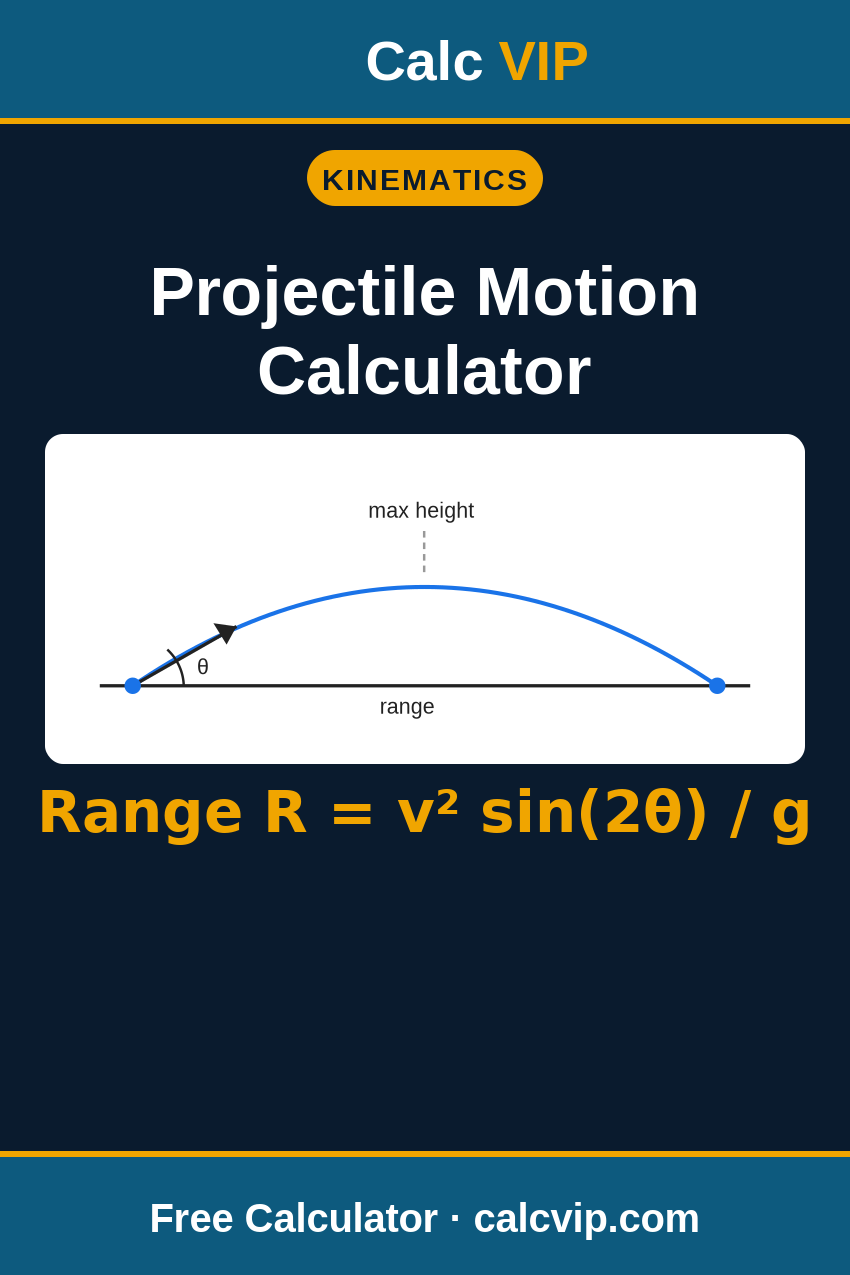
Throw a ball, kick a football, fire a fountain of water into the air — the object follows the same elegant curve every time: a parabola. Projectile motion is what happens when something is launched and then left to move under gravity alone. It is the physics of every ball game, every long jump, every shell and sprinkler and ski jump ever made.
The key insight, Galileo's again, is that the motion splits into two completely independent parts. Horizontally, nothing pushes or pulls (we ignore air resistance), so the horizontal velocity never changes — the object keeps covering the same horizontal distance each second. Vertically, gravity accelerates it downwards at 9.81 m/s², exactly as if it had been dropped, first slowing its rise, stopping it for an instant at the top, then speeding its fall. Add a steady sideways drift to ordinary free fall and the parabola appears.
This calculator assumes the standard textbook conditions: launch and landing at the same height, flat ground, and no air resistance. Within those conditions its three answers — range, maximum height and flight time — are exact. The FAQ discusses how real balls, with drag and spin, differ.
Formulas
Range R = v² sin(2θ) / g • Max height H = v² sin²θ / (2g) • Flight time T = 2v sinθ / g
All three formulas come from splitting the launch velocity into components: horizontal v cosθ and vertical v sinθ. Only the vertical component decides how long the object stays airborne — gravity must cancel it on the way up and rebuild it on the way down, which takes T = 2v sinθ/g. The range is then simply that time multiplied by the steady horizontal speed. The maximum height is reached halfway through the flight, when the vertical component has been braked to zero.
Notice what is absent: mass. Like free fall, projectile motion in this idealised form is the same for a pebble and a cannonball launched identically — one reason the formulas have survived since the seventeenth century.
| Symbol | Meaning | Units |
|---|---|---|
| R | range — horizontal distance travelled | metres (m) |
| H | maximum height | metres (m) |
| T | total flight time | seconds (s) |
| v | launch speed | m/s |
| θ | launch angle above the horizontal | degrees (°) |
| g | acceleration due to gravity | 9.81 m/s² |
Why 45° wins — and the pairs that match
The range formula contains sin(2θ), which reaches its maximum value of 1 when 2θ = 90°, i.e. at θ = 45°. Launch slower or faster and 45° still wins — for a fixed speed on flat ground, it is always the best angle for distance.
But 45° has rivals that tie with each other. Because sin(2θ) is symmetric, angles equally spaced either side of 45° give the same range: 30° and 60°, 20° and 70°. Examples 2 and 3 below use exactly such a pair at 30 m/s. Both balls land 79.45 m away — but the 60° ball flies nearly three times higher and stays airborne almost twice as long. Same destination, very different journey.
How to use
- Enter the launch (initial) speed in metres per second.
- Enter the launch angle in degrees, measured from the ground (0–90°).
- Click "Calculate Projectile Motion" to see the range, maximum height and total time in the air.
- Remember the assumptions: launch and landing at the same height, on flat ground, with no air resistance — so treat the answers as the ideal values real launches approach.
Worked examples
Example 1 — the 45° kick. A ball is kicked at 20 m/s at 45°. Range = (20² × sin 90°) ÷ 9.81 = 400 ÷ 9.81 = 40.77 m. Max height = (20² × sin²45°) ÷ (2 × 9.81) = 200 ÷ 19.62 = 10.19 m. Flight time = (2 × 20 × sin 45°) ÷ 9.81 = 2.88 s.
Example 2 — the flat throw, 30°. A ball launched at 30 m/s at 30°: Range = (900 × sin 60°) ÷ 9.81 = 779.4 ÷ 9.81 = 79.45 m. Max height = (900 × sin²30°) ÷ 19.62 = 225 ÷ 19.62 = 11.47 m. Flight time = (2 × 30 × sin 30°) ÷ 9.81 = 30 ÷ 9.81 = 3.06 s.
Example 3 — the lob, 60°. The same 30 m/s at 60°: Range = (900 × sin 120°) ÷ 9.81 = 79.45 m — identical to Example 2, as promised. But Max height = (900 × sin²60°) ÷ 19.62 = 675 ÷ 19.62 = 34.40 m, and Flight time = (2 × 30 × sin 60°) ÷ 9.81 = 51.96 ÷ 9.81 = 5.30 s. The lob trades the flat throw's directness for height and hang time.
Example 5 — straight up: the 90° launch. A ball launched at 15 m/s vertically has Range = 0, but Height = 225 ÷ (2 × 9.81) = 11.47 m and Flight time = 30 ÷ 9.81 = 3.06 s. The formulas handle the extreme gracefully: sin(180°) = 0 kills the range while sin²(90°) = 1 maximises the height. Every launch lives somewhere on the trade between these two poles.
Example 6 — the golf drive. A drive leaves the tee at 50 m/s at 30°. Range = (2500 × sin 60°) ÷ 9.81 = 2165 ÷ 9.81 ≈ 220.7 m. Max height = (2500 × 0.25) ÷ 19.62 = 31.86 m. Flight time = 50 ÷ 9.81 ≈ 5.10 s — five full seconds of hang time, in the ideal model. Real drives fall shorter: the dimples and drag that this model ignores are a whole second physics course of their own.
Projectile motion in real life
Sport. A golf drive launched at 70 m/s would, in this idealised model at 45°, carry over 490 m — real drives fall well short, the clearest everyday proof that air resistance matters enormously at high speed (and why golf balls have dimples, which reduce drag). Long jumpers, who launch themselves, take off at only about 20° rather than 45°: the human body generates far less speed when jumping steeply, so a flatter, faster launch wins in practice.
Water and fountains. A garden sprinkler or fountain jet is a visible projectile machine. Tilt the nozzle and the parabolic arc stretches or shrinks exactly as the formulas describe — fire wardens and irrigation designers use the same range equation, with corrections, to place water where it is needed.
On the Moon. With g = 1.62 m/s² instead of 9.81, every answer stretches by the ratio 9.81 ÷ 1.62 ≈ 6. The 45° kick of Example 1 would carry 400 ÷ 1.62 ≈ 247 m on the Moon. Alan Shepard famously hit golf balls there on Apollo 14 — with no air and one-sixth gravity, they flew, as he put it, "miles and miles".
Fire hoses and water cannon. A fire hose jet leaving at 20 m/s at 45° reaches, by Example 1's arithmetic, about 40.8 m — the number crews implicitly know when they judge whether a stream can be lobbed over a roofline into a courtyard. Drop the angle and the jet flattens and shortens; the parabola is a working tool, not a classroom ornament.
Ski jumping. A ski jumper leaves the table at about 25 m/s, nearly horizontal, and the "projectile" is rescued by the landing slope falling away beneath the flight — the hill is shaped to stay close to the ideal parabola, so the jumper lands after 100+ metres with a gentle meeting angle instead of a cliff-edge drop.
What air resistance changes
Real projectiles drag air with them, and three things change. First, the range shrinks — dramatically at high speeds, which is why the 490 m ideal golf drive of the real-life section is really about 280 m. Second, the best angle drops below 45°, typically to somewhere in the 30s for balls, because a flatter launch spends less time fighting drag. Third, the path stops being a symmetric parabola: the descent is steeper and shorter than the climb, because the projectile keeps losing horizontal speed all the way. Light, large objects are affected most — a beach ball barely follows the model at all — while dense, slow projectiles like a thrown stone or a shot put follow it closely. The formulas here are the ideal limit that real motion approaches, and they remain the right starting point for every more complicated treatment.
Example 4 — a horizontal launch (a step beyond this calculator). A ball rolls off a table 1 m high at 3 m/s horizontally. This is a projectile with θ = 0°, but since it lands lower than it launched, it needs the free-fall formula for its flight time: t = √(2 × 1 ÷ 9.81) ≈ 0.45 s. In that time its steady horizontal motion carries it 3 × 0.45 ≈ 1.35 m from the table's edge. The same two-part thinking — free fall vertically, steady motion horizontally — solves every projectile problem, including the ones this calculator's same-height formulas do not cover.
A short history of the parabola
Projectile motion was the first motion problem of the modern age, because armies needed the answer. In 1537 the Italian mathematician Niccolò Tartaglia published the first mathematical treatment of gunnery, arguing — correctly and controversially — that no part of a cannonball's path is straight. A century later Galileo, rolling balls down inclined planes to slow their motion enough to measure, worked out the two-component structure this page is built on and proved the path is a parabola. Newton's laws then explained why: a steady horizontal velocity plus a constant downward acceleration cannot draw any other curve. Modern ballistics adds drag, spin and the Earth's rotation back in, but every firing table and sports-tracking system still starts from Galileo's parabola and corrects it.
Launched from a height: the cliff extension
The three headline formulas assume launch and landing at the same level. Launch from a cliff of height h and the flight time must be earned differently: the vertical motion is now governed by h = −v sinθ × T + ½gT², and for the simplest case — a horizontal launch (θ = 0) — the time is just the free-fall time from that height, T = √(2h/g). A stone thrown horizontally at 10 m/s from a 20 m cliff stays airborne for √(40 ÷ 9.81) ≈ 2.02 s and lands 10 × 2.02 ≈ 20.2 m out — the horizontal launch of Example 4, priced in full.
Height also breaks the 45° rule. From a cliff, the best angle drops below 45°, because the fall itself supplies extra flight time and the launch is better spent on horizontal speed. Artillery on hills, golfers on elevated tees and basketball players (whose "cliff" is the release height above the hoop's level on the way down) all live in this corrected version of the theory — same components, one extra term.
Quick reference: one launch speed, five angles (v = 20 m/s)
Fix the speed at Example 1's 20 m/s and vary only the angle, and the whole personality of projectile motion appears: range rises to 45° and falls symmetrically, height climbs relentlessly, and the complementary pairs (15°/75°, 30°/60°) share ranges while differing wildly in height.
| Launch angle | Range | Max height |
|---|---|---|
| 15° | 20.39 m | 1.37 m |
| 30° | 35.31 m | 5.10 m |
| 45° | 40.77 m | 10.19 m |
| 60° | 35.31 m | 15.29 m |
| 75° | 20.39 m | 19.02 m |
Air resistance: the honest correction
Every number on this page is computed in a vacuum, and real projectiles file their objections immediately. A baseball driven at 40 m/s at 45° has a vacuum range of 40² ÷ 9.81 ≈ 163.1 m; a real baseball, dragging its way through the air, lands nearer 120 m. The shortfall grows with speed, because drag grows roughly with the square of velocity — double the launch speed and the air pushes back four times as hard, eating the v² advantage the range formula promised.
Shape and spin fight back. A golf ball's dimples trip its boundary layer and halve its drag; a well-spun ball generates lift that stretches its flight; a badminton shuttlecock, drag's masterpiece, barely obeys the parabola at all. The vacuum formulas remain the right starting point — they are exact for the Moon, close for dense, slow projectiles like shot puts, and an upper bound everywhere else. Knowing the size of the correction is what separates using a model from believing one.
The javelin shows the model at its most flattering: an elite throw leaves at about 30 m/s at roughly 40°, and the vacuum range is 900 × sin 80° ÷ 9.81 ≈ 90.3 m — within a few metres of the world record. A javelin is dense, slow by projectile standards and thrown at altitude-friendly angles, so the air's correction is a footnote rather than a chapter; the parabola, unusually, gets the last word.
Common mistakes
- Expecting the horizontal velocity to fade. In this model it never does — only gravity acts, and gravity pulls straight down. Real balls do slow horizontally, but that is air resistance, which the model deliberately leaves out.
- Using the formulas when landing height differs. Launching from a cliff or a rooftop breaks the symmetry: the flight lasts longer and the range grows. The formulas here assume launch and landing at the same height.
- Thinking the velocity at the top is zero. Only the vertical component is zero at the peak. The horizontal component carries on unchanged, so the object is still moving at v cosθ at the top of its arc.
- Mixing degrees and radians. The angle here is in degrees. If you evaluate sin(2θ) by hand with a calculator set to radians, every answer will be wrong — check the mode before trusting the sine.
- Measuring the angle from the vertical. Every formula here takes θ from the horizontal. A launch described as "30° from vertical" is a 60° launch in this calculator's language — entering 30 would swap it for its complement and quietly exchange a lob for a drive.
FAQ
Which angle gives the maximum range?
45 degrees. At 45° the range formula reaches its maximum for a given launch speed (on flat ground, ignoring air resistance).
Does this calculator include air resistance?
No. Like most physics textbook problems, it assumes the only force acting after launch is gravity.
What happens at an angle of 90°?
The object goes straight up and comes straight down, so the range is zero but the height and flight time are at their largest for that speed.
What is the velocity at the top of the arc?
The vertical component is zero there, but the horizontal component continues at v cosθ — so the projectile is moving purely horizontally at the peak, not resting. For Example 1, that is 20 × cos45° ≈ 14.14 m/s.
Does the mass of the projectile matter?
Not in this model — the formulas contain no mass, so identical launches of a pebble and a cannonball give identical results. In reality mass matters indirectly, because heavier, denser objects are less affected by air resistance.
Do two different angles ever give the same range?
Yes — any pair of angles that add to 90° (such as 30° and 60°) gives the same range at the same launch speed. The steeper launch goes higher and stays up longer, as Examples 2 and 3 show.
How would the answers change on the Moon?
Range, height and flight time all grow because g is smaller (1.62 m/s²). Range, height and flight time all grow by the factor 9.81 ÷ 1.62 ≈ 6, because each of the three formulas divides by g.
What range does a 10 m/s launch at 45° give?
R = 10² ÷ 9.81 = 100 ÷ 9.81 ≈ 10.19 m. Quarter the speed of Example 1 and the range quarters too — range grows with v², which is why small speed gains are worth so much in throwing events.
Why do shot-putters release below 45°?
Two reasons: the shot is released about 2 m above its landing level (the cliff effect, which favours a flatter launch), and human shoulders produce more speed at lower angles. The physics optimum and the body's optimum compromise at around 37–42° in practice.
Does a projectile accelerate horizontally?
No — in this model nothing pushes it sideways after launch, so the horizontal velocity is constant from launch to landing. All of the action, and the whole of the parabola's curve, comes from the vertical component being steadily rewritten by gravity.