 Calc
Acceleration Calculator – Change in Velocity Over Time
 Created by Sarah Mitchell · Physics Editor · Motion & Measurement · Last updated: November 2026
Use this free Acceleration Calculator to find how quickly an object's velocity changes. Enter the starting velocity, the final velocity and the time taken, and get the acceleration in metres per second squared (m/s²).
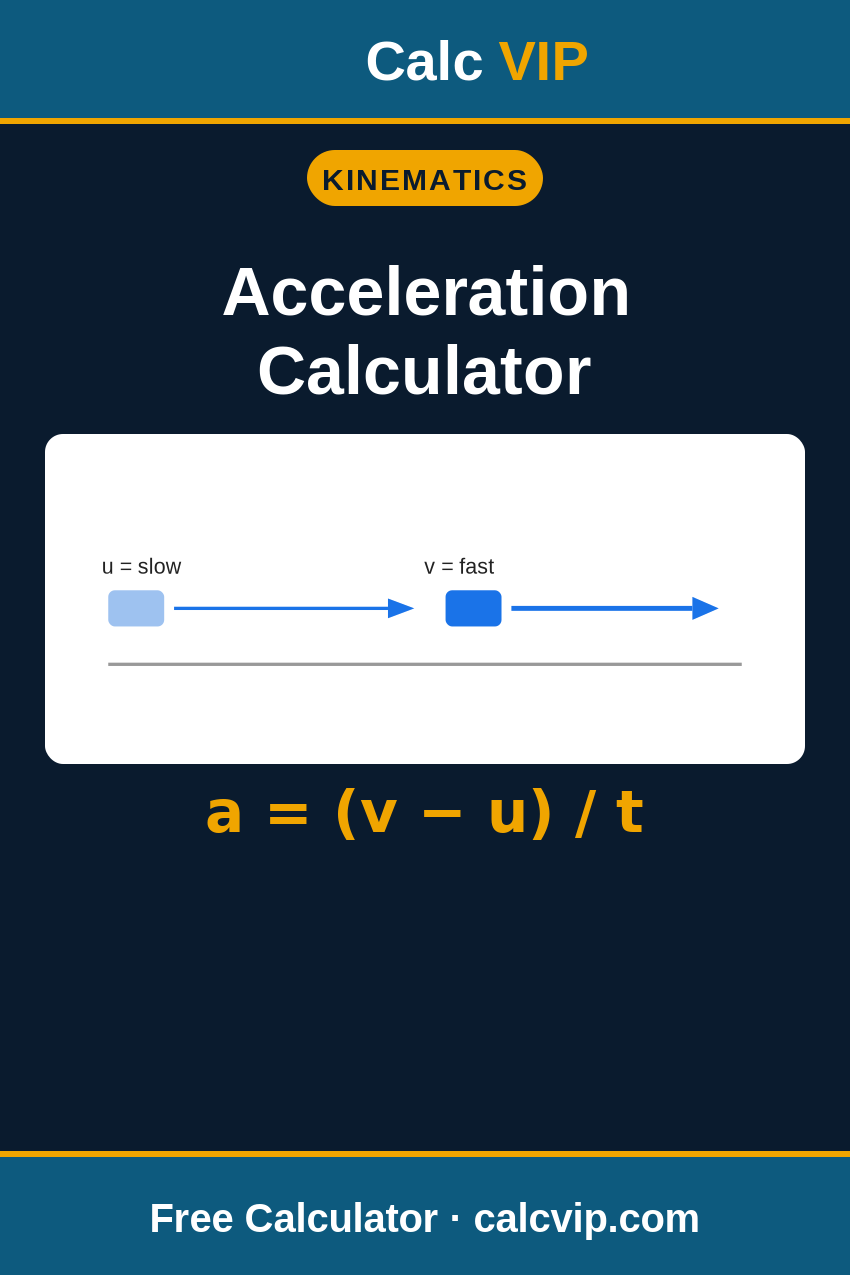
Acceleration is one of the first things you feel in everyday life, even if you never calculate it. When a car pulls away from a traffic light, your body is pressed back into the seat — that push is acceleration. When the same car brakes hard, you are thrown forward — that is acceleration too, in the opposite direction. A roller coaster, a lift starting to rise, a footballer sprinting from a standing start: all of them are changing velocity, and acceleration is simply the number that says how fast that change happens.
Velocity tells you how fast something is moving and in which direction. Acceleration tells you how fast that velocity itself is changing. A car cruising steadily at 60 km/h has a velocity of 60 km/h but an acceleration of zero, because its velocity is not changing. A car that goes from 0 to 60 km/h in 6 seconds has an average acceleration of about 2.78 m/s². The number is small, but it is the whole story of how quickly the car picked up speed.
Formula
Acceleration = (Final velocity − Initial velocity) ÷ Time → a = (v − u) / t
The same formula can be rearranged, which is useful when a different value is missing. To find the final velocity, use v = u + a × t. To find how long a change takes, use t = (v − u) ÷ a. All three versions say the same thing: acceleration, change in velocity and time are tied together, so knowing any two lets you work out the third.
The unit, m/s², is worth reading literally: metres per second, per second. An acceleration of 5 m/s² means the velocity grows by 5 m/s every single second — after 1 second the object is 5 m/s faster, after 2 seconds it is 10 m/s faster, and so on, as long as the acceleration stays constant.
| Symbol | Meaning | Units |
|---|---|---|
| a | acceleration — rate of change of velocity | m/s² |
| v | final velocity | m/s |
| u | initial velocity (the starting velocity) | m/s |
| t | time taken for the change | seconds (s) |
Acceleration on a velocity–time graph
If you plot velocity against time, acceleration is the slope of the line. A steep upward slope means rapid acceleration; a flat line means zero acceleration; a downward slope means the object is slowing down. The cyclist in the worked example below goes from 10 m/s to 30 m/s in 4 seconds, so the graph climbs steadily and its slope is 5 m/s² — the same number the calculator gives.
How to use
- Enter the starting velocity (u) in m/s — use 0 if the object starts from rest.
- Enter the final velocity (v) in m/s and the time in seconds.
- Click "Calculate Acceleration". A negative result means the object is slowing down (deceleration).
- Keep the units consistent: if your speeds are in km/h, divide by 3.6 first to get m/s (for example, 72 km/h = 20 m/s).
Worked examples
Example 1 — a cyclist speeding up. A cyclist speeds up from 10 m/s to 30 m/s in 4 seconds. Acceleration = (30 − 10) ÷ 4 = 20 ÷ 4 = 5 m/s².
Example 2 — a car accelerating from rest. A car goes from 0 to 100 km/h in 8 seconds. First convert the speed: 100 ÷ 3.6 = 27.78 m/s. Then acceleration = (27.78 − 0) ÷ 8 = 27.78 ÷ 8 = 3.47 m/s². This is why car makers quote 0–100 km/h times — the shorter the time, the bigger the acceleration, and the harder the push you feel in your seat.
Example 3 — braking to a stop. A car travelling at 20 m/s brakes to a complete stop in 5 seconds. Acceleration = (0 − 20) ÷ 5 = −20 ÷ 5 = −4 m/s². The minus sign is the important part: the car is accelerating backwards relative to its motion, which is exactly what slowing down means in physics.
Example 4 — a motorcycle pulling away. A motorcycle accelerates from 20 m/s to 35 m/s in 3 seconds as it joins a motorway. Acceleration = (35 − 20) ÷ 3 = 15 ÷ 3 = 5 m/s² — brisk enough to pin the rider's arms straight, and a reminder that the formula cares only about the change: where the speed started matters not at all, only how much it grew and how long the growth took.
Example 5 — a train braking gently. A train slows from 30 m/s to 10 m/s over 20 seconds as it approaches a station. Acceleration = (10 − 30) ÷ 20 = −20 ÷ 20 = −1 m/s². The small size is deliberate: trains brake gently because hundreds of passengers are standing, holding coffee, and trusting the driver to keep the change of velocity civilised.
Example 6 — how long does the speed build take? A go-kart accelerates at 2.5 m/s² from 5 m/s to 45 m/s. Rearranging, t = (v − u) ÷ a = (45 − 5) ÷ 2.5 = 40 ÷ 2.5 = 16 s. The same three numbers, a different one missing — the calculator handles all three arrangements, and so should you: decide which value is unknown before touching the numbers.
Acceleration in real life
Driving. Gentle city driving is usually 1–3 m/s². Emergency braking can reach −8 m/s² or more on dry roads. That is why stopping distances grow so fast with speed: doubling your speed does not double the braking distance, it roughly quadruples it, because the distance depends on velocity squared.
Sport. A sprinter leaving the blocks accelerates at roughly 3–4 m/s² for the first couple of seconds. A footballer changing direction at full speed is accelerating too — acceleration includes changes of direction, not just changes of speed, which is why a car going steadily around a bend is accelerating towards the centre of the bend.
Falling objects. Near Earth's surface, gravity accelerates everything downwards at about 9.81 m/s², ignoring air resistance. A dropped ball is travelling at 9.81 m/s after 1 second and 19.62 m/s after 2 seconds, and it has fallen 19.62 m in those 2 seconds. That constant 9.81 m/s² is the reason the free-fall calculator and this one are close cousins.
Rockets and roller coasters. A rocket at liftoff accelerates slowly at first, then faster as it burns fuel and gets lighter. Roller coasters are designed around acceleration: drops and loops are shaped so the acceleration you feel stays thrilling but safe, usually under about 4–5 times gravity.
Aeroplanes on the runway. A passenger jet accelerates at roughly 3 m/s² — modest by car standards — but it sustains that push for about 30 seconds, reaching 3 × 30 = 90 m/s (324 km/h) before the nose lifts. Acceleration problems in the air are endurance problems: a small rate of change, held for a long time, builds an enormous velocity.
Electric cars and the traffic-light sprint. A quick electric car reaches 100 km/h (27.78 m/s) in about 4 seconds, an average acceleration of 27.78 ÷ 4 ≈ 6.94 m/s² — about 0.71 g. That is why passengers feel pinned to their seats: for four seconds their bodies are being accelerated at over two-thirds the rate of a falling stone.
Measuring acceleration in g's
Engineers and pilots rarely quote large accelerations in m/s²; they divide by 9.81 and quote g's. Firm braking in a car is about 0.8 g (0.8 × 9.81 ≈ 7.85 m/s²). A roller coaster may briefly reach 4 g (39.24 m/s²). A rocket crew experiences around 3 g (29.43 m/s²) near the end of a burn, when the tanks are nearly empty and the same thrust is accelerating far less mass. The g scale is really a comfort-and-survival scale: the human body tolerates a few g briefly, struggles near 5 g sustained, and blacks out when the acceleration drives blood away from the brain faster than the heart can replace it.
The conversion also runs the other way and exposes sloppy claims. An advertisement boasting that a fairground ride pulls "10 g" is claiming 98.1 m/s² — a velocity change of nearly 100 m/s every second, which no gentle family ride delivers. Whenever a number sounds heroic, multiply by 9.81 and ask whether the implied change of velocity is plausible.
Jerk: the acceleration of acceleration
Acceleration itself can change, and the rate at which it changes has its own name: jerk, measured in m/s³. If a lift's acceleration grows from 0 to 2 m/s² in half a second, the jerk is 2 ÷ 0.5 = 4 m/s³. You rarely feel acceleration itself — a plane at cruising speed accelerates not at all, and even a fast car's steady push soon feels normal. What you feel is jerk: the lurch when the driver stamps on the pedal, the jolt when a train couples carriages, the stomach-flip in the first instant of a lift starting. Vehicle designers budget jerk as carefully as acceleration, because comfort lives in the third derivative, not the second.
Quick reference: accelerations you can picture
Anchor numbers turn a formula into intuition. A pedestrian starting to walk accelerates at roughly 1 m/s²; a family car pulling away manages about 3 m/s²; a sports car reaches about 7 m/s²; emergency braking is around 8 m/s²; and free fall — the benchmark against which everything is compared — is 9.81 m/s². Anything claiming to accelerate a person much beyond 30 m/s² for more than a moment should be treated with suspicion.
| Situation | Acceleration |
|---|---|
| walking away from rest | ≈ 1 m/s² |
| family car pulling away | ≈ 3 m/s² |
| sports car launch | ≈ 7 m/s² |
| emergency braking | ≈ 8 m/s² (0.8 g) |
| free fall near Earth | 9.81 m/s² (1 g) |
| rocket crew near burn-out | ≈ 29.43 m/s² (3 g) |
From nought to sixty and back: reading a car's two numbers
Car journalism quotes two acceleration stories for every model, and this calculator reads both. The launch — 0 to 100 km/h in 8 seconds, from Example 2 — is an average acceleration of 3.47 m/s², a number that flatters ordinary cars because it is measured over the flattering part of the speed range, with a fresh engine, a prepared surface and a driver who does this for a living. The braking figure is the one that matters on the road: a family car braking hard at 0.8 g (7.85 m/s²) from the same 100 km/h (27.78 m/s) stops in t = 27.78 ÷ 7.85 ≈ 3.54 s, covering s = 27.78² ÷ (2 × 7.85) ≈ 49.2 m while doing it — and that is after the brakes bite, with a further car-length or two travelled during the driver's reaction time before the deceleration even begins.
Set the two numbers side by side and a piece of folk wisdom falls out: a car brakes roughly twice as hard as it accelerates. The asymmetry is structural. Acceleration is limited by an engine sized for cruising economy; braking is limited only by the tyres' grip, because the brakes merely have to convert motion into heat, a far easier engineering problem than creating motion in the first place. It is also why following distances are measured in seconds, not metres: at a steady speed the gap in seconds converts directly into the time budget within which the car ahead's acceleration — usually a large, negative one — must be matched by your own.
There is a third number, rarely quoted, that this page's formula prices just as well: the acceleration of the unplanned stop, the crash. A car that hits a barrier at 27.78 m/s and stops within half a metre of crumple experiences an average deceleration of 27.78² ÷ (2 × 0.5) ≈ 771.7 m/s² — nearly 79 g. Nothing in the car's normal operation comes within a factor of twenty of that figure, which is why crash engineering is its own discipline: the entire design problem is to stretch that half-metre of stopping distance and shave the peak off a number this formula computes without blinking.
One more translation is worth owning, because car culture speaks two dialects. The American benchmark, 0–60 mph, is not the same test as 0–100 km/h: 60 mph is 96.56 km/h, or 26.82 m/s, so the car of Example 2, reaching it in the same 8 seconds, averages 26.82 ÷ 8 ≈ 3.35 m/s² rather than 3.47. The difference is small — about 3.5% — but it is large enough to flatter or sink a brochure claim, and it is invisible until the units are converted honestly. That, in miniature, is the whole discipline of this page: acceleration is a simple ratio, and nearly every error ever made with it has been an error of units, signs or timekeeping rather than of physics. Master the conversions and the formula will never surprise you; skip them and even a correct division will faithfully produce the wrong answer.
One last anchor from the track: an elite sprinter's first strides average an acceleration of the order of 4 m/s² — reaching roughly 10 m/s after about 2.5 s of drive phase. It is less than half the acceleration of a falling stone, sustained by nothing but legs, and it is close to the most a human body can produce horizontally.
Common mistakes
- Mixing up velocity and acceleration. A fast object is not necessarily accelerating. A plane cruising at 900 km/h has huge velocity and zero acceleration; a car just starting to move has tiny velocity and large acceleration.
- Forgetting the units. Speeds in km/h must be converted to m/s before using the formula, or the answer will be 3.6 times too big.
- Dropping the minus sign. A negative answer is not a mistake — it is the correct way of saying the object is slowing down.
- Dividing the wrong way round. It is (final − initial) ÷ time, not time ÷ (final − initial). Swapping them gives seconds squared per metre, which is not an acceleration at all.
- Feeding in km/h. The formula expects velocities in m/s. A change from 0 to 100 km/h is a change of 27.78 m/s, not 100 — divide km/h by 3.6 first, or your acceleration comes out 3.6 times too big.
FAQ
What is the unit of acceleration?
Acceleration is measured in metres per second squared (m/s²). It means the velocity changes by that many m/s every second.
Can acceleration be negative?
Yes. Negative acceleration (deceleration or retardation) means the object is slowing down, for example when a car brakes.
What is the acceleration of a falling object?
Near Earth's surface, gravity accelerates falling objects at about 9.81 m/s², ignoring air resistance.
What is the difference between velocity and acceleration?
Velocity is how fast something is moving and in which direction. Acceleration is how fast that velocity is changing. An object can have a high velocity with zero acceleration (steady cruising), or a low velocity with high acceleration (just starting to move).
Can acceleration be zero while an object is moving?
Yes — whenever velocity is constant. A car driving at a steady 60 km/h in a straight line has zero acceleration, even though it is moving.
What is average vs instantaneous acceleration?
Average acceleration is the total change in velocity divided by the total time — what this calculator gives. Instantaneous acceleration is the value at one exact moment, such as the reading on a car's accelerometer. For motion with steady acceleration, the two are the same.
Can acceleration be greater than 9.81 m/s²?
Yes, easily. Sports cars, rockets and roller coasters all exceed it. Fighter pilots train to handle several times 9.81 m/s², which is why acceleration is often also quoted in "g" units, where 1 g = 9.81 m/s².
How do I find acceleration if I only know the distance?
You need one more ingredient. With distance and time, and a start from rest, a = 2s ÷ t² (from s = ½at²); with distance and the two velocities, a = (v² − u²) ÷ 2s. This calculator covers the velocity-and-time version; the displacement calculator covers the distance versions.
Can acceleration point sideways while the speed stays the same?
Yes. Turning a corner at a steady speed is acceleration, because velocity — speed with direction — is changing. That sideways acceleration is the centripetal acceleration, a = v²/r, and it is why passengers lean in bends even when the speedometer never moves.
What acceleration does a lift passenger feel?
When a lift accelerates upwards at 1.5 m/s², you feel heavier, as if gravity had grown to 9.81 + 1.5 = 11.31 m/s². When it accelerates downwards at the same rate you feel lighter, as if g had shrunk to 8.31 m/s². Your velocity may be modest throughout; it is the acceleration that your body reports.