 Calc
Kinetic Energy Calculator – KE = ½mv² Solver
 Created by Priya Sharma · Physics Editor · Energy & Gravity · Last updated: November 2026
Use this free Kinetic Energy Calculator to find the energy an object has because of its motion. Enter the mass and speed, and the calculator gives you the kinetic energy in joules (J).
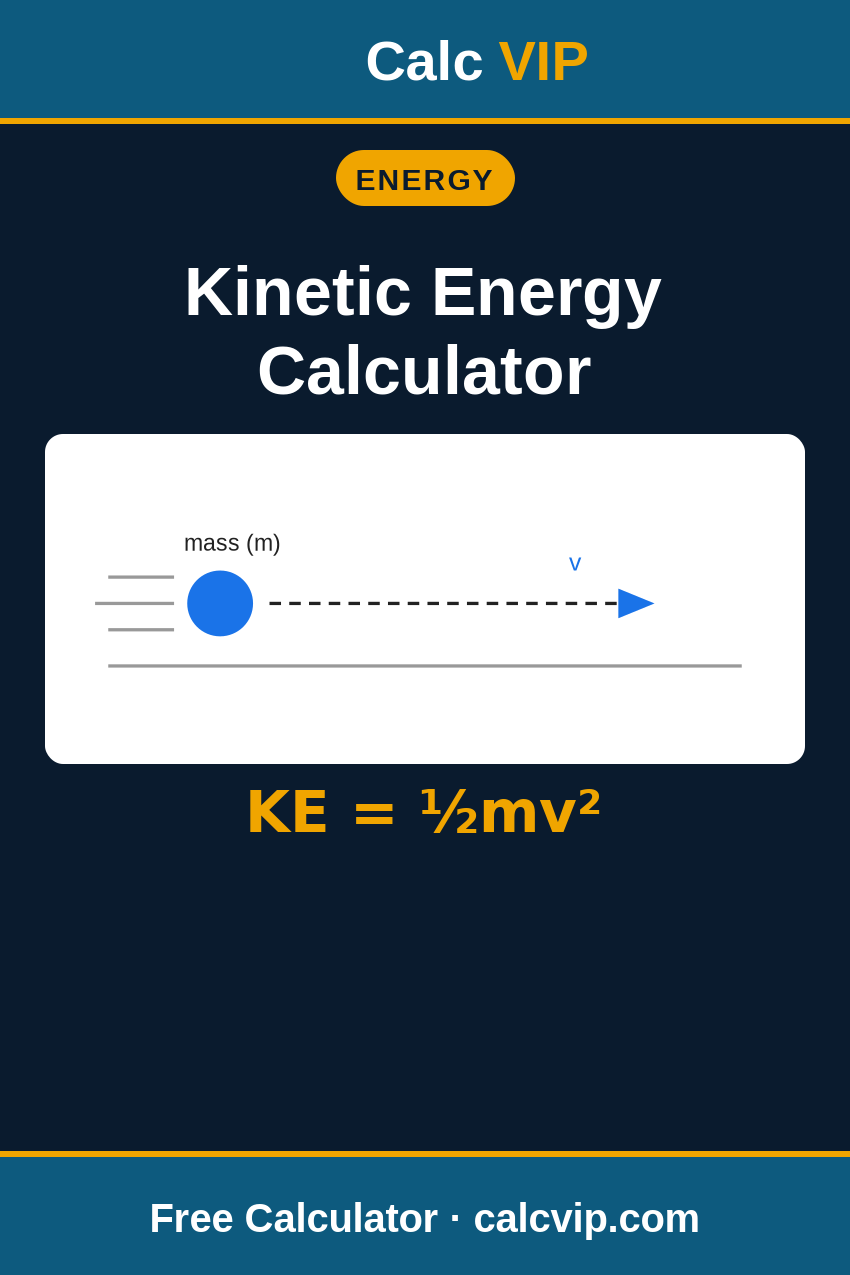
Kinetic energy is the energy of movement. Anything that moves has it: a rolling ball, a flowing river, the wind, a speeding train, even the air molecules jiggling inside this room. The word "kinetic" comes from the Greek word for motion, and the idea is simple — a moving object can do work when it is stopped or slowed, and the amount of work it can do is exactly its kinetic energy. A hammer in motion drives a nail; a moving car crumples against a barrier; moving water turns a turbine. In each case, kinetic energy is being handed over and changed into something else.
Two things decide how much kinetic energy an object carries: its mass and its speed. Mass behaves the way you would expect — double the mass at the same speed and you double the energy. Speed does not behave so politely. Because speed is squared in the formula, doubling the speed multiplies the kinetic energy by four, and tripling it multiplies the energy by nine. This single fact shapes everything from speed limits to spacecraft design, and it is the most important thing this page can teach you.
Kinetic energy is also a scalar: it has a size but no direction. A car travelling north at 20 m/s and the same car travelling south at 20 m/s have identical kinetic energies, even though their velocities point opposite ways. And it is never negative — an object either moves and has kinetic energy, or it is at rest and has none.
Formula
Kinetic Energy = ½ × Mass × Velocity² → KE = ½mv²
Because the velocity is squared, doubling the speed makes the kinetic energy four times bigger — but doubling the mass only doubles it. The formula rearranges to find the other quantities. Speed from energy and mass: v = √(2KE ÷ m) — an object with 50 J of kinetic energy and a mass of 4 kg must be moving at √(100 ÷ 4) = √25 = 5 m/s. Mass from energy and speed: m = 2KE ÷ v² — 2 × 50 ÷ 25 = 4 kg, the same object checked the other way round.
Where does the one-half come from? It falls out of the work needed to speed an object up. A force accelerating an object from rest does work, and when you add up that work over the whole acceleration, the total comes to exactly ½mv². The one-half is not a fudge factor — it is built into how acceleration and distance combine, and the work–energy theorem guarantees that the kinetic energy gained always equals the work put in.
| Symbol | Meaning | Units |
|---|---|---|
| KE | kinetic energy | joules (J) |
| m | mass | kilograms (kg) |
| v | speed | m/s |
Why the square on speed matters so much
Take the 4 kg ball from the worked example and throw it faster. At 5 m/s its kinetic energy is 50 J. At 10 m/s — just twice the speed — it is ½ × 4 × 100 = 200 J, four times as much. At 20 m/s it is ½ × 4 × 400 = 800 J, sixteen times the original. Nothing about the ball changed except its speed, yet it became sixteen times harder to stop and sixteen times more damaging in a collision. This is the deep reason that crash forces climb so viciously with speed, and why engineers lose sleep over velocity far more than over mass.
How to use
- Enter the mass of the object in kilograms (kg).
- Enter its speed in metres per second (m/s).
- Click "Calculate Kinetic Energy" to see the result in joules.
- If your speed is in km/h, divide it by 3.6 first to get m/s — for example, 72 km/h ÷ 3.6 = 20 m/s.
Worked examples
Example 1 — a thrown ball. A 4 kg ball moves at 5 m/s. KE = ½ × 4 × 5² = ½ × 4 × 25 = 50 J.
Example 2 — a family car. A car of mass 1000 kg travels at 20 m/s (72 km/h). KE = ½ × 1000 × 20² = ½ × 1000 × 400 = 200,000 J — 200 kJ of energy that the brakes must turn into heat every single time the car stops from that speed.
Example 3 — a sprinter. A runner of mass 70 kg sprinting at 10 m/s has KE = ½ × 70 × 100 = 3500 J. That is 70 times the energy of the gently thrown ball in Example 1, mostly because the runner is both heavier and twice as fast — and the speed counts twice.
Example 5 — the lorry at town speed. A lorry of 10,000 kg travelling at 15 m/s (54 km/h) has KE = ½ × 10,000 × 15² = ½ × 10,000 × 225 = 1,125,000 J — over a megajoule, more than five times the family car of Example 2 despite a lower speed. Mass lost the headline battle to the square, but at lorry scale it wins wars.
Example 6 — finding the speed from the energy. A cyclist and bike of 80 kg together carry 1000 J of kinetic energy. Rearranging, v = √(2 × 1000 ÷ 80) = √25 = 5 m/s (18 km/h). Energy measurements run backwards into speeds more often than you would expect — crash investigators do it from skid marks, and physicists do it from calorimeter readings.
Kinetic energy in real life
Braking distances. To stop a car, the brakes must remove all of its kinetic energy. Double the speed and the energy quadruples, so the braking distance roughly quadruples too: a car that stops from 30 km/h in a few metres may need four times that distance from 60 km/h, before you even count the driver's thinking distance. This is the squared term of the formula written into road-safety law.
Wind and water power. A wind turbine harvests the kinetic energy of moving air, and a hydroelectric turbine does the same for moving water. Because energy grows with the square of speed, a site with winds averaging 12 m/s offers roughly four times the energy of a 6 m/s site — which is why wind farms are placed so carefully.
Falling and crashing. Anything dropped converts potential energy into kinetic energy as it falls, arriving with exactly the energy it had at the top (minus air resistance). A meteor arrives with the kinetic energy of its enormous speed: even a small rock at 20,000 m/s carries staggering energy per kilogram — ½ × 1 × 20,000² = 200,000,000 J for every single kilogram.
Example 4 — a rifle bullet. A bullet of mass 0.02 kg leaves the barrel at 400 m/s. KE = ½ × 0.02 × 400² = ½ × 0.02 × 160,000 = 1600 J. The bullet is 200 times lighter than the 4 kg ball of Example 1, yet it carries 32 times more kinetic energy — a dramatic proof that speed, squared, beats mass almost every time.
Meteors: small rocks, civic energies. A single kilogram of meteor arriving at 20 km/s (20,000 m/s) carries KE = ½ × 1 × 20,000² = 200,000,000 J — two hundred megajoules, the energy of a small truck of explosives, in a stone you could hold. Space speeds are so large that the v² term turns pebbles into ordnance, which is why spacecraft shielding is a kinetic-energy problem.
Flywheels and regenerative braking. A flywheel banks kinetic energy in spin and returns it on demand; a hybrid car does the same with its battery, catching energy the brakes would have burned as heat. Both technologies exist because stopping throws away exactly the energy this page computes — recovering even half of a city car's 200 kJ per stop transforms its fuel bill.
Kinetic energy and momentum: cousins, not twins
Kinetic energy is often confused with momentum (p = mv), and the difference matters. Momentum depends on velocity to the first power and has a direction; kinetic energy depends on velocity squared and has none. In a collision, momentum is always conserved, but kinetic energy is not — in a typical car crash most of it is deliberately destroyed, converted into heat, sound and crumpled metal. Two objects can even have the same momentum with very different energies: a 4 kg ball at 5 m/s and a 1 kg ball at 20 m/s both have momentum 20 kg·m/s, but their kinetic energies are 50 J and 200 J. When a question asks "how much damage?", think energy; when it asks "which way and how fast afterwards?", think momentum.
A sense of scale
Kinetic energies span a huge range. A raindrop of mass 0.00005 kg falling at 9 m/s carries just ½ × 0.00005 × 81 ≈ 0.002 J — which is why rain stings but does not injure. A cruising airliner of 70,000 kg at 250 m/s carries ½ × 70,000 × 62,500 ≈ 2.2 × 10⁹ J, over two billion joules, all of which must be gently shed during landing. Between those extremes sits everything you will ever throw, drive or drop, all described by one short formula with a square in it.
Heat is kinetic energy in disguise. The temperature of a substance is, at bottom, a measure of the average kinetic energy of its particles. The molecules in a hot drink are moving and jiggling faster than those in a cold one, and heating something up literally means giving its particles more kinetic energy. This is why friction turns motion into warmth so naturally: the organised kinetic energy of a sliding object becomes the disorganised kinetic energy of jiggling atoms, and the total is conserved all the way down to the smallest scale.
Kinetic energy depends on where you stand
Here is a quiet scandal inside this tidy formula: kinetic energy is not a property of the object alone. A passenger sitting in a train at 30 m/s has KE = 0 measured from the train, and ½ × 70 × 30² = 31,500 J measured from the platform. Both answers are correct, because velocity — the formula's raw material — is measured relative to a chosen frame, and energy inherits the choice. Momentum plays the same trick. What never changes between frames is the accounting: in every frame, the work done equals the change in KE, and collisions conserve what they conserve.
This is why the Earth's orbital kinetic energy — ½ × 5.97 × 10²⁴ × 29,800² ≈ 2.65 × 10³³ J relative to the Sun — is not a resource anyone can spend: relative to the Earth itself it is zero. Energy, like velocity, is a relationship between the object and the observer, and the formula's little v smuggles the observer in.
Quick reference: kinetic energies, weighed
The square does the talking in this table: the sprinter and the bullet are separated by a factor of two, while the car and the meteor — differing in mass by a thousandfold the other way — are separated by speed alone. When an answer lands far outside its neighbours here, suspect a missing square or an unconverted km/h.
| Mover | Kinetic energy |
|---|---|
| thrown ball, 4 kg at 5 m/s (Ex. 1) | 50 J |
| rifle bullet (Ex. 4) | 1600 J |
| sprinter, 70 kg at 10 m/s (Ex. 3) | 3500 J |
| family car at 20 m/s (Ex. 2) | 200,000 J |
| lorry at 15 m/s (Ex. 5) | 1,125,000 J |
| 1 kg meteor at 20 km/s | 200,000,000 J |
Braking distances: the square, measured in metres
The v² law leaves its clearest fingerprint on the road. A car's brakes must convert its kinetic energy to heat, and at 50 km/h (13.89 m/s) each kilogram of the car carries ½ × 13.89² ≈ 96.5 J. At 100 km/h the same kilogram carries 385.8 J — exactly four times as much — so the braking distance, on the same tyres and road, roughly quadruples too: a stop that took about 14 metres of braking now takes about 56. Thinking distance grows only in proportion to speed; it is the braking distance that squares, and it dominates the total.
This asymmetry is why small speed increases near the limit are so costly and why motorway collisions are categorically different events from town ones. The energy that must go somewhere in the stop doubles and doubles again with each 41% rise in speed. Every road-safety campaign about "just a few mph over" is, underneath the slogans, a lecture on this page's square.
For a sense of the unit itself: a 1500 kg car at 30 m/s (108 km/h) carries ½ × 1500 × 30² = 675,000 J. That is the energy its brakes, or in the worst case its crumple zones, must dispose of in a single stop from motorway speed — roughly the energy of climbing the stairs of Example 3 in the potential-energy sense nearly two hundred times over, spent in a few seconds of heat and noise.
Common mistakes
- Forgetting to square the speed. The most common error of all: ½ × 4 × 5 = 10 J is wrong; you must square the 5 first to get 25, giving 50 J.
- Using km/h directly. The formula needs m/s. A speed of 72 km/h must be converted to 20 m/s before it goes anywhere near the formula.
- Dropping the one-half. Writing KE = mv² doubles every answer. The half is part of the physics, not decoration.
- Using weight instead of mass. The formula needs mass in kilograms. If you know an object's weight in newtons, divide by 9.81 to get its mass first.
- Squaring the mass instead of the speed. In ½mv² the square belongs to v alone. Squaring the mass of Example 1's ball would give ½ × 16 × 5 = 40 J instead of 50 J — close enough to look plausible, wrong enough to fail the question.
FAQ
Why does speed matter more than mass?
Speed is squared in the formula. If a car doubles its speed, its kinetic energy becomes 4 times greater — which is why higher speeds need much longer braking distances.
Can kinetic energy be negative?
No. Mass is positive and velocity is squared, so kinetic energy is always zero or positive. A stationary object has zero kinetic energy.
What is the unit of kinetic energy?
Kinetic energy is measured in joules (J), the same unit as all other forms of energy.
How do I use a speed given in km/h?
Divide by 3.6 to convert it to m/s. For example, 90 km/h ÷ 3.6 = 25 m/s. Then use the m/s value in the formula or the calculator.
Does the direction of travel affect kinetic energy?
No. Kinetic energy depends on speed, not velocity direction. Turning a corner at a steady 20 m/s does not change a car's kinetic energy at all, even though its velocity (a vector) changes.
Where does the kinetic energy go when an object stops?
It is transferred, never destroyed. Brakes turn it into heat, a crumpling car body turns it into deformation and sound, and a ball landing in sand turns it into heat and displaced sand. The total energy is always accounted for.
Does a rotating object have kinetic energy?
Yes — rotational kinetic energy, calculated as ½Iω², where I measures how the mass is spread around the axle and ω is the spin rate. A flywheel stores energy exactly this way, and a rolling ball holds both kinds at once: ½mv² for its travel plus ½Iω² for its spin.
If I double both the mass and the speed, what happens to the kinetic energy?
It grows eightfold: the mass contributes a factor of 2 and the squared speed a factor of 4, and 2 × 4 = 8. This is why a heavier car at higher speed is so disproportionately hard to stop.
Why do speed limits fall more steeply for trucks?
A truck's mass already multiplies its kinetic energy; the v² term then punishes every extra km/h twice over. Brakes must convert all of that energy to heat without fading, so regulators cap the product of the two — mass via weight limits, energy via lower speeds.
Can kinetic energy be converted back into height?
Completely, in the ideal case: a ball thrown up trades KE for potential energy until, at the peak, KE is (momentarily) zero and mgh holds the full amount. The two calculators — this one and the potential-energy one — are two views of a single bank account.