 Calc
Cyclotron Calculator – Radius r = mv/(qB) & Frequency f = qB/(2πm)
 Created by Thomas Becker · Physics Writer · Electricity & Magnetism · Last updated: November 2026
Use this free Cyclotron Calculator to find the radius of a charged particle's circular path in a magnetic field, r = mv ÷ (qB), and the cyclotron frequency, f = qB ÷ (2πm) — the number of orbits per second, famously independent of the particle's speed.
A cyclotron is a machine built on a lucky accident of algebra. Fire a charged particle across a magnetic field and the field bends it into a circle whose radius grows with the particle's speed: faster particle, wider circle. But the time to complete each circle does not grow at all, because the particle has proportionally further to travel at proportionally higher speed. The two effects cancel exactly, leaving an orbital frequency that depends only on the particle and the field. Ernest Lawrence spotted in 1929 that this constancy is a gift: a fixed-frequency alternating voltage can kick the particle twice per orbit, every orbit, for hundreds of orbits, walking it up to enormous energies with a modest voltage. The cyclotron — and the Nobel Prize that followed — is that observation made of copper and steel.
The two formulas on this page are the machine's whole theory of motion. The radius, r = mv/(qB), is just the magnetic force qvB doing duty as the centripetal force mv²/r — the same circle that the magnetic-force calculator describes, with the radius solved for. The frequency, f = qB/(2πm), comes from dividing the speed by the circumference, and watching v cancel. This calculator lets you choose a proton, an electron or an alpha particle, because the ratio q/m is the particle's fingerprint here: the alpha, with twice the proton's charge but nearly four times its mass, orbits at half the proton's frequency in the same field.
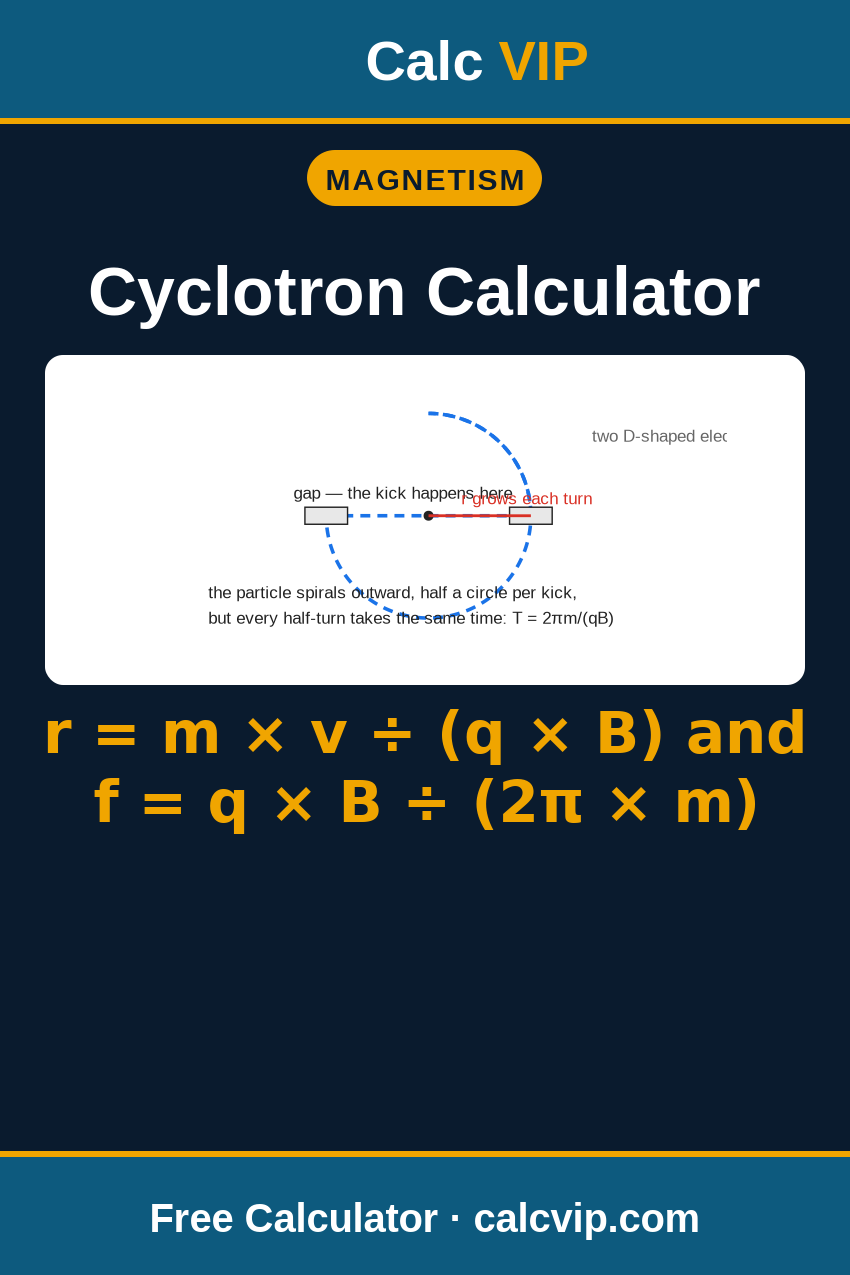
Real cyclotrons bend these numbers into hardware. Hospital cyclotrons the size of a car make radioactive isotopes for medical scans at fields of 1–2 T and proton energies around 10–20 MeV; research machines reach hundreds of MeV. The frequency this calculator returns is literally the radio frequency the machine's engineers tune their transmitters to — Lawrence's fixed note. Where the model eventually fails is also written in the physics: as a particle approaches light speed, relativity makes it behave as if heavier, the frequency sags, and the fixed note falls out of tune — the limit explored in the depth section and FAQ 2.
Formula
r = m × v ÷ (q × B) and f = q × B ÷ (2π × m) • r in metres (m), f in hertz (Hz). The magnetic force qvB provides exactly the centripetal force mv²/r, which is why the path is a circle. The charge's sign only sets the direction of circling, so the charge magnitude is used.
The pair of formulas rearrange into each other's territory: v = qBr ÷ m gives the speed of a particle on a known orbit — the extraction formula, since a cyclotron's radius and field fix its beam energy; B = mv ÷ (qr) turns an observed orbit into a field measurement; and the period T = 1/f = 2πm ÷ (qB) is the quantity the accelerating voltage is timed against. The kinetic energy at radius r follows by substitution: KE = ½mv² = q²B²r² ÷ (2m) — note the r², which is why builders crave radius: double the machine's size and the beam energy quadruples at the same field. This calculator uses m = 1.673 × 10⁻²⁷ kg, q = 1.602 × 10⁻¹⁹ C for a proton; m = 9.109 × 10⁻³¹ kg for an electron; and m = 6.645 × 10⁻²⁷ kg, q = 3.204 × 10⁻¹⁹ C for an alpha particle.
| Symbol | Meaning | Units |
|---|---|---|
| r | radius of the particle's circular path | metres (m) |
| f | cyclotron frequency — orbits per second | hertz (Hz) |
| m | mass of the particle | kilograms (kg) |
| v | speed of the particle across the field | m/s |
| q | charge magnitude of the particle | coulombs (C) |
| B | magnetic field strength | tesla (T) |
The cancellation that built an industry
Write the frequency out longhand and watch the trick happen. The particle travels a circle of circumference 2πr at speed v, so f = v ÷ (2πr). Substitute r = mv/(qB): f = v ÷ (2πmv/(qB)) = qB/(2πm). The v's divide away. A particle dawdling at 10⁵ m/s on a centimetre orbit and the same particle screaming at 10⁷ m/s on a metre orbit keep identical time, like runners on a track whose lanes widen exactly in step with their speed. No other accelerator geometry has this property so cheaply — a linac must be timed stage by stage, a synchrotron must ramp everything together — and it is why a 1930s tabletop device with a few kilovolts could reach energies that looked absurd for its size: the voltage is small, but it is applied hundreds of times, always in step.
The radius formula deserves equal respect, because it is a measuring instrument in disguise. Rearranged as mv = qBr, it says the field and radius together read off the particle's momentum — physicists call the product Br the beam's "rigidity". Mass spectrometers, momentum analysers and the great curved detectors at colliders all cash this cheque: photograph the curve, measure r, know B, and you have weighed the particle's momentum. The same equation, with the atmosphere as the field region, describes cosmic rays bending in the Earth's magnetism — the calculator's physics at planetary scale.
How to use
- Select the particle — proton, electron or alpha particle. The calculator fills in its mass and charge magnitude from the table in the Formula section.
- Enter the particle's speed v in metres per second (scientific notation such as 1e6 works).
- Enter the field B in tesla.
- Click "Calculate" to get the path radius r in metres and centimetres, and the cyclotron frequency f in hertz and megahertz.
- Try doubling the speed: the radius doubles, the frequency does not move. That invariance is the whole point of the machine — and a built-in check that you are using the calculator correctly.
Worked examples
Example 1 — the reference proton. A proton (m = 1.673 × 10⁻²⁷ kg, q = 1.602 × 10⁻¹⁹ C) travels at 1 × 10⁶ m/s in a field of 0.5 T.
r = mv ÷ (qB) = (1.673 × 10⁻²⁷ × 1 × 10⁶) ÷ (1.602 × 10⁻¹⁹ × 0.5) = 0.0209 m = 2.09 cm.
f = qB ÷ (2πm) = (1.602 × 10⁻¹⁹ × 0.5) ÷ (2π × 1.673 × 10⁻²⁷) = 7.62 × 10⁶ Hz = 7.62 MHz.
Speed the proton up and the radius grows — but the frequency stays exactly the same, which is what lets a cyclotron's fixed-frequency voltage keep kicking the particle on every half-turn.
Example 2 — an electron, light and quick. An electron at 1 × 10⁷ m/s in a gentle 0.01 T field.
r = (9.109 × 10⁻³¹ × 1 × 10⁷) ÷ (1.602 × 10⁻¹⁹ × 0.01) = 0.00569 m = 5.7 mm; f = (1.602 × 10⁻¹⁹ × 0.01) ÷ (2π × 9.109 × 10⁻³¹) = 2.80 × 10⁸ Hz = 280 MHz. The electron's tiny mass makes it both tightly curled and frantically fast around its circle — its frequency per tesla is about 28 GHz, a microwave oven's neighbourhood.
Example 3 — the alpha particle. An alpha (m = 6.645 × 10⁻²⁷ kg, q = 3.204 × 10⁻¹⁹ C) at 1 × 10⁶ m/s in 0.5 T.
r = (6.645 × 10⁻²⁷ × 1 × 10⁶) ÷ (3.204 × 10⁻¹⁹ × 0.5) = 0.0415 m = 4.15 cm; f = (3.204 × 10⁻¹⁹ × 0.5) ÷ (2π × 6.645 × 10⁻²⁷) = 3.84 × 10⁶ Hz = 3.84 MHz. Almost exactly the proton's frequency halved and radius doubled — the q/m ratio speaking.
Example 4 — a stronger field. The Example 1 proton at the same speed in 1 T.
r halves to 0.0104 m = 1.04 cm, and f doubles to 15.24 MHz. Field is the designer's throttle for both quantities at once — and at 1.5 T, the MRI field, the proton frequency would be 22.9 MHz, which is why proton-based instruments cluster in the radio band.
Example 5 — doubling the speed. The Example 1 proton again, now at 2 × 10⁶ m/s in 0.5 T.
r = (1.673 × 10⁻²⁷ × 2 × 10⁶) ÷ (1.602 × 10⁻¹⁹ × 0.5) = 0.0418 m = 4.18 cm; f = 7.62 MHz, unchanged. One orbit now takes T = 1/f = 131 nanoseconds, during which the proton covers 2πr = 26 cm — the wider circle exactly eats the doubled speed.
Example 6 — the energy at the rim. A cyclotron with B = 1 T extracts protons at its full radius R = 0.25 m. Their speed there is v = qBR ÷ m = (1.602 × 10⁻¹⁹ × 1 × 0.25) ÷ 1.673 × 10⁻²⁷ = 2.39 × 10⁷ m/s, and their kinetic energy is ½mv² = 4.79 × 10⁻¹³ J ≈ 3 MeV. That is a respectable isotope-making beam from a magnet the size of a coffee table — and the r² in the energy formula says a machine twice as wide would deliver 12 MeV.
Cyclotrons and circular paths in real life
Medical isotope production. Hospitals need short-lived radioactive tracers — fluorine-18 for PET scans has a two-hour half-life, too short to ship far. Compact cyclotrons in hospital basements make them on site, accelerating protons at exactly the frequencies this calculator predicts into targets that transmute into the tracer.
Proton therapy. Cancer centres aim proton beams whose depth of penetration is set by their energy — hence by Br at extraction. The beam's circular physics is the same; the machine is a cyclotron (or its synchrotron cousin) with a hospital attached.
Mass spectrometry. In ion cyclotron resonance instruments, trapped ions orbit at f = qB/(2πm) in a strong field, and measuring that frequency to many decimal places weighs the ions — the most precise mass measurements in chemistry rest on the frequency formula's indifference to speed.
Space weather and the radiation belts. Electrons and protons gyrate around the Earth's field lines at their cyclotron frequencies — electrons at hundreds of kilohertz to megahertz in the magnetosphere — and radio waves at those frequencies interact with them, a diagnostic and occasionally a hazard for satellites.
Plasma heating. Fusion experiments pump radio waves into plasma at the ions' cyclotron frequency (ion cyclotron resonance heating): the particles' fixed orbital note makes them resonant absorbers, heating the plasma towards fusion temperatures — Lawrence's trick, played on a star in a bottle.
The first particle accelerators. Lawrence's first cyclotron was 11 inches across and reached about 1 MeV; within a decade the design had scaled to machines that founded nuclear physics. Every modern accelerator — synchrotrons included — is a negotiation with the two formulas on this page and with the relativistic limit that finally breaks the second one.
Where the simple cyclotron ends: the relativistic wall
The frequency's constancy rests on m being constant. Einstein says it is not: a particle's effective inertia grows by the factor γ = 1 ÷ √(1 − v²/c²). At v = 0.5c, γ = 1.155 — the particle behaves 15.5% heavier, its true frequency sags 13% below this calculator's value, and a fixed-frequency machine loses step with it after enough turns. Protons reach that regime around a few hundred MeV, which is why classical cyclotrons top out there. The escapes define the next machines: the synchrocyclotron sweeps its frequency down to follow the sagging note; the synchrotron ramps B as well, holding r fixed; and isochronous cyclotrons sculpt the field with radius so the average field grows just enough to cancel γ. All of accelerator engineering is a footnote to f = qB/(2πm) — and to where it stops being true.
Quick reference: cyclotron frequency of a proton vs field
| Field B | Proton frequency f | Period T |
|---|---|---|
| 0.1 T | 1.52 MHz | 656 ns |
| 0.5 T | 7.62 MHz | 131 ns |
| 1 T | 15.24 MHz | 65.6 ns |
| 1.5 T | 22.9 MHz | 43.7 ns |
| 3 T | 45.7 MHz | 21.9 ns |
For an alpha particle, halve every frequency (its q/m is half the proton's); for an electron, multiply by about 1,836 — its f at 1 T is 28 GHz, far up in the microwave band.
Common mistakes
- Expecting the frequency to rise with speed. It does not — that is the entire point. Doubling v doubles r and leaves f untouched; an answer where f changes with v signals a formula error upstream.
- Using the diameter as r. r is the radius of the path. A particle orbiting "in a 0.5 m machine" may have r = 0.25 m at extraction; entering 0.5 doubles the computed momentum and quadruples the energy.
- Mixing particles' constants. The alpha has q = 2e but m ≈ 4 proton masses, not 2. Using q/m = the proton's for an alpha doubles its frequency wrongly — the fingerprint is the ratio, and each particle's differs.
- Applying the formulas to motion along the field. These circles exist only for velocity across B. A velocity component along the field is untouched and turns the circle into a helix; the radius uses the across-field component alone.
- Trusting the frequency at relativistic speeds. Once v is an appreciable fraction of c, γ grows and the true frequency sags below qB/(2πm). For protons the error reaches 1% near 0.14c (about 10 MeV) — small, but accelerators live and die by it.
FAQ
Why doesn't the frequency depend on the speed?
A faster particle makes a bigger circle, but it has proportionally further to travel, so each orbit takes the same time. f = qB/(2πm) contains no v and no r — the frequency is set only by the particle and the field.
What limits a cyclotron's top energy?
At very high speeds relativity makes the particle effectively heavier, so its frequency drops and it falls out of step with the accelerating voltage. Synchrotrons fix this by ramping the field and frequency together — the design used by the LHC.
Why is an alpha particle's radius bigger than a proton's at the same speed and field?
An alpha has about 4 times the proton's mass but only twice its charge, so r = mv/(qB) roughly doubles. Heavier, less-charged particles are harder for a field to bend.
What does the accelerating voltage actually do, if the field does no work?
The magnetic field only steers. The energy comes from the electric field in the gap between the two electrodes, which the particle crosses twice per orbit. Each crossing adds q times the gap voltage to its energy; hundreds of crossings accumulate to MeV from a few kilovolts.
Why is the path a spiral in a real cyclotron, not a circle?
Because the radius grows with every kick: each half-orbit is a semicircle of slightly larger r than the last. Joined together they form an outward spiral, ending at the extraction radius where the beam is peeled off — the circle of this calculator is the spiral's local shape.
What sets the direction of circling?
The sign of the charge. Positive particles circulate one way, negative the other, for the same field direction; reverse B and both swap. The calculator uses magnitudes, so it reports the same r and f for a particle and its antiparticle.
How fast is the electron's circling, really?
Its frequency per tesla is about 28 GHz — at the 0.01 T of Example 2, 280 MHz, a period of 3.6 nanoseconds. Electron resonance at these frequencies is a laboratory tool in its own right (electron spin resonance), tuned with the same formula.
Can a cyclotron accelerate electrons?
Badly — electrons are so light that they turn relativistic at modest energies (γ reaches 1.15 at only about 75 keV), so their frequency sags almost immediately and a fixed-frequency machine loses them. A specialised cousin, the microtron, turns that very sag into its timing mechanism instead.
What is the period of the Example 1 proton?
T = 1/f = 1 ÷ 7.62 × 10⁶ = 1.31 × 10⁻⁷ s = 131 nanoseconds per orbit. The accelerating voltage must reverse every half-period — about every 66 ns — which is why cyclotron transmitters are radio-frequency engineering, not mains engineering.
How big can the radius get before the model breaks?
The circle formula itself stays sound; what breaks is the frequency's constancy (relativity) and, practically, the magnet: field must fill the whole orbit area uniformly, and magnet cost grows brutally with diameter. The largest cyclotrons are a few metres across; beyond that, synchrotrons — rings of magnets with empty middle — take over.