 Calc
Internal Resistance Calculator – Terminal Voltage V = E − Ir
 Created by Michael Chen · Electronics Specialist · Last updated: November 2026
Use this free Internal Resistance Calculator to find the terminal voltage of a real battery or cell. A real source has a small resistance r inside it, so the voltage you actually get at the terminals is less than the EMF once current flows. Work from the load current, or from the load resistance — your choice.
Every real source of electrical energy is two things in one box: a perfect source of EMF, and a resistor you never asked for. The electrolyte in a battery, the windings in a generator, the chemistry at the electrodes — all of it resists the very current the source is trying to push out. That built-in opposition is the internal resistance r, and it explains a family of everyday mysteries: why headlights dim while the starter motor cranks, why a "good" battery reads 1.5 V on a meter yet cannot run a toy, and why short-circuiting a cell makes it hot rather than infinitely powerful.
The model is simple enough to draw on a napkin: an ideal EMF E in series with a small resistor r, both sealed inside the cell, with only the two terminals accessible. Everything measurable follows from that drawing. Draw current I and a slice of the EMF — exactly Ir — is spent inside the box before the current ever reaches your circuit. What remains at the terminals, V = E − Ir, is the only voltage your load will ever see.
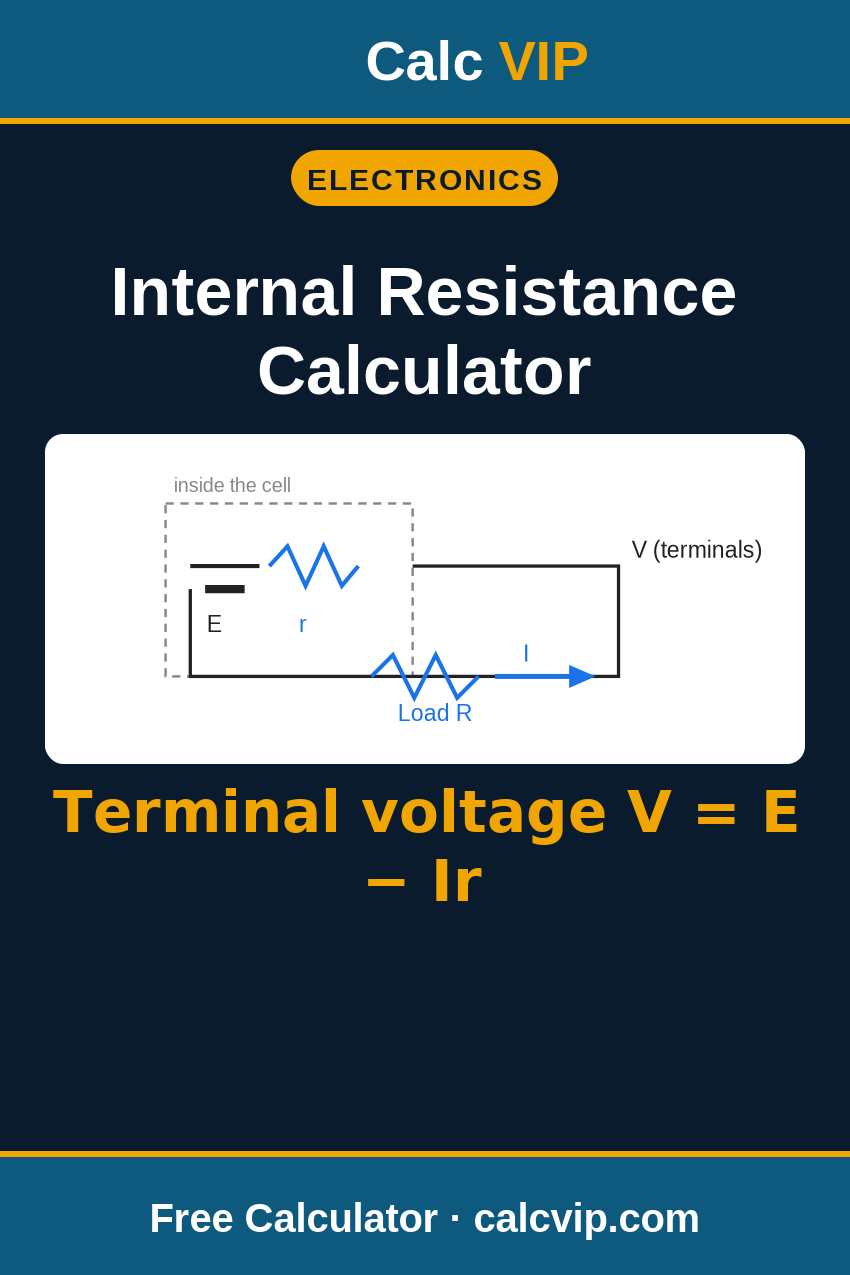
This calculator works in both directions. If you know the load current, it applies V = E − Ir directly and reports the lost volts. If you know the load resistance instead, it first finds the current from I = E ÷ (R + r) — note that r joins the load in the denominator, because from the EMF's point of view the internal resistor is simply part of the circuit — and then gives the terminal voltage as V = IR. Either way you see the current, the lost volts and the terminal voltage together.
Formula
Terminal voltage V = E − Ir • lost volts = Ir • from the load: I = E ÷ (R + r) and V = IR • voltages in volts (V), currents in amps (A), resistances in ohms (Ω)
Every rearrangement earns its keep. Solving for internal resistance gives the measurement formula r = (E − V) ÷ I: read the EMF with no load, then read the terminal voltage under a known current, and r falls out. Solving for current at a dead short (R = 0) gives the short-circuit current Isc = E ÷ r — finite, and set entirely by r, which is why a low-r source like a car battery is so much more dangerous shorted than a high-r one like a 9 V battery. Efficiency also falls out of the model: the fraction of the total power that reaches the load is R ÷ (R + r), so a load matched to a tiny r wastes almost nothing, while a load comparable to r throws a large share of the energy away inside the cell as heat. Finally, the terminal voltage as a function of current, V = E − Ir, is a straight line: intercept E at I = 0, slope −r, reaching zero at I = E ÷ r. One graph summarises the whole behaviour of the source.
| Symbol | Meaning | Units |
|---|---|---|
| E | EMF — the total voltage the source generates internally | volts (V) |
| V | terminal voltage — what the load actually receives | volts (V) |
| r | internal resistance of the source | ohms (Ω) |
| I | current delivered to the load | amps (A) |
| R | load resistance | ohms (Ω) |
EMF, terminal voltage and the lost volts
EMF is the energy given to each coulomb of charge as it passes through the source — the full budget. But the charge must climb through the source's own innards to get out, and that journey costs Ir of the budget, dissipated as heat inside the cell. The terminal voltage is what is left: the energy each coulomb still has to spend in your circuit. The missing slice, Ir, is traditionally called the lost volts — lost to you, though not to physics: it warms the battery, which is why a hard-worked battery gets warm and why a shorted one can get dangerously hot.
Two consequences organise most practical behaviour. First, the drop is proportional to current, so a source can look perfect on a voltmeter — which draws almost no current and therefore loses almost nothing — yet collapse the moment a real load asks for amps. A voltmeter reading is a reading of E, not a promise about V. Second, charging runs the equation backwards: push current into a rechargeable cell and the terminal voltage must rise above E by Ir, which is why a 12 V battery needs a charger delivering around 14 V, and why the charging voltage settles back down when the charger disconnects.
How to use
- Choose what you know: the load current I, or the load resistance R.
- Enter the EMF E of the cell — for a battery, its nominal fresh, open-circuit voltage is the usual estimate.
- Enter the internal resistance r (typical values are in the quick reference table below).
- Enter the current or the load resistance, then click "Calculate".
- Read the three results together: current, lost volts Ir, and terminal voltage V. If the lost volts are a large share of E, the source is being worked too hard for its r.
Worked examples
Example 1 — a 12 V battery under load. A battery has EMF E = 12 V and internal resistance r = 0.5 Ω. It supplies a current of 4 A.
Voltage lost inside the battery = Ir = 4 × 0.5 = 2 V.
Terminal voltage V = E − Ir = 12 − 2 = 10 V.
If instead the load is a 5.5 Ω resistor: I = E ÷ (R + r) = 12 ÷ 6 = 2 A, and V = IR = 2 × 5.5 = 11 V — the gentler load loses only 1 V inside the battery.
Example 2 — a single AA cell. An AA cell has E = 1.5 V and r ≈ 0.2 Ω, feeding a 2.8 Ω torch bulb. I = 1.5 ÷ (2.8 + 0.2) = 0.5 A; the lost volts are 0.5 × 0.2 = 0.1 V, so the bulb sees V = 1.4 V — about 93% of the EMF, a healthy working point for so small a source.
Example 3 — why lights dim during cranking. A car battery (E = 12.6 V, r ≈ 0.02 Ω) must supply the starter motor's 150 A. Lost volts = 150 × 0.02 = 3 V, leaving a terminal voltage of just 9.6 V for everything else on the car. The headlights are not faulty — for a few seconds, the whole car really is a 9.6 V system.
Example 4 — the short circuit. Short a 9 V battery (E = 9 V, r = 1.5 Ω) and the only resistance in the circuit is its own: I = E ÷ r = 9 ÷ 1.5 = 6 A, with the terminal voltage at zero and all 54 W of power dissipated inside the battery itself. Internal resistance is the only reason the current is not infinite — and the reason the battery gets hot fast.
Example 5 — a phone battery at full chat. A phone cell (E = 3.7 V, r ≈ 0.08 Ω) delivering 2 A to the processor and screen loses 2 × 0.08 = 0.16 V internally, so the phone actually runs on 3.54 V. As the cell ages and r climbs toward 0.3 Ω, the same 2 A would lose 0.6 V — and the phone starts shutting down at 20% charge, because under load its voltage dips below the cut-off.
Example 6 — maximum power transfer. Power delivered to the load is greatest when R = r. For the 12 V, 0.5 Ω battery, that means a 0.5 Ω load: I = 12 ÷ 1 = 12 A, V = 6 V, and the load receives 6 × 12 = 72 W — while another 72 W heats the battery. Maximum power is not maximum efficiency: exactly half the energy is wasted inside the source, which is why power systems are designed with r far below R instead.
Internal resistance in real life
Testing batteries properly. A voltmeter alone cannot judge a battery, because it draws almost no current and reads E. Real battery testers apply a load and watch the terminal voltage sag: the size of the sag, divided by the load current, is r itself — and a rising r is the earliest warning of a dying battery.
Cold mornings and old cars. Internal resistance rises as temperature falls, because the chemistry slows. The same battery that cranked easily in summer loses far more volts per amp on a frosty morning — exactly when the starter needs more current to turn thick, cold oil. Both effects squeeze V from opposite sides.
Why big batteries are built different. A car battery's plates are large, close together and paralleled in many pairs, all to drive r down to a few hundredths of an ohm so that hundreds of amps cost only a volt or two. A coin cell, asked for milliamps, can afford an r of several ohms — and is destroyed by jobs a car battery shrugs off.
Charger design. Chargers must overcome E plus Ir, and smart chargers measure both: the voltage they must apply, and the way the terminal voltage responds to current pulses, tells them the cell's capacity and health. Fast charging is ultimately a fight against r — the lost volts become heat that the cell must shed.
Solar panels and power supplies. Internal resistance is not just for batteries. A solar panel's output sags with current in the same way (its "r" is one reason maximum-power-point tracking exists), and every bench power supply specifies how much its output may dip from no load to full load — its effective internal resistance, boasted in milliohms.
Electric vehicles. An EV pack's internal resistance decides how much voltage sags under hard acceleration and how much heat the cooling system must remove. Battery management systems track r cell by cell over the pack's life; a single cell whose r climbs becomes the weak link that limits the whole string.
Measuring r yourself: the two-load method
You can measure a battery's internal resistance with nothing but a voltmeter and one known resistor. First measure the open-circuit voltage — that is E (a worked case: 12.8 V). Then connect a known load, say R = 10 Ω, and measure the terminal voltage under load (here 12.0 V). The load current is I = V ÷ R = 12.0 ÷ 10 = 1.2 A, and the lost volts are 12.8 − 12.0 = 0.8 V, so r = 0.8 ÷ 1.2 = 0.67 Ω. Use a load that draws a realistic current — too gentle a load makes the sag too small to measure honestly — and work quickly with batteries that heat up. Battery testers and the impedance meters used on EV packs automate exactly this, sometimes with a small AC signal instead of a DC load so the measurement can be repeated thousands of times over the battery's life.
Quick reference: typical internal resistances
| Source | Typical r | What it means in practice |
|---|---|---|
| Car battery (12 V lead-acid) | ≈ 0.02 Ω | hundreds of amps for cranking, a few volts lost |
| 18650 lithium cell | ≈ 0.05 Ω | strong torches and vapes; sags ~0.5 V at 10 A |
| AA alkaline cell | ≈ 0.15–0.3 Ω | fine to ~1 A; climbs steeply as it empties |
| Phone battery | ≈ 0.08 Ω (new) | ageing doubles or triples it — shutdowns follow |
| 9 V battery | ≈ 1–2 Ω | built for milliamps; 100 mA already costs ~0.2 V |
| Coin cell (CR2032) | ≈ 5–10 Ω | watches and key fobs only; LEDs pulse it briefly |
These are healthy, room-temperature ballparks — every one of them rises as the source discharges, ages or gets cold, which is precisely why r is such a useful health measure.
Common mistakes
- Judging a battery by its open-circuit voltage. With I ≈ 0 there are no lost volts, so even a tired battery reads near E. Judge it under load: the sag is the truth, and r = (E − V) ÷ I turns the sag into a number.
- Forgetting r in the current calculation. Writing I = E ÷ R with R = 5.5 Ω gives 2.18 A for Example 1's battery; the honest figure, with r included, is 2 A. The smaller the load, the bigger the error — at a short circuit the r-free formula predicts infinite current.
- Treating r as constant. Internal resistance changes with charge level, temperature, age and even the size of the current. Calculations are snapshots of a moving target — good for design margins, not for false precision.
- Confusing EMF with terminal voltage in energy sums. The load only ever receives V × I of power; the full E × I includes the slice heating the battery. Efficiency calculations that use E overstate what the load got by exactly the lost-volts fraction.
- Designing for maximum power transfer by accident. Matching R to r delivers maximum power but at 50% efficiency and a terminal voltage of E ÷ 2. Power engineers do the opposite: r is made tiny compared with R so V stays near E and almost all the energy reaches the load.
FAQ
Why does a battery's voltage drop when it is used?
Part of the EMF is used up pushing the current through the battery's own internal resistance (the "lost volts", Ir). The bigger the current, the bigger the drop.
What is the terminal voltage when no current flows?
With I = 0 there are no lost volts, so the terminal voltage equals the full EMF. That is why a voltmeter alone reads E.
Why do old batteries fail under load?
As a cell ages its internal resistance rises. It may still show nearly full voltage on a meter, but under load the Ir drop becomes huge and the terminal voltage collapses.
Can internal resistance be zero?
Only in idealised sources — and in superconductors, briefly. Every chemical cell and real generator has some r, because moving charge through matter always meets opposition. Good engineering makes r small for the job at hand; it never makes it vanish.
Does internal resistance waste much energy?
It depends on the current. The power lost inside is I²r, so it grows with the square of the current: negligible for a TV remote, dominant for a starter motor. In Example 1, 4 A through 0.5 Ω wastes 8 W inside the battery while the load receives 40 W.
Why does r increase as a battery runs down?
The chemistry depletes the active materials and coats the electrodes with reaction products, so charge moves through the cell less freely. Cold does the same temporarily. A rising r is therefore both a fuel gauge and a health meter.
Is internal resistance the same in both directions?
Roughly, yes — charging also has to overcome Ir, which is why the charging voltage sits above E. Precision battery models use slightly different values for charge and discharge, but for hand calculations one r serves both ways.
What is a good r for a bench power supply?
Milliohms. A decent regulated supply holds its output within a few tens of millivolts from no load to full load, which at 5 A means an effective r of only a few mΩ — achieved not by magic components but by a feedback loop that measures the sag and corrects it thousands of times per second.
How does r limit a solar panel?
A panel's internal (series) resistance eats voltage exactly as V = E − Ir does, so its output power peaks at one particular current — push beyond it and the lost volts grow faster than the current. Maximum-power-point trackers exist to sit precisely on that peak as light and temperature move it.
Can a battery's r be too low?
For safety, it can be uncomfortably low: short-circuit current is E ÷ r, so a very low r means a short delivers enormous current and heat almost instantly. That is why lithium packs carry protection circuits and fuses despite their excellent low r — the same property that makes them powerful makes their faults violent.