 Calc
Parallel Resistor Finder – Resistor to Add in Parallel for a Target Total
 Created by Michael Chen · Electronics Specialist · Last updated: November 2026
Use this free Parallel Resistor Finder to work out which extra resistor to connect in parallel with one you already have, so the pair gives the total resistance you want. Handy when the exact value you need is not in your parts box.
Every electronics parts box has the same gap: the circuit wants 60 Ω, and the drawer holds 100 Ω, 150 Ω, 220 Ω — everything except 60 Ω. The rescue is an old trick with a precise formula. Connect a second resistor in parallel with one you already own and the combination is always worth less than either part alone, by an amount you can calculate exactly. This finder runs that calculation backwards: tell it the resistor you have (R1) and the total you want (Rtotal), and it tells you the resistor to add in parallel — with an automatic check that the pair really does combine to your target.
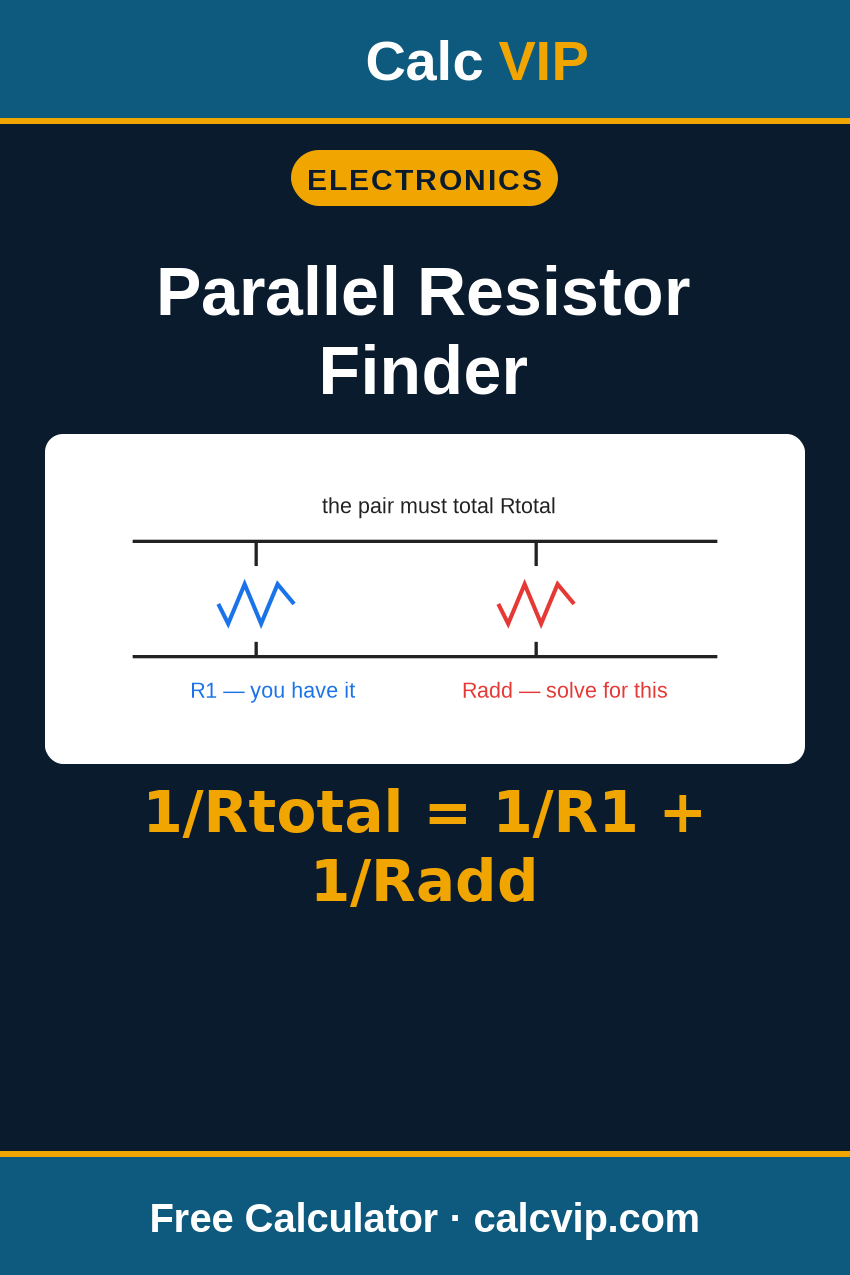
The backwards formula falls out of the parallel rule. For two resistors in parallel, 1/Rtotal = 1/R1 + 1/Radd; solving for the unknown gives Radd = (R1 × Rtotal) ÷ (R1 − Rtotal). Notice the subtraction in the denominator — it carries the physics. The target must be smaller than R1, because a parallel path can only ever lower a resistance; and as the target creeps closer to R1, the required partner races towards infinity, which is the mathematics saying "you barely need a partner at all". Ask for a target of exactly half of R1 and the answer is the friendliest in electronics: add an identical resistor, because equal pairs halve.
Use it whenever an exact value is missing: trimming a sensor divider, nudging an LED's brightness, making a non-standard value for a filter, or building a high-power resistor from two smaller ones that share the load. Enter R1 and the target in ohms — the answer is formatted in Ω, kΩ or MΩ as appropriate. If the exact answer is not a stock value either (it often is not — 413.6 Ω appears in Example 3), the FAQ and the depth section show how to land within a whisker using the nearest E12 part or a second combination.
Formula
For two resistors in parallel: 1/Rtotal = 1/R1 + 1/Radd, so
Radd = (R1 × Rtotal) ÷ (R1 − Rtotal)
The target total must be smaller than R1 — a parallel combination is always less than the smallest resistor in it.
The forward rule deserves a slow look, because everything on this page is its shadow. Parallel resistors share the same voltage, and their currents add; conductance — the reciprocal of resistance, G = 1 ÷ R, measured in siemens — is the quantity that simply sums: Gtotal = G1 + G2. The famous "product over sum" form, Rtotal = (R1 × R2) ÷ (R1 + R2), is that addition turned back into ohms, valid for exactly two resistors. This calculator inverts it: given the sum you want and one part you have, it finds the missing conductance and converts it back. The check line in the result is not decoration — it re-runs product-over-sum on the answer, so an impossible or mistyped request reveals itself immediately.
| Symbol | Meaning | Units |
|---|---|---|
| R1 | the resistor you already have | ohms (Ω) |
| Rtotal | the combined resistance you want | ohms (Ω) — must be < R1 |
| Radd | the resistor to connect in parallel | ohms (Ω) |
| G | conductance, 1 ÷ R — the quantity that adds | siemens (S) |
Why parallel always lowers resistance: the two-lane road
Resistance measures how hard it is for current to get through. Give the current a second, independent route between the same two points and getting through becomes easier — never harder, no matter how poor the new route is. Even a very large Radd, a narrow country lane beside a motorway, still carries some traffic, so the total resistance always dips at least slightly below R1. The mathematics honours the picture exactly: as Radd → ∞ (a lane that is practically closed), Rtotal → R1 from below; as Radd → 0 (a motorway with no resistance at all — a short circuit), Rtotal → 0. Every real case lives between those rails, and this calculator's demand that the target sit below R1 is the two-lane picture stated as a rule.
Current, meanwhile, divides between the branches in inverse proportion to their resistances — the smaller resistor takes the larger share. In the reference pair (100 Ω alongside 150 Ω) across 12 V, the 100 Ω branch carries 12 ÷ 100 = 0.12 A and dissipates 144 ÷ 100 = 1.44 W, while the 150 Ω branch carries 0.08 A and 0.96 W. Total current 0.2 A, total power 2.4 W — and a check: 12 V across the 60 Ω combination gives exactly 0.2 A. This inverse sharing is why the smaller partner in any parallel pair needs the bigger power rating, a point the common mistakes section returns to.
How to use
- Enter the value of the resistor you already own, R1, in ohms.
- Enter the total resistance you want the parallel pair to give — it must be less than R1; if it is not, the calculator will say so, and you need series addition instead.
- Click "Calculate" — you get the resistor to add, with a check of the combination.
- If the answer is not a stock value, take the nearest E12 value and re-check the total with the forward rule (product ÷ sum), or read the depth section on hitting awkward targets with two added resistors.
- Before soldering, check power: the smaller resistor of the pair dissipates V² ÷ R at the full voltage across the pair — rate both parts accordingly.
Worked examples
Example 1 — the reference pair. You have a 100 Ω resistor but need 60 Ω in total.
Radd = (100 × 60) ÷ (100 − 60) = 6000 ÷ 40 = 150 Ω. Check: 100 Ω in parallel with 150 Ω gives (100 × 150) ÷ (100 + 150) = 15000 ÷ 250 = 60 Ω. ✔
Example 2 — halving with a twin. You have 1000 Ω and need 500 Ω.
Radd = (1000 × 500) ÷ (1000 − 500) = 1000 Ω — an identical twin. Halving is always done with an equal partner, the most useful special case on this page: two of anything in parallel is half of it.
Example 3 — an awkward, honest answer. You have 470 Ω and need 220 Ω.
Radd = (470 × 220) ÷ (470 − 220) = 103,400 ÷ 250 = 413.6 Ω — not a stock value. The nearest E12 choices bracket it: 390 Ω gives a total of 213.14 Ω (−3.1%), 470 Ω gives exactly 235 Ω (+6.8%). For an LED or a pull-up, either serves; for a precision divider, build 413.6 Ω from a series pair (390 + 22 = 412 Ω) and parallel that.
Example 4 — power territory. You have a 10 Ω power resistor and need 6 Ω.
Radd = (10 × 6) ÷ (10 − 6) = 15 Ω. Check: (10 × 15) ÷ 25 = 6 Ω. ✔ At any voltage across the pair, the 10 Ω part takes 60% of the total power — rate it first.
Example 5 — trimming a common value. You have 220 Ω and need 100 Ω.
Radd = (220 × 100) ÷ (220 − 100) = 22,000 ÷ 120 = 183.333 Ω. The E12 neighbour 180 Ω delivers (220 × 180) ÷ 400 = 99 Ω — within 1% of target, close enough for almost any job outside a measuring instrument.
Example 6 — kilohm scale. You have 4.7 kΩ and need 2.2 kΩ.
Radd = (4700 × 2200) ÷ (4700 − 2200) = 4136 Ω ≈ 4.136 kΩ. Nothing in the method changes with scale — ohms, kilohms and megohms all obey the same reciprocals, which is why the calculator formats its answer to match your magnitude.
Parallel tricks in real life
Making the value the drawer lacks. The founding use: prototypes and repairs cannot wait for a delivery. A calculated parallel partner gets the circuit running today, and in a surprising number of products the "temporary" pair is still there at the product's retirement.
Building power resistors from small parts. Two 10 Ω, 5 W resistors in parallel make a 5 Ω resistor that can dissipate 10 W — provided both are rated alike, since equal partners share power equally. Unequal partners share in inverse proportion (see the concept section), and the smaller one must be rated for its bigger slice.
Trimming and calibration. Precision circuits are finished by soldering a large "trim" resistor in parallel with a main one to pull the total down by a percent or two. The huge Radd values near the top of this calculator's range are exactly trim values — the gentlest possible nudge.
Speaker loads. Wiring two 8 Ω loudspeakers in parallel presents 4 Ω to the amplifier — this page's formula deciding whether the amp is comfortable or in danger. Speaker installers run the reciprocal sum the way electricians run voltage drop.
Shunts for meters. A current meter's range is extended by a calculated parallel shunt that diverts a precise fraction of the current around the movement. The shunt is this calculator's answer made from a stub of resistance wire — and the foundation of every multimeter's current ranges.
Heater and lamp banks. Parallel is how identical loads share a supply at full voltage: every lamp in a house is in parallel with every other, each taking its rated share, the total resistance of the house falling with every switch closed — the same reciprocals, at national scale.
Quick reference: handy parallel pairs
| R1 you have | Add in parallel | Total |
|---|---|---|
| 100 Ω | 100 Ω | 50 Ω |
| 100 Ω | 150 Ω | 60 Ω |
| 220 Ω | 220 Ω | 110 Ω |
| 470 Ω | 470 Ω | 235 Ω |
| 1 kΩ | 1 kΩ | 500 Ω |
| 10 Ω | 15 Ω | 6 Ω |
| 33 Ω | 33 Ω | 16.5 Ω |
The twin rows teach the pattern at a glance: an equal partner halves the value, whatever the value is. Three equal resistors in parallel give a third (three 100 Ω parts make 33.33 Ω), four give a quarter — with n equal resistors, divide by n. The general formula on this page is just the two-resistor case of that same sharing.
Hitting an awkward target exactly
When Radd is not a stock value, two escapes exist. The first is composition: build Radd itself from a series pair (values add) or a parallel pair, as Example 3 did with 390 + 22 = 412 Ω standing in for 413.6 Ω — an error of 0.4% in the partner, which moves the final total by even less. The second is tolerance shopping: standard parts are ranges, not points, so measure a handful of nominal 390 Ω ± 5% resistors and select the one nearest the need — "hand-selecting" is how laboratories stock precision values without buying precision parts. And remember the direction of safety: for current-limiting duties, err with the total slightly high (partner slightly large); for timing and filtering, whichever error your circuit tolerates better decides. The calculator gives the exact centre of the target; engineering judgement chooses which side to land on.
From pairs to networks: series and parallel together
Real circuits rarely stop at one pair, but every network of resistors, however tangled, collapses by the two rules on this page applied in turns: resistors in series add; resistors in parallel combine by reciprocals (or product-over-sum for a pair). Work from the inside out. A 100 Ω resistor in parallel with a series pair of 100 Ω + 100 Ω is a 100 Ω alongside a 200 Ω: (100 × 200) ÷ 300 = 66.67 Ω. Add a further 100 Ω in series with the whole network and the total is 166.67 Ω. The calculator on this page handles the pair step; a pencil handles the bookkeeping. The reverse journey — synthesising a network that hits a target from stock values — is the same steps backwards, and it is how engineers conjure exact resistances (a 66.67 Ω load, a precise divider ratio) from a drawer of ordinary parts. When a network resists collapsing by inspection, the conductance view usually unlocks it: convert every parallel branch to siemens, add, and convert back at the end.
One caution travels with the trick: every added resistor is another part to fail, another pair of solder joints, another few cents and another square centimetre. Networks are the right answer for prototypes, repairs, precision one-offs and power sharing; for production designs, ordering the exact value — or redesigning the circuit around a standard one — is usually cheaper than the cleverness. The formula tells you what is possible; judgement decides what is wise.
Common mistakes
- Asking for a target above R1. Impossible — parallel can only subtract. The denominator R1 − Rtotal goes negative and the request is really for a series resistor: to raise 100 Ω to 150 Ω, add 50 Ω in series, not anything in parallel.
- Averaging the two resistors. The parallel total is not (R1 + R2) ÷ 2 — for 100 Ω and 150 Ω that wrongly gives 125 Ω instead of 60 Ω. It is product over sum, and it always lands below the smaller partner.
- Forgetting the power split is unequal. Partners share voltage, not power. The smaller resistor dissipates more (1.44 W against 0.96 W in the concept section's example) — rate the small one for its real share, not for half the total.
- Measuring the pair in circuit and blaming the formula. A multimeter across one resistor of an assembled circuit reads the whole parallel combination of everything connected — including paths you forgot. Lift one leg before measuring, or trust the check line instead.
- Ignoring tolerance stack-up. Two ± 5% parts combine into a total that is also roughly ± 5% — the combination does not average away inaccuracy. If the target must be met within 1%, measure the actual parts and select, as the depth section describes.
FAQ
Why must the target be smaller than R1?
Adding a resistor in parallel always opens another path for the current, so the total resistance can only fall — never rise. To increase a resistance, add a resistor in series instead.
What if the answer is not a standard value?
Pick the nearest standard (E12) value and accept a small error in the total, or use two resistors in parallel whose calculated combination hits the target more closely.
Does the power rating matter?
Yes. The smaller resistor of the pair carries the larger share of the current, so check each resistor's power: P = V² ÷ R for the voltage across the pair.
What if I need to add two resistors in parallel, not one?
Combine the two you plan to add into a single equivalent first (product ÷ sum), then treat that as Radd here — or work in conductances throughout: the total conductance needed is 1/Rtotal, subtract 1/R1, and split what remains between your two additions in any proportion you like.
Why does the answer shoot up when the target is close to R1?
Because only a whisper of extra conductance is needed, and a whisper of conductance is a mountain of resistance. Needing 99 Ω from 100 Ω requires a partner of (100 × 99) ÷ 1 = 9900 Ω — the trim-resistor regime described in the applications.
Can I use this for speakers or lamps?
Yes — the reciprocal rule governs any parallel loads. Two 8 Ω speakers give 4 Ω; two 230 V lamps in parallel each see full voltage and their resistances combine by the same formula, though for lamps you usually care about the total current, found from the combined resistance.
What is the total of three equal resistors in parallel?
A third of one: R ÷ 3. Three 100 Ω resistors give 33.33 Ω. The pattern extends — n equal resistors give R ÷ n — because each identical path carries an identical share of the current.
Does it matter which physical resistor is "R1"?
No. The formula is symmetric in effect — the pair {100 Ω, 150 Ω} totals 60 Ω whichever one you call the original. R1 is simply the one already soldered down or already in your hand.
How close is close enough for the added resistor?
It depends on the job. LED brightness forgives ± 20%; a voltage divider's ratio inherits the error of both arms; a measurement shunt wants ± 1% or better. The calculator gives the exact target — the application's tolerance, found in its design notes, sets your shopping precision.
Why not just use a variable resistor?
Often you can — a preset trimmer is a parallel-or-series adjustable in one part. But trimmers handle little power, drift with age and vibration, and cost more than two fixed parts. The fixed pair wins wherever the value, once found, should never move again.