 Calc
Power Triangle Calculator – P, Q, S & Power Factor from Any Two Values
 Created by Michael Chen · Electronics Specialist · Last updated: November 2026
Use this free Power Triangle Calculator to complete the AC power triangle from any two known values. Give it real power P with apparent power S, or P with reactive power Q, or S with the power factor — it finds everything else, including the phase angle.
Give an AC engineer any two corners of a load's power behaviour and she will reconstruct the rest on the back of an envelope, because the three powers of AC — real P, reactive Q, apparent S — are locked together in a right-angled triangle with no degrees of freedom left over. S² = P² + Q². That single Pythagorean fact, plus pf = P/S and φ = cos−1(pf), is the entire contents of this calculator: it accepts whichever pair you happen to know — P with S, P with Q, or S with the power factor — and completes the triangle, returning all three powers, the factor and the angle.
The triangle deserves its central place because it is where three professions meet. The electrician sizing a cable works from S (the current is S/V, whatever the watts say). The energy manager reading a bill works from P and the pf penalties that φ drags behind it. The engineer designing correction works from Q — specifically, from how much of it a capacitor bank must cancel to drag S down towards P. Each of them holds two corners of the same triangle and needs the third; each is a user of this page. The worked examples deliberately solve one triangle three ways, once from each input mode, to show the three professions arriving at the same figure.
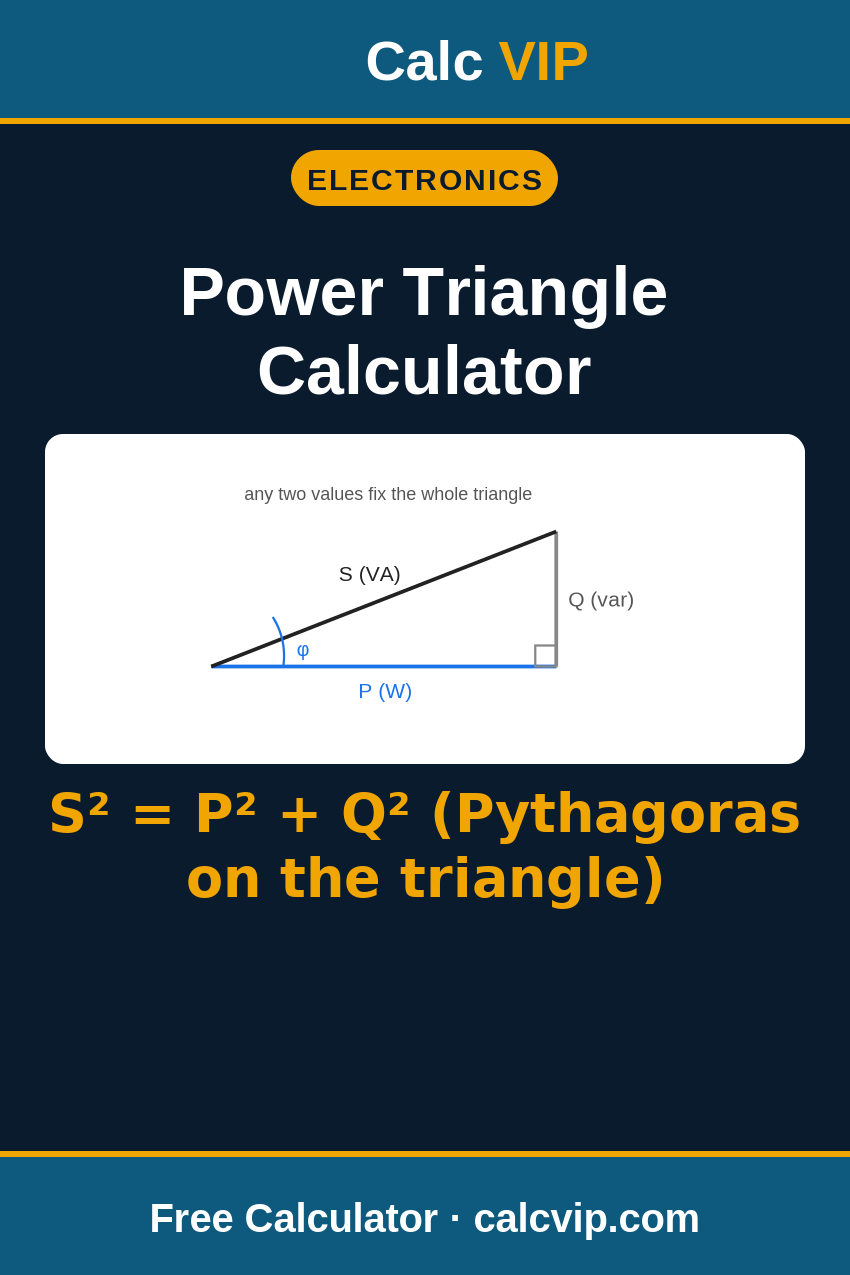
One warning before the arithmetic: the triangle is a statement about magnitudes at a single frequency with sine waves, and its Q is signed in the wider world (positive for inductive, negative for capacitive loads) even though a triangle's side is drawn as a length. This calculator returns Q as a magnitude; the sign must be supplied by your knowledge of the load — lagging or leading — exactly as on a nameplate. With that convention understood, the triangle never lies.
Formula
S² = P² + Q² (Pythagoras on the triangle) • power factor pf = P / S = cos φ • φ = cos−1(pf)
Each input mode is one rearrangement. From P and S: Q = √(S² − P²). From P and Q: S = √(P² + Q²). From S and pf: P = S × pf and Q = S × √(1 − pf²) (equivalently S × sin φ). Two further identities do daily duty: Q = P × tan φ — the fastest route from a wattmeter reading and an angle to the reactive power — and the current form, I = S/V, which converts any completed triangle into the cable-loading number. The triangle also scales: multiply P, Q and S by the same factor and φ and pf are unchanged, which is why the classic 3-4-5 triangle reappears at every size from watts to megawatts, as the examples show.
| Symbol | Meaning | Units |
|---|---|---|
| P | real power — the triangle's horizontal side | watts (W) |
| Q | reactive power — the vertical side (signed in context) | vars (var) |
| S | apparent power — the hypotenuse | volt-amperes (VA) |
| pf | power factor, pf = P/S = cos φ | dimensionless, 0 to 1 |
| φ | phase angle, φ = cos−1(pf) = tan−1(Q/P) | degrees (°) |
Why a triangle at all: perpendicular powers
Students reasonably ask why the powers do not simply add — why S is not P + Q. The answer is timing. Real power is the average of the instantaneous product v × i contributed by the current component in step with the voltage; reactive power is the amplitude of the product contributed by the component a quarter-cycle out of step. Those two current components are perpendicular in the phasor sense — one cannot substitute for the other, any more than northward velocity substitutes for eastward. Perpendicular quantities combine by Pythagoras in every branch of physics, from forces to impedances to these powers; the triangle is not a convention but the shadow of that perpendicularity.
The geometry has immediate practical teeth. Because S is the hypotenuse, S is always less than P + Q — often much less. A load with P = 800 W and Q = 600 var needs S = 1000 VA of supply capacity, not 1400. Conversely, shaving Q has diminishing returns as the triangle flattens: cancelling the first half of Q in that example (600 → 300 var) cuts S from 1000 to 854 VA, but cancelling the second half entirely (300 → 0) only reaches 800. Correction engineers live inside this curve — the cheap kvar are the first ones, and the last few points of power factor are the most expensive, which is why targets stop at 0.95–0.99 rather than 1.00.
The triangle is also the impedance triangle in disguise. Multiply the impedance triangle (R, X, Z) through by I² and you get (I²R, I²X, I²Z) = (P, Q, S): same angle, same shape, scaled. Everything the phase-angle page says about φ therefore transfers without translation — including the sign story, the resonance condition (Q = 0, a triangle collapsed flat), and the sweep of φ with frequency. Learn one triangle and you own both.
How to use
- Pick which pair of values you know from the drop-down: P + S, P + Q, or S + power factor.
- Enter the two values — the input labels change to match your choice.
- Click "Calculate" for the complete triangle: P, Q, S, power factor and phase angle.
- Attach the sign of Q from your knowledge of the load (positive if lagging/inductive, negative if leading/capacitive) before using Q in any correction calculation — the triangle gives the magnitude; the installation gives the direction.
Worked examples
Example 1 — from P and S. A load consumes P = 800 W while the supply delivers S = 1000 VA.
Q = √(S² − P²) = √(1000² − 800²) = √360,000 = 600 var.
Power factor = P / S = 800 / 1000 = 0.8, and φ = cos−1(0.8) = 36.87°.
This is the classic 3-4-5 triangle scaled by 200: 600-800-1000.
Example 2 — the same triangle from P and Q. A wattmeter reads P = 800 W and a varmeter reads Q = 600 var. S = √(800² + 600²) = √1,000,000 = 1000 VA, pf = 800/1000 = 0.8, φ = 36.87°. Identical triangle, entered through a different door — the consistency the manifest of any good measurement set should show.
Example 3 — the same triangle from S and pf. A nameplate states S = 1000 VA at pf = 0.8. P = 1000 × 0.8 = 800 W; Q = 1000 × √(1 − 0.8²) = 1000 × 0.6 = 600 var; φ = cos−1(0.8) = 36.87°. Three modes, one triangle: whichever pair the datasheet, the meter or the bill hands you, the destination is the same.
Example 4 — the 3-4-5 triangle at industrial scale. A machine hall draws P = 5000 W with S = 6250 VA. Q = √(6250² − 5000²) = √14,062,500 = 3750 var; pf = 0.8; φ = 36.87°. The 600-800-1000 of Example 1, scaled by 6.25 — the angle and factor are scale-invariant, which is why a single triangle sketch serves a bench load and a factory alike.
Example 5 — a poorer factor from P and Q. A lightly loaded motor line draws P = 3000 W and Q = 4000 var. S = √(3000² + 4000²) = 5000 VA; pf = 3000/5000 = 0.6; φ = cos−1(0.6) = 53.13°. The supply delivers 5 kVA to harvest 3 kW — the triangle behind every "why is this breaker warm?" investigation on an under-loaded motor circuit.
Example 6 — correction, computed on the triangle. Take Example 1's load (P = 800 W, Q = 600 var, S = 1000 VA) on a 230 V supply, drawing 1000/230 = 4.35 A. Add capacitors supplying −450 var: the new Q is 600 − 450 = 150 var, the new S = √(800² + 150²) = 813.94 VA, the new pf = 800/813.94 = 0.98, φ falls to 10.62°, and the current falls to 813.94/230 = 3.54 A — nearly a fifth less current for identical work, from one subtraction on the triangle's vertical side.
The power triangle in real life
Correction design. Example 6 is the industry workflow in miniature: read P and Q (or P and pf), choose a target factor, compute the kvar of capacitance that closes the gap. Capacitor-bank datasheets are catalogued in kvar because Q is their native currency.
Cable and breaker sizing. Current is S/V. Two loads with identical kilowatts but factors of 1.0 and 0.6 differ in current by 67% — the triangle, not the wattage, decides the cable. Undersized neutrals and warm breakers on motor circuits are usually triangle errors, not workmanship errors.
Generator and transformer loading. Alternators and transformers are thermally limited by S (winding current) and mechanically by P (the prime mover or the load's work). Both limits are watched simultaneously — a generator can be at 100% kVA and 70% kW, fully loaded and under-worked at once, a sentence only the triangle makes sensible.
Utility metering and tariffs. Modern meters record all three quantities plus the factor, and industrial tariffs price them separately: energy (P over time), demand (peak S or peak current), and reactive penalties (Q beyond an allowance). A month's bill is the triangle, integrated.
UPS and inverter selection. A UPS rated "1000 VA / 900 W" is publishing two corners of its own triangle: it can supply at most 1000 VA of S and at most 900 W of P. Loads whose triangle violates either corner overload it — the pf of the load decides which limit bites first.
Site surveys and troubleshooting. A clamp meter (current → S), a wattmeter (P) and this calculator reconstruct a load's whole character in minutes, including whether a correction bank already installed is under-sized, correctly sized, or — the dangerous case — over-correcting into leading territory at light load.
Quick reference: Pythagorean power triples
| P (W) | Q (var) | S (VA) | pf | φ |
|---|---|---|---|---|
| 300 | 400 | 500 | 0.60 | 53.13° |
| 800 | 600 | 1000 | 0.80 | 36.87° |
| 500 | 1200 | 1300 | 0.38 | 67.38° |
| 800 | 1500 | 1700 | 0.47 | 61.93° |
| 700 | 2400 | 2500 | 0.28 | 73.74° |
The integer triples (3-4-5, 5-12-13, 8-15-17, 7-24-25) are worth recognising on sight: when a survey produces numbers near one of them, the third value can be estimated mentally before any calculator wakes. The bottom rows carry the warning — once Q exceeds P, the factor collapses below 0.5 and the supply is mostly in the field-building business.
Three-phase triangles
Nothing about the triangle changes in three-phase work except the bookkeeping that feeds it. For a balanced system, total P, Q and S are three times the per-phase values, or equivalently S = √3 × Vline × Iline with the same pf and φ. The triangle's shape — and therefore every conclusion about correction, sizing and tariffs — is identical. Unbalanced systems are handled phase by phase and summed (arithmetically for P and signed Q; the total S needs care with the utility's metering convention). When in doubt, complete each phase's triangle with this calculator and add the P and Q columns; the method survives where memorised three-phase formulas fail.
Common mistakes
- Adding P and Q arithmetically. S = √(P² + Q²), never P + Q. The error overstates the required supply capacity — by 40% in Example 1 (1400 VA claimed against 1000 VA real) — and propagates into oversized cables, breakers and generators.
- Entering P larger than S. The hypotenuse is the longest side; P > S is geometrically impossible and signals swapped or mis-measured inputs. This calculator refuses it — treat the refusal as a measurement audit, not an inconvenience.
- Forgetting Q's sign outside the calculator. The triangle yields |Q|. Correction arithmetic is signed: capacitors subtract from inductive Q. Dropping the sign can turn a correction into an aggravation, pushing a leading load further leading.
- Using the triangle on distorted waveforms without care. With harmonics, S² = P² + Q² + D², where D is distortion power. A triangle completed from P and S on a drive-heavy load silently folds D into "Q" — and capacitors sized from it will not fix what is actually wrong.
- Confusing the load's pf with the supply's capability. pf = P/S describes the load's triangle. A UPS or generator additionally has its own rated pf window; a load at pf 0.6 can overload a source rated for pf 0.8 loads even at modest VA. Both triangles must fit, not just one.
FAQ
Why is it a triangle and not just a sum?
Real and reactive power act at right angles to each other: P does the work while Q magnetises coils and charges capacitors. Like perpendicular forces, they add by Pythagoras, not by simple addition — so S is always less than P + Q.
Can the power factor be bigger than 1?
No. P can never exceed S (you cannot do more work than the total power supplied), so pf = P/S is at most 1, reached when Q = 0 and the load is purely resistive.
How do I fix a poor power factor with this triangle?
Work out Q, then add capacitors that supply the opposite (negative) reactive power. Shrinking Q pulls S down towards P, raising the power factor and cutting the current the supply must deliver.
Given only V and I, can I complete the triangle?
You get S = V × I and nothing more — one side of a triangle does not fix its shape. One further measurement (a wattmeter for P, or a pf reading) is indispensable; that is exactly why this calculator's modes all take two inputs.
Why does the calculator ask for pf in the third mode instead of φ?
Because pf is what nameplates and meters report. The conversion is one step — φ = cos−1(pf) — and the calculator performs it and returns the angle with the rest of the triangle, so nothing is lost by entering the quantity you actually have.
What does a triangle with Q = 0 look like?
A flat line: S = P, pf = 1, φ = 0. It is the resistive ideal every correction scheme chases and none quite reaches economically — the last sliver of Q costs more to cancel than it saves, as the diminishing-returns curve in the concept section shows.
How do I find the current from a completed triangle?
I = S/V for single phase (and I = S/(√3 × Vline) for balanced three-phase). Example 6 runs it both before and after correction: 4.35 A falling to 3.54 A at 230 V — the number a cable feels, and the reason correction pays.
Can Q be larger than S?
No — Q is a leg, S the hypotenuse, so |Q| ≤ S always, with equality only in the limit of a pure reactance (P = 0). A data set violating this has the same disease as P > S: mixed instruments or mixed conventions.
Is the triangle the same for every phase of a three-phase load?
For a balanced load, yes — one triangle, tripled. For an unbalanced load, each phase has its own triangle; sum the P values and the signed Q values across phases to characterise the whole, as the three-phase section describes.
Why do some sources write S = P + jQ?
That is the complex-power notation: the real part P and the imaginary part Q packaged as one complex number whose magnitude is S and whose angle is φ. It is the triangle in algebra's clothing — convenient for computation, and the reason Q's sign convention (inductive positive) must be fixed before formulas are trusted.