 Calc
Resistor Color Code Calculator – 4-Band Resistor Reader
 Created by Michael Chen · Electronics Specialist · Last updated: November 2026
Use this free Resistor Color Code Calculator to read a 4-band resistor. Choose the colour of each band and the calculator shows the resistance value, the tolerance and the minimum–maximum range. The resistor picture updates with your colours.
Resistors are too small to print numbers on — or were, for most of their history — so manufacturers paint their values on in a code of coloured bands. Four bands do the whole job: the first two are digits, the third is a multiplier (how many zeros follow), and the fourth, set a little apart, is the tolerance, the maker's promise of accuracy. Read in the right order, a rainbow of stripes becomes an exact specification: Red, Violet, Brown, Gold is not decoration, it is "270 ohms, plus or minus five percent". This calculator decodes any 4-band resistor, shows the allowed range its tolerance permits, and recolours the resistor picture as you choose, so you can match the component in your hand to the answer on the screen.
The colour-to-digit mapping is a fixed international standard: black 0, brown 1, red 2, orange 3, yellow 4, green 5, blue 6, violet 7, grey 8, white 9 — the colours of the rainbow, roughly in order, with black and brown anchoring the low end. Generations of electronics students have memorised it with mnemonics ("Black Boys Race Our Young Girls But Violet Generally Wins" is the classic), because fluency matters: a parts drawer holds hundreds of look-alike resistors, and the bands are the only label they will ever have.
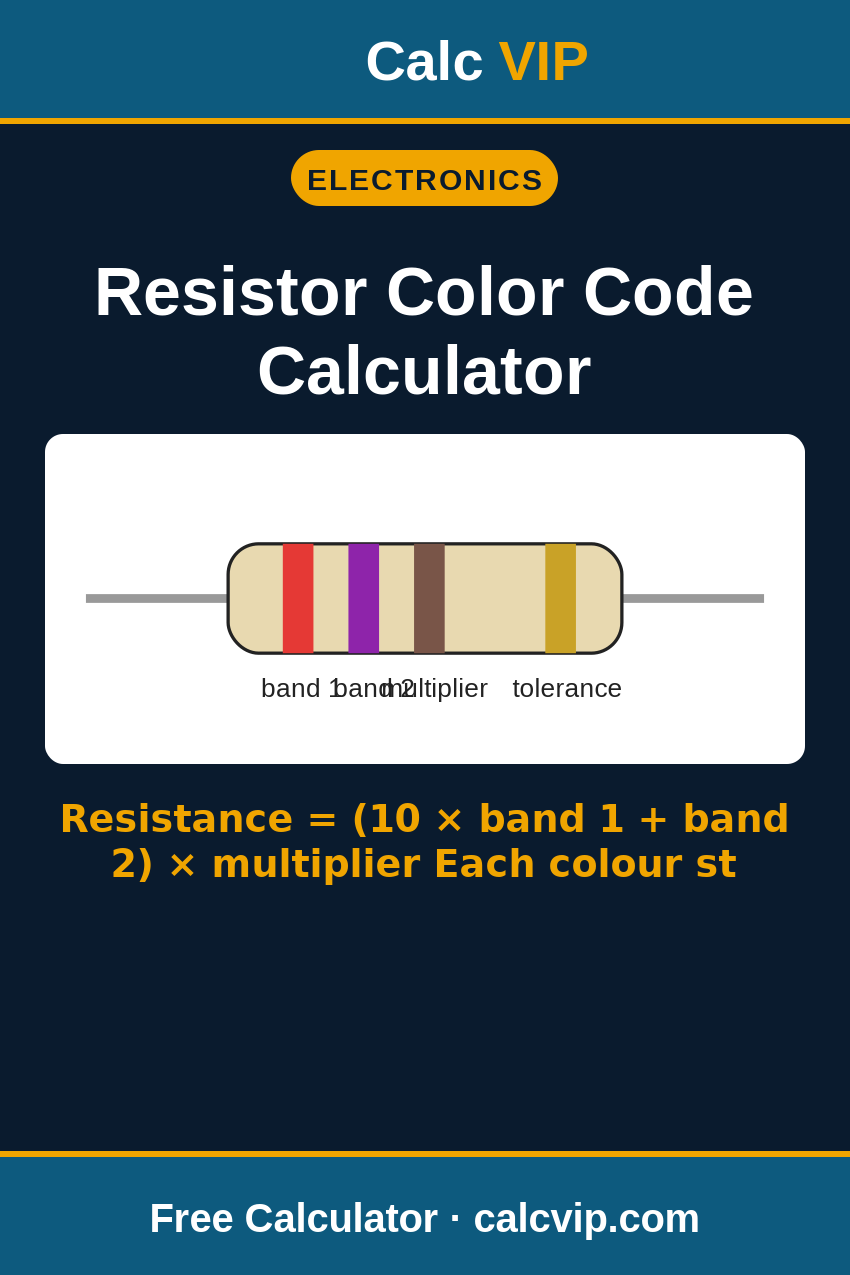
Two judgements make readings reliable. First, direction: the tolerance band — gold, silver, or absent — sits apart from the others and goes on the right; read towards it, never from it. Second, tolerance is part of the value: a "270 Ω" resistor at ±5% is honestly anything from 256.5 Ω to 283.5 Ω, and a circuit that cannot work across that whole range is a circuit designed too tightly. Choose the four colours here and the calculator gives you the nominal value, the tolerance, and both ends of the allowed range, formatting the answer in Ω, kΩ or MΩ as appropriate.
Formula
Resistance = (10 × band 1 + band 2) × multiplier
Each colour stands for a digit: Black 0, Brown 1, Red 2, Orange 3, Yellow 4, Green 5, Blue 6, Violet 7, Grey 8, White 9. The multiplier band adds zeros (gold = × 0.1, silver = × 0.01).
Work it as three steps. Bands 1 and 2 form a two-digit number from 10 to 99 — never with a leading zero, since band 1 is never black on a 4-band part. The multiplier then scales that number by a power of ten: brown ×10, red ×100, orange ×1000, and so on up to violet ×10,000,000, with black as ×1 and gold and silver reaching below 1 for the small values under 10 Ω. Finally the tolerance band turns the nominal value into a range: minimum = value × (1 − tolerance) and maximum = value × (1 + tolerance). Gold promises ±5%, silver ±10%, no band at all ±20%, and the rarer brown and red tolerance bands tighten the promise to ±1% and ±2%.
| Colour | Digit | Multiplier | Tolerance |
|---|---|---|---|
| Black | 0 | × 1 | — |
| Brown | 1 | × 10 | ± 1% |
| Red | 2 | × 100 | ± 2% |
| Orange | 3 | × 1,000 | — |
| Yellow | 4 | × 10,000 | — |
| Green | 5 | × 100,000 | ± 0.5% |
| Blue | 6 | × 1,000,000 | ± 0.25% |
| Violet | 7 | × 10,000,000 | ± 0.1% |
| Grey | 8 | — | ± 0.05% |
| White | 9 | — | — |
| Gold | — | × 0.1 | ± 5% |
| Silver | — | × 0.01 | ± 10% |
| No band | — | — | ± 20% |
Why the values are not round numbers: the E12 series
Newcomers expect resistors to come in tidy values — 100, 200, 300 Ω — and are baffled by 270, 330 and 470 instead. The reason is tolerance itself. Manufacturers space values so that each value's tolerance range just about touches the next: in the E12 series (10, 12, 15, 18, 22, 27, 33, 39, 47, 56, 68, 82 per decade) every step is about 21% up, so ±10% parts cover the whole number line with no gaps and no wasteful overlap. Twelve values per decade for ±10–20% parts, twenty-four (E24) for ±5%, ninety-six (E96) for ±1% — the tighter the tolerance, the finer the staircase must be. This is also why the calculator's answers so often land on those "odd" numbers: 270 Ω (27 × 10) and 4.7 kΩ (47 × 100) are not odd at all; they are the standard rungs of the ladder, and the colour code's two digits plus multiplier can name every rung exactly.
The system has a practical consequence for reading bands: the first two bands of a standard part almost always form one of the E-series pairs. If your reading gives digits like 29 or 71 on an ordinary resistor, suspect a misread colour — 27 (red-violet) and 68 (blue-grey) are the values the factory actually made. Treat the E-series as a spell-checker for your eyes.
How to use
- Hold the resistor with the tolerance band (gold, silver, or the band set apart) on the right.
- Read the other three bands from the left and pick their colours in the three lists — the resistor picture at the top recolours to match what you select.
- Pick the tolerance band colour and click "Calculate" — you get the value and its allowed range.
- Compare the picture with the component in your hand; if a band's colour is ambiguous (red versus brown is the classic), good light and the E-series spell-check — digits should form a standard pair — settle most arguments.
- When it truly matters, confirm with a multimeter. Colours fade, bodies discolour with heat, and a measurement beats an argument.
Worked examples
Example 1 — the reference resistor. Bands: Red, Violet, Brown, Gold.
First digit 2, second digit 7, multiplier × 10: value = 27 × 10 = 270 Ω. Gold means ± 5%, so the real value lies between 270 × 0.95 = 256.5 Ω and 270 × 1.05 = 283.5 Ω.
Example 2 — into kilohms. Bands: Yellow, Violet, Red, Gold.
47 × 100 = 4700 Ω = 4.7 kΩ, ± 5% → between 4465 Ω and 4935 Ω. The 4.7 kΩ is the most common resistor value in all of hobby electronics — the default pull-up and base resistor of a thousand circuits.
Example 3 — a tidy one. Bands: Brown, Black, Red, Gold.
10 × 100 = 1000 Ω = 1 kΩ, ± 5% → 950 Ω to 1050 Ω. Brown-black is the "10" pair; with a red multiplier it is the textbook 1 kΩ.
Example 4 — a looser tolerance. Bands: Orange, Orange, Brown, Silver.
33 × 10 = 330 Ω, silver means ± 10% → 297 Ω to 363 Ω. A wide range, perfectly acceptable for an LED current limiter, where the eye cannot judge a 10% brightness change.
Example 5 — black multiplier. Bands: Green, Blue, Black, Gold.
56 × 1 = 56 Ω, ± 5% → 53.2 Ω to 58.8 Ω. The black multiplier (× 1) is how values under 100 Ω are written without gold or silver.
Example 6 — the gold multiplier. Bands: Brown, Black, Gold, Gold.
10 × 0.1 = 1 Ω, ± 5% → 0.95 Ω to 1.05 Ω. Gold in the third position divides instead of multiplying — the only way the 4-band code reaches values below 10 Ω (silver, × 0.01, reaches below 1 Ω). Note too that the rarer brown tolerance band (± 1%) exists: it would tighten a 220 Ω part (Red, Red, Brown, Brown) to 217.8–222.2 Ω — and it is easily mistaken for a digit band, one more reason to identify the tolerance end first.
Colour codes in real life
Sorting a mixed parts drawer. Every electronics bench accumulates a jar of anonymous resistors. The bands are the only way back to order: read, verify against the E-series pairs, and file by value — the workflow this calculator exists to speed up.
Repairing vintage equipment. Old radios and amplifiers are forests of banded parts, some heat-darkened past easy reading. Knowing the code (and its failure modes) lets a restorer identify a burnt resistor's value from its surviving bands when the schematic is lost.
Choosing replacements. A failed 270 Ω ± 5% part can be replaced by anything within its job's tolerance — including a measured 265 Ω from the ± 20% bin. The code plus the range arithmetic tells you what "close enough" honestly means.
Education and exams. The colour code remains a fixture of physics and electronics courses precisely because it compresses digits, powers of ten and percentage tolerance into one small artefact — reading one fluently is a genuine practical skill, tested with real components in hand.
Why SMD parts broke the tradition. Modern surface-mount resistors are far too small for bands, so they print digits instead ("472" = 47 × 100 = 4.7 kΩ — the same two-digits-and-multiplier idea, in numerals). The code did not die; it changed clothes.
Safety-critical identification. In medical and aerospace work, component values are verified by measurement, not eyesight, because a misread band (red for brown under poor light) can shift a value tenfold. The colour code is the first check, never the only one.
Five and six bands: the precision dialect
Precision resistors add bands without changing the language. A 5-band part carries three digits, then a multiplier, then tolerance: Brown, Black, Black, Brown, Gold reads 100 × 10 = 1 kΩ ± 5% — though 5-band parts usually wear the tighter tolerances (brown ±1%, red ±2%) that justify the extra digit. A 6-band part adds a final band for the temperature coefficient, in parts per million per degree: the figure that says how far the value will wander as the component warms, linking this page to the resistance-and-temperature calculator. The reading discipline never changes — find the spaced or metallic tolerance band, put it on the right, and read towards it.
A short history of painting numbers
The band system dates from the 1920s, when the Radio Manufacturers Association needed a marking that survived small cylindrical bodies, indifferent printing technology and colour-blindness-unfriendly workshops. Dots and body-colour codes came first — the whole body painted one colour, with dots for the rest — before the industry settled on the axial bands still used today, standardised internationally as IEC 60062. The scheme outlived the valve radios it was born in, the transistor era and the hi-fi boom, because it asks nothing of the component but paint and nothing of the reader but eyesight and a memorised rainbow. Only the arrival of surface-mount parts too small to band finally displaced it — and even then, as the applications section notes, the replacement was the same code in digits rather than colours.
There is a quiet design lesson in the code's survival. It encodes a number in a form that cannot smudge into a different number, can be read from any side of the component, needs no power and no database, and degrades gracefully — a faded band narrows the possibilities but rarely destroys them. Modern printed markings are denser but more fragile. When you read a resistor made decades before you were born and its bands still tell the truth, you are seeing information engineering of a very high order, done in paint.
The code beyond resistors
The same colours mark other components, with the grammar adjusted. Axial inductors wear bands read exactly like a resistor's, giving microhenries instead of ohms — a 4.7 µH choke and a 4.7 Ω resistor can look identical until the circuit context separates them. Capacitors historically used a more elaborate dot-and-band dialect (now mostly replaced by printed digits), and diodes use printed type numbers but sometimes a colour band simply to mark the cathode end. Cable and wire insulation borrows the digit colours too: in multi-core cables the cores are identified by the same black-to-white sequence, so a technician who knows the resistor code already knows the wiring code. Learn the rainbow once and it pays out across the whole parts catalogue.
Common mistakes
- Reading from the tolerance end. The classic blunder: it turns 270 Ω (red-violet-brown) into a meaningless reading from the other side. Gold and silver bands are never digits — if your first "digit" is gold, you are holding the resistor backwards.
- Confusing red, brown and orange. Under warm workshop light these three neighbours blur together, and each confusion costs a factor of ten or a wrong digit. Read under daylight-quality light, and let the E-series pairs arbitrate: 27 and 33 exist, 29 does not.
- Ignoring the gold and silver multipliers. A gold third band divides by ten. Brown-black-gold is 1 Ω, not 100 Ω with an odd band — small-value resistors catch out everyone who assumes the multiplier always adds zeros.
- Treating the nominal value as exact. Designing a circuit that only works at exactly 270.0 Ω when the part promises 256.5–283.5 Ω is designing a lottery. Always carry the tolerance range into the circuit calculation.
- Trusting bands on a heat-damaged part. Overheating shifts paint colours (red darkens towards brown, bodies tan). On a scorched resistor, measure — and if it has failed open or drifted, identify the value from the circuit diagram or an identical channel elsewhere in the device.
FAQ
How do I know which end to start reading from?
Start from the end opposite the tolerance band. The tolerance band (gold, silver, or missing) is usually spaced a little apart from the others — read towards it, never from it.
What does tolerance mean?
The maker's promise of accuracy. A 270 Ω resistor with ± 5% tolerance may really measure anywhere from 256.5 Ω to 283.5 Ω and still be within specification.
What about 5-band and 6-band resistors?
Precision resistors add a third digit band (5-band) and sometimes a temperature-coefficient band (6-band). The colour meanings stay the same — only the digit count changes.
What is the mnemonic for the colour order?
"Black Boys Race Our Young Girls But Violet Generally Wins" — Black, Brown, Red, Orange, Yellow, Green, Blue, Violet, Grey, White for digits 0–9. Any sentence you invent yourself and actually remember beats the classic you forget.
Why is there no black first band?
A leading zero would be meaningless, so band 1 runs from brown (1) to white (9). If you think you see a black first band, you are probably looking at a 5-band part — or reading from the wrong end.
What does a single black band mean?
A lone black band marks a zero-ohm resistor — a wire link dressed as a component, used as a jumper on circuit boards. Its "value" really is 0 Ω, and the band is the whole message.
How do I read a resistor with only three bands?
The fourth band is simply absent: digits, multiplier, and an implied ± 20% tolerance. Three-band parts are the oldest and loosest grade — common in vintage equipment and cheap toys.
Are the colours the same worldwide?
Yes. The code is standardised internationally (IEC 60062), and the same scheme also marks capacitors and inductors in related forms. A resistor read in Tokyo reads identically in Berlin.
What if the bands are too faded to read?
Measure with a multimeter — out of circuit, or with one leg lifted, so parallel paths do not corrupt the reading. Then, if the measured value sits near a standard E-series value within tolerance, you have your answer.
Why do some resistors have a band right at the very end?
On some parts an extra end band denotes a solderable or fusible type, or a military reliability grade. It sits outside the value code; the four (or five) value bands still read exactly as this page describes.