 Calc
RMS Converter Calculator – Peak, RMS & Peak-to-Peak Voltage and Current
 Created by Michael Chen · Electronics Specialist · Last updated: November 2026
Use this free RMS Converter to change an AC voltage or current between peak, RMS and peak-to-peak values. Datasheets and oscilloscopes often quote the peak, while meters and nameplates quote RMS — this converts between them for a pure sine wave.
Alternating current refuses to sit still long enough to be described by one number, so electrical practice has settled on three. The peak is the highest point of the wave — what an oscilloscope shows and what insulation must withstand. The peak-to-peak value is the full swing from trough to crest — what you measure between cursors on a screen. And the RMS value is the engineer's compromise: a single steady number that captures the wave's power-delivering ability, the number on every nameplate, meter and electricity bill. Converting between the three is a daily task wherever datasheets (which love peaks) meet instruments (which love RMS).
RMS stands for root mean square, and the name is the recipe: square the wave (making every part positive and weighting the peaks heavily), take the mean over a cycle, then take the square root to return to the original units. For a sine wave the recipe collapses into one memorable constant: the RMS value is the peak divided by √2 ≈ 1.414, or about 70.7% of the peak. That is the whole mathematics of this calculator — but the constant is strictly a sine-wave constant, and much of the practical wisdom around RMS consists of remembering when it applies and when it quietly does not.
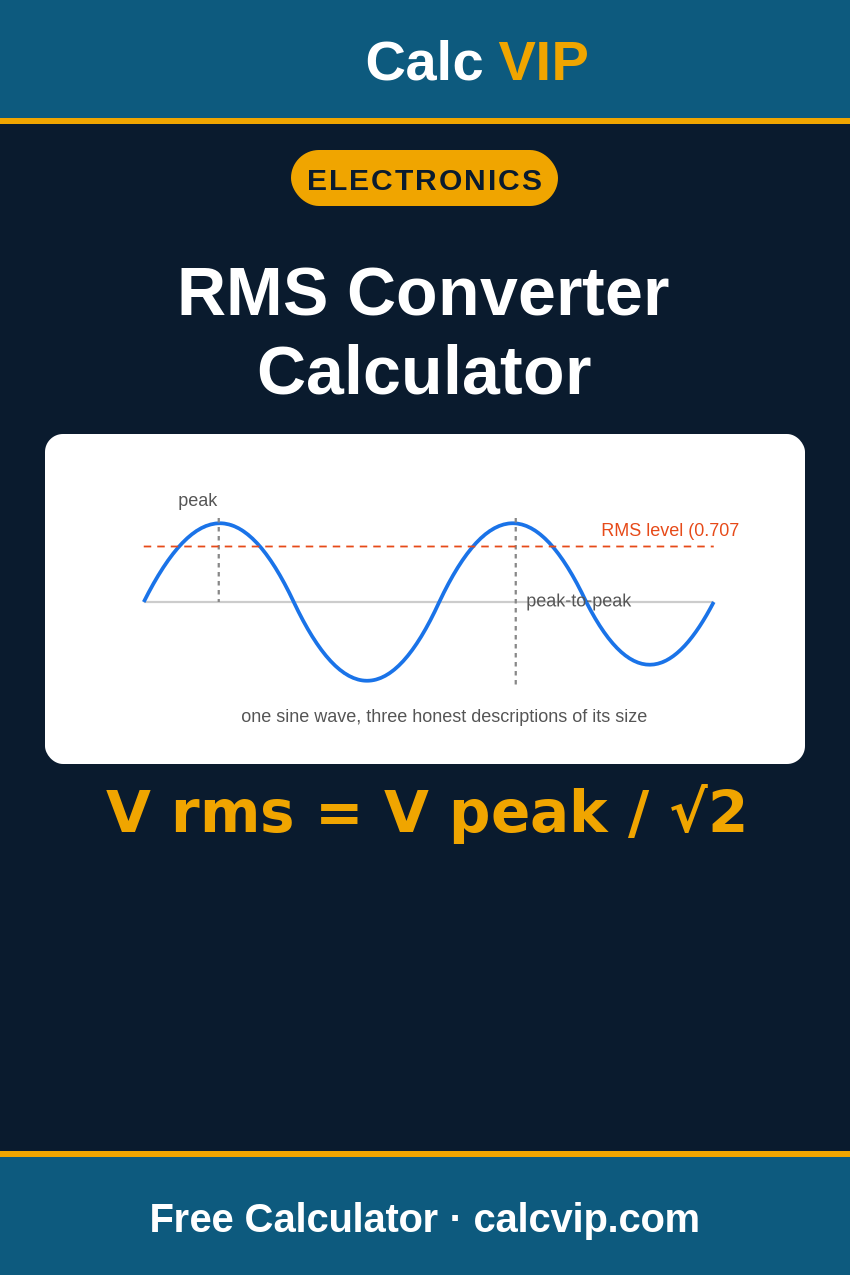
The stakes are concrete. A "230 V" mains supply actually peaks at 325 V, twice a second in each direction, and every capacitor, rectifier and insulation barrier in a mains-powered device must be rated for the peak, not the label. Conversely, an amplifier specified at "50 W into 8 Ω" is making an RMS claim whose peak voltage and current the output stage must survive. This calculator converts any one of peak, RMS and peak-to-peak into the other two, for voltage or current, so the number you have becomes the number the job needs.
Formula
Vrms = Vpeak / √2 • Vpeak = √2 × Vrms • Vpp = 2 × Vpeak = 2√2 × Vrms (for a sine wave, √2 ≈ 1.414)
The rearrangements follow from the same constant. Given peak-to-peak, halve it to get the peak, then divide by √2: Vrms = Vpp / (2√2) ≈ Vpp / 2.828. Given RMS, the peak is 1.414 × Vrms and the full swing 2.828 × Vrms. A fourth quantity sometimes appears alongside these: the average of the rectified wave, which for a sine is Vavg = (2/π) × Vpeak ≈ 0.637 × Vpeak — for a 325 V peak, 206.9 V. Cheap multimeters secretly measure this average and multiply by 1.11 to display "RMS", a shortcut that is exact only for undistorted sine waves, as the FAQ explains.
| Symbol | Meaning | Units |
|---|---|---|
| Vpeak | peak (amplitude) — highest point of the wave | volts (V) or amps (A) |
| Vrms | root mean square — the DC-equivalent heating value | volts (V) or amps (A) |
| Vpp | peak-to-peak — full swing, trough to crest | volts (V) or amps (A) |
| √2 | the sine-wave crest factor, ≈ 1.414 | dimensionless |
| Vavg | mean of the rectified wave, 0.637 × Vpeak for sine | volts (V) or amps (A) |
Why RMS is the value that matters: the heating definition
RMS was not chosen for mathematical elegance; it was chosen because it answers the question the nineteenth century actually asked: "this new alternating supply — what direct voltage is it worth?" The answer is defined by heat. Run the AC through a resistor and measure the average power; the RMS value is the DC voltage that would produce exactly that average power in the same resistor. Since power goes as V², the squaring in "root mean square" is not decoration — it is the physics. A 230 V RMS supply drives a heater exactly as 230 V DC would, even though the AC spends part of each cycle at 325 V and part at zero.
This definition has a beautiful consequence: it works for any waveform, not just sine waves. Square, sample, average, root — the recipe never mentions sines. What is sine-specific is only the shortcut constants (÷√2 from peak, ×1.11 from rectified average). A true-RMS instrument performs the full recipe electronically and reads correctly on the chopped, distorted waveforms of modern power electronics; an average-responding instrument applies the sine shortcut and lies, sometimes by tens of percent, on anything else. Knowing which kind of meter you are holding is a genuine professional skill.
The peak, meanwhile, governs a different set of failures. Insulation breaks down at the peak electric field; rectifier diodes and filter capacitors in a power supply charge to the peak; semiconductor junctions avalanche at peak reverse voltage. A designer therefore lives in both worlds at once: RMS for power, heat and billing; peak for survival. This calculator exists because translating between those worlds, quickly and without a √2 slip, is needed far more often than textbooks admit.
How to use
- Choose whether you are converting a voltage or a current — the conversion factors are identical; only the unit label changes.
- Type the value you know and say whether it is the peak, the RMS or the peak-to-peak value.
- Click "Calculate" to see all three values side by side.
- Sanity-check against the sine landmarks: RMS should be about 71% of the peak, and peak-to-peak almost exactly 2.83 times the RMS. If your trio violates those ratios, a non-sine waveform or a slipped decimal is involved.
Worked examples
Example 1 — the mains, from the scope's point of view. A mains waveform measured on an oscilloscope peaks at 325 V.
Vrms = 325 / √2 = 229.81 V — the familiar "230 V" supply.
Vpp = 2 × 325 = 650 V from the bottom of one half-cycle to the top of the next.
Example 2 — the mains, from the nameplate's point of view. Starting from the rated 230 V RMS: Vpeak = 230 × √2 = 325.27 V and Vpp = 2 × 325.27 = 650.54 V. This is why a capacitor in a mains filter is rated at 400 V or more despite living on a "230 V" rail — it charges to the peak on every half-cycle, with margin demanded on top.
Example 3 — a signal on an oscilloscope. A waveform spans 5 V peak-to-peak between cursors. The peak is 5 / 2 = 2.5 V, and the RMS value is 2.5 / √2 = 1.77 V. If this signal drives a 50 Ω load, the power is Vrms²/R = 1.77²/50 ≈ 0.063 W — a calculation that only works because the RMS value, not the peak, carries the power.
Example 4 — a tidy laboratory sine. A function generator set to 1.414 V peak delivers Vrms = 1.414 / √2 = 1.00 V and Vpp = 2.83 V. Generator front panels are a notorious trap here: some specify amplitude as peak, others as peak-to-peak into 50 Ω, and the factor of two between them has embarrassed many careful experimenters.
Example 5 — North American mains. A 120 V RMS supply peaks at 120 × √2 = 169.71 V with a peak-to-peak swing of 339.41 V. Equipment designed for both continents must insulate for the European peak (325 V) while heating correctly at the American RMS — one reason "universal input" supplies are specified 90–264 V RMS.
Example 6 — when the wave is not a sine. Three waveforms, all with a 10 V peak. The sine gives Vrms = 10/√2 = 7.07 V. A square wave, sitting at ±10 V almost all the time, gives Vrms = 10 V — it delivers twice the power of the sine into the same resistor. A triangle wave gives Vrms = 10/√3 = 5.77 V. Same peak, three different heating values: the definitive demonstration that peak alone cannot describe an AC quantity, and that this calculator's factors belong to sine waves only.
RMS in real life
Mains ratings and safety. Every socket, breaker and appliance rating is RMS. The 13 A fuse in a plug protects against RMS current heating; the insulation of the same plug is designed against the 325 V peak. Both numbers govern the same object through different failure modes.
Audio power ratings. Amplifier watts are RMS-derived: P = Vrms²/R. A "100 W into 8 Ω" amplifier must swing Vrms = √(100 × 8) = 28.28 V, i.e. a 40 V peak — which sets its supply rails near ±45 V. Peak-power marketing figures exploit exactly the √2 gap this calculator exposes.
Oscilloscope work. Scopes display peaks and peak-to-peak directly. Converting to RMS is the daily bridge between what the screen shows and what circuit equations, power budgets and datasheets expect.
Motor and transformer nameplates. Currents quoted for motors are RMS load currents; the copper heating they cause follows Irms²R. Variable-frequency drives distort the current waveform, which is why drive installations specify true-RMS metering.
LED and lighting retrofits. LED drivers fed from dimmers see chopped sine waves whose true RMS differs sharply from the sine shortcut. Lamps that flicker or overheat on dimmers are often victims of an average-responding measurement somewhere in the design chain.
Medical and welding equipment. Diathermy, defibrillator test loads and welding current specifications are all RMS-defined because their effects — tissue heating, arc energy — are heating effects. The recipe, not the shortcut, is what standards committees write down.
Quick reference: familiar RMS values in full
| RMS | Peak | Peak-to-peak | Where you meet it |
|---|---|---|---|
| 120 V | 169.71 V | 339.41 V | North American mains |
| 230 V | 325.27 V | 650.54 V | European / UK mains |
| 12 V | 16.97 V | 33.94 V | low-voltage AC adapters, doorbells |
| 5 V | 7.07 V | 14.14 V | bench supplies, signal levels |
| 1 V | 1.41 V | 2.83 V | line-level audio reference |
Two ratios are worth committing to memory from this table: peak ≈ 1.41 × RMS and peak-to-peak ≈ 2.83 × RMS. With those, a scope reading becomes an RMS estimate in your head (650 V peak-to-peak ÷ 2.83 ≈ 230 V — mains, as expected), and a nameplate becomes a peak estimate just as fast.
Crest factor and form factor: the two ratios that describe a waveform
Engineers characterise a waveform's shape with two ratios this calculator's constants come from. The crest factor is peak ÷ RMS: √2 ≈ 1.41 for a sine, 1.00 for a square wave, √3 ≈ 1.73 for a triangle. It tells you how much headroom above the RMS the peaks demand — critical for meter inputs, which clip on peaks while displaying RMS. The form factor is RMS ÷ rectified average: 1.11 for a sine, 1.00 for a square, 1.15 for a triangle. It is the multiplier hidden inside average-responding multimeters. When a waveform's crest or form factor departs from the sine's 1.41 and 1.11, every sine-shortcut instrument reading departs with it — modern switch-mode loads, with crest factors of 2 or 3, are precisely the loads that make cheap meters fib.
One arena where these ratios earn their keep daily is audio power ratings. An amplifier's honest specification is its continuous RMS output power — the power computed from RMS voltage into a stated load, sustained, at a stated distortion. The same hardware advertised by its peak capability can claim double that figure, and "music power" ratings inflate further by exploiting the crest factor of real programme material, whose peaks tower 10–20 dB above its RMS level. None of these numbers is fabricated; they are simply different answers from this page's table, which is why standards bodies mandate the RMS basis. The same logic protects loudspeakers: a driver survives peaks far above its RMS rating because its voice coil responds to heating — to RMS current — with a thermal time constant of seconds. Read every audio watt through the crest factor, and the marketing fog around amplifiers and speakers largely evaporates: divide the peak claim by the waveform's own ratios and the comparable RMS figure falls out.
Common mistakes
- Applying √2 to non-sine waves. The factor belongs to sine waves alone. A 10 V peak square wave has an RMS of 10 V, not 7.07 V — Example 6 shows the three-way split. When in doubt, use a true-RMS meter or the full recipe.
- Confusing peak with peak-to-peak. They differ by exactly two, and the confusion doubles or halves every downstream power calculation (a factor of four in watts). State which one you mean, every time.
- Rating components by the RMS label. A "230 V" rail peaks at 325 V. Capacitors, diodes and clearances chosen against 230 V will fail — sometimes immediately, sometimes after months of overstress.
- Trusting an average-responding meter on distorted waveforms. Such meters display 1.11 × the rectified average. On the chopped output of a dimmer or drive they can under-read the true RMS by 20–40%, hiding overheating behind a reassuring display.
- Mixing RMS current with peak voltage in power sums. P = Vrms × Irms × cos φ requires both quantities in the same convention. One peak value slipped into the product inflates the answer by √2 and the error survives every subsequent step.
FAQ
What does RMS actually mean?
Root Mean Square: the DC value that would deliver the same average power to a resistor. A 230 V RMS AC supply heats a heater exactly like 230 V DC, even though its peaks reach 325 V.
Do these factors work for square or triangle waves?
No. The √2 and 2× factors are for sine waves only. A square wave has Vrms = Vpeak, and a triangle wave has Vrms = Vpeak/√3.
Why do multimeters sometimes disagree with oscilloscopes?
Scopes show the peak directly, while most meters display RMS. Cheap meters assume a sine wave and just scale the average, so they read wrongly on distorted waveforms — a true-RMS meter measures the heating effect properly.
Why is the RMS of a sine exactly the peak divided by √2?
Because the mean of sin² over a cycle is exactly ½. Squaring the wave gives an average of Vpeak²/2; the square root then yields Vpeak/√2. It is a property of the sine's shape, not an approximation — the approximation in practice is assuming your waveform is a sine at all.
What does a true-RMS meter do differently?
It performs the actual recipe — sampling the waveform, squaring, averaging and rooting (or heating a thermal sensor equivalently) — so it reads correctly on distorted waves up to a specified crest factor. Average-responding meters measure the rectified average and multiply by 1.11, correct only for clean sines.
Is the "230 V" of a wall socket peak, RMS or peak-to-peak?
RMS. The socket's voltage peaks at about 325 V and swings 650 V peak-to-peak, but its heating value — the number that matters for appliances and billing — is 230 V, and that is the number standards print.
How do I convert an oscilloscope's peak-to-peak reading to RMS?
For a sine wave, divide by 2√2 ≈ 2.83. A 650 V peak-to-peak mains waveform gives 650 / 2.83 ≈ 230 V RMS. This calculator's peak-to-peak mode performs exactly that division.
Does RMS apply to current the same way?
Identically. Irms = Ipeak/√2 for a sine, and Irms is the DC-equivalent current for heating: copper losses are Irms²R regardless of waveform shape, which is why cable sizing is always done in RMS amps.
What is the average value of a sine wave, and why do meters care?
Over a full cycle the average is zero (the halves cancel), so meters use the average of the rectified wave: 0.637 × peak, or 206.9 V for a 325 V peak mains wave. Average-responding meters measure this and scale by the form factor 1.11 to display RMS — valid only while the waveform stays sinusoidal.
Can RMS be larger than the peak?
Never. RMS is a kind of average of the wave's magnitude, weighted by squares, and no average can exceed the maximum. If a conversion yields RMS > peak, the inputs were mixed up — most often peak-to-peak was entered where peak was meant.