 Calc
Vector Addition Calculator – Add Two Vectors by Magnitude & Angle
 Created by Sarah Mitchell · Physics Editor · Motion & Measurement · Last updated: November 2026
Use this free Vector Addition Calculator to add two vectors given by magnitude and angle. The calculator resolves each vector into components, adds them, and gives the resultant vector's magnitude and direction.
Walk 3 km east, then 4 km north, and you are 5 km from where you started — not 7. That simple fact, that journeys do not add by their odometer readings, is why vectors need their own arithmetic. Adding vectors means combining their effects: two displacements into the single displacement that achieves the same end point, two forces into the single force that pulls the same way, two velocities into the one velocity actually travelled. The combined vector is called the resultant, and finding it correctly — size and direction — is the operation this calculator performs.
There are two classical ways to picture the addition. Tip-to-tail: draw the second vector starting where the first ends, and the resultant runs from the start of the first to the end of the second. Parallelogram: draw both from one point, complete the parallelogram, and the resultant is its diagonal. Both pictures are exact but awkward to measure from; the component method this calculator uses is the same geometry translated into arithmetic. Each vector is resolved into x and y components, the components are added separately — numbers in the same direction add like ordinary numbers — and the resultant is rebuilt from the summed components.
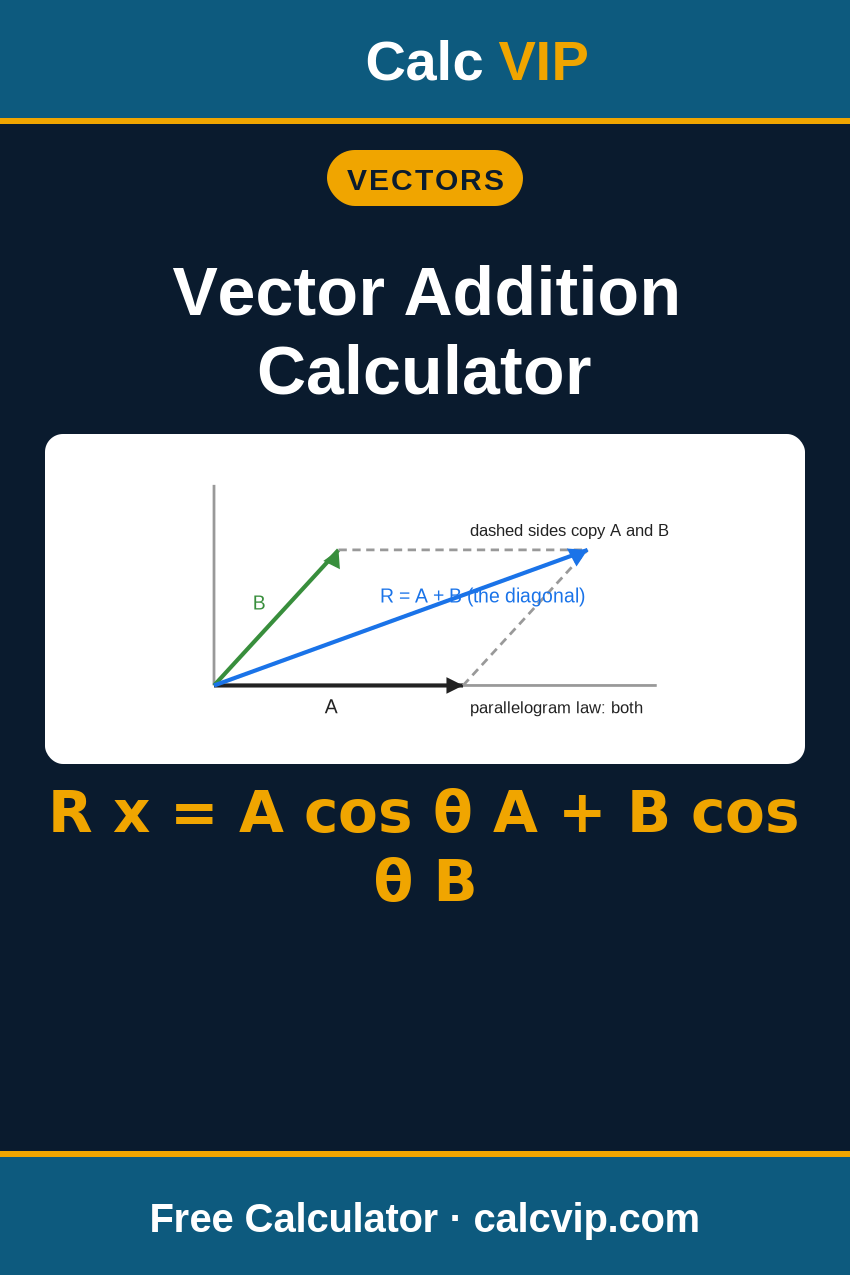
One consequence deserves attention before any numbers: the resultant is fenced in. It can never exceed the sum of the two magnitudes (reached only when the vectors point the same way), and it can never be less than the difference of the magnitudes (reached only when they point oppositely). Between those fences, the angle between the vectors decides everything. Two vectors of 10 give a resultant of 20 aligned, 14.14 at right angles, 10 at 120° apart, and nothing at all at 180°. Direction is not a detail in vector addition; it is most of the answer.
Formula
Rx = A cos θA + B cos θB, Ry = A sin θA + B sin θB, then |R| = √(Rx² + Ry²) and θR = atan2(Ry, Rx)
The same result is packaged in a single closed form, the law of cosines applied to the tip-to-tail triangle: |R|² = A² + B² + 2AB cos φ, where φ is the angle between the two vectors when placed tail to tail. It is a valuable check on the component arithmetic (and the component method is a valuable check on it), but components win in practice: they handle any angles without special cases, they extend unchanged to three or more vectors, and they deliver the resultant's direction as well as its size. For the special case of two equal magnitudes the formula collapses to |R| = 2A cos(φ/2) — the resultant bisects the angle between them, with a size set entirely by how far apart they point.
| Symbol | Meaning | Units |
|---|---|---|
| A, B | magnitudes of the two vectors being added | the vectors' shared unit (N, m/s, m…) |
| θA, θB | their direction angles from the +x axis | degrees, anticlockwise from +x |
| Rx, Ry | components of the resultant | same unit as A and B |
| |R|, θR | magnitude and direction of the resultant | unit as above; degrees, 0° to 360° |
The resultant lives between two fences
The bounds |A| − |B| ≤ |R| ≤ |A| + |B| are the triangle inequality wearing work clothes, and they are the fastest sanity check in all of vector work. Any computed resultant outside the fences is certainly wrong; a resultant inside them is at least possible. The fences also explain everyday experience. Two people pushing a car in the same direction combine fully; at right angles they waste part of their effort pulling against each other's line; pushing from opposite sides, they mostly cancel. Tug-of-war, rowing crews, and engines mounted at angles all live inside this one inequality.
The equal-magnitude case shows the fences being approached smoothly. For two vectors of 10 with angle φ between them, |R| = 2 × 10 × cos(φ/2): at φ = 0° the full 20; at 60°, 17.32; at 90°, 14.14; at 120°, exactly 10 — each vector's contribution is being cancelled as fast as it is added beyond that point; at 180°, zero. The resultant also points exactly halfway between the two directions (at φ/2 from each), which is why two equal ropes pulling symmetrically on a load share it evenly and the load moves straight ahead.
How to use
- Enter the magnitude and angle (degrees from the +x axis) of vector A.
- Do the same for vector B — both vectors must be the same kind of quantity in the same units (two forces in newtons, two velocities in m/s).
- Click "Add Vectors" to see the resultant magnitude, its direction angle, and its components.
- Check the resultant against the fences before trusting it: it must lie between |A − B| and A + B.
Worked examples
Example 1 — the perpendicular pair. Add A = 10 at 0° and B = 10 at 90°. Components: A = (10, 0), B = (0, 10), so R = (10, 10). Resultant magnitude = √(10² + 10²) = √200 = 14.14, at an angle of 45° — exactly halfway between the two, as symmetry demands.
Example 2 — same direction. Add 5 at 0° and 7 at 0°: R = (12, 0), so |R| = 12 at 0°. Only in this aligned case do magnitudes simply add — the upper fence of the inequality, reached exactly.
Example 3 — a general pair. Add 8 at 30° and 6 at 120°. Components: A = (6.93, 4), B = (−3, 5.20), so R = (3.93, 9.20). Magnitude = √(3.93² + 9.20²) = √100 = 10, direction = atan2(9.20, 3.93) = 66.87°. Note how the x components partly cancel (6.93 against −3, leaving 3.93) while the y components reinforce — the resultant leans strongly towards B's side.
Example 4 — a resultant in quadrant II. Add 20 at 60° and 15 at 210°. Components: A = (10, 17.32), B = (−12.99, −7.5), giving R = (−2.99, 9.82). Magnitude = 10.27, direction = 106.94°. The negative Rx is essential information — drop it and the answer points into the wrong half of the plane.
Example 5 — the river-crossing pair. A boat points north (90°) at 12 units while the current carries it east (0°) at 5 units: R = (5, 12), magnitude 13 at 67.38°. The boat's actual path over the ground is this resultant — 13 units in the direction 67.38°, not the 12 due north its bow points along. Another 5-12-13 triangle hiding in plain sight.
Example 6 — total cancellation. Add 10 at 0° and 10 at 180°: R = (10 − 10, 0) = (0, 0). The calculator reports a resultant of 0 — the lower fence. Equal and opposite vectors annihilate each other completely, which is why a book resting on a table (gravity down, normal force up, equal sizes) goes nowhere.
Vector addition in real life
Relative velocity. Example 5 is the template for every moving-vehicle problem: vehicle velocity plus medium velocity (wind, current) equals velocity over the ground. Pilots compute it as a matter of routine; the "wind correction angle" a plane crabs into is the direction adjustment that makes the resultant follow the intended course.
Forces and equilibrium. Cables holding a sign, ropes on a sledge, the legs of a tripod — each tension is a vector, and the structure is in equilibrium exactly when their resultant (plus gravity) is zero. Engineers add the vectors first and design afterwards.
Navigation. A journey logged as legs — 30 km at 40°, then 20 km at 130° — adds to a single displacement from the start, which is the direct course and distance home. Dead reckoning at sea was this calculation performed with tables and patience.
Electric and magnetic fields. Fields from several charges or wires add vectorially at every point in space: the total field is the resultant of the individual fields, which is why field patterns curve and cancel in such intricate ways near multiple sources.
Robotics and animation. A character controller adds "move forward" and "strafe" inputs as vectors; a robot arm sums joint contributions. The diagonal-speed bug in old video games — moving faster diagonally than straight — was precisely a failure to take the magnitude of this resultant.
Tugboats and towing. Two tugs pulling a ship at angles to its course deliver a resultant along the bisector only if their pulls are equal; harbour masters exploit the component split deliberately, using one tug largely for steering (perpendicular component) and one for drive.
Adding more vectors — and subtracting them
Nothing about the component method limits it to two vectors. Resolve every vector, sum all the x components into one column and all the y components into another, and rebuild once at the end: Rx = ΣAx, Ry = ΣAy. A three-leg journey, a knot of five cables, the field of ten charges — the procedure never changes, only the length of the columns. This scalability is exactly why components, rather than the parallelogram picture or the cosine rule, are the working method of physics.
Subtraction is addition in disguise: A − B means A + (−B), and −B is B with both components negated — the same arrow reversed. Take Example 1's pair and subtract instead: 10 at 0° minus 6 at 90° gives R = (10, −6), magnitude √136 = 11.66 at 329.04°. Relative velocity is the everyday home of this operation: your velocity relative to a moving walkway, or one aircraft relative to another, is always a difference of vectors, found by adding one and the reverse of the other.
A full wind-correction problem shows addition and the fence-check working together. A plane flies north (90°) at 200 km/h through the air while a wind blows it east (0°) at 40 km/h. The velocity over the ground is the resultant: R = (40, 200), magnitude √(40² + 200²) = √41600 = 203.96 km/h at atan2(200, 40) = 78.69°. The fences approve the answer — 203.96 lies between 200 − 40 = 160 and 200 + 40 = 240 — and the direction explains the pilot's craft: to actually travel north, the plane must aim somewhat west of north so the wind's eastward component cancels the westward lean, arriving at a resultant that points due north at slightly less than full airspeed.
Equilibrium: when the interesting resultant is zero
Statics — the physics of things that do not move — is vector addition with the answer demanded in advance: the resultant of all forces must be zero. Three forces can balance only if they form a closed triangle when placed tip-to-tail, and the cleanest case is three equal forces at 120° to each other: 5 at 0°, 5 at 120° and 5 at 240° have components x: 5 − 2.5 − 2.5 = 0 and y: 0 + 4.33 − 4.33 = 0, so their resultant is exactly 0. This is why three-legged stools and three-way tug arrangements can hang in perfect balance, and why a hanging sign's two cable tensions plus gravity must close into a triangle whose shape fixes each tension. When an engineer "resolves the forces and sets the sums to zero", the two columns ΣFx = 0 and ΣFy = 0 are this calculator run in reverse: given that the resultant is zero, solve for the unknown forces that make it so.
Quick reference: two equal vectors of 10
| Angle between them φ | Resultant |R| = 2A cos(φ/2) | Reading |
|---|---|---|
| 0° | 20 | fully aligned — magnitudes add |
| 60° | 17.32 | most of both survives |
| 90° | 14.14 | the √2 case of Example 1 |
| 120° | 10 | resultant equals each vector |
| 180° | 0 | complete cancellation |
The direction of each resultant in this table is exactly φ/2 measured from the first vector — symmetry guarantees it for equal magnitudes. With unequal magnitudes the resultant leans towards the larger vector, as Example 3 showed, and only the component arithmetic gives its exact direction.
One more symmetry is worth pocketing: two equal vectors placed symmetrically about an axis produce a resultant exactly on that axis. Forces of 6 at 30° and 6 at 150° give R = (5.20 − 5.20, 3 + 3) = (0, 6) — a resultant of 6 at 90°, the sideways components cancelling perfectly. Rigging, archery and the paired engines of a catamaran all exploit this: arrange equal pulls symmetrically and the resultant's direction is guaranteed by geometry before any number is computed, leaving only its size, 2A cos(φ/2), to calculate.
Common mistakes
- Adding the magnitudes. 10 + 10 = 20 is the answer only at 0° between the vectors. At 90° the true resultant is 14.14; at 180° it is 0. If you did not use the angles, you have not added vectors.
- Adding vectors of different kinds or units. A force in newtons cannot be added to a velocity in m/s, nor a force in newtons to one in pounds. Convert to a single unit and a single quantity first.
- Feeding in bearings as standard angles. Bearings run clockwise from north. A bearing of 130° is a standard angle of −40° (or 320°). Convert with standard = 90° − bearing before entering.
- Losing a negative component. Vectors pointing into quadrants II, III or IV contribute negative components. Dropping a minus sign during resolution flips the resultant into the wrong quadrant — Example 4's answer becomes a mirror image of the truth.
- Expecting the resultant to point "between" the vectors when one dominates. It does lean between them, but weighted: a 20 and a 15 at right angles give a resultant much closer to the 20's direction. Intuition that ignores the sizes misjudges the direction badly.
FAQ
Why can't I just add the magnitudes?
Because vectors have direction. Two vectors of 10 at right angles give a resultant of 14.14, not 20. Magnitudes only add directly when the vectors point in exactly the same direction.
What is the tip-to-tail method?
It is the picture version of this calculation: place the tail of B at the tip of A; the resultant runs from the tail of A to the tip of B. The component method used here gives the same answer, exactly.
Can the resultant be zero?
Yes — if the two vectors have equal magnitudes and opposite directions (angles 180° apart), their components cancel and the resultant is the zero vector.
Does the order of addition matter?
No. Vector addition is commutative (A + B = B + A) and associative ((A + B) + C = A + (B + C)) — the component sums are identical either way. This is a genuine contrast with the cross product, where order flips the sign.
Can the resultant be smaller than both vectors?
Yes. Whenever the angle between the vectors exceeds 120° (for equal sizes), cancellation dominates: two vectors of 10 at 150° apart give a resultant of about 5.18, smaller than either. At 180° it vanishes entirely.
How do I add three or more vectors?
Resolve each one, add all the x components together and all the y components together, then rebuild the resultant from those two sums — exactly the component method of this page, with longer columns. The calculator handles the two-vector case; repeat it pairwise or sum the columns by hand for more.
How do I subtract one vector from another?
Reverse the vector being subtracted (add 180° to its angle, or negate both its components) and add as usual. A − B is A + (−B); for 10 at 0° minus 6 at 90° the result is 11.66 at 329.04°.
What does a resultant of zero mean physically?
For forces, equilibrium — the object does not accelerate. For displacements, a closed loop — you end where you started. For velocities, no net motion. Zero is a meaningful answer, not a failed calculation.
My angles are compass bearings. What do I enter?
Convert each bearing b to a standard angle with 90° − b (adding 360° if negative). Bearing 0° (north) becomes 90°, bearing 90° (east) becomes 0°, bearing 180° (south) becomes 270°.
Why is the direction of my resultant in the "wrong" quadrant?
Almost always a dropped minus sign while resolving the second vector, or a bearing entered unconverted. Recompute the components of each vector separately and check their signs against the picture before adding.