 Calc
Vector Magnitude Calculator – Magnitude & Direction Angle from Components
 Created by Sarah Mitchell · Physics Editor · Motion & Measurement · Last updated: November 2026
Use this free Vector Magnitude Calculator to rebuild a vector from its components. Enter the x and y components and the calculator finds the magnitude (length) of the vector and its direction angle from the positive x-axis.
Components are how a vector is stored; magnitude and angle are how it is understood. After resolving forces, velocities or displacements into x and y parts and doing the arithmetic a problem demands — adding components, scaling them, balancing them — you are left holding two numbers that mean little until they are recombined. The magnitude answers "how big?", the direction angle answers "which way?", and together they are the vector in its most human-readable form: 5 units at 53.13° says more at a glance than (3, 4) ever will.
The magnitude half of the job is Pythagoras in modern dress. The components are the legs of a right-angled triangle and the vector itself is the hypotenuse, so its length is the square root of the sum of the squares. The direction half is the triangle's angle, recovered with an arctangent — and that is where the subtlety lives, because the ordinary arctangent on a pocket calculator cannot distinguish a vector pointing up-right from one pointing down-left. This calculator uses the two-argument arctangent (atan2), which inspects the sign of each component separately and always lands in the correct quadrant.
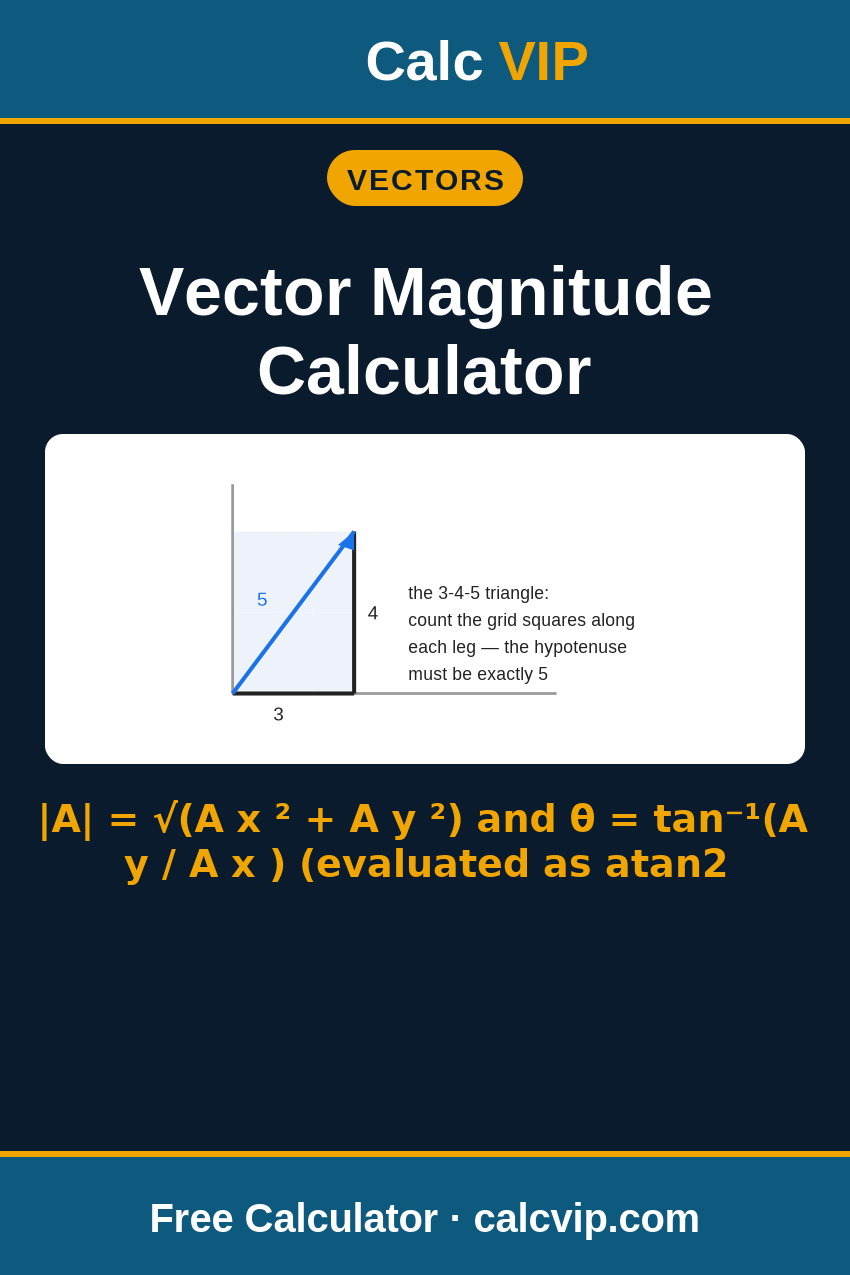
Read the formula once more and notice that it is also the distance formula. The magnitude of the vector from the origin to the point (Ax, Ay) is the distance from the origin to that point, and the magnitude of a vector drawn between any two points is the distance between them, computed from the differences of their coordinates. One piece of arithmetic serves as the length of an arrow, the size of a force, the speed hidden inside two velocity components, and the distance between two places on a map — which is why this modest calculation appears in every branch of physics and engineering.
Formula
|A| = √(Ax² + Ay²) and θ = tan⁻¹(Ay / Ax) (evaluated as atan2, so the quadrant is correct)
Both formulas rearrange into useful companions. If you know the magnitude and one component, the other follows from Ay = ±√(|A|² − Ax²) — the ± is real: a magnitude and one component leave a mirror ambiguity above and below the axis, which only the sign of the missing component can settle. The ratio form tan θ = Ay / Ax underlies the angle, and the component recovery formulas Ax = |A| cos θ and Ay = |A| sin θ run the whole conversion backwards. One structural fact is worth internalising: because both components are squared, the magnitude is blind to signs — (−3, −4), (3, −4) and (3, 4) all have magnitude 5 — while the angle depends on nothing but the signs and the ratio.
| Symbol | Meaning | Units |
|---|---|---|
| Ax, Ay | the components of the vector along the x and y axes | the vector's own unit (N, m/s, m…) |
| |A| | magnitude — the length of the vector, always ≥ 0 | same unit as the components |
| θ | direction angle, anticlockwise from the +x axis | degrees, reported between 0° and 360° |
| atan2(y, x) | two-argument arctangent that uses both signs to fix the quadrant | — |
Why the angle needs two arguments
Ask a pocket calculator for tan⁻¹(4/3) and it answers 53.13° — correctly, for the vector (3, 4). Now ask for the vector (−3, −4): the ratio Ay/Ax is again 4/3 (the minus signs cancel), so the calculator repeats 53.13°, yet this vector points in exactly the opposite direction, at 233.13°. The single-argument arctangent only ever returns angles between −90° and +90°, because a ratio alone has forgotten which component carried which sign. Every quadrant error in student work — and in hastily written software — is born here.
The two-argument arctangent, atan2(Ay, Ax), fixes it by receiving the components separately: it computes the ratio's arctangent and then adds or subtracts 180° according to the signs, placing the answer in the true quadrant. This calculator reports the result between 0° and 360°, measured anticlockwise from the +x axis: quadrant I gives 0–90°, quadrant II 90–180°, quadrant III 180–270° and quadrant IV 270–360°. If your own working produces a negative angle such as −67.38°, nothing is wrong — adding 360° converts it to the equivalent 292.62° reported here.
How to use
- Enter the x component and the y component of the vector (negatives are allowed — they carry the direction information).
- Click "Calculate Magnitude & Angle".
- Read off the magnitude |A| and the direction angle θ. The angle is given between 0° and 360°, measured anticlockwise from the positive x-axis.
- If you expected an angle 180° away from the one shown, check the signs of your components — the calculator places the vector in the quadrant its signs describe.
Worked examples
Example 1 — the classic. A vector has components Ax = 3 and Ay = 4. Magnitude = √(3² + 4²) = √25 = 5. Angle = tan⁻¹(4/3) = 53.13°. The 3-4-5 triangle is the most quoted right triangle in physics; meeting it should always trigger recognition.
Example 2 — scaling up. Components (6, 8) are Example 1 doubled: magnitude = √(36 + 64) = √100 = 10, and the angle is unchanged at 53.13°. Scaling a vector scales its magnitude but never its direction — the angle depends only on the ratio of the components.
Example 3 — quadrant II. Components (−3, 4): magnitude = √(9 + 16) = 5 again, but the vector points up and to the left, so atan2 gives 126.87° — which is 180° − 53.13°. A plain arctangent of 4/(−3) would have mislead you towards −53.13°.
Example 4 — quadrant IV. Components (5, −12): magnitude = √(25 + 144) = √169 = 13. The raw arctangent gives −67.38°, and adding 360° puts the direction in this calculator's convention: 292.62°. Both numbers describe the same arrow; only the reporting convention differs.
Example 5 — quadrant III. Components (−6, −8): magnitude = √(36 + 64) = 10, angle = 233.13° — exactly opposite to Example 2's vector, as it must be, since every component has flipped sign while keeping the same ratio.
Example 6 — a less round pair. Components (8, 15): magnitude = √(64 + 225) = √289 = 17, angle = tan⁻¹(15/8) = 61.93°. The 8-15-17 triple is worth remembering alongside 3-4-5 and 5-12-13; exam setters use all three constantly because the square root comes out whole.
Vector magnitude in real life
Speed from velocity components. A drone reporting 27.19 m/s east and 12.68 m/s north is flying at √(27.19² + 12.68²) = 30 m/s over the ground — this calculation, run continuously, is the ground-speed readout on every flight display.
Distance between two points. The magnitude of the difference vector is the straight-line distance: a delivery point 3 km east and 4 km north of the depot is 5 km away as the crow flies, whatever the road network says. Mapping software starts from exactly this number before it starts routing.
Resultant forces. Two perpendicular forces of 3 N and 4 N on one object behave as a single 5 N force at 53.13° — the first step in deciding whether the object accelerates, and in which direction.
Screen and image geometry. A "17-inch" monitor is sold by the magnitude of its width-height vector: 17 inches is the diagonal, √(width² + height²). Pixel distances in graphics programming — how far the cursor moved, whether two sprites collide — are the same square root.
Navigation legs. Sailors and pilots log each leg of a journey as components (northings and eastings); the magnitude of the summed vector is the direct distance from the start, and its angle is the course to steer home.
Signal strength and phasors. In AC circuit work, voltages and currents are carried as components (in-phase and quadrature); the magnitude is the amplitude an oscilloscope shows. The identical formula also gives the length of a vector in data science, where it normalises everything from search rankings to machine-learning features.
The same formula in three dimensions
Space adds one more leg to the triangle and one more square under the root: |A| = √(Ax² + Ay² + Az²). The geometry is two applications of Pythagoras — first across the floor of a box to get the diagonal of the base, then up the vertical edge to the far corner. The vector (2, 3, 6) is the textbook-clean case: base diagonal √(4 + 9) = √13, then magnitude √(13 + 36) = √49 = 7. Distances between points in 3D — atoms in a molecule, stars in a catalogue, vertices in a game world — are all this formula fed with coordinate differences. Direction in 3D needs two angles rather than one, which is why this calculator stays in the plane; but the magnitude generalises without any new idea.
In 3D the single direction angle is replaced by direction cosines: the cosines of the angles the vector makes with each axis, cos α = Ax/|A| and cos β = Ay/|A| (plus cos γ for z). They are just the components of the unit vector, and they obey cos²α + cos²β + cos²γ = 1. The 2D case of this page is the same idea with γ = 90°: for (3, 4), cos α = 0.6 gives α = 53.13° from the x-axis and cos β = 0.8 gives β = 36.87° from the y-axis — and notice 53.13 + 36.87 = 90, as two angles against perpendicular axes in a plane must.
Magnitude is a norm: three rules it never breaks
Mathematicians call a size function with the following three properties a norm, and the vector magnitude is the prototype. First, it is never negative, and it is zero only for the zero vector — size cannot be less than nothing. Second, it scales honestly: multiplying a vector by k multiplies its magnitude by |k|, so tripling (3, 4) to (9, 12) triples the magnitude 5 to 15, a fact this page's Example 2 used in miniature. Third, it obeys the triangle inequality: |A + B| ≤ |A| + |B|, with equality only when the vectors are parallel. Check it on A = (3, 4) and B = (1, 0): the sum is (4, 4), magnitude √32 = 5.66, which is indeed less than 5 + 1 = 6 — the shortcut across the field is shorter than walking both legs, which is all the inequality ever says. Any "magnitude" that breaks one of these rules is not measuring length, and any computed answer that breaks one contains an error.
The norm is also where long component chains come home. A projectile problem may carry velocity components through pages of algebra — launched at (27.19, 12.68), gravity eroding the second number frame by frame — but the question actually asked is usually "how fast?", and the answer is one magnitude away: √(27.19² + 12.68²) = √(739.3 + 160.8) = √900 = 30 m/s at launch, recovering the original speed exactly. That round trip — split with the components calculator, work in components, recombine with this one — is the standard operating procedure of two-dimensional physics, and the magnitude is its closing bracket.
Quick reference: Pythagorean triples worth recognising
| Ax | Ay | |A| | Angle θ |
|---|---|---|---|
| 3 | 4 | 5 | 53.13° |
| 5 | 12 | 13 | 67.38° |
| 8 | 15 | 17 | 61.93° |
| 7 | 24 | 25 | 73.74° |
| 20 | 21 | 29 | 46.40° |
| 9 | 40 | 41 | 77.32° |
Any multiple of a row is also a triple — (6, 8, 10) is the first row doubled. Spotting one mid-problem is a free accuracy check: if your components are 6 and 8 and the calculator in front of you says anything but 10, a digit has gone astray. Dividing both components by the magnitude also produces the unit vector: (3, 4) ÷ 5 = (0.6, 0.8), the standard way of storing "direction only". Triples are also how carpenters have squared foundations for millennia: measure 3 units along one wall and 4 along the other, then adjust the corner until the diagonal reads exactly 5.
Common mistakes
- Trusting a plain arctangent for the angle. tan⁻¹(Ay/Ax) cannot separate (3, 4) from (−3, −4) — both ratios are 4/3 — and will silently place quadrant II and III vectors 180° wrong. Use atan2, or correct by hand from the signs.
- Adding the components. 3 + 4 = 7 is not the magnitude of anything here; the hypotenuse is √(3² + 4²) = 5. Components combine through squares, never by simple addition (except in the degenerate case where one of them is zero).
- Forgetting the square root. Ax² + Ay² = 25 is the squared magnitude. Reporting 25 for the (3, 4) vector overstates it five-fold — a very common slip when working quickly.
- Rounding the components before recombining. If components were themselves rounded (say 86.6 and 50 from an earlier step), the rebuilt magnitude inherits their errors. Keep full precision through a chain of calculations and round only the final answer.
- Quoting the angle from the wrong axis. This calculator measures from the +x axis. Some fields measure from the y-axis or as compass bearings (clockwise from north); an angle of 53.13° from +x is 36.87° from +y and a bearing of 36.87°. State the reference with the number.
FAQ
Why not just use tan⁻¹(Ay/Ax) on a normal calculator?
A plain arctan cannot tell quadrants apart — for example (−3, −4) gives the same ratio as (3, 4) but points the opposite way. This calculator uses the two-argument arctangent (atan2), so the angle is always in the correct quadrant.
Can the magnitude ever be negative?
No. A magnitude is a length, so it is always zero or positive, even when one or both components are negative.
What if both components are zero?
Then the vector is the zero vector: its magnitude is 0 and it has no direction, so no angle can be given.
Is the magnitude of a sum the sum of the magnitudes?
Almost never. Magnitudes add only when the vectors point in exactly the same direction. At right angles, (3, 4) has magnitude 5 while the magnitudes of its parts sum to 7; in opposite directions they cancel to zero. In general |A + B| lies between |A| − |B| and |A| + |B|.
Why did my angle come out negative?
Many tools report angles between −180° and +180° instead of 0° to 360°. The two conventions describe the same directions: add 360° to a negative result (for example −67.38° becomes 292.62°) to convert to the convention used here.
How do I get a bearing from the angle given here?
Bearings run clockwise from north; this angle runs anticlockwise from east. Bearing = 90° − θ, adding 360° if that goes negative. The 53.13° direction of the (3, 4) vector is a bearing of 36.87°.
What is the magnitude in three dimensions?
|A| = √(Ax² + Ay² + Az²) — one more square under the same root. For example (2, 3, 6) has magnitude √(4 + 9 + 36) = √49 = 7.
What is a unit vector and how do I make one?
A unit vector has magnitude 1 and carries direction only. Divide each component by the magnitude: (3, 4) becomes (0.6, 0.8), and indeed √(0.6² + 0.8²) = √1 = 1. Unit vectors are the standard currency for directions in physics and graphics.
Does the order of the components matter?
For the magnitude, no: √(Ax² + Ay²) is unchanged if you swap them. For the angle, completely: swapping (3, 4) to (4, 3) moves the direction from 53.13° to 36.87°, the mirror image across the 45° line.
Can I find a missing component from the magnitude and the other component?
Yes: Ay = ±√(|A|² − Ax²). A magnitude of 5 with Ax = 3 gives Ay = ±4 — two mirror-image vectors, one above and one below the x-axis. The magnitude alone cannot choose between them; you need one sign's worth of extra information.