 Calc
Torque on a Coil Calculator – τ = NIAB sinθ (Motor Principle)
 Created by Thomas Becker · Physics Writer · Electricity & Magnetism · Last updated: November 2026
Use this free Torque on a Coil Calculator to find the turning effect on a current-carrying coil in a magnetic field, using τ = NIAB sinθ — the principle behind every electric motor and moving-coil meter.
Every electric motor that has ever turned — in cars, washing machines, drones, hard drives, hospital scanners — does so because of the quantity on this page. A coil carrying a current in a magnetic field is twisted by a torque, a turning force, and that torque has a beautifully simple recipe: turns × current × area × field × the sine of an angle. Four of the five factors are pure multiplication — more turns, more current, a bigger coil, a stronger magnet, each buys torque in exact proportion — which is why motor design is an honest trade among copper, iron and electricity, with no hidden terms.
The angle is the one subtlety, and it is worth fixing firmly. Here θ is the angle between the field and the normal to the coil — the line through the coil's axis, perpendicular to its face. When the coil's plane lies along the field, its normal is at 90° to the field, sinθ = 1, and the torque is at its maximum. Turn the coil to face the field square-on and the normal aligns with B, θ = 0°, and the torque vanishes: the forces on the coil's sides then pull straight along the axis, squeezing rather than turning. A motor lives by never lingering at that dead position — the commutator flips the current just as the coil passes it, so the torque, like a pusher on a roundabout, always shoves the same way round.
The same torque, gentled, measures the world's currents. In a moving-coil meter the coil turns against a spring until the magnetic torque and the spring's resistance balance; the pointer's resting angle is then a direct reading of the current. Run hard, τ = NIAB is a motor; run delicately, it is an instrument; and the galvanometer in a school lab and the traction motor of an electric bus are the same device at different scales of N, I, A and B. The examples below visit both ends of that range — from a meter's whisper of 2 × 10⁻⁶ N·m to a coil twisting with 2 N·m.
Formula
τ = N × I × A × B × sinθ • τ (torque) in newton-metres (N·m), N = turns, I in amps (A), A = coil area in m², B in tesla (T). θ is the angle between the field and the normal to the coil, so the torque is maximum (θ = 90°) when the coil's plane lies along the field, and zero when the coil faces the field square-on.
The product NIA appears so often it has its own name and symbol: the coil's magnetic moment, μ = NIA, measured in A·m². The formula then reads τ = μB sinθ — a coil in a field behaves exactly like a compass needle (a permanent magnet with the same μ) trying to align with the field. Rearrangements serve design: I = τ ÷ (NAB sinθ) finds the current a meter coil draws for a given deflection torque; A = τ ÷ (NIB sinθ) sizes a motor coil; B = τ ÷ (NIA sinθ) turns a known coil into a torque-based field probe. One more relation earns its keep: mechanical power is torque times angular speed, P = τω, so a torque figure converts straight into watts once the rotation rate is known (the concept section works an example).
| Symbol | Meaning | Units |
|---|---|---|
| τ | torque (turning effect) on the coil | newton-metres (N·m) |
| N | number of turns in the coil | — (a count) |
| I | current in the coil | amps (A) |
| A | area enclosed by each turn | m² |
| B | magnetic field strength | tesla (T) |
| θ | angle between B and the coil's normal (axis) | degrees (°) |
From two side forces to a couple — and to watts
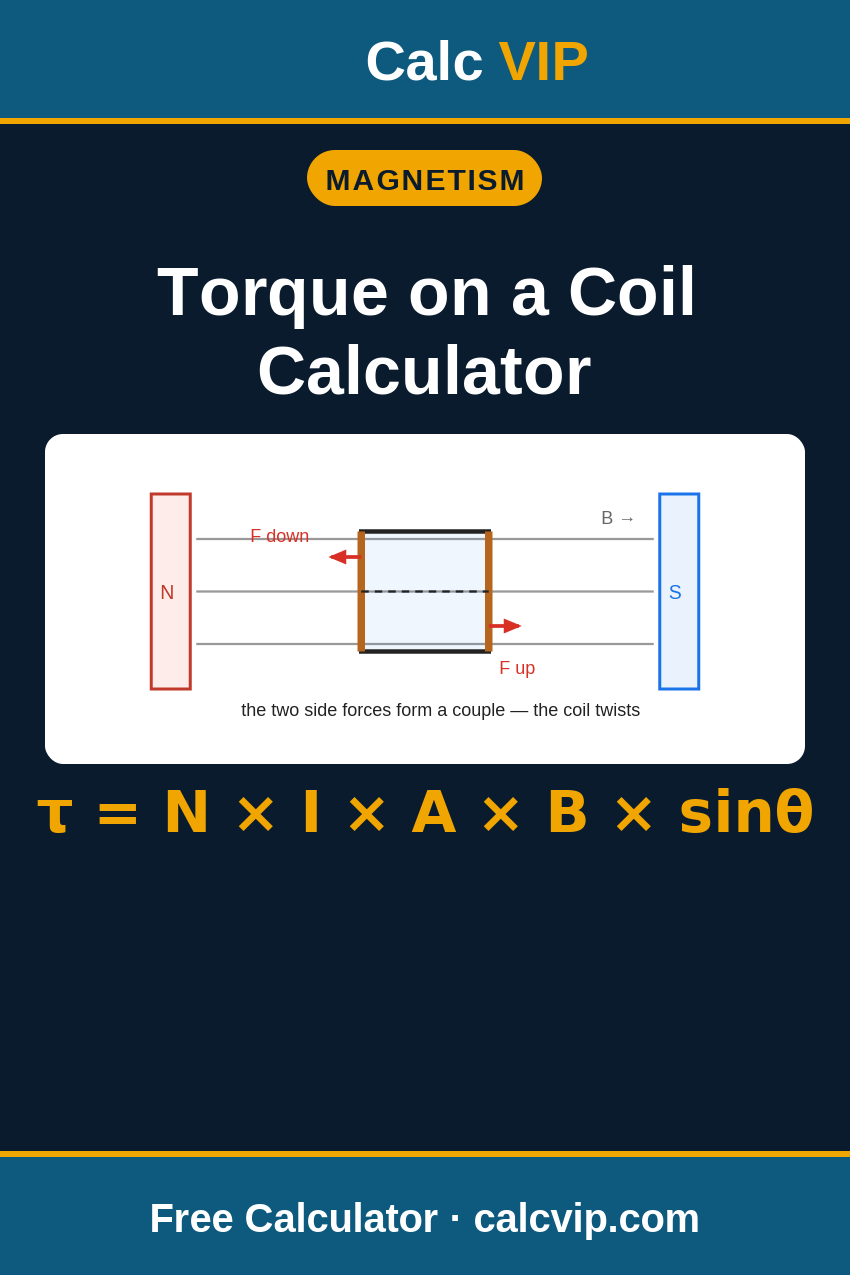
The torque is not a new force; it is the wire force F = BIL wearing a lever. Take Example 1's coil: 50 turns, 2 A, area 0.01 m², in 0.3 T. Suppose the coil is square, 0.1 m × 0.1 m. Each long side, with 0.1 m of wire in the field per turn, feels F = BIL = 0.3 × 2 × 0.1 = 0.06 N per turn — 3 N summed over 50 turns on one side, and 3 N the opposite way on the other side. Two equal, opposite, offset forces make a couple whose torque is force × separation: 3 N × 0.1 m = 0.3 N·m — the calculator's answer, rebuilt from first principles. The top and bottom sides contribute nothing to the turning, because their forces point along the axis; they merely try to stretch the coil, which is why motor windings are braced.
Torque becomes power the moment the coil spins. At 3,000 revolutions per minute — ω = 2π × 50 = 314 rad/s — a coil held at Example 1's peak torque would deliver P = τω = 0.3 × 314 ≈ 94 W, the class of a small power tool. Real motors average less than the peak (the torque undulates with θ through each turn, and the commutator's timing matters), but the estimate explains the family resemblance among motors: to make a 1 kW motor you need roughly ten times the NIAB product, the speed, or some trade between them. It also explains the electric car's party trick — full torque from standstill — because τ = NIAB needs current, not motion. A stationary coil with current in a field is already twisting at full strength; it is the petrol engine, needing revs, that starts from zero.
How to use
- Enter N, the number of turns wound in the coil.
- Enter the current I in amps.
- Enter A, the area of one turn in square metres — for a rectangular coil, length × width of the opening (10 cm × 10 cm = 0.01 m²); for a circular coil, πr².
- Enter the field B in tesla, and θ in degrees — measured between the field and the coil's normal (axis): 90° when the coil's plane lies along the field (maximum torque), 0° when the coil faces the field (no torque).
- Click "Calculate" for the torque in newton-metres. For a motor's average output, remember the torque varies through the turn roughly as sinθ — the peak figure is the ceiling, not the mean.
Worked examples
Example 1 — a healthy small motor coil. A motor coil has 50 turns, area 0.01 m², carries 2 A in a field of 0.3 T, at the maximum-torque position (θ = 90°).
τ = NIAB sinθ = 50 × 2 × 0.01 × 0.3 × 1 = 0.3 N·m.
That is a healthy twist for a small coil — multiply the turns, area or field and the torque grows in proportion.
Example 2 — the same coil at 30°. Half a quarter-turn later, the normal sits at θ = 30° to the field (sinθ = 0.5).
τ = 50 × 2 × 0.01 × 0.3 × 0.5 = 0.15 N·m — exactly half the peak. The sinθ curve is the motor's breathing: torque swells and fades twice per revolution unless the design smooths it.
Example 3 — a model motor. A small DC motor's coil: 200 turns, 0.5 A, area 0.002 m² (20 cm²), field 0.2 T, at θ = 90°.
τ = 200 × 0.5 × 0.002 × 0.2 = 0.04 N·m. Modest — but geared down 50:1 in a model crane or robot arm, it becomes 2 N·m at the output shaft, enough to lift real loads slowly.
Example 4 — a galvanometer's whisper. A moving-coil meter: 100 turns, area 0.0004 m² (4 cm²), field 0.5 T from a permanent magnet, measuring a current of just 0.0001 A (0.1 mA), with radial poles keeping θ = 90°.
τ = 100 × 0.0001 × 0.0004 × 0.5 = 2 × 10⁻⁶ N·m. Two millionths of a newton-metre, turning against a hairspring, moves a pointer across a scale — the sensitivity that made analogue instruments possible.
Example 5 — a beefy coil. An industrial actuator coil: 20 turns of thick wire, 5 A, area 0.05 m², field 0.4 T, θ = 90°.
τ = 20 × 5 × 0.05 × 0.4 = 2 N·m — the twist of a decent screwdriver arm, from a coil you could hold in one hand. Few turns, but every other factor is large: the product is what counts.
Example 6 — the 45° position. Example 1's coil at θ = 45° (sinθ = 0.707).
τ = 0.3 × 0.707 = 0.212 N·m. Between the 30° and 90° values, as the sine curve demands — a useful mid-turn checkpoint when estimating a motor's average torque over a revolution.
Coil torque in real life
DC motors everywhere. From toy cars to cordless drills to the starter that cranks an engine, the DC motor is τ = NIAB plus a commutator. Its torque is available from a standstill and proportional to current, which is why a drill strains audibly — drawing more current — exactly when the screw resists.
Electric vehicles. EV traction motors (usually AC variants playing the same torque game with rotating fields) are specified by this physics: a family car's motor delivers 200–400 N·m. The recipe is Example 5's, industrialised — huge currents, strong fields from permanent magnets, and many effective turns.
Moving-coil meters and galvanometers. Example 4's instrument family measured current for a century before digital displays. The radial-field trick — curved poles keeping the coil's plane always along B, so θ stays at 90° — makes the deflection exactly proportional to I, giving the meter its even, honest scale.
Voice-coil actuators. A hard drive's read head is positioned by a coil in a magnet's field, swinging on a pivot under τ = NIAB control millions of times a day; loudspeaker cones are the linear cousins, driven by F = BIL. Precision torque, microsecond response.
Torque motors and gimbals. Camera gimbals and satellite reaction systems use frameless torque motors — essentially one big coil-and-magnet pair per axis — because τ = NIAB is smooth, cog-free and exactly proportional to current, ideal for holding a lens or a spacecraft steady against disturbances.
Electricity meters of the analogue era. The spinning-disc meter on older houses is an induction variant, but its calibration chain ends at the same truth: electrical quantities converted to a mechanical torque that anyone can watch accumulating, one revolution per fixed ration of energy.
The magnetic moment: a coil is a compass needle you can dial
Group the formula as τ = (NIA) × B sinθ and the bracketed trio — the magnetic moment μ — emerges as the coil's identity card. Example 1's coil has μ = 50 × 2 × 0.01 = 1 A·m². A bar magnet with the same moment feels the same torque in the same field; the coil's advantage is that its moment is adjustable live, from zero to maximum, by a knob controlling I, and reversible by flipping the current. This is why coils steer spacecraft (magnetorquers push against the Earth's field with dial-a-moment coils), why MRI shim coils trim field imperfections, and why the torque formula doubles as the theory of the compass: a compass needle is just a magnetic moment with no wires, settling where τ = μB sinθ falls to zero — pointing along the field.
Quick reference: torque of the Example 1 coil through its turn
| θ (normal to B) | sinθ | Torque τ |
|---|---|---|
| 0° | 0 | 0 N·m |
| 30° | 0.5 | 0.15 N·m |
| 45° | 0.707 | 0.212 N·m |
| 60° | 0.866 | 0.260 N·m |
| 90° | 1 | 0.30 N·m |
Average the sine over the productive half-turn and you get 2/π ≈ 0.64 of the peak — about 0.19 N·m for this coil — the honest figure to carry into power estimates for a simple commutator motor.
Common mistakes
- Measuring θ from the coil's plane. This formula's θ is from the normal. If you take θ from the plane instead, sine and cosine swap: you would predict maximum torque exactly where the true torque is zero. Check against the anchor cases — plane along the field = maximum.
- Entering the area in cm². A must be in m²: 100 cm² is 0.01 m². Entering 100 inflates the torque ten-thousandfold and turns a toy motor into an industrial one on paper only.
- Quoting the peak as the average. τ = NIAB is the θ = 90° ceiling. Through a revolution the torque pulses with sinθ, averaging about 64% of peak in a simple motor — power calculations from the peak alone overpromise by half as much again.
- Forgetting that the force pair needs a separation. Torque is force × distance between the sides. Two coils with equal NIAB but different shapes share this formula's answer — but if you rebuild the result from F = BIL, the lever arm is the coil's width, and dropping it understates the torque by exactly that factor.
- Expecting torque with no current or no field. τ is a product of five factors; zero anywhere means zero torque. A motor that "should" turn but does not has usually lost one factor entirely — an open circuit (I = 0) or a demagnetised field — not a mysterious partial failure.
FAQ
Where does the turning effect come from?
The two long sides of the coil carry current in opposite directions, so the field pushes one side up and the other down (F = BIL on each side). The pair of equal, opposite forces — a couple — spins the coil. The top and bottom sides contribute nothing because their forces act along the axis.
Why doesn't a motor coil stop at the zero-torque position?
It would — so motors use a split-ring commutator that reverses the current every half-turn, just as the coil passes the zero-torque position. The torque then keeps pushing the same way round, and momentum carries the coil through the swap.
How is this used in meters?
In a moving-coil galvanometer the same torque turns the coil against a spring until the two balance; the pointer's deflection is then proportional to the current. Curved (radial) magnet poles keep θ effectively at 90°, making the scale even.
Why does an electric motor draw more current when it is loaded?
A spinning coil generates a back-EMF that opposes the supply, limiting the current. Load the motor and it slows; the back-EMF falls; more current flows; and τ = NIAB rises to meet the load. Stalled completely, the current peaks — which is why stalled motors overheat.
What is the magnetic moment of a coil?
It is the product μ = NIA, in A·m² — the coil's effective strength as a magnet. The torque formula is τ = μB sinθ, identical in form to the torque on a compass needle or bar magnet of the same moment. Bigger μ, stronger twist in the same field.
Does the coil's shape matter — round versus rectangular?
Only through the enclosed area A. A circular coil and a rectangular coil with the same area, turns, current and field feel the same torque. Shape matters for practicalities — how the winding fits the machine — not for the formula.
How do brushless motors manage without a commutator?
Electronics do the commutator's job: sensors (or back-EMF sensing) track the rotor's position and a controller switches the current in the stator coils at the right instants to keep θ near 90°. Same τ = NIAB, with the switching done by transistors instead of sliding contacts — quieter, longer-lived, and standard in everything from drones to EVs.
Can the torque be increased without more current?
Yes — the product has four other doors: more turns, a larger coil area, or a stronger field (better magnets, an iron core, a smaller air gap). Current is the factor that costs heat (I²R in the windings), so good designs usually spend geometry and magnet before amperage.
Why do big motors have many poles?
Each pole pair is another region where coil sides experience the torque-producing arrangement, and multi-pole designs smooth the sinθ ripple, raise torque at low speed and shorten the magnetic paths. The per-coil physics is unchanged — it is this page's couple, tiled around the rim.
What torque does a car's starter motor produce?
Of the order of 10–20 N·m at the motor shaft, from currents of 100–300 A through coils in strong fields — Example 5's 2 N·m scaled by bigger currents, more turns and gearing at the pinion. It is the largest torque-per-kilogram demand in an ordinary car, which is why the starter is built like a winch.