 Calc
Density Calculator – ρ = m/V in kg/m³
 Created by Elena Petrova · Physics Editor · Fluids & Rotation · Last updated: November 2026
Use this free Density Calculator to find how much mass is packed into a volume. Enter the mass and volume, and the calculator gives you the density in kilograms per cubic metre (kg/m³).
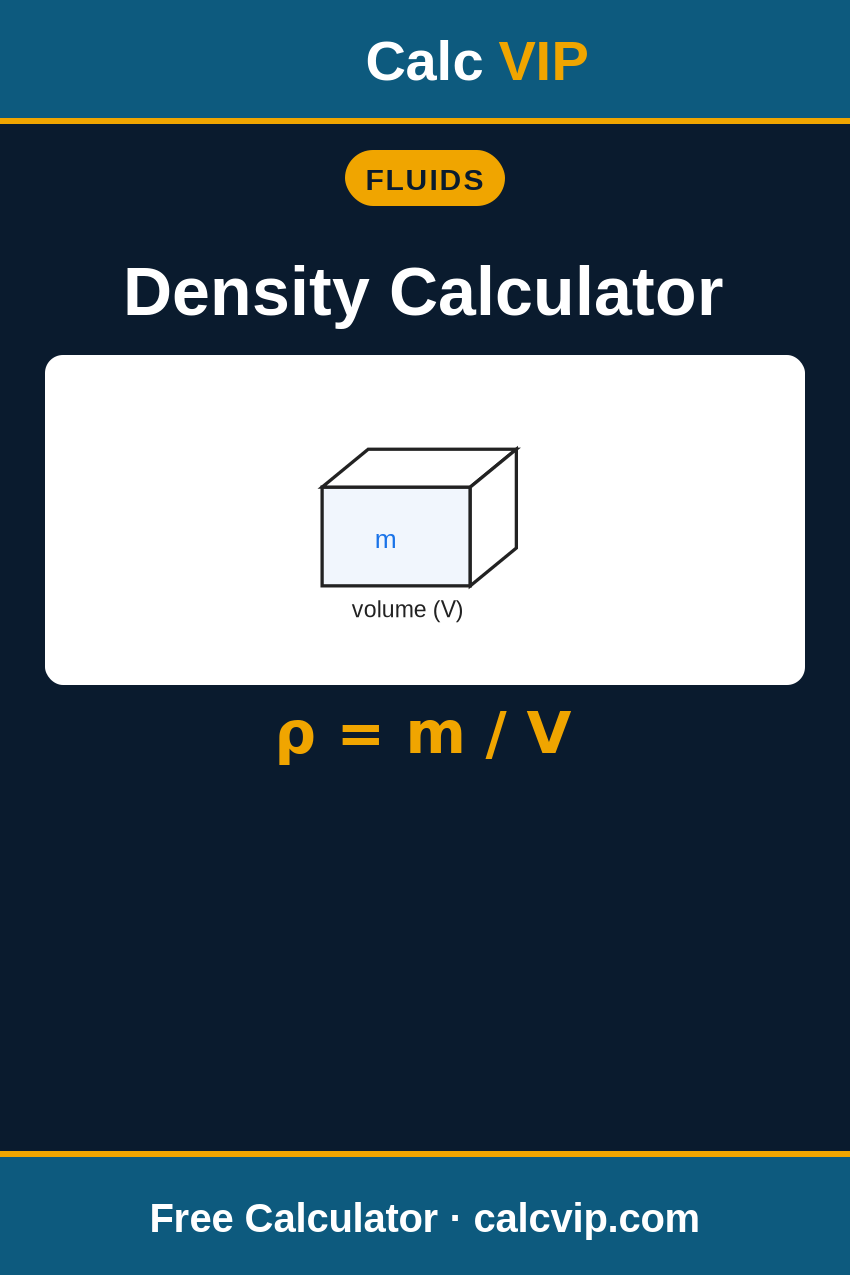
Density is the answer to a deceptively simple question: how tightly is matter packed? Take two boxes of exactly the same size, one filled with feathers and one with lead shot. They occupy identical volumes, yet one is a struggle to lift and the other is not. The difference is density — the mass contained in every unit of volume. It is the property that lets a physicist look at an unknown lump of metal, measure just its mass and its size, and name the metal.
Every pure substance has its own characteristic density at a given temperature, like a fingerprint. Water's is 1000 kg/m³, aluminium's is 2700, gold's is a hefty 19,300. Because the fingerprint is so reliable, density is one of the oldest detective tools in science: it exposes watered-down milk, diluted fuel, fake gold and honey mixed with syrup. If the measured density does not match the claimed substance, something has been added or taken away.
Density also quietly decides what floats and what sinks, why hot air rises, why oil sits on water and why a huge steel ship can cross an ocean while a small steel bolt drops straight to the bottom. Few single numbers explain so much of the everyday world, and all of it starts with one division: mass by volume.
Formula
Density = Mass ÷ Volume → ρ = m / V
Density tells you whether something will float: an object floats in a liquid if its density is less than the liquid's density. Water has a density of 1000 kg/m³. The formula rearranges to find mass or volume. Mass from density: m = ρ × V — a 0.05 m³ block of aluminium (2700 kg/m³) has a mass of 2700 × 0.05 = 135 kg, a serious two-person lift despite its modest size. Volume from density: V = m ÷ ρ — the 45 kg block of the worked example, at 900 kg/m³, occupies 45 ÷ 900 = 0.05 m³, the same answer approached from the other side.
The Greek letter ρ (rho) is density's standard symbol. Notice that density is a property of the material, not the object: a gold ring and a gold bar share the same density, because cutting a sample in half halves its mass and its volume together, leaving the ratio untouched. That invariance is exactly what makes density useful as an identification test.
| Symbol | Meaning | Units |
|---|---|---|
| ρ | density (Greek letter rho) | kg/m³ |
| m | mass | kilograms (kg) |
| V | volume | cubic metres (m³) |
Density and floating
Floating is a density contest. An object placed in a fluid sinks until the weight of fluid it pushes aside equals its own weight — or until it reaches the bottom. If the object's average density is less than the fluid's, it can displace its own weight of fluid while still partly above the surface, so it floats. Ice at 917 kg/m³ floats in water at 1000 kg/m³ with the submerged fraction matching the density ratio: 917 ÷ 1000 = 0.917, so about 92% of an iceberg hides below the waterline — the literal origin of "tip of the iceberg". A steel ship floats for the same reason an iceberg does: hull plus enclosed air gives an average density below water's, even though the steel itself is nearly eight times denser.
How to use
- Enter the mass of the object or material in kilograms (kg).
- Enter its volume in cubic metres (m³).
- Click "Calculate Density" to see the result in kg/m³.
- Working in grams and cm³ instead? The answer in g/cm³ is the kg/m³ value divided by 1000 — water is 1 g/cm³.
Worked examples
Example 1 — an unknown block. A block has a mass of 45 kg and a volume of 0.05 m³. Density = 45 ÷ 0.05 = 900 kg/m³ — about the density of ice or oil, so it would float in water.
Example 2 — testing a "gold" bar. A bar has a mass of 19.3 kg and a volume of exactly 0.001 m³ (one litre). Density = 19.3 ÷ 0.001 = 19,300 kg/m³ — precisely gold's fingerprint, so the bar passes the first test of authenticity. A gold-plated tungsten fake would be harder to catch (tungsten is 19,250 kg/m³), but lead at 11,340 kg/m³ would be exposed instantly.
Example 3 — an aluminium sheet. A sheet has a mass of 5.4 kg and a volume of 0.002 m³. Density = 5.4 ÷ 0.002 = 2700 kg/m³ — aluminium, confirmed without scratching the surface.
Example 5 — how much petrol is that, in litres? A drum holds 40 kg of petrol with density 750 kg/m³. V = m ÷ ρ = 40 ÷ 750 = 0.0533 m³, and since a cubic metre is 1000 litres, that is 53.3 litres. Fuel is sold by volume but burned by mass — density is the exchange rate between the two, and it shifts with temperature, which is why forecourts in hot climates occasionally make the news.
Example 6 — naming a metal from two measurements. A beam has a mass of 15.7 kg and a volume of 0.002 m³. Density = 15.7 ÷ 0.002 = 7850 kg/m³ — steel, to within measurement error. No spark test, no scratching: two weighings and a division identified the material, the same trick as Example 3's aluminium sheet, played on a heavier metal.
Density in real life
Ships and submarines. A submarine steers its average density with ballast tanks: flood them and the average density passes water's, so it dives; blow them empty with compressed air and it rises. Surface ships are designed so that even fully loaded, their average density stays safely below the waterline mark painted on the hull.
Hot air balloons. Heating the air inside a balloon makes it expand, so some air escapes through the mouth and the air that remains is less dense than the cool air outside. The balloon floats because the total mass of the balloon plus its hot air is less than the mass of the same volume of outside air it pushes aside. Pilots climb by heating the air — lowering its density — and descend by letting it cool and grow denser again.
The kitchen and the garage. Oil floats on vinegar in a salad dressing, ice floats in your drink, and a mechanic's hydrometer floats higher or lower in battery acid and coolant to report their condition. Even lava lamps are density theatre: the wax blob, warmed from below, becomes slightly less dense than the surrounding liquid, rises, cools, densifies and sinks again.
Example 4 — how much oil is in the drum? A workshop needs the volume of 18 kg of oil with density 900 kg/m³. V = m ÷ ρ = 18 ÷ 900 = 0.02 m³, which is 20 litres — the rearranged formula doing quiet, practical work.
Helium balloons and the arithmetic of lift. Helium's density is about 0.18 kg/m³ against air's 1.2 kg/m³, so each cubic metre of helium can lift (1.2 − 0.18) ≈ 1.02 kg — balloon skin, string and payload included. A party balloon holds about 0.014 m³, lifting barely 14 grams: that is why it can carry a birthday card but never the cat.
Oil spills and layered drinks. Crude oil, at roughly 900 kg/m³, floats on seawater and spreads into a slick — a disaster, but a recoverable one, because booms and skimmers exploit exactly that density gap. The same layering, made friendly, is the striped cocktail and the salad dressing that separates in the bottle: density sorting, served at table.
Density changes with temperature
Heat a substance and it usually expands: same mass, bigger volume, lower density. This is why hot air and hot water rise through their cooler surroundings, driving everything from sea breezes to the circulation of the oceans. Water breaks the rule in one famous place: it is densest at about 4 °C and expands again as it cools toward freezing, so ice forms at the surface of a lake while the densest 4 °C water sinks to the bottom — where fish spend the winter in liquid water beneath the ice lid. If ice were denser than water, lakes would freeze solid from the bottom up and aquatic life would be impossible in cold climates.
Measuring density in practice
For a regular solid, measure the sides, compute the volume, weigh it, divide. For an irregular solid, use displacement: submerge it and measure the water it pushes aside, the method Archimedes reportedly used to test a king's crown. For liquids, a hydrometer — a weighted float with a scale — sinks until it displaces its own weight of liquid, floating high in dense liquids and low in thin ones; brewers, mechanics and battery technicians read density straight off its stem. Every method is the same formula wearing different clothes: get the mass, get the volume, divide.
A sense of scale: from foams to neutron stars
Everyday densities run from about 1 kg/m\u00b3 for gases up to 22,590 kg/m\u00b3 for osmium, the densest ordinary element \u2014 slightly ahead of iridium and well beyond gold. At the other extreme, aerogels, the lightest engineered solids, can be as low as about 2 kg/m\u00b3: a block the size of a person would have a mass of only a few hundred grams, yet these materials insulate spacecraft. Beyond Earth the scale explodes. The Sun's core is compressed to about 150,000 kg/m\u00b3, a white dwarf star packs roughly a billion kilograms into each cubic metre, and a neutron star reaches around 10\u00b9\u2077 kg/m\u00b3 \u2014 a single teaspoon of it would have a mass comparable to a mountain. The humble division on this page, mass by volume, stretches unbroken from a feather pillow to the densest objects known.
Mixtures, alloys and the density between densities
Mix two materials and the result's density is neither a guess nor a simple average of the two — it is the total mass divided by the total volume, so the ingredient present in greater volume pulls the answer closer. A litre of aluminium (2700 kg/m³) joined to a litre of iron (7870 kg/m³) gives two litres totalling 2.7 + 7.87 = 10.57 kg, a density of 5285 kg/m³ — the plain average, because the volumes were equal. Join a kilogram of each instead and the iron contributes far less volume, dragging the mixture's density below the midpoint.
Alloy makers and brewers both live inside this arithmetic. Brass is copper and zinc blended to a target density as much as to a colour; a hydrometer floating in fermenting beer reads the density falling as sugar becomes alcohol, telling the brewer the strength without a single chemical test. Wherever a mixture's recipe matters, density is the cheapest instrument that can audit it.
Quick reference: densities from air to gold
Water at 1000 kg/m³ is the hinge of the table: everything above it floats on water, everything below it sinks. Read with that rule, the table becomes a prediction machine — ice at 917 floats, iron at 7870 sinks, and a gold bar at 19,300 sinks with total conviction.
| Material | Density |
|---|---|
| air at sea level | ≈ 1.2 kg/m³ |
| petrol | ≈ 750 kg/m³ |
| ice | ≈ 917 kg/m³ |
| water | 1000 kg/m³ |
| aluminium | 2700 kg/m³ |
| steel | ≈ 7850 kg/m³ |
| copper | ≈ 8960 kg/m³ |
| lead | ≈ 11,340 kg/m³ |
| gold | 19,300 kg/m³ |
The hydrometer: density read by floating
The oldest density instrument is a weighted glass float. Placed in a liquid, a hydrometer sinks until it has displaced its own weight of liquid — deep in thin liquids, shallow in dense ones — and the density is read off the stem at the surface line, no division required. Battery testers work exactly this way: a fully charged car battery's acid sits near 1280 kg/m³, a discharged one nearer 1150 kg/m³, and the float's height reports the difference as a state of charge.
Brewers, winemakers and maple-syrup makers all read the same instrument for the same reason: density is a recipe's fingerprint. Sugar solutions are denser than the alcohol they become, brine is denser than the eggs it must float, and in each case a ten-second float reading replaces a laboratory. The formula ρ = m/V is being evaluated by buoyancy itself, continuously and for free.
The iceberg's famous nine-tenths is this formula in a life jacket. Ice at 917 kg/m³ floating in seawater at about 1025 kg/m³ must submerge 917 ÷ 1025 ≈ 89.5% of itself before the displaced water's weight matches its own — so the visible tip really is about a tenth of the whole. In fresh water (1000 kg/m³) the submerged share rises to 91.7%. The fraction is set entirely by the ratio of the two densities, which is why the same berg rides measurably lower as it drifts from the salty sea into a fresh fjord.
Common mistakes
- Mixing grams with cubic metres. kg/m³ needs kilograms and cubic metres together. A mass of 45,000 g in 0.05 m³ is 45 kg ÷ 0.05 m³ = 900 kg/m³ — convert first, then divide.
- Believing heavy means dense. A tonne of feathers is far heavier than a kilogram of lead, yet lead is over a hundred times denser. Density compares equal volumes only.
- Thinking density depends on the amount. A drop of water and a lake of it share the same density. Halving a sample halves mass and volume together.
- Forgetting hollow objects. A sealed empty bottle floats not because plastic is light but because its average density, plastic plus trapped air, is below water's. Crush it full of water and it sinks.
- Measuring a powder's volume by its tub. A tub of flour or sand contains a great deal of trapped air, so mass ÷ tub volume gives the bulk density — useful for shipping, but not the material's density. Comparing it with solid-material tables produces phantom mismatches.
FAQ
What are typical densities?
Water is 1000 kg/m³, ice is about 917 kg/m³, aluminium is 2700 kg/m³, iron is about 7870 kg/m³ and gold is 19,300 kg/m³.
Why does ice float on water?
Ice has a lower density (about 917 kg/m³) than liquid water (1000 kg/m³), so it floats — with about 90% of it below the surface.
How do I find the volume of an irregular object?
Submerge it in water and measure the rise in water level — the rise equals the object's volume. This is the displacement method Archimedes is famous for.
What is the density of air?
About 1.2 kg/m³ at sea level — roughly 800 times less dense than water. It feels like nothing, yet a roomful of it has a mass of tens of kilograms.
How can a steel ship float when steel sinks?
Because floating depends on average density. The ship's hull encloses a large volume of air, so the total mass divided by the total volume comes out below 1000 kg/m³. Fill the hull with water and the average rises — and the ship sinks.
What is relative density (specific gravity)?
The ratio of a substance's density to water's, with no units. Gold's relative density is 19.3, ice's is 0.917. It says at a glance how many times heavier than water a material is, volume for volume.
Does density change if I cut the object in half?
No. Mass and volume both halve, so their ratio — the density — stays exactly the same. Density describes the material, not the piece.
What is the densest ordinary material?
Osmium, at about 22,590 kg/m³ — a litre of it would mass 22.59 kg, like carrying three bowling balls in a milk carton. It is rare and expensive, so lead and tungsten do most of the everyday "very dense" work.
What is the average density of the Earth?
About 5514 kg/m³ — five and a half times water, and nearly twice the density of the rocks at the surface. That single comparison told geologists the core must be metal long before any sample could exist: the surface rocks are too light to average out at 5514 unless something much denser hides below.
Why does a hot-air balloon rise if hot air is still air?
Heating expands the air inside the envelope, so some escapes and the mass remaining occupies the same volume at a lower density — around 0.95 kg/m³ against the cooler 1.2 kg/m³ outside. The density gap, multiplied by a balloon-sized volume, is the lift.