 Calc
Density Solver Calculator – Find Mass or Volume from Density
 Created by Elena Petrova · Physics Editor · Fluids & Rotation · Last updated: November 2026
Use this free Density Solver Calculator to rearrange the density formula. If you know the density and volume, find the mass — or if you know the density and mass, find the volume.
Density is the most informative single number a material has. It tells you whether the material floats, how much a tank of it will weigh, how big a container a shipment needs, and — very often — what the material actually is, since every common substance has a characteristic density that impostors rarely match. But in real problems the density is usually the thing you already know, looked up in a table; the unknown is the mass or the volume. This calculator is the density formula turned around: give it any two of the three quantities and it returns the third.
The three quantities live very different lives. Mass is what scales, cranes and load cells measure, and what structures must ultimately carry. Volume is what tanks, moulds, holds and bottles provide. Density is the exchange rate between them — the property that converts the space something occupies into the load it imposes. A warehouse floor does not care how many cubic metres of oil you store; it cares about the tonnes. A fuel bowser does not care about kilograms; it cares whether the load fits its tank. Almost every practical density problem is a currency conversion between those two points of view.
The numbers involved span a humbling range. A cubic metre of balsa wood weighs about 160 kg; a cubic metre of water, 1000 kg; of concrete, about 2400 kg; of steel, 7850 kg; of gold, 19,300 kg — more than a hundred times the balsa figure for the same box. Gases live far below all of these: a cubic metre of air weighs only about 1.2 kg, which is why gas problems are usually done in grams per litre instead. One formula, m = ρ × V, prices them all, and its two rearrangements — used by everyone from foundry workers to pharmacists — are what this page is for.
Formula
Density ρ = m / V • ρ in kilograms per cubic metre (kg/m³), m in kilograms (kg), V in cubic metres (m³)
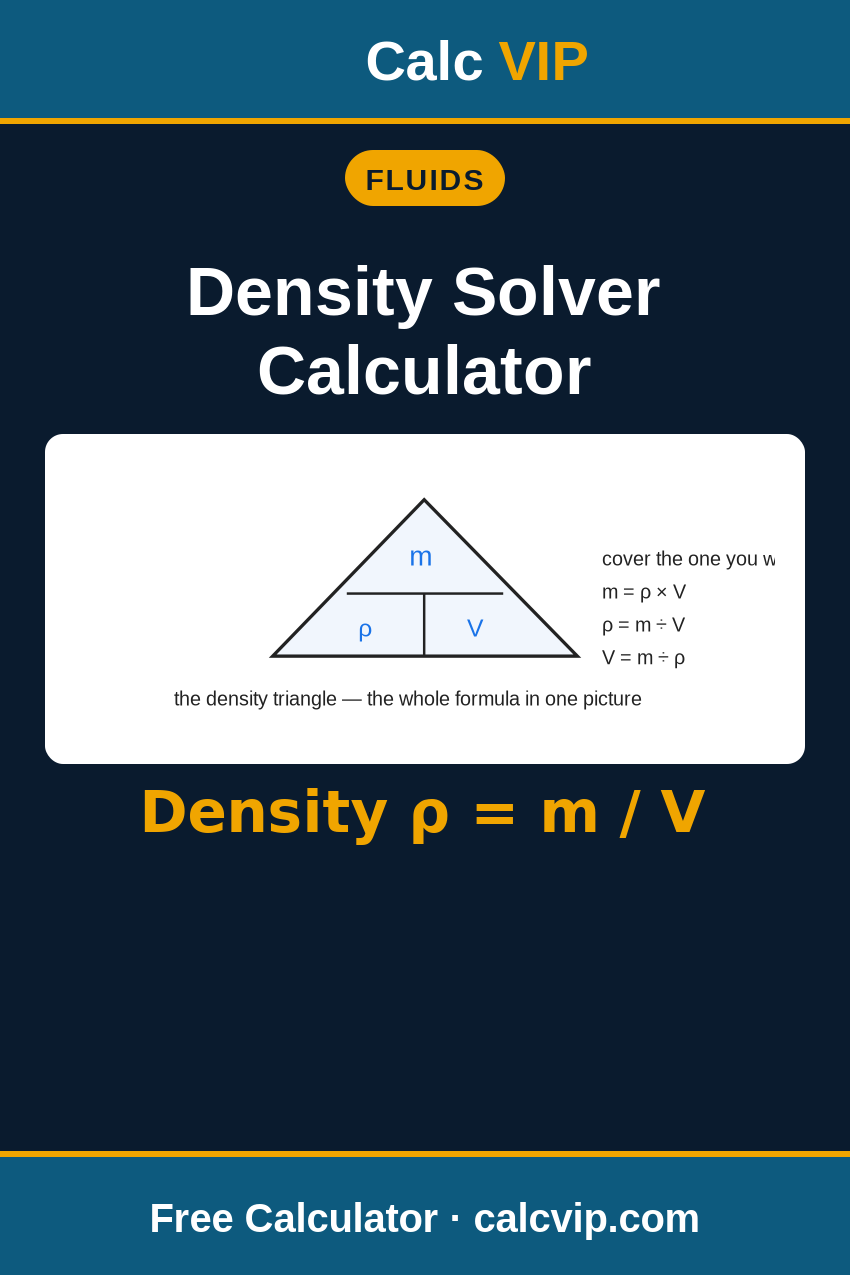
The two rearrangements this calculator performs are m = ρ × V (mass from density and volume) and V = m ÷ ρ (volume from mass and density). The triangle diagram above encodes all three: cover the quantity you want and the positions of the other two show the operation — side by side means multiply, stacked means divide. Unit discipline decides most real errors: volumes quoted in litres must be divided by 1000 to become cubic metres (1 L = 0.001 m³), and densities quoted in g/cm³ must be multiplied by 1000 to become kg/m³. This calculator works throughout in kg, m³ and kg/m³, and helpfully reports large masses in tonnes and small volumes in litres.
| Symbol | Meaning | Units |
|---|---|---|
| ρ | density — mass packed into each cubic metre | kg/m³ (1 g/cm³ = 1000 kg/m³) |
| m | mass | kg (1000 kg = 1 tonne) |
| V | volume | m³ (1 m³ = 1000 litres) |
Density: the material's fingerprint
Density earns its keep as an identifier. Pure substances at a given temperature have fixed densities, so a measurement of mass and volume — the two easiest quantities in physics to measure — becomes a test of identity and purity. Archimedes founded the science on exactly this trick, checking whether a crown was pure gold (19,300 kg/m³) or adulterated with silver (10,490 kg/m³) by comparing weights in air and water. The same logic today catches watered milk, diluted fuel and underweight deliveries: the density is wrong, so something about the material is wrong, and no label can argue with the arithmetic.
Two refinements separate textbook density from the engineer's version. The first is temperature: materials expand as they warm, so density falls — water slides from 1000 kg/m³ at 4 °C to about 958 kg/m³ at 100 °C, and fuel delivered by volume on a hot day carries measurably less mass, which is why bulk fuel is temperature-corrected to a standard 15 °C. The second is packing: the density of a powder, grain or crushed rock is not the density of the solid it is made from, because the heap is part air. "Bulk density" — mass divided by the volume of the heap, air gaps included — is the number that sizes silos and lorries, and it can be barely half the solid density. This calculator uses whatever density you give it; choosing the right one for the material's actual state is the user's half of the bargain.
The fingerprint idea scales all the way up to planets. Astronomers cannot sample a planet, but they can measure its mass (from the orbits of moons or spacecraft) and its volume (from its silhouette), and the ratio is a composition detector: Earth's mean density of 5514 kg/m³ demands a large iron core, the Moon's 3344 kg/m³ says mostly rock with a small core, and Saturn's 687 kg/m³ — less than water — says a world of hydrogen and helium so light it would float in a big enough ocean. The same three quantities, mass, volume and density, that size a fuel tank also read the interiors of worlds.
How to use
- Choose the mode: "Mass (m = ρ × V)" if you know the density and volume, or "Volume (V = m ÷ ρ)" if you know the density and mass.
- Enter the density in kg/m³ — look it up in the quick-reference table below if you are unsure (water 1000, steel 7850, aluminium 2700).
- Enter the volume in cubic metres (litres ÷ 1000) or the mass in kilograms, as the label asks.
- Click "Calculate" to see the result — masses of 1000 kg and up are also shown in tonnes, and volumes are also shown in litres.
Worked examples
Example 1 — the oil tank, checked both ways. Oil has a density of 800 kg/m³. A tank holds 0.25 m³ of it, so the mass is m = 800 × 0.25 = 200 kg. Checking the other way: V = 200 ÷ 800 = 0.25 m³ (250 litres) — the two formulas agree.
Example 2 — a steel plate. A steel plate has a volume of 0.02 m³ (a square metre, 2 cm thick). With steel at 7850 kg/m³: m = 7850 × 0.02 = 157 kg — a two-person lift with proper equipment, not a one-person carry, and the calculation is exactly how fabricators price and rig such plates before they are cut.
Example 3 — a tonne of water. How much space does 1000 kg of water occupy? V = 1000 ÷ 1000 = 1 m³ — a cube one metre on each side, or a 1000-litre tank. This is the anchor fact of the whole subject: the metric system was designed so that water makes the arithmetic trivial.
Example 4 — an aluminium casting. A casting has a volume of 0.05 m³. In aluminium (2700 kg/m³): m = 2700 × 0.05 = 135 kg. Cast the same mould in iron (7870 kg/m³) and it would weigh 393.5 kg — the density ratio of nearly three to one is the entire reason vehicle and aircraft parts are cast in aluminium despite the higher material cost.
Example 5 — sizing a fuel store. A depot must store 5000 kg of petrol (density 737 kg/m³). V = 5000 ÷ 737 ≈ 6.78 m³ — about 6,784 litres, so a nominal 7,000-litre tank with a safety margin is the right purchase. Sizing by mass first is how fuel is actually bought and taxed; sizing the tank is this rearrangement.
Example 6 — a concrete pour. A slab needs 12 m³ of concrete at 2400 kg/m³: m = 2400 × 12 = 28,800 kg = 28.8 tonnes. That figure drives everything downstream — the number of mixer trucks (about four 7-tonne loads), the formwork strength, and the load the ground beneath must bear.
Density solving in real life
Shipping and freight. Carriers charge by whichever is greater — actual mass or volumetric weight — because a lorry can be "full" of feathers long before it is heavy. Density is the deciding number, and V = m ÷ ρ is how dispatchers test whether a load cubes out or weighs out.
Construction ordering. Aggregates, asphalt and concrete are batched by mass but placed by volume. The density conversion runs both ways all day on a building site: tonnes ordered from the volume of the pour, volumes checked from the weighbridge tickets.
Foundry and casting work. A pattern maker knows the mould volume; the founder needs the mass of metal to melt, plus an allowance for the runner system. m = ρ × V with the alloy's density is the first line of every casting estimate.
Aquarium and pond keeping. Water changes, salt dosing for marine tanks and medication are all prescribed per litre, while pumps and stands are rated in kilograms. A 200-litre marine aquarium holds 200 × 1.025 ≈ 205 kg of sea water — before rock, sand and glass are added to the stand's load.
Cooking and food production. Recipes scale by mass, but tins, bottles and moulds are volumes. Batter density near 1100 kg/m³ is why a "500 mL" cake tin takes about 550 g of mix — and why production lines fill by weight while labelling by volume.
Medicine and pharmacy. Syrups and suspensions are dosed by volume (a 5 mL spoon) but manufactured by mass. With a syrup density around 1300 kg/m³, that spoon delivers about 6.5 g of product — the conversion pharmacists check when a dose is specified in milligrams of a liquid preparation.
Bulk density: when the material is part air
Solid density is a property of a substance; bulk density is a property of a substance in a state — poured, crushed, stacked or baled. Grain wheat has a solid density near 1400 kg/m³, but a silo of wheat bulks at about 750–800 kg/m³ because roughly 40% of the silo is air between kernels. Crushed rock bulks around 1500–1600 kg/m³ against a solid 2650; a bale of hay may bulk at only 100–150 kg/m³. Every silo, hopper, tipper lorry and shipping container is sized with the bulk figure, and every year somewhere a structure designed with the solid figure — or vice versa — is overloaded by the difference. When you use this calculator for heaped or packed materials, the density you enter should be the bulk density measured in the same state the material will actually be in.
Mass is not weight — why this calculator works in kilograms
This page solves for mass, in kilograms, and the distinction matters. Mass is the amount of material; weight is the force with which gravity pulls on it, measured in newtons: W = m × g. The 200 kg of oil in Example 1 weighs 200 × 9.81 = 1962 N on Earth. Take the same sealed tank to the Moon and the mass is still 200 kg — the volume is still 0.25 m³, the density is still 800 kg/m³, and this calculator gives exactly the same answers — but the weight falls to 200 × 1.62 = 324 N, because lunar gravity is weaker. Bathroom scales and spring balances measure weight and merely report it as mass, calibrated for Earth's gravity; a beam balance compares masses directly and reads true anywhere. In everyday commerce on Earth the two are used interchangeably and no harm follows, but in physics problems — and anywhere off this planet — density belongs with mass, and confusing them corrupts every step that follows.
Quick reference: densities of common materials
| Material | Density (kg/m³) | Mass of 1 m³ |
|---|---|---|
| air (sea level) | ≈ 1.2 | ≈ 1.2 kg |
| balsa wood | ≈ 160 | 160 kg |
| petrol | ≈ 737 | 737 kg |
| engine oil | ≈ 880 | 880 kg |
| ice | 917 | 917 kg |
| fresh water | 1000 | 1000 kg (1 tonne) |
| sea water | 1025 | 1025 kg |
| honey | ≈ 1420 | 1420 kg |
| concrete | ≈ 2400 | 2400 kg |
| aluminium | 2700 | 2700 kg |
| steel | 7850 | 7850 kg |
| copper | 8960 | 8960 kg |
| lead | 11,340 | 11,340 kg |
| gold | 19,300 | 19,300 kg |
The right-hand column is the table's real gift: it is the answer to "what does a cubic metre of it weigh?" — the question behind every crane lift, floor loading and tank order — obtained by reading m = ρ × V with V set to 1.
Common mistakes
- Entering litres as cubic metres. 250 litres is 0.25 m³, not 250 m³. The slip multiplies the mass by 1000 and has sunk real loading plans; convert litres ÷ 1000 first.
- Using g/cm³ values as kg/m³. A density quoted as 0.8 g/cm³ is 800 kg/m³. Entering 0.8 makes every answer a thousand times too small — the mirror image of the litre mistake.
- Using solid density for heaps and powders. Grain, gravel and powders bulk at far below their solid density because of trapped air. Silos and lorries need the bulk density, measured in the material's actual state.
- Forgetting temperature for liquids. Fuel and oil densities are quoted at a standard temperature (often 15 °C). A tank gauged hot holds less mass than the cold-weather figure suggests.
- Assuming the container is weightless. The calculator gives the contents. Add the tank, drum or bottle itself before checking a floor, a vehicle payload or a courier limit.
FAQ
How do I measure the density of a liquid?
Weigh a known volume of it. For example, if 1 litre (0.001 m³) of the liquid has a mass of 0.8 kg, its density is 0.8 ÷ 0.001 = 800 kg/m³.
What is the density of water in these units?
1000 kg/m³. So 1 m³ of water has a mass of 1000 kg (one tonne), and 500 kg of water takes up 0.5 m³.
Why would I solve for volume?
To size a container or tank: if you must store 2000 kg of a fuel with density 850 kg/m³, you need at least 2000 ÷ 850 ≈ 2.35 m³ of capacity.
How do I find the volume of an irregular object?
By displacement: submerge it in a measuring vessel and read the rise in level — that rise is the object's volume. Divide its mass by that volume and you also have its density, which is the Archimedes test for what the object is made of.
Why does the same material sometimes show different densities?
Temperature and state. Warm liquids are less dense than cold ones; foams, powders and heaps include air and bulk far below the solid value; and alloys vary with composition — "steel" spans roughly 7750–8050 kg/m³ depending on the grade. Use the figure for the material and condition you actually have.
What is the densest and least dense thing I might enter?
At the top, osmium at about 22,600 kg/m³ — a cubic metre would mass 22.6 tonnes. At the bottom, gases: hydrogen at about 0.09 kg/m³, so a cubic metre of it masses less than 100 grams. The formula is indifferent; only the magnitudes change.
Can I use this for gases?
Yes, with the gas density at the actual pressure and temperature — gas density is not a constant the way a solid's is. Air is about 1.2 kg/m³ at sea level, but roughly 0.9 kg/m³ at 3000 m altitude, and it doubles if you double the pressure in a cylinder.
How accurate is the tonnes figure?
It is the same mass divided by 1000, rounded to two decimals — 28,800 kg shows as 28.8 tonnes. Nothing is lost in the conversion; it is a change of clothing, not of content.
What density should I use for wood?
It varies more than almost any other material: balsa ≈ 160 kg/m³, pine ≈ 500, oak ≈ 720, and ebony ≈ 1100 — ebony sinks in water. Moisture content moves any of these figures by tens of percent, so freshly felled ("green") timber is noticeably denser than the kiln-dried values in most tables.
Does this calculator handle hollow objects?
Indirectly: enter the average density — total mass divided by total outer volume. A steel ship floats precisely because its average density, steel shell plus enclosed air, is below 1000 kg/m³, even though the steel itself is 7850.