Calc
Dynamic Viscosity Calculator – η = Shear Stress ÷ Shear Rate
 Created by Elena Petrova · Physics Editor · Fluids & Rotation · Last updated: November 2026
Use this free Dynamic Viscosity Calculator to find how thick or "sticky" a fluid is. Enter the shear stress applied to the fluid and the shear rate (velocity gradient) it produces — the calculator divides one by the other to give the dynamic (absolute) viscosity η.
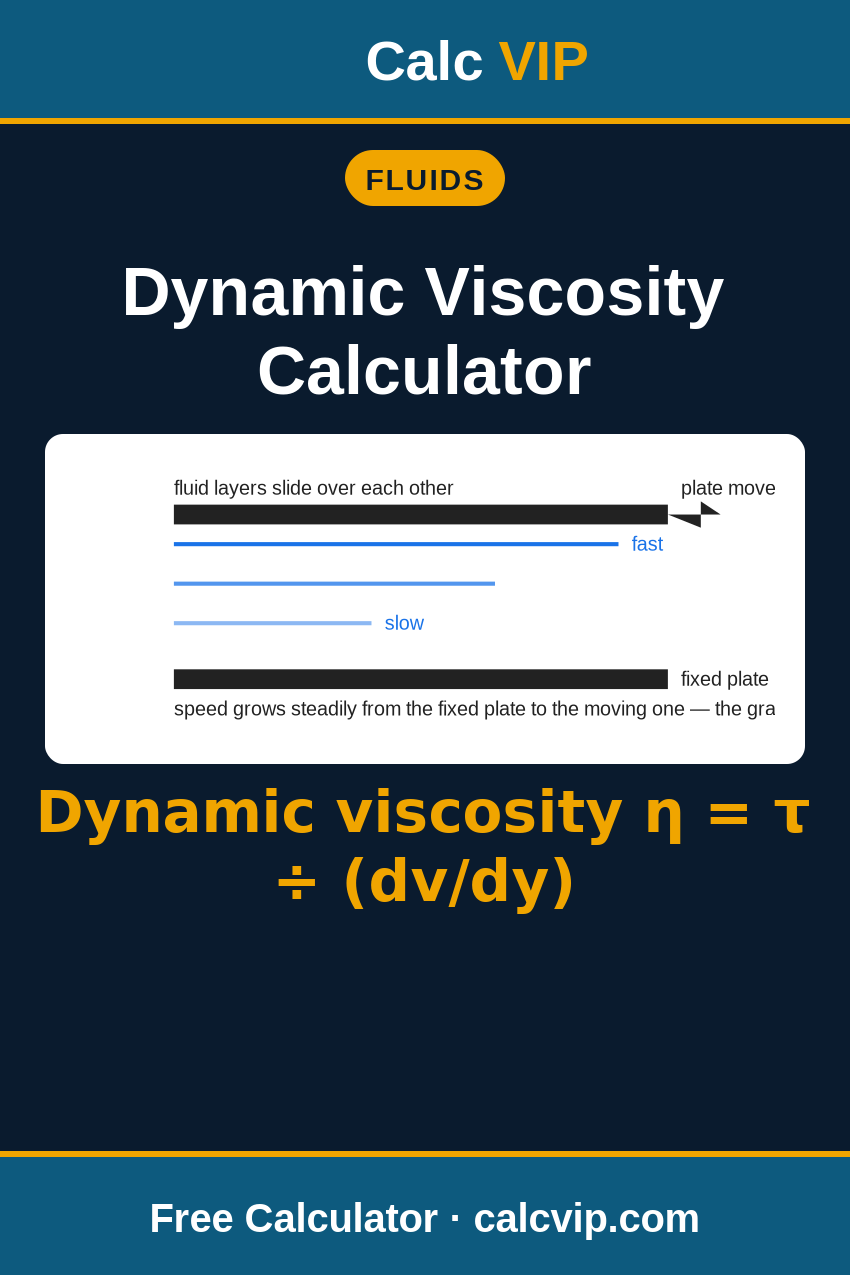
Viscosity is a fluid's internal friction: its resistance to being made to flow. Pour water and pour honey and you feel the difference instantly — honey resists, water does not. Dynamic viscosity, written η (eta) and also called absolute viscosity, turns that everyday impression into a number. It is defined by a simple experiment: sandwich the fluid between two plates, slide the top plate sideways, and measure the force needed. The force per unit area is the shear stress τ; how steeply the fluid's speed changes from the still bottom plate to the moving top one is the shear rate. Divide one by the other and you have η.
The definition matters because it explains what viscosity is not. It is not density — a light oil can be far more viscous than a heavy brine. It is not stickiness to a surface — that is adhesion, a different effect. Dynamic viscosity is purely the price, in stress, that a fluid charges for being sheared at a given rate, and for the great family of "Newtonian" fluids — water, oils, air, syrups — that price is a constant of the material at a given temperature, the same whether you stir gently or hard. This calculator applies Newton's law of viscosity exactly as he wrote it: τ = η × (dv/dy).
The range of the number is staggering. Air's dynamic viscosity is about 0.000018 Pa·s; water's is 0.001 Pa·s; a typical engine oil sits near 0.2 Pa·s; glycerin is 1.41 Pa·s; honey can reach 10 Pa·s; and pitch — the famous "solid" that drips in the Queensland experiment — is around 10⁸ Pa·s, yet still a fluid by this definition, because given years it does shear and flow. One formula spans all of them, which is why η appears everywhere from bearing design to blood-flow medicine: wherever a fluid is pushed, dragged or pumped, the dynamic viscosity sets the forces.
Formula
Dynamic viscosity η = τ ÷ (dv/dy) • η in pascal-seconds (Pa·s), τ in pascals (Pa), dv/dy in reciprocal seconds (1/s)
Newton's law of viscosity rearranges both ways: τ = η × (dv/dy) if you know the viscosity and want the stress a flow will exert — the form used for drag on pipes and bearings — and dv/dy = τ ÷ η if you know the stress and want the shear rate it produces. The shear rate dv/dy is the velocity difference between neighbouring layers divided by their separation: a layer moving 0.1 m/s faster than another 1 mm away gives dv/dy = 0.1 ÷ 0.001 = 100 1/s. Unit discipline is the main trap: 1 Pa·s = 1000 mPa·s, and because 1 mPa·s equals exactly 1 centipoise (cP), the calculator reports both — water at 20 °C, at almost exactly 1 cP, is the reference everyone calibrates against. The older poise is bigger: 1 Pa·s = 10 P.
| Symbol | Meaning | Units |
|---|---|---|
| η | dynamic (absolute) viscosity | Pa·s (also mPa·s = cP) |
| τ | shear stress — sideways force per unit area | Pa (N/m²) |
| dv/dy | shear rate — velocity gradient across the flow | 1/s (s⁻¹) |
What viscosity really is: friction between layers
Picture the fluid as a deck of cards. Push the top card and it drags the one beneath it, which drags the next, each moving a little slower than the one above. The drag between cards is viscosity. At the molecular level two things create it: in liquids, molecules cling to each other and must be torn past their neighbours; in gases, fast molecules wander between layers and exchange momentum. That difference explains the opposite temperature behaviour flagged in the FAQ below — heating a liquid loosens the clinging, so it thins; heating a gas makes its molecules wander more vigorously, so it thickens slightly.
The constant-η picture — stress exactly proportional to shear rate — defines a Newtonian fluid, and most simple fluids obey it well. But some of the most interesting fluids do not. Ketchup and paint are shear-thinning: stir or shake them and their effective viscosity collapses, which is why ketchup sulks in the bottle then floods the plate. Cornflour paste is shear-thickening: punch it and it fights back like a solid. Blood sits in between, thinning as it flows faster. For such fluids this calculator still returns a number — the apparent viscosity at the shear rate you entered — but the number is only valid at that rate, and quoting the shear rate alongside it is essential.
How to use
- Enter the shear stress τ in pascals — the sideways force per square metre applied to the fluid (force in newtons divided by the area it acts over, in m²).
- Enter the shear rate dv/dy in 1/s — the velocity difference between layers (m/s) divided by the gap between them (m).
- Click "Calculate" to see the dynamic viscosity in Pa·s and in mPa·s (numerically equal to centipoise).
- Sanity-check against water: a fluid sheared at 100 1/s by a stress of 0.1 Pa should return 0.001 Pa·s = 1 mPa·s. If your result is a thousand times bigger or smaller, a unit prefix has slipped.
Worked examples
Example 1 — the reference measurement. A viscometer applies a shear stress of 50 Pa and the fluid shears at 100 1/s.
η = τ ÷ (dv/dy) = 50 ÷ 100 = 0.5 Pa·s = 500 mPa·s — about the thickness of a light syrup or a heavy olive oil blend.
Example 2 — water. Water sheared gently, τ = 0.1 Pa at 100 1/s: η = 0.1 ÷ 100 = 0.001 Pa·s = 1 mPa·s. This is the anchor value of the whole subject: water at 20 °C is 1.002 cP, close enough to 1 that the centipoise was practically built around it.
Example 3 — honey. Honey resists pouring: at a shear rate of only 20 1/s it needs a stress of 200 Pa.
η = 200 ÷ 20 = 10 Pa·s = 10,000 mPa·s — ten thousand times water, which is why honey crawls off the spoon while water leaps.
Example 4 — engine oil. A warm engine oil under a stress of 30 Pa shears at 150 1/s: η = 30 ÷ 150 = 0.2 Pa·s = 200 mPa·s. That is the working thickness that keeps a film between piston and cylinder wall; cold, the same oil can be ten times thicker, which is why winter cranking is sluggish.
Example 5 — glycerin. τ = 141 Pa at 100 1/s: η = 141 ÷ 100 = 1.41 Pa·s = 1,410 mPa·s. Glycerin's syrupy pour and its use in damping gauges and slow-motion demonstration tanks both come from this figure.
Example 6 — blood. Blood at a shear rate of 100 1/s under a stress of 0.35 Pa: η = 0.35 ÷ 100 = 0.0035 Pa·s = 3.5 mPa·s. Only three and a half times water — a deliberate evolutionary compromise, thick enough to carry cells, thin enough for the heart to pump through capillaries.
Dynamic viscosity in real life
Engine oil grades. The "30" in a 10W-30 oil is a viscosity promise at working temperature, and the "10W" a promise about cold flow. Both are η measurements under standard shear — engines are designed around a viscosity window, too thin and metal touches metal, too thick and power is wasted churning oil.
Paint and spraying. Paint must be thick at rest (so it does not sag on the wall) and thin under the brush or spray gun (so it levels smooth). That is engineered shear-thinning, and quality control measures the apparent viscosity at several shear rates with exactly this division.
Food processing. Ketchup, yoghurt, chocolate and dough all have viscosity specifications; a chocolate enrobing line, for instance, holds its coating thickness by holding η constant to a few percent, adjusting temperature minute by minute.
Medicine. Blood viscosity rises with haematocrit and in several diseases; an abnormally high η means the heart works harder for the same flow, and clinicians measure it with the same stress-over-rate principle.
Pumping and pipelines. The pressure needed to push a fluid through a pipe grows in direct proportion to η for laminar flow — double the viscosity, double the pumping bill. Pipeline engineers heating heavy crude are buying a lower η with fuel.
Glacier and lava flows. Ice and molten rock obey the same law at enormous viscosities and geological shear rates; the flow speed of a lava stream is forecast from its measured η just as surely as the flow of oil in a bearing.
Temperature: the hidden variable in every viscosity
No property of a common liquid changes faster with temperature than viscosity. Water falls from 1.79 mPa·s at 0 °C to 1.00 at 20 °C and 0.28 at 100 °C; a typical engine oil can thin a hundredfold between a frosty start and full operating temperature. The fall is roughly exponential (the Andrade relation, η ∝ e^(B/T)), which is why a single "the viscosity of oil" figure is meaningless without its temperature — every serious datasheet quotes η at stated temperatures, and every careful measurement in this calculator's spirit controls the bath to a fraction of a degree. Gases run the other way, thickening gently as they heat (air rises about 25% between 0 °C and 100 °C), because their viscosity comes from molecular traffic, which speeds up when hot.
Quick reference: dynamic viscosity of common fluids at 20 °C
| Fluid | η (Pa·s) | η (mPa·s = cP) |
|---|---|---|
| air | 0.000018 | 0.018 |
| water | 0.001 | 1 |
| blood | 0.0035 | 3.5 |
| olive oil | 0.056 | 56 |
| engine oil (warm) | 0.2 | 200 |
| glycerin | 1.41 | 1,410 |
| honey | ~10 | ~10,000 |
Read the table as a ladder of effort: every factor of ten is a fluid that takes roughly ten times the stress to shear at the same rate — or shears ten times more slowly under the same stress.
How η is actually measured: four instruments
The definition τ ÷ (dv/dy) is honoured by four families of instrument, each dominant somewhere. The rotational viscometer is the definition mechanised — a spindle or cup turns at a known rate and the torque is read; it alone can sweep shear rates and expose non-Newtonian behaviour, so it rules paint, food and polymer labs. The capillary (Ostwald) viscometer times a gravity drain through a fine tube; because gravity drives it through the density, it natively measures kinematic viscosity ν, and η follows by multiplying by ρ. The falling-ball viscometer times a sphere sinking at its terminal speed and inverts Stokes' law: a 1 mm-radius steel ball (ρ = 7,800 kg/m³) in glycerin (η = 1.41 Pa·s, ρ = 1,260) sinks at v = 2r²g(ρball − ρfluid) ÷ 9η = 0.0101 m/s — a stately 10 mm/s that a stopwatch can time beautifully, which is the point. And the vibrational viscometer, a tuning-fork probe whose damping is read electronically, gives instant in-line readings in process plants. Four machines, one division — the calculator's — dressed for four different workplaces.
Inside a bearing: the extreme shear rates of real machines
The gentle shear rates of the worked examples (20–150 1/s) are a laboratory luxury. Inside a journal bearing, a shaft surface moving at 5 m/s drags oil across a film only 0.05 mm thick: the shear rate is 5 ÷ 0.00005 = 100,000 1/s, and with a warm oil of η = 0.2 Pa·s the shear stress in the film is τ = η × dv/dy = 0.2 × 100,000 = 20,000 Pa. That stress, acting over the bearing's area, is the friction the engine pays for its oil film — and the heat it must reject. It is also why engine oils are specified with a high-shear viscosity measured near a million reciprocal seconds: an oil that is honestly 0.2 Pa·s at viscometer rates may shear-thin to less in the bearing, and the number that protects the metal is the one measured where the metal lives. Newton's division still governs — but it must be evaluated at the machine's own shear rate, a lesson this whole page has been quietly teaching.
The bearing's bill is easy to total from those numbers: a film stress of 20,000 Pa over a modest bearing area of 0.01 m² is a friction force of 200 N, and at a surface speed of 5 m/s that is 200 × 5 = 1,000 W of power turned into heat in one bearing — a kettle's worth, which the oil must carry away or cook. Viscosity is never an abstraction where metal spins.
Common mistakes
- Confusing dynamic with kinematic viscosity. η (Pa·s) and ν (m²/s) differ by the density: ν = η/ρ. Using one where a formula wants the other is the commonest viscosity error in engineering — check which symbol the formula carries.
- Mixing poise and pascal-seconds. 1 Pa·s = 10 P, and 1 cP = 1 mPa·s exactly. Reading a value in poise as if it were Pa·s understates the viscosity tenfold.
- Quoting a viscosity without its temperature. A liquid's η can halve over a 20 °C rise. A number with no temperature attached is half a measurement.
- Assuming every fluid is Newtonian. For ketchup, blood, paints and pastes, η depends on the shear rate. A single division gives the apparent viscosity at that rate only — say which rate.
- Computing the shear rate from the wrong gap. dv/dy needs the velocity difference divided by the layer separation in metres. Using the full speed of a plate over a gap quoted in millimetres, unconverted, inflates the rate a thousandfold.
FAQ
What are the units of dynamic viscosity?
The SI unit is the pascal-second (Pa·s). You will also meet the poise (1 Pa·s = 10 P) and the centipoise: 1 mPa·s = 1 cP, which is handy because water at 20 °C is almost exactly 1 cP (0.001 Pa·s).
What is the difference between dynamic and kinematic viscosity?
Dynamic viscosity η measures resistance to shearing. Kinematic viscosity ν = η/ρ also accounts for the fluid's density, so it describes how fast the fluid itself flows under gravity.
Does temperature change dynamic viscosity?
Yes. Liquids get thinner when heated (hot oil flows far more easily than cold oil), while gases get slightly more viscous as they heat up.
How is dynamic viscosity measured in practice?
Most directly with a rotational viscometer: a spindle turns in the fluid at a set speed, the instrument measures the torque (stress) needed, and divides by the shear rate — this calculator, mechanised. Capillary and falling-ball instruments infer η from flow time or sinking speed instead.
What is a Newtonian fluid?
One whose viscosity is the same at every shear rate — water, air, simple oils and syrups. Its stress-versus-rate graph is a straight line through the origin, and a single η describes it completely at a given temperature.
Why does honey flow so slowly if it is not much denser than water?
Because density is not the obstacle — internal friction is. Honey's η is about 10,000 times water's while its density is only 1.4 times greater. Pouring is a shearing motion, and shearing is exactly what η resists.
What is the viscosity of air?
About 0.000018 Pa·s (0.018 mPa·s) at room temperature — roughly 55 times less than water. Tiny, but not zero: it is what makes drag on a moving car, and the lift on a wing, possible at all.
Can a fluid have zero viscosity?
Only one known substance manages it: liquid helium below 2.17 K becomes a superfluid that flows without any measurable friction. Every ordinary fluid has some η — even gases, whose viscosity is small but real.
Does pressure change viscosity?
Barely, for most liquids at everyday pressures — a few percent over hundreds of atmospheres. It matters in two extreme places: deep oil reservoirs and the crushing contact inside gear teeth, where pressures are so high that oil can thicken dramatically and even behave almost like a solid.
Why do motor oils carry two numbers, like 10W-30?
Because one number cannot describe a fluid whose η changes so much with temperature. The first number rates its cold ("W" for winter) flow, the second its viscosity at engine temperature; polymer additives flatten the temperature curve so one oil can satisfy both.