 Calc
Hydraulic Lift Calculator – Force Multiplication & Distance Trade-off
 Created by Elena Petrova · Physics Editor · Fluids & Rotation · Last updated: November 2026
Use this free Hydraulic Lift Calculator to see how a hydraulic jack or car lift multiplies force. A small force on a small piston creates the same pressure throughout the fluid, which pushes a large piston up with a much bigger force — but through a smaller distance.
Here is the closest thing in engineering to a free lunch that is not one. Push on a small piston with a modest force — 100 N, a firm hand-push — and a connected large piston rises with 2000 N, enough to lift a grand piano. No motor, no gears, no electronics: just liquid in a sealed system and Blaise Pascal's seventeenth-century insight that pressure applied to a confined fluid is transmitted undiminished in every direction. The force multiplication is real, and it powers car lifts, hydraulic jacks, excavators, aircraft controls and the brakes of nearly every vehicle on Earth.
The catch is written into the same physics, and this calculator refuses to hide it: the large piston moves proportionally less than the small one. Push the small piston down 40 cm and the load rises 2 cm. Force is multiplied by the area ratio; distance is divided by the same ratio; the product — the work, the energy — is unchanged (minus a little friction). A hydraulic lift is a lever made of liquid, trading travel for force at whatever ratio the piston areas dictate, and like a lever it creates nothing. What it creates is convenience: force exactly where you want it, in whatever direction the hose bends, controlled by a fingertip.
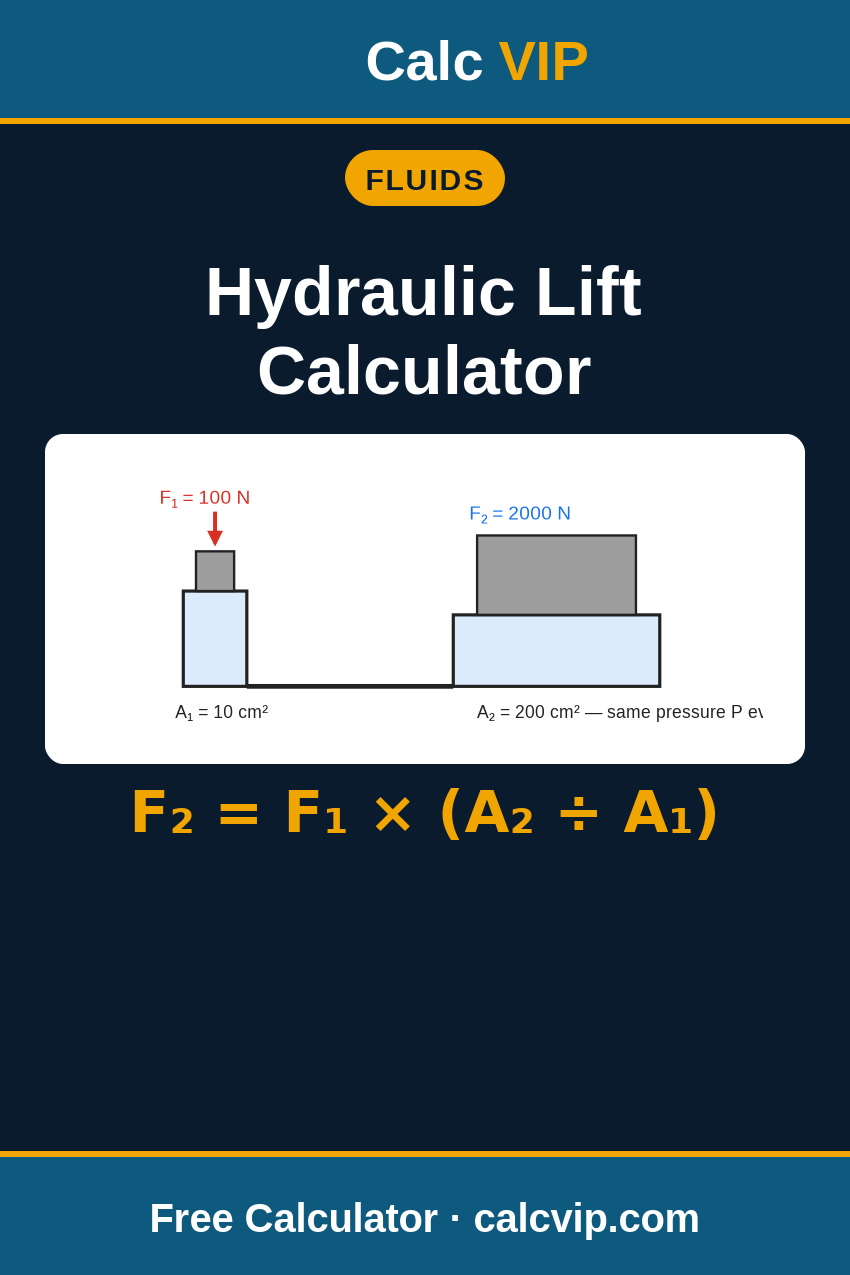
This calculator evaluates the whole bargain from four inputs — input force, the two piston areas, and the input travel. It returns the output force, the pressure the fluid and seals must withstand, and the output travel, so both halves of the trade are on the page before any metal is cut. Try the numbers of a real car lift or a bottle jack and you will find the same arithmetic looking back at you.
Formula
Pascal's law applied P = F₁ ÷ A₁ = F₂ ÷ A₂ → F₂ = F₁ × (A₂ ÷ A₁) • forces in newtons (N), areas in the same unit as each other, P in pascals when areas are in m²
The distance trade-off is the same ratio inverted: d₂ = d₁ × (A₁ ÷ A₂), because the liquid is incompressible — the volume the small piston sweeps, A₁ × d₁, must equal the volume the large piston gains, A₂ × d₂. Multiply the two headline results together and the ratio cancels: F₂ × d₂ = F₁ × d₁, work in equals work out, the conservation of energy auditing Pascal's law and finding it honest. In the worked example: 100 N × 0.40 m = 40 J in; 2000 N × 0.02 m = 40 J out. This calculator takes areas in cm² (the size pistons are actually specified in), converts to m² for the pressure, and reports F₂ in newtons, the pressure in kPa, and d₂ in cm.
| Symbol | Meaning | Units |
|---|---|---|
| F₁, F₂ | input and output forces | N |
| A₁, A₂ | small and large piston areas | cm² in the calculator (1 cm² = 10⁻⁴ m²) |
| d₁, d₂ | piston travels | cm |
| P | pressure in the fluid — the same at both pistons | Pa (calculator reports kPa) |
Pascal's law: pressure is the messenger
The deep idea is that the pistons never touch. The small piston's job is not to push the large one but to pressurise the fluid; the fluid then pushes on everything it touches — both pistons, the cylinder walls, the seals — with that same pressure, force per unit area. The large piston collects more total force simply because it presents more area to be pushed on, exactly as a wide sail collects more wind than a narrow one at the same wind pressure. This is why hydraulics route so freely: the messenger is pressure, and pressure travels around corners, along hoses, up and down, arriving undiminished (in a static system) wherever the fluid reaches. One pump can feed a dozen actuators at different heights and angles, each drawing force in proportion to its own piston area — a flexibility no shaft, chain or linkage can match. A practical corollary: one pressure gauge fitted anywhere in a static circuit speaks for the whole system, which is why hydraulic troubleshooting so often begins with a single gauge and the arithmetic on this page.
Why liquid, and why oil in particular? Because the whole bookkeeping — A₁d₁ = A₂d₂ — rests on the fluid keeping its volume, and liquids are magnificently incompressible: squeeze hydraulic oil to 300 bar and it shrinks by barely a percent or two. (Air, the pneumatic alternative, compresses eagerly, which makes air systems springy and imprecise but also forgiving and fast — the right trade for tools, the wrong one for lifting a car.) Oil adds lubrication for the seals and pumps, rust protection, and stability across temperatures. Its enemies are contamination and heat: grit scores the polished surfaces the seals depend on, and sustained overload work — pressure × flow with nowhere to go — cooks the oil through relief valves, which is why real systems are sized with the pressure figure this calculator reports, not merely the force.
How to use
- Enter the input force F₁ in newtons (a firm hand push is 50–150 N; a person's full bodyweight lean is several hundred).
- Enter the small piston area A₁ and the large piston area A₂, both in cm². For a round piston, A = π × (diameter ÷ 2)².
- Enter the small piston's travel d₁ in centimetres — for a pumped jack, the total travel summed over all the strokes.
- Click "Calculate Lift Force" to see the output force F₂, the fluid pressure in kPa (what the seals and hoses must be rated for), and the load's rise d₂.
- Sanity-check the bargain: F₂ ÷ F₁ should equal A₂ ÷ A₁, and d₂ should shrink by the same factor. If the lift is too slow, the cure is a bigger pump flow, not a bigger ratio.
Worked examples
Example 1 — the demonstration lift. You push with 100 N on a piston of 10 cm²; the lift piston has an area of 200 cm². The pressure is 100 ÷ 0.001 = 100 kPa, and F₂ = 100 × (200 ÷ 10) = 2000 N — enough to lift a 200 kg mass. The trade-off: pushing your piston down 40 cm raises the load by only 40 × (10 ÷ 200) = 2 cm.
Example 2 — a car lift. A mechanic leans 400 N onto a pump piston of 5 cm² driving a lift piston of 500 cm². Pressure = 400 ÷ 0.0005 = 800 kPa; F₂ = 400 × (500 ÷ 5) = 40,000 N — the weight of about 4.08 tonnes, a family car with margin. The price: 100 cm of total pump travel raises the car just 100 × (5 ÷ 500) = 1 cm, which is why real lifts use a motor-driven pump making thousands of small strokes.
Example 3 — hydraulic brakes. A driver's foot applies 200 N to the pedal; the pedal lever multiplies it about fourfold to 800 N on a master-cylinder piston of 3 cm². Pressure = 800 ÷ 0.0003 ≈ 2667 kPa. At a brake caliper piston of 12 cm², the clamping force is 800 × (12 ÷ 3) = 3200 N per piston — from a foot, through a lever, through a liquid, to a force that can stop two tonnes of car. (Enter F₁ = 800, A₁ = 3, A₂ = 12 in the calculator to see it.)
Example 4 — a workshop press. A press has an area ratio of 100:1. A pump force of 250 N becomes 25,000 N at the ram — 2.5 tonnes of pressing force for bearings, bushings and broaching, delivered slowly and controllably, with the ram creeping a hundredth as far as the pump handle travels. Slowness here is not a defect; it is the control that makes pressing safe.
Example 5 — checking the energy audit. Take Example 2's numbers over the full lift: the mechanic's pump sweeps 100 cm × 5 cm² = 500 cm³ of oil; the lift piston gains 500 cm³ ÷ 500 cm² = 1 cm of rise. Work in: 400 N × 1 m = 400 J. Work out: 40,000 N × 0.01 m = 400 J. The books balance to the joule — Pascal's law multiplies force, never energy, and any design that seems to promise otherwise has an error in it.
Example 6 — an excavator cylinder. A hydraulic pump supplies oil at 20,000 kPa (200 bar, typical plant pressure) to a cylinder of 80 cm². Working backwards from the pressure: the force is P × A = 20,000,000 × 0.008 = 160,000 N — sixteen tonnes of push from a piston the size of a saucer. High pressure is the excavator's secret: at 200 bar, modest cylinders wield enormous forces, which is why hydraulic power, not engine size, is what a digger's specification really advertises.
Hydraulics in real life
Car lifts and bottle jacks. The two-post lift in every workshop and the bottle jack in many boots are this page with paint on: a small pump piston, a large lift piston, ratios of 50–200, and a release valve that lets the pressure — and the load — down gently.
Brakes and clutches. Every hydraulic brake system is a force multiplier with a safety obsession: the pedal's modest force becomes tonnes of clamping, split between circuits so a single leak cannot take all four wheels. The spongy pedal of a car with air in the lines is Pascal's law reporting a compressible intruder.
Earth-moving machinery. Excavators, loaders and bulldozers are hydraulic animals: one engine-driven pump, pressures of 200–350 bar, and cylinders at every joint. The operator's feather-light joystick movements are amplified into forces that tear rock — the largest force multiplication most people will ever personally command.
Aircraft controls. Airliner control surfaces face aerodynamic loads no pilot's arm could move. Hydraulic actuators at 200+ bar move them, with two or three independent systems in parallel — the same piston arithmetic, engineered so that no single failure can silence it.
Hydraulic presses and shears. From the 25,000 N workshop press of Example 4 to forging presses of 100,000 tonnes, the principle scales without changing its character: pressure times area, distance divided, energy conserved.
The human body. Your cardiovascular system is not a force multiplier, but it runs on Pascal's principle: the pressure the heart generates is transmitted through the blood to every capillary, which is why a pressure measured at the arm speaks for the whole circuit — and why the sphygmomanometer works at all.
Quick reference: what pressures do real systems use?
| System | Typical pressure | Note |
|---|---|---|
| this page's Example 1 | 100 kPa (1 bar) | a gentle hand system |
| car brake lines | up to ≈ 10,000 kPa (100 bar) | in a panic stop |
| bottle jack (10-tonne) | tens of MPa | small piston, huge ratio |
| excavators & loaders | 20,000–35,000 kPa | 200–350 bar |
| aircraft hydraulics | ≈ 21,000 kPa (3000 psi) | newer types run higher still |
| waterjet cutters | up to ≈ 400,000 kPa | 4000 bar — cuts steel with water |
The pattern across the table: as the required force per kilogram of machine rises, so does the pressure — because force is pressure × area, and pressure is the cheaper of the two to increase. Seals, hoses and safety factors are what the pressure costs; this calculator's kPa figure is where that costing starts.
Common mistakes
- Believing the energy is multiplied too. It is not: F₂ × d₂ = F₁ × d₁. A design that lifts a heavy load and lifts it far on little input work is a perpetual-motion claim, not a hydraulic one.
- Mixing cm² and m² in the pressure. Force ÷ area gives pascals only with the area in m². 100 N on 10 cm² is 100,000 Pa, not 10 — the calculator converts; notebooks must too.
- Using diameters as areas. The ratio needs areas. Two pistons of diameter 4 cm and 20 cm have an area ratio of 25, not 5 — areas grow with the square of diameter, and lifts designed on the diameter ratio underperform fivefold.
- Ignoring the pressure rating. The force may be achievable while the pressure is not safe: a huge ratio on a small piston generates enormous pressure in seals and hoses. Check the kPa figure against the components' ratings, not just the newtons against the load.
- Expecting speed from a force ratio. A hand pump moving a 100:1 lift raises the load 1 cm per metre of handle travel. Real systems solve this with powered pumps and flow, not with wishful ratios — power, pressure × flow, is the quantity that sets speed.
FAQ
Does a hydraulic lift create energy from nothing?
No. The output force is bigger, but the output piston moves a proportionally smaller distance, so force × distance (the work) is the same on both sides, minus small friction losses.
Where are hydraulics used?
Car lifts and jacks, hydraulic brakes, excavator arms, aircraft controls and presses — anywhere a large, controllable force is needed from a small input.
Why use liquid instead of air?
Liquids are nearly incompressible, so the pressure is transmitted instantly and the volume trade-off is exact. Air compresses, which would make the lift spongy and waste the input movement.
How is a hydraulic lift like a lever?
Exactly, in accounting: a lever multiplies force by the ratio of its arms and divides the movement by the same ratio. The hydraulic version replaces the rigid bar with pressurised liquid, so the "arms" are piston areas and the pivot is everywhere the fluid reaches — the force can be delivered around corners and at a distance.
What limits the force a real system can produce?
The pressure the pump, seals, hoses and cylinder walls can safely withstand, times the piston area. Industrial systems standardise around 200–350 bar because beyond that, seals and fittings become exotic and failures violent. Force records are set by area instead: the largest forging presses use enormous cylinders at ordinary pressures.
Why does a jack need many pumps to lift a car?
Because each stroke moves only a small volume, and the volume trade is exact: at a ratio of 100, a thousand cubic centimetres of pumped oil raise the load piston by 1000 ÷ A₂. A pump stroke might deliver 2 cm³ — hundreds of strokes per centimetre of lift, unless a motor does the pumping. The handle's ease and the lift's slowness are the same fact.
What happens if air gets into a hydraulic system?
Air compresses where oil does not, so the system turns spongy: travel is wasted squeezing bubbles, the load can bounce or sink, and in brakes the pedal goes soft. Bleeding the system — letting the air out at high points — restores the exact, incompressible behaviour the formulas assume.
Can hydraulics multiply distance instead of force?
Yes — run the machine backwards: push the large piston and the small one moves farther, with less force. The arrangement appears in some motion-amplifying mechanisms and in reverse-osmosis intensifiers' cousins, but lifting is the common need, so the force-multiplying direction owns the name.
Who was Pascal?
Blaise Pascal (1623–1662), French mathematician and physicist. His experiments with tubes and barrels of water — including the legendary barrel burst by a tall thin column — established that pressure in a fluid depends on depth and is transmitted equally, the principle published in his treatise on the equilibrium of liquids and honoured in the SI unit of pressure itself.
How efficient is a hydraulic lift?
Very: a well-maintained system returns 80–95% of the input work, losing the rest to seal friction and fluid shear. The calculator's ideal figures are the ceiling; multiply the output work by about 0.9 for a realistic estimate, and expect the force — set by pressure and area — to be affected far less than the travel.