 Calc
Hydraulic Solver Calculator – Pascal's Principle F1/A1 = F2/A2 Solver
 Created by Elena Petrova · Physics Editor · Fluids & Rotation · Last updated: November 2026
Use this free Hydraulic Solver Calculator to solve Pascal's principle for any one unknown in a two-piston hydraulic system. Enter any three of the input force, output force and the two piston areas, and the fourth is calculated — the maths behind car lifts, jacks and hydraulic brakes.
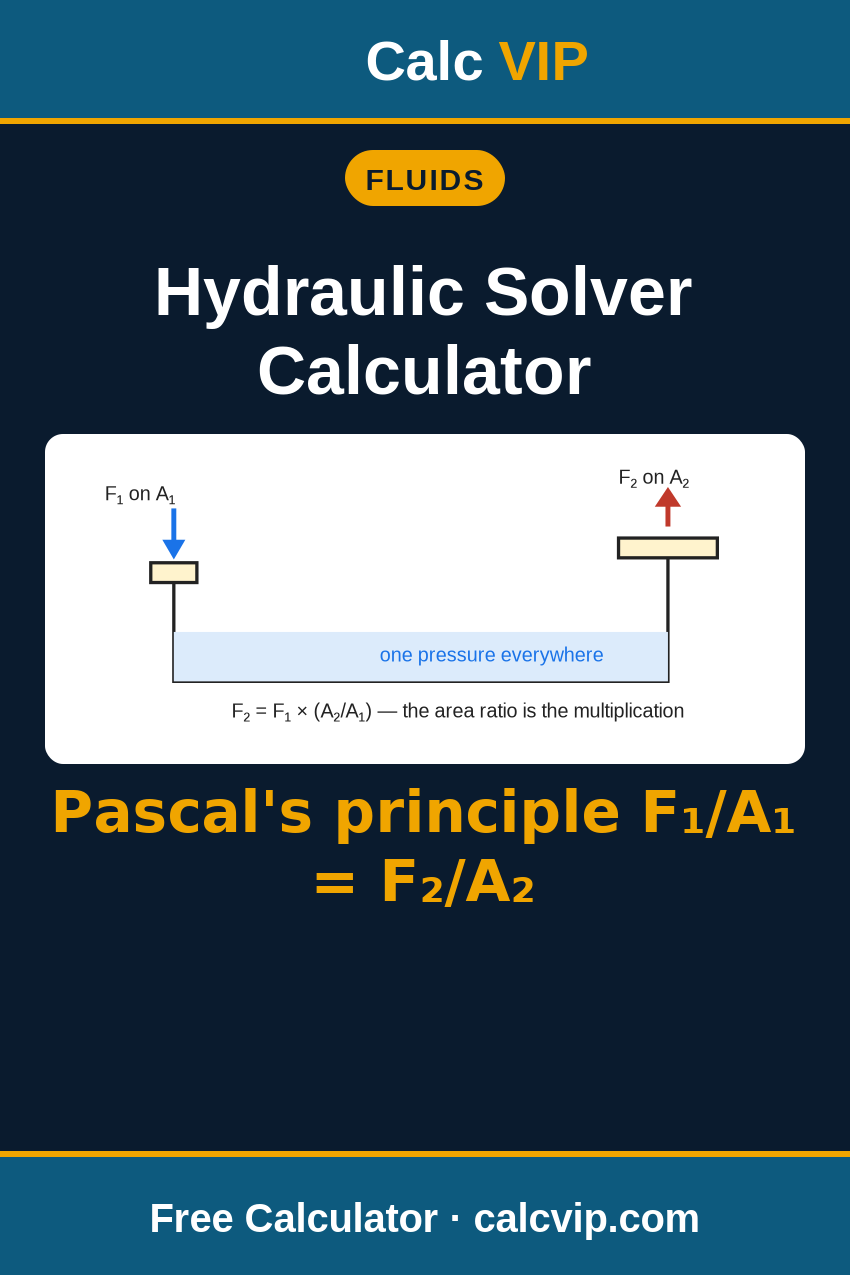
Press down on the fluid in a sealed system and the pressure appears everywhere at once — that single fact, Pascal's principle, is the most productive idea in all of fluid machinery. It means a modest push on a small piston can be traded, through nothing but oil and plumbing, for an enormous push on a large one: the force multiplies by the ratio of the piston areas. This solver handles the trade from any corner — give it any three of the input force, output force and two piston areas, and it returns the fourth, together with the system pressure and the multiplication factor.
The bargain has a price, and the price is distance. The fluid is (nearly) incompressible, so the volume the small piston sweeps must equal the volume the large piston gains: if the output force is 25 times the input, the output piston rises one twenty-fifth as far as the input travels. Work in equals work out — hydraulics is a lever made of liquid, obeying the same conservation law as the crowbar and the gear train, merely with the fulcrum replaced by a pressure. The depth section below works that trade with real numbers, because a design that forgets it produces lifts that run out of travel before they run out of strength.
Why oil and not air? Because the trick depends on the fluid transmitting pressure without absorbing the motion itself. A liquid compresses by a fraction of a percent even at hundreds of bar, so the pedal feels solid and the output moves the instant the input does. Air, by contrast, is a spring: a pneumatic system stores energy in compression, responds softly and can release that energy dangerously. Pneumatics has its own kingdom — fast, light, clean actuation — but wherever force, stiffness and precision meet, from excavator arms to aircraft flight controls, the fluid is a liquid and this equation is in charge.
Formula
Pascal's principle F₁/A₁ = F₂/A₂ • the shared pressure is P = F₁/A₁ = F₂/A₂; forces in newtons, areas in m², pressure in pascals
The equation rearranges for each unknown: F₂ = F₁ × (A₂/A₁), F₁ = F₂ × (A₁/A₂), A₂ = A₁ × (F₂/F₁), A₁ = A₂ × (F₁/F₂). In every form the only thing that matters is the area ratio — the force multiplication — which is why designers speak of a "25-to-1" hydraulic stage. For round pistons the area is πD²/4, so the ratio can equally be written (D₂/D₁)²: doubling the output piston's diameter quadruples the multiplication. This solver also reports the system pressure, the quantity the hoses, seals and pump must actually withstand.
| Symbol | Meaning | Units |
|---|---|---|
| F₁, A₁ | input force and input (small) piston area | N, m² |
| F₂, A₂ | output force and output (large) piston area | N, m² |
| P | pressure throughout the confined fluid | Pa (industrial systems: bar, 1 bar = 100,000 Pa) |
| A₂/A₁ | force multiplication (area ratio) | dimensionless |
Pascal's principle: pressure is the messenger
The deep reason the trade works is that a confined fluid cannot keep a pressure difference to itself. Push on one piston and the pressure rise propagates through the fluid at the speed of sound in oil, equalising everywhere within milliseconds; every square metre of every surface then feels that same pressure, pushing with force P × A wherever it lands. The small piston, having little area, needs little force to create the pressure; the large piston, having much area, converts the same pressure into much force. Nothing is created — the energy audit of the depth section shows the books balancing to the joule — but force has been exchanged for travel at an exchange rate set purely by geometry.
It is worth contrasting the fluid lever with its solid ancestors. A crowbar multiplies force by the ratio of two lengths; a gear pair by the ratio of two tooth counts; a hydraulic stage by the ratio of two areas. The hydraulic version wins where the path between input and output must bend, split or travel — one pump can feed a dozen cylinders at the ends of hoses that snake through a machine, each cylinder's force set by its own area, all sharing one pressure like appliances sharing a voltage. That electrical analogy is exact enough to design with: pressure is voltage, flow is current, and this solver is Ohm's law for the force side of the circuit.
How to use
- Choose which quantity to solve for — F₂, F₁, A₂ or A₁ — from the "Solve for" menu; the three known quantities' boxes will be shown.
- Enter the three known values: forces in newtons, areas in square metres (for a round piston, A = πD²/4).
- Click "Solve" to get the missing value, the system pressure and the force multiplication.
- Check the pressure against your hardware: hoses, seals and pumps are rated in bar (divide Pa by 100,000) — the multiplication is free, the pressure rating is not.
Worked examples
Example 1 — the reference lift. F₁ = 100 N on A₁ = 0.01 m², output piston A₂ = 0.25 m².
P = 100 ÷ 0.01 = 10,000 Pa; F₂ = 10,000 × 0.25 = 2,500 N — a multiplication of ×25. In reverse, achieving 2,500 N from 100 N on 0.01 m² requires A₂ = 0.01 × 2,500/100 = 0.25 m², closing the loop.
Example 2 — car brakes. A driver's foot, through the pedal lever, applies 200 N to a master-cylinder piston of 5 cm² (0.0005 m²): P = 200 ÷ 0.0005 = 400,000 Pa (4 bar). A brake caliper piston of 0.002 m² converts it back: F₂ = 400,000 × 0.002 = 800 N of clamping per piston — before the vacuum booster, which multiplies the driver's effort several-fold upstream, is even counted.
Example 3 — the workshop jack. To lift a car corner needing F₂ = 5,000 N with a comfortable handle force, choose a ratio of 50: F₁ = 5,000 ÷ 50 = 100 N. With A₁ = 0.001 m² the pressure is 100 ÷ 0.001 = 100,000 Pa (1 bar) and A₂ must be 0.05 m². The handle's pumping stroke then trades travel for height, a few millimetres of lift per stroke — the felt reality of the ratio.
Example 4 — solving for an area. A press must deliver F₂ = 3,000 N from an available F₁ = 150 N, with A₂ fixed at 0.03 m² by the machine frame.
A₁ = A₂ × F₁/F₂ = 0.03 × 150/3,000 = 0.0015 m² — a piston about 44 mm across (from A = πD²/4). The solver's area modes exist for exactly this design-backwards question.
Example 5 — the distance audit. In the Example 1 system, push the small piston down 0.5 m: swept volume = 0.01 × 0.5 = 0.005 m³, so the large piston rises 0.005 ÷ 0.25 = 0.02 m. Work in: 100 N × 0.5 m = 50 J. Work out: 2,500 N × 0.02 m = 50 J. The books balance to the joule — the multiplication was an exchange, never a gift.
Example 6 — the excavator's arm. Industrial hydraulics runs at pressures near 200 bar (20,000,000 Pa). A cylinder bore with area 0.01 m² at that pressure delivers F = P × A = 200,000 N — twenty tonnes of push from a cylinder the width of a dinner plate. Framed in this solver's terms, the pump is the "input piston" working continuously, and the ratio logic is identical.
Hydraulics in real life
Vehicle brakes. Example 2 is every car's stopping system: one master cylinder, four calipers, a shared pressure — and the terrifying corollary that a leak anywhere drops the pressure everywhere, which is why brake circuits are split in two for redundancy.
Jacks, lifts and presses. From the bottle jack under a car to the 10,000-tonne forging press, the area ratio is chosen to trade a human-scale force (or a pump's) against the load, exactly as in Examples 1 and 3.
Earth-moving machinery. Excavators, loaders and cranes are hydraulic sculptures: one engine-driven pump, many cylinders, each sized by area for its job — the bucket curls, the boom lifts, the tracks drive, all off one pressure rail.
Aircraft controls. Flight-control surfaces far too loaded for cables and arms are moved by hydraulic actuators at around 200 bar; airliners carry three independent hydraulic systems because the physics is trusted and the plumbing is duplicated.
Hospital and workshop beds, lifts and tailgates. The quiet hydraulic ram that raises a delivery truck's tailgate or a dentist's chair is a single-acting version of the same two-piston trade, with a spring or gravity providing the return stroke.
The hydraulic press meme, honestly. The internet's favourite press crushes objects with forces computed exactly as here — pressure times ram area — and its drama is the area ratio's: enormous force, millimetres of travel, work conserved throughout.
The fine print: losses, seals and safety
Real systems fall short of the ideal equation in instructive ways. Seal friction steals a few percent of the force in both directions, which is why a jack can need more handle force than F₂/ratio yet hold its load without creeping when the handle stops. Oil compresses slightly — about half a percent per 100 bar — adding a springiness that precision systems must model. Trapped air is the great corruptor: a single bubble makes the whole circuit spongy, because the bubble, not the oil, absorbs the travel; bleeding a brake line is the ritual of restoring this calculator's assumptions. And the pressure the solver reports is the number that safety is built on: hoses are commonly rated with a 4:1 burst margin over working pressure, because a burst line at 200 bar whips with lethal energy. The ideal equation designs the machine; the fine print keeps it honest.
Quick reference: what a ratio buys you
| Area ratio A₂/A₁ | F₂ from 100 N in | Output travel per 100 mm in |
|---|---|---|
| 2 | 200 N | 50 mm |
| 5 | 500 N | 20 mm |
| 10 | 1,000 N | 10 mm |
| 25 | 2,500 N | 4 mm |
| 100 | 10,000 N | 1 mm |
The two right-hand columns are the same trade read from opposite ends: every row multiplies force and divides travel by the identical factor. There is no row — in this table or in physics — that wins both.
A memory hook for the workshop: the multiplication is the ratio of the squares of the piston diameters. A 20 mm master cylinder driving a 100 mm ram is not a ×5 system but a ×25 — the same numbers as Example 1 — because (100/20)² = 25. Diameter is what you can measure with calipers; area is what the fluid believes.
Intensifiers and accumulators: negotiating with the trade
Engineers who need both high force and respectable travel have developed two honourable negotiations with the conservation law — neither breaks it, both rearrange when the bill is paid. The first is the pressure intensifier: a large piston and a small piston fixed on one rod, driven by ordinary system pressure on the large face, delivering a much higher pressure from the small face — Pascal's equation applied twice in one housing, trading flow for pressure exactly as a transformer trades current for voltage. Intensifiers feed the 500-bar demands of waterjet cutters and test rigs from ordinary 200-bar pumps. The second device is the accumulator: a gas-charged reservoir that stores pressurised oil while the pump idles and releases it in a surge when the cylinder must move fast. The accumulator does not change the force equation at any instant; it changes the timing, letting a small pump do a big pump's job in bursts — the hydraulic equivalent of a capacitor smoothing a power supply.
A third negotiation is staging: a press cylinder that advances quickly under low pressure on a large-bore "approach" circuit, then switches to a small, high-pressure stage for the final squeeze. Travel where travel is cheap, force where force is needed — the two rows of the quick-reference table, visited in sequence. Every one of these refinements is still F₁/A₁ = F₂/A₂ underneath, applied with an engineer's sense of timing.
Common mistakes
- Using diameters as if they were areas. The ratio is of areas: (D₂/D₁)². A piston twice as wide gives four times the force, not two — the happiest error in hydraulics, but an error in a design calculation all the same.
- Expecting force multiplication without travel loss. If the output must rise far and fast, the input must sweep the same volume — check the travel budget (Example 5) before falling in love with a ratio.
- Ignoring the pressure rating. Raising force by raising pressure is limited by hoses and seals; raising it by area is limited by space. The solver's pressure readout is the constraint that bites first in compact designs.
- Feeding in cm². Areas here are m²: 100 cm² = 0.01 m². A cm² value typed directly inflates the force a hundredfold on paper and not at all in the workshop.
- Assuming a spongy system has a leak of force. Sponginess means compressible gas in the circuit, not a failure of Pascal's principle — bleed the air and the equation's crispness returns.
FAQ
Does a hydraulic lift create energy from nothing?
No. The small piston must move 25 times farther than the large piston rises, so work in (force × distance) equals work out, minus friction losses.
Why is the fluid usually oil rather than air?
Liquids are nearly incompressible, so the pressure is transmitted instantly and firmly. Air compresses, which would make the pedal or lever feel spongy and waste motion.
Where is Pascal's principle used?
Car brake systems, hydraulic jacks and lifts, excavator arms, aircraft controls and hydraulic presses all rely on it.
What pressure do car hydraulic systems actually run at?
Brakes peak around 100 bar or more under a hard stop (the 4 bar of Example 2 is gentle braking without the booster); power steering historically ran near 100 bar, and construction machinery works at 200–350 bar. This solver's Pa readout divided by 100,000 gives bar — figures worth checking against the ratings of any real system you service or repair.
Can one input drive several outputs?
Yes — connect several cylinders to the same pressure line and each produces P × its own area, like Example 6's machine. The constraint is flow: the pump must supply the total swept volume of all cylinders moving at once.
Why does the output piston move less, exactly?
Because the liquid's volume is conserved: A₁ × (input travel) = A₂ × (output travel). The travel ratio is the inverse of the force ratio — the two multiplications are one fact seen from two sides.
What is the difference between hydraulic and pneumatic?
The working fluid: liquid versus gas. Hydraulics is stiff, strong and precise; pneumatics is fast, light and forgiving but springy and weaker per unit area, because safe air pressures are far lower than oil pressures.
How efficient is a hydraulic system?
Well-maintained systems deliver 80–95% of the input work; the losses are seal friction and fluid friction in the lines. The force equation itself is not where the loss hides — it is in the travel, which is why work, not force, is the honest audit.
Who was Pascal and why is the pressure unit also his name?
Blaise Pascal, the 17th-century French physicist who demonstrated that pressure in a fluid is transmitted equally — famously bursting a barrel with a long thin tube of water. The SI unit of pressure honours that work; the principle on this page is its foundation.
Can the ratio be less than 1?
Yes — swap the roles and the system trades force for travel: a small output piston moves farther and faster than the input. Hydraulic motors and some presses use exactly this inverted arrangement when speed matters more than force. The equation does not care which piston you call first; only the ratio speaks.