 Calc
Malus Law Calculator – Light Intensity Through Polarising Filters
 Created by Rachel Novak · Senior Editor · All Topics · Last updated: November 2026
Use this free Malus Law Calculator to find how much light survives a polarising filter: I = I0 cos²θ. It also handles the classic two-filter case, where unpolarised light first loses half its intensity, then obeys Malus's law at the second filter.
Light is a transverse wave: its electric field oscillates in a direction across the line of travel, and that direction — the polarisation — is a property most light sources scramble completely. A polarising filter is a sieve for that direction, passing only the field component aligned with its axis. Étienne-Louis Malus, watching sunlight reflect off the windows of the Luxembourg Palace in 1808 through a crystal of Iceland spar, found the law that prices the sieve: I = I0 cos²θ. Rotate the filter by θ against the light's polarisation and the transmitted intensity falls as the square of the cosine — all of it through at 0°, three quarters at 30°, half at 45°, a quarter at 60°, and nothing at all at 90°.
The square in the formula is the fingerprint of how waves carry energy. The filter passes the component of the electric field along its axis, and components are projections: the transmitted amplitude is E cosθ. But intensity — the energy flow, the thing eyes and meters register — goes as the amplitude squared. Project once for the field, square for the energy: that two-step is the entire derivation, and it explains the law's gentle start and ruthless finish. Near θ = 0 the cosine is flat, so small misalignments cost almost nothing (at 15° you still keep 93.3%); near 90° the curve plunges through 25% at 60° and 6.7% at 75° into total darkness at the crossing point.
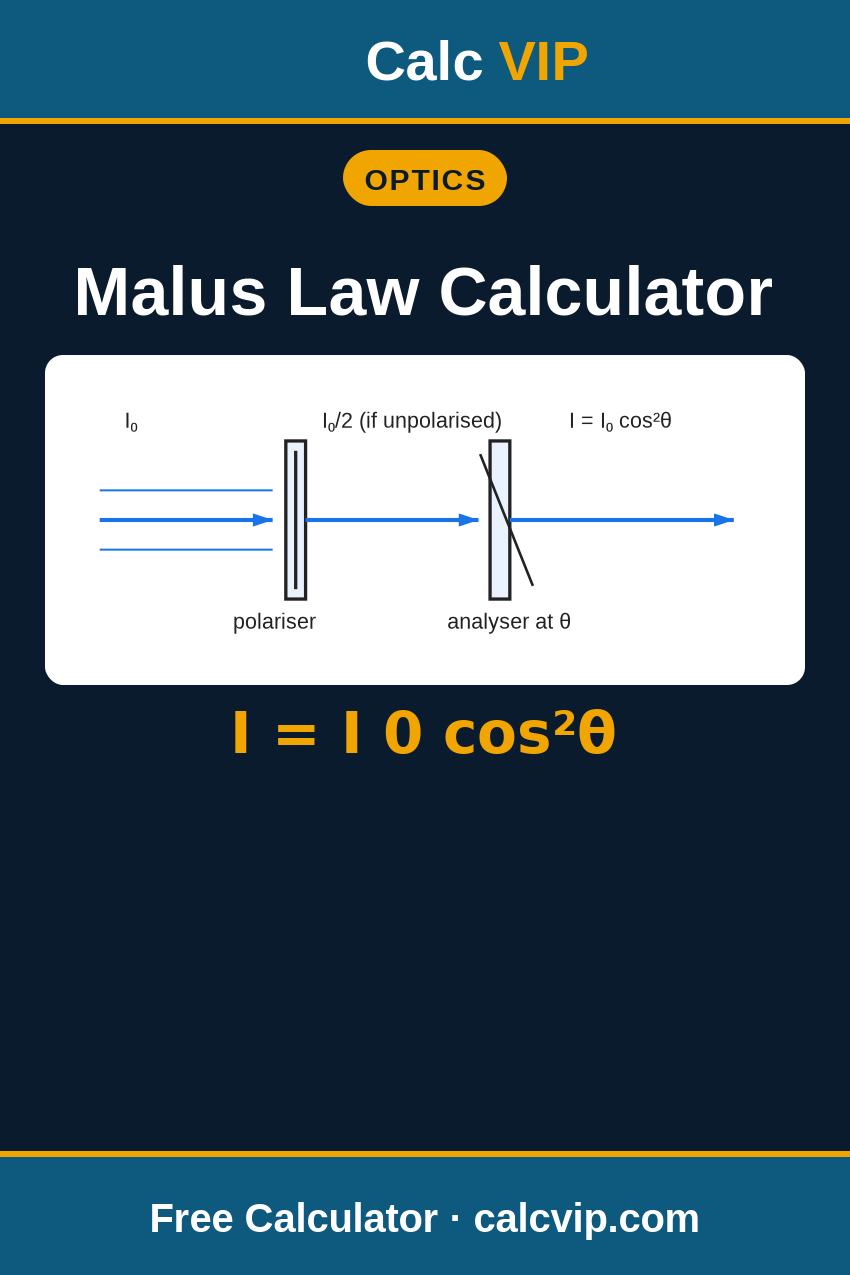
This calculator also handles the configuration that makes polarisation famous: unpolarised light meeting two filters. Unpolarised light has no single θ — its field direction cycles through all angles — so the first filter passes exactly half, whatever its orientation, and delivers perfectly polarised light at half intensity. Only then does Malus's law take over at the second filter, the "analyser". Two filters, one halving rule and one cosine-squared: from those ingredients come sunglasses, LCD screens, stress analysis and one of the most startling parlour tricks in physics — light appearing through two crossed filters when a third is slipped between them.
Formula
I = I0 cos²θ • two filters with unpolarised input: I = (I0/2) cos²θ
A polariser passes only the component of the electric field along its axis — a factor cosθ in amplitude, and cos²θ in intensity. Unpolarised light has every direction at once, so the first filter always passes exactly half. The angle θ is measured between the incoming light's polarisation direction and the filter's transmission axis — not from the filter's edge, its frame, or any marking, which is why careful workers calibrate the zero by finding the transmission maximum. The law has no wavelength and no intensity scale in it: it is a pure fraction machine, valid for any units (W/m², lux, arbitrary meter readings) and any colour, provided the polariser is ideal. Real polarisers leak slightly at the crossing (a good sheet passes perhaps 0.01–0.1% at 90° rather than exactly zero) and absorb a few percent even at perfect alignment — refinements this calculator's ideal law deliberately omits, and the depth section quantifies.
| Symbol | Meaning | Units |
|---|---|---|
| I | transmitted intensity | same as I₀ (e.g. W/m²) |
| I₀ | incoming intensity (already polarised, in the one-filter case) | W/m², lux, any unit |
| θ | angle between the light's polarisation and the filter axis | degrees (0–90) |
Where polarised light comes from in the first place
If sunlight and lamplight are unpolarised, where does the polarised I₀ of the one-filter formula ever come from? From the world, which polarises light constantly. Reflection is the great polariser: light bouncing off water, glass, wet roads or any dielectric surface emerges partially polarised parallel to the surface, and at one special angle — Brewster's angle, 53.1° for water and 56.3° for glass — the reflection is completely polarised. Scattering is another: skylight is strongly polarised in the band of sky 90° from the sun, which is why a polarising filter darkens blue sky so dramatically in photographs. And every LCD screen, laser and previous polariser emits polarised light by construction. Malus's law is therefore not a laboratory curiosity about filtered beams; it is the rule governing a large fraction of the light that reaches your eyes outdoors, and the reason polarised sunglasses — axes vertical, to reject the horizontally polarised glare from roads and water — work at all.
The three-filter paradox shows the law's quantum soul. Cross two polarisers at 90° and nothing passes: cos²90° = 0. Now slide a third filter, at 45°, between them — and light appears, 12.5% of the original unpolarised intensity (100 → 50 after the first, → 25 after the 45° middle, → 12.5 after the last, which sits at 45° to the middle). Adding a barrier lets light through, because the middle filter does not merely select from the light; it re-prepares it, projecting the field onto a new axis that is no longer perpendicular to the final filter. Polarisation is a property the measurement itself participates in — a tabletop preview of quantum measurement that costs nothing but three sheets of polarising film.
How to use
- Choose the setup: already-polarised light meeting one filter, or unpolarised light meeting two filters (the sunglasses/LCD case).
- Enter the incoming intensity I0 in any unit — W/m², lux, or a relative reading; the answer comes out in the same unit, and the percentage is unit-free.
- Enter the angle θ in degrees between the light's polarisation (or the first filter's axis) and the second filter's axis.
- Click "Calculate Transmitted Intensity". For a chain of more filters, run the calculation step by step, feeding each output in as the next I₀ with the angle between neighbouring axes.
Worked examples
Example 1 — the reference case. Polarised light of I0 = 100 W/m² meets a filter at θ = 30°. I = 100 × cos²30° = 100 × 0.75 = 75 W/m². If instead the 100 W/m² is unpolarised and passes two filters crossed at 30°, the first halves it to 50, then I = 50 × 0.75 = 37.5 W/m². Same angle, same law — the halving rule for unpolarised input is the only difference, and confusing the two setups is the commonest error in the topic.
Example 2 — the 45° midpoint. At θ = 45°, cos²45° = 0.5 exactly: polarised light of 100 emerges at 50. The 45° setting is the polariser's half-way house, and it is the angle that makes the three-filter paradox work — each 45° step is a fair coin-flip of intensity, ½ × ½ × ½ of the polarised stream.
Example 3 — near the crossing. At θ = 60° only cos²60° = 0.25 survives: 100 → 25. At 75° it is 6.7%, and at 90° exactly zero. Photographers rotating a polariser on the lens live on this curve: the sky darkens gradually at first, then the effect collapses into the crossing over the last few degrees — the curve's flat top and steep cliff, felt through the fingertips.
Example 4 — the three-polariser paradox. Unpolarised light of 100 units meets filters at 0°, then 45°, then 90°. First filter: 50. Middle filter at 45° to the first: 50 × 0.5 = 25. Last filter at 45° to the middle: 25 × 0.5 = 12.5. Remove the middle filter and the crossed pair passes 0. An extra obstacle admits an eighth of the light — run the calculator three times and watch it happen arithmetically before trying it with real film.
Example 5 — bright laboratory light. A polarised beam of I₀ = 800 W/m² (a modest laser's worth, spread out) meets an analyser at 25°: I = 800 × cos²25° = 800 × 0.821 = 657.1 W/m². The same beam unpolarised through two filters at 25° gives 400 × 0.821 = 328.6 W/m². Note how much the flat top of the curve forgives: a 25° misalignment still passes over four fifths of the polarised light.
Example 6 — sunglasses arithmetic. Bright glare reflected from a wet road is, say, 60% polarised horizontally with a total intensity of 100 units: the polarised part contributes 60, the unpolarised part 40. Vertical-axis sunglasses apply Malus at 90° to the polarised part (60 → 0) and the halving rule to the rest (40 → 20). Total transmitted: 20 units — an 80% cut in glare while ordinary scene light, mostly unpolarised, is merely halved. That selective arithmetic is the entire product.
Malus's law in real life
LCD screens. Every pixel is a Malus valve: polarisers front and back, a liquid-crystal layer between them that rotates the polarisation by an electrically controlled angle. Voltage sets θ, the law sets the brightness — and the crossed-polariser black state is cos²90° = 0 doing its silent work a million times per screen.
Polarised sunglasses. Example 6 is the product description. By fixing the axis vertical, the glasses exploit the fact that glare from horizontal surfaces is horizontally polarised — rejecting the glare by Malus while merely dimming everything else.
Photography. A polarising filter on the lens darkens polarised skylight, cuts reflections from water and foliage, and saturates colours — all by rotating θ against light the world has already polarised. The photographer's rotating ring is a Malus dial.
Stress analysis (photoelasticity). Stressed transparent plastic rotates polarisation by amounts that vary with the stress, so between crossed polarisers a machine part glows with coloured fringes mapping its internal forces. Engineers read bridges and gears in Malus rainbows before building them in steel.
3D cinema. Modern 3D projection sends the two eyes' images in opposite circular polarisations; the glasses' filters pass one to each eye. The principle is Malus generalised — each eye's filter sits at its own angle to its own image's polarisation state.
Optical isolators and lab practice. Polariser pairs are the volume knobs of laser laboratories: a rotating analyser attenuates a beam smoothly and predictably by cos²θ, with no change to the beam's path or colour — the law used as an instrument, thousands of times a day.
Real polarisers: extinction ratios and other imperfections
The ideal law promises exactly zero at 90°, but real sheet polariser is a stretched polymer dyed with iodine, not a mathematical projection. A good photographic polariser at its crossing still leaks of order 0.1% of the light, and premium laboratory polarisers (Glan-type crystal prisms) reach extinction ratios of 100,000:1 — leakage of 0.001%. Real filters also tax the aligned state: a typical sheet transmits about 38–42% of unpolarised light rather than the ideal 50%, because the "passed" polarisation is itself partly absorbed. None of this dethrones Malus's law — it remains the exact description of the projection step — but precision work multiplies the ideal answer by the filter's measured transmission and adds the leakage floor. When an experiment between crossed polarisers shows a stubborn glow, the glow is data about the filters (or about something between them rotating the polarisation — which is how liquid crystals and stressed plastics announce themselves).
Quick reference: the cos²θ table
| Angle θ | cos²θ | Transmitted (polarised input) | Two filters, unpolarised input |
|---|---|---|---|
| 0° | 1.000 | 100% | 50% |
| 15° | 0.933 | 93.3% | 46.6% |
| 30° | 0.750 | 75% | 37.5% |
| 45° | 0.500 | 50% | 25% |
| 60° | 0.250 | 25% | 12.5% |
| 75° | 0.067 | 6.7% | 3.3% |
| 90° | 0 | 0% | 0% |
Commit the landmarks to memory — 0.75 at 30°, 0.5 at 45°, 0.25 at 60° — and you can estimate any polariser problem standing in front of the apparatus. The two-filter column is the same table halved throughout: the first filter's tax is paid before the law even starts.
Common mistakes
- Forgetting the square. Using cosθ instead of cos²θ gives 87% at 30° instead of the true 75%, and 50% at 60° instead of 25%. The amplitude is projected once; the intensity — what you measure — is the square. This is the topic's signature error.
- Applying Malus's law to unpolarised light directly. Unpolarised light has no θ. The first filter halves it (always exactly half, at any orientation); only the now-polarised remainder obeys cos²θ at the second filter. Choosing the wrong setup in the calculator reproduces the mistake faithfully.
- Measuring θ from the wrong reference. θ is between the polarisation direction and the filter's transmission axis — not the angle of the filter's frame, its printed arrow (which may mark either axis), or the bench. Calibrate by rotating for maximum transmission and calling that zero.
- Using the angle between filters when the light's polarisation is what matters. In the one-filter setup, θ is between the incoming polarisation and the axis. If the incoming light was polarised by reflection or a laser, its direction — not some other filter's — sets the angle.
- Expecting exactly zero from real crossed filters. Real sheet polarisers leak ~0.1% and the room adds stray light; a measured "zero" of a fraction of a percent is the filters' extinction limit, not a failure of the law — and if a sample sits between the filters, its glow is information, not error.
FAQ
Why does no light pass at θ = 90°?
cos90° = 0, so the transmitted intensity is zero. Two crossed polarisers block everything — the second filter's axis is perpendicular to the only field direction the first one let through.
Where does the blocked light's energy go?
It is absorbed by the filter material (a dichroic sheet absorbs one polarisation strongly) and warms it slightly. Nothing is reflected back in an ideal polariser.
How do LCD screens use Malus's law?
Each pixel sits between polarisers, and a liquid-crystal layer twists the polarisation direction by an amount set by the pixel voltage. That changes θ, and Malus's law turns it into a brightness.
Who was Malus, and how did he find a cosine-squared in a palace window?
Étienne-Louis Malus (1775–1812), a French military engineer, noticed in 1808 that sunlight reflected from the Luxembourg Palace windows varied in brightness as he rotated a calcite crystal — the first hint that reflection polarises light. Within a year he had the quantitative law that bears his name, derived from experiments with reflected light at many angles.
Does Malus's law work for partially polarised light?
Yes, by decomposition: split the light into a fully polarised part and an unpolarised part. The polarised part follows cos²θ; the unpolarised part halves. Example 6 works exactly this way for road glare (60% polarised, 40% not), and the general method handles any mixture.
Why do two pairs of polarised sunglasses go black when crossed?
Each lens is a polariser. Aligned, you look through two halvings of the unpolarised world — dim but visible. Rotate one lens 90° against the other and the second sits at cos²90° = 0 to the light the first prepared: black. It is the quickest demonstration of the law ever devised, and it is in most people's kitchen drawer.
Can a polariser make light brighter than I₀/2 from an unpolarised source?
No passive filter can. The first polariser's half is a hard ceiling for unpolarised input — a fact with a thermodynamic backbone (beating it would let you build a brightness amplifier from still parts). Everything downstream of the first filter is Malus fractions of that half.
How is θ found if the filter's axis isn't marked?
Empirically: pass light of known polarisation (or use a second, known filter) and rotate for maximum transmission — that orientation is θ = 0 by definition, and the axis is whatever direction the light's field then has. Laboratory polarisers are sold pre-marked, but the calibration ritual is the same one Malus performed.
Does the law depend on colour?
The law itself does not — cos²θ is colour-blind. Real polarisers, however, polarise some wavelengths better than others (cheap sheet leaks blue and red at the crossing, tinting the "black" purple), which is a property of the material, not of Malus's geometry.
What is the connection to quantum mechanics?
For a single photon, cos²θ is a probability: the chance that a photon polarised at θ to a filter passes it. The three-filter paradox is then a statement about measurement changing the state — the middle filter re-prepares photons at 45°, giving them a cos²45° chance at the last filter. Malus's classical intensity law and the quantum probability law are the same equation wearing two centuries' different clothes.