 Calc
Mirror Focal Length Calculator – f = R/2 Radius of Curvature Converter
 Created by Rachel Novak · Senior Editor · All Topics · Last updated: November 2026
Use this free Mirror Focal Length Calculator to convert between a spherical mirror's radius of curvature R and its focal length f. For any spherical mirror the focus sits exactly halfway to the centre of curvature, so f = R/2 — and this tool runs the conversion in both directions.
It may be the simplest formula in all of optics — a single division by two — yet it is the hinge between how a mirror is made and how it behaves. The optician grinding the glass works with the radius of curvature: the mirror is a cap of a sphere, and R is that sphere's radius, measurable with a spherometer while the glass is still on the polishing machine. The person using the finished mirror works with the focal length: where parallel light converges, where a bulb must sit to throw a parallel beam, where a sensor belongs. f = R/2 is the dictionary between the workshop and the world.
The factor of two is pure geometry, and worth understanding rather than merely memorising. A ray arriving parallel to the axis strikes the spherical surface at a point whose normal — the line along which it reflects symmetrically — passes through the centre of curvature C. Chasing the equal angles of that reflection through the triangle it makes with the axis shows the reflected ray crossing the axis exactly halfway between C and the mirror's surface. Every near-axis ray obeys the same triangle, so they all cross at that one halfway point: the focus F, with f = R/2 not as an empirical rule but as a theorem.
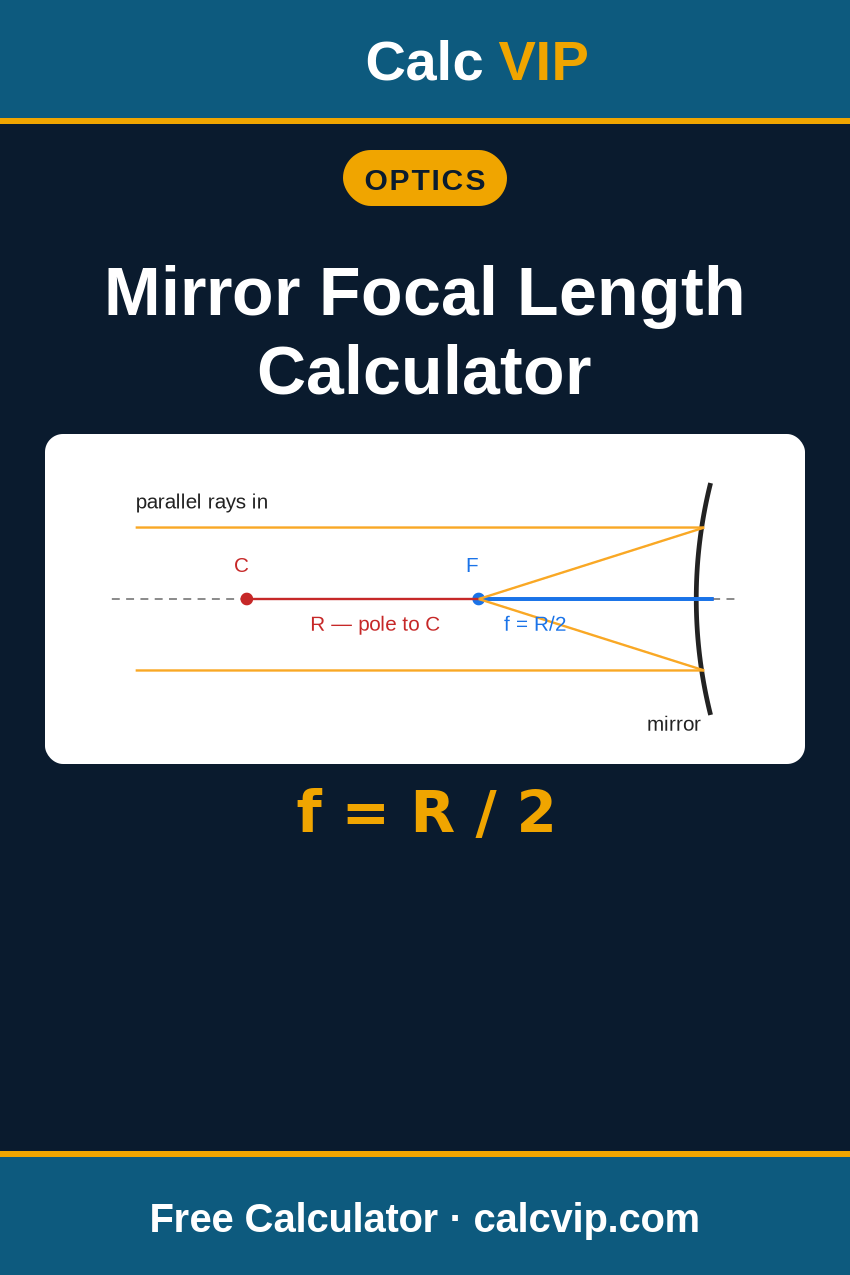
The conversion matters because specifications arrive in both currencies. Telescope mirrors are sold by focal length and focal ratio, but mirror-making kits and spherometer readings give R; vehicle and security mirrors are often described by their curvature; solar concentrator designs start from a target f and must be cut to R = 2f. This calculator also handles the sign for you — choose concave or convex and the answer carries the correct sign for direct use in the mirror equation, where the distinction between +20 cm and −20 cm is the distinction between a shaving mirror and a shop-security mirror.
Formula
f = R / 2 • rearranged: R = 2f • mirror power (in metres) P = 1/f = 2/R
Two rearrangements, both trivial — and that is the point: the conversion costs nothing, so there is never an excuse for feeding R into the mirror equation where f belongs (the single most common curved-mirror error). The third form is worth knowing: like a lens, a mirror has a power in dioptres when f is in metres, P = 1/f. A concave mirror with f = 0.5 m is a +2 D reflector — the same "strength" language opticians use for lenses, and the reason a mirror of R = 1 m (f = 0.5 m) shows up in eye-testing rooms as a way to fold a long optical path into a short room.
| Symbol | Meaning | Units & signs |
|---|---|---|
| R | radius of curvature — pole to centre C | cm; + concave, − convex |
| f | focal length — pole to focus F, f = R/2 | cm; same sign as R |
| C | centre of curvature — centre of the sphere | a point, at distance R |
| P | power, P = 1/f with f in metres | dioptres (D) |
Why the focus sits exactly halfway
Picture the sphere the mirror was cut from, centre C, and a ray arriving parallel to the axis, striking the surface at point P. The normal at P is the radius CP. The ray reflects so that its angles to this normal match, and the reflected ray crosses the axis at some point F. The triangle CPF that results has two equal angles — the angle of incidence and the angle subtended at C are alternate angles of parallel lines — which makes it isosceles: CF = FP... in the small-angle (paraxial) limit, FP ≈ the axial distance from P's foot to F, and the geometry collapses to CF = F-to-pole. F is the midpoint of the segment from pole to C. Hence f = R/2, for every paraxial ray, regardless of its height.
The phrase "paraxial limit" in that proof is doing quiet but crucial work. The isosceles step is exact; the identification of the slanted distance with the axial distance is not. For rays striking far from the axis, the crossing point creeps towards the mirror — spherical aberration — so a wide spherical mirror has not one focus but a small caustic smear of them, with R/2 naming its paraxial heart. Grinding the curve into a paraboloid removes the smear. Notice the moral: f = R/2 is exact where mirrors are used gently, and the starting point — not the last word — where they are used hard, as in fast telescopes.
How to use
- Choose whether you are finding f from R, or R from f — the input label changes to match.
- Pick the mirror shape (concave or convex) so the sign comes out right, then enter the value you know, in centimetres, as a positive number.
- Click "Calculate" to get the other value, with its sign, ready to feed into the mirror equation.
- Working in metres instead? The halving and doubling are unit-free — just keep one unit throughout, and remember dioptres (P = 1/f) require metres.
Worked examples
Example 1 — the shaving mirror. A concave shaving mirror is part of a sphere with radius of curvature R = 40 cm.
f = R ÷ 2 = 40 ÷ 2 = +20 cm — parallel rays reflect through a point 20 cm in front of the mirror.
Run it the other way: a mirror with f = 15 cm must have been ground from a sphere of radius R = 2 × 15 = 30 cm.
Example 2 — the same glass, convex. Silver the other side of that sphere and the identical curvature gives a convex mirror: R = −40 cm, so f = −20 cm. Same |R|, opposite sign, utterly different behaviour — virtual focus, upright diminished images. The sign is not a detail; it is the mirror's personality.
Example 3 — a make-up mirror specified by f. A make-up mirror is advertised with f = 30 cm. Its glass was ground on a sphere of R = 2 × 30 = 60 cm — and its gentler curvature (longer f) is why such mirrors magnify modestly and forgive a range of face distances.
Example 4 — a car side mirror. A passenger mirror is convex with focal length f = −50 cm (half a metre, behind the glass). R = 2 × (−50) = −100 cm: the sphere it belongs to is a full metre in radius, which is why the mirror looks almost flat yet still compresses a wide view.
Example 5 — an amateur telescope mirror. A popular Dobsonian primary is figured to R = 480 cm, so f = 480 ÷ 2 = 240 cm = 2.4 m — a long-focus mirror whose curve departs from flat by only about 2.3 mm across a 30 cm blank, yet still takes weeks of polishing to figure correctly. Mirror-makers measure that R with a spherometer long before any starlight confirms it.
Example 6 — a shop security mirror. A convex security mirror has R = −80 cm, so f = −40 cm. Feed that f into the mirror equation with a customer 4 m away and you get the small, upright, wide-angle image the shopkeeper wants — this conversion is the first step of that design.
f = R/2 in real life
Mirror-making workshops. Amateur telescope makers spend their weekends measuring R with spherometers and Foucault testers while the mirror is still being ground; f — the number the telescope will be sold by — only exists through this halving.
Eye-testing rooms. An optometrist's mirror folds the 6-metre test-chart distance into a 3-metre room: the patient reads a chart behind them via a mirror whose modest power (f of a few metres, R twice that) makes the chart optically distant.
Solar concentrators. A solar cooker's designer picks the focus first — where the pot must hang — then cuts the reflector to R = 2f. Satellite dishes do the same in reverse for radio waves: feed antenna at F, dish figured from R.
Vehicle mirrors. Regulations specify curvature: the R range allowed for car mirrors balances field of view against distance distortion, and every value in those standards converts to f by this page's rule.
Stage and funfair mirrors. Distorting mirrors are cylinders and freeform curves rather than spheres, but locally each patch still has an R and an f = R/2 — which is why your reflection stretches and squeezes as you move across the glass.
Cassegrain telescopes. A convex secondary mirror — specified, like all mirrors, by its R — intercepts the primary's converging beam and folds it back through a hole in the primary, multiplying the effective focal length several-fold. Metres of effective f live in a tube well under a metre long: the R-to-f conversion applied twice in one instrument.
Laser cavities. The curved end-mirrors of a laser are specified by R (often 1–10 m), and the cavity's stability analysis runs entirely on those radii — a place where the humble halving rule sits inside research-grade engineering.
Quick reference: common radii and their focal lengths
| R (cm) | f = R/2 (cm) | Typical concave use |
|---|---|---|
| 10 | 5 | dentist's mirror, strong magnifier |
| 20 | 10 | laboratory demonstration mirror |
| 40 | 20 | shaving mirror |
| 60 | 30 | make-up mirror |
| 100 | 50 | solar cooker reflector |
| 200 | 100 | small telescope primary |
Convex mirrors use the same sizes with negative signs: R = −100 cm (f = −50 cm) is a typical car mirror, R = −80 cm (f = −40 cm) a typical shop security mirror.
A note on the trade's units: workshop drawings and spherometer work are usually in millimetres, school optics in centimetres, and telescope specifications in a cheerful mixture of millimetres, centimetres and inches. The halving rule is indifferent to all of it — but a radius quoted as "480" is a very different mirror in millimetres (f = 24 cm) than in centimetres (f = 2.4 m), so the unit deserves the same care as the sign.
Measuring R without touching the focus: the spherometer
Because a mirror's useful surface is a shallow cap of its sphere, R can be measured mechanically from the cap's sagitta — its depth. A spherometer's three legs span a circle of radius r on the surface while a central probe measures the sagitta depth s; the sphere's radius follows from R = (r² + s²)/(2s). For a telescope blank with r = 7.5 cm and a sagitta of just s = 0.012 cm (a tenth of a millimetre), R = (56.25 + 0.000144)/(0.024) ≈ 2,344 cm — a 23-metre sphere inferred from a hair's depth. This is why mirror-makers speak of R with such confidence: the halving rule is trivial, but the R feeding it is measured to extraordinary precision.
Focal ratio: the number R is really steering
Telescope people rarely quote f alone; they quote the focal ratio N = f ÷ D, with D the mirror's diameter, because N predicts the instrument's character — wide bright fields at low N, narrow planetary views at high N. R steers it from behind: since f = R/2, choosing the grinding sphere chooses the ratio. A 30 cm mirror figured to R = 480 cm has f = 240 cm and works at f/8, a classic planetary Dobsonian. Refigure the same blank to R = 240 cm and f falls to 120 cm — an f/4 "light bucket" whose focal plane receives light (8 ÷ 4)² = 4 times faster per unit area, at the price of far tighter figuring and focusing tolerances. Every mirror-maker's first decision — which sphere to grind towards — is silently a decision about this ratio, made with the halving rule before the first handful of abrasive.
Common mistakes
- Feeding R into the mirror equation as f. The classic. Every image distance doubles or halves wrongly downstream. Convert first: the equation only ever wants f.
- Dropping the convex sign. R and f for a convex mirror are negative in the real-is-positive convention. Enter the shape in this calculator and the sign is handled — ignore it elsewhere and a security mirror turns into a telescope.
- Believing f = R/2 fails for "strong" mirrors. It holds paraxially for any sphere; what fails for wide, fast mirrors is the sharpness of the focus (spherical aberration), not the location of its paraxial heart.
- Confusing focal length with focal ratio. A telescope's f/5 describes f divided by aperture, not f itself. An f/5 mirror of 200 mm aperture has f = 1,000 mm and R = 2,000 mm — three different numbers for one mirror.
- Measuring R to the wrong surface point. R runs from the pole (the centre of the mirror's surface) to C along the axis — not from the mirror's edge, and not along the glass. On shallow mirrors the difference is small; on deep ones it is not.
FAQ
Why is the focal length exactly half the radius?
Geometry. A ray parallel to the axis reflects off the spherical surface at a point where the normal passes through the centre C. For rays close to the axis (the paraxial approximation), the reflected rays all cross the axis at one point, and that point sits halfway between C and the mirror's surface.
Is f = R/2 exact for every spherical mirror?
It is exact for rays close to the axis. Rays striking the edge of a wide spherical mirror cross the axis slightly closer to the mirror — an imperfection called spherical aberration, which is why telescopes often use parabolic mirrors instead.
What if I only know the focal length of a convex mirror?
Select "Convex" and "Radius of curvature R — from the focal length f", enter the focal length as a positive number, and the calculator returns R with the correct negative sign.
Where exactly is the centre of curvature?
On the mirror's axis, at distance R from the pole — in front of a concave mirror, behind a convex one. It is the centre of the sphere of which the mirror is a cap; an object placed there images onto itself, life-size and inverted.
How is R measured in practice?
Opticians use a spherometer, which reads the surface's sagitta (depth) across a known span and converts it to R geometrically; telescope makers confirm with optical tests — a point source at C should image back onto itself when the figure is a true sphere.
Does a flat mirror fit the rule?
Yes, as the limiting case: a plane is a sphere of infinite radius, so f = R/2 = infinity — parallel rays stay parallel, and the mirror equation reduces to image distance = object distance behind the glass, magnification +1. The formula degrades gracefully into the familiar case.
Why are telescope mirrors parabolic if f = R/2 is so neat?
Because the parabola focuses all parallel rays — edge and centre alike — to one point, while the sphere only manages it for paraxial rays. The parabola has no single R (its curvature varies across the surface), so makers quote its focal length and focal ratio instead.
Can I find f by sunlight?
For a concave mirror, yes: reflect sunlight onto a card and slide the card to the smallest, brightest spot — that distance is f (mind your eyes and anything flammable; the spot is genuinely hot). It is the quickest sanity check on any claimed R.
What is the sagitta, and why do mirror-makers care?
The sagitta is the depth of the mirror's curve at its centre relative to its rim. It is what a spherometer measures, and through R = (r² + s²)/(2s) it fixes R — and therefore f — before the mirror ever sees light.
Do lenses have an equivalent of R?
A lens has two surface radii, and the lensmaker's equation combines them with the glass's refractive index to give f. The mirror's version is simpler because reflection ignores the glass entirely: one surface, one radius, one halving.