 Calc
Mirror Calculator – Concave Mirror Equation & Magnification
 Created by Rachel Novak · Senior Editor · All Topics · Last updated: November 2026
Use this free Mirror Calculator to find where a concave (converging) mirror forms an image, and how large that image is. Enter the focal length and the object distance — distances use the "real is positive" convention taught in school physics.
A concave mirror is a piece of a hollow sphere, silvered on the inside of the curve, and it behaves like a lens that works by bouncing rather than bending. Light from an object strikes the curved surface, reflects according to the same law as any mirror, and — because of the curve — the reflected rays can be made to meet at a point in front of the mirror, forming a real image you can catch on a card. Move the object and the image moves, grows, shrinks or flips into a virtual image behind the glass, all according to one equation — the same thin-equation shape as the lens formula, which this calculator solves for you.
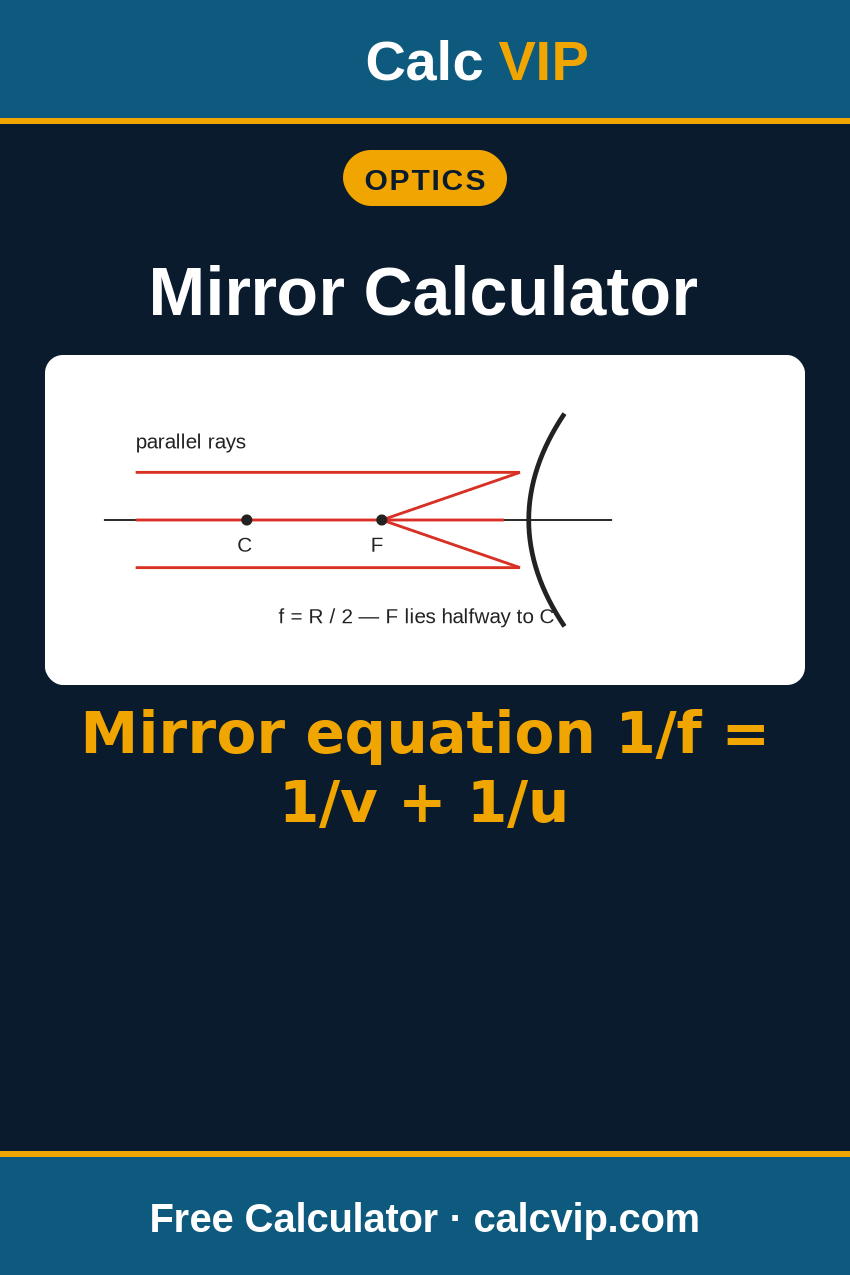
Every concave mirror carries two landmarks stamped into its geometry. The centre of curvature, C, is the centre of the sphere the mirror was cut from, sitting on the axis at a distance R (the radius of curvature) in front of the surface. Halfway between the mirror and C lies the focal point F, where rays arriving parallel to the axis are reflected to meet. The focal length is therefore f = R/2 — a mirror ground from a sphere of radius 40 cm has f = 20 cm, no measurement needed. Almost everything about a mirror's behaviour follows from where the object stands relative to these two points.
The applications split neatly by image type. Where a real, magnified image is wanted on a surface — a telescope gathering starlight, a projector, a solar furnace — concave mirrors do the work, and the biggest telescope mirrors are metres across and accurate to millionths of a millimetre. Where an upright, magnified virtual image is wanted — a shaving or make-up mirror — the same curve is used the other way, with the face inside the focal length. And run backwards, with a lamp placed at the focus, the mirror throws a parallel beam: every car headlight and torch reflector is a concave mirror earning its living in reverse.
Formula
Mirror equation 1/f = 1/v + 1/u, so v = f × u / (u − f) • Magnification m = v / u • the focal length is half the radius of curvature: f = R / 2
The rearrangements cover the usual unknowns. Finding the focal length from a measured setup: f = (u × v) / (u + v) — an object at 30 cm imaging at 60 cm gives f = (30 × 60) ÷ (30 + 60) = 1800 ÷ 90 = 20 cm. Finding where to place an object for a wanted image: u = (f × v) / (v − f). And the mirror-maker's pair: R = 2f and f = R / 2, so a mirror specified by its 80 cm radius of curvature is a 40 cm focal length mirror before any light touches it. Compare the lens equation and you will see the algebra is identical — only the geometry of where the image lives has changed.
| Symbol | Meaning | Units |
|---|---|---|
| f | focal length — mirror to focal point F | cm |
| R | radius of curvature — mirror to centre C; R = 2f | cm |
| u | object distance, in front of the mirror | cm |
| v | image distance, in front of the mirror if real | cm |
| m | magnification — image height ÷ object height | none (a ratio) |
Why f = R/2, and the five object positions
The f = R/2 rule is geometry, not coincidence. A ray arriving parallel to the axis strikes the mirror at some height; the radius drawn to that point is the normal, and reflection across it sends the ray through the axis at a point that — for rays close to the axis — is always the same: halfway between the mirror and C. That halfway point is F. (Rays striking far from the axis cross slightly closer in, a flaw called spherical aberration, which is why precision mirrors are ground to a parabola instead — more on that below.)
With F and C marked, the mirror's behaviour sorts into the same five cases as a lens, mirrored. Object beyond C: image between F and C — real, inverted, diminished (the telescope case, gathering distant light). Object at C: image at C — real, inverted, life-size. Object between C and F: image beyond C — real, inverted, magnified (the projector case). Object at F: reflected rays parallel, image at infinity — the headlight case, run in reverse. Object inside F: the reflected rays diverge, and their backward extensions meet behind the mirror — a virtual, upright, magnified image, the shaving-mirror case. The symmetry with lenses is exact except for one practical difference: a mirror's real image forms in front of the surface, in the same space as the object, so screens and sensors must be placed there without blocking the incoming light — the reason telescope eyepieces sit off to the side or behind a hole in the mirror.
How to use
- Enter the focal length of the concave mirror in centimetres (if you know the radius of curvature, halve it — f = R/2).
- Enter the distance from the object to the mirror in centimetres.
- Click "Calculate Image Distance" to see where the image forms and its magnification. Real images form in front of the mirror and are inverted.
- If the object is closer to the mirror than the focal length, expect a virtual image behind the mirror instead — the calculator reports its distance behind the surface and its (upright) magnification.
Worked examples
Example 1 — between C and F. A concave mirror has a focal length of 20 cm and an object is placed 30 cm in front of it.
v = (20 × 30) ÷ (30 − 20) = 600 ÷ 10 = 60 cm
m = v / u = 60 ÷ 30 = 2 — a real, inverted image, twice the height of the object. The object sat between F (20 cm) and C (40 cm), so the magnified image beyond C is exactly what the five cases predict.
Example 2 — object at C. A mirror of f = 15 cm (so C is at 30 cm) with the object at 30 cm: v = (15 × 30) ÷ (30 − 15) = 450 ÷ 15 = 30 cm, m = 30 ÷ 30 = 1. Object and image coincide at C, life-size and inverted — a favourite laboratory arrangement because it is so easy to verify with a pin and a screen.
Example 3 — the shaving mirror. A make-up mirror has f = 30 cm; a face is 20 cm away, inside the focal length. v = (30 × 20) ÷ (20 − 30) = 600 ÷ (−10) = −60 cm: a virtual image 60 cm behind the mirror, with m = 60 ÷ 20 = 3, upright and three times life size. The negative v is information, not an error — it locates the image behind the glass where no screen could ever catch it, yet your eyes see it perfectly.
Example 4 — beyond C. An object 90 cm from a mirror of f = 30 cm (C at 60 cm): v = (30 × 90) ÷ (90 − 30) = 2700 ÷ 60 = 45 cm, m = 45 ÷ 90 = 0.5. A real, inverted, half-size image between F and C — the arrangement by which telescope mirrors receive the light of objects effectively at infinity, scaled down to a manageable focal plane.
Example 5 — the headlight, run backwards. Put a lamp filament exactly at the focal point of a reflector with f = 10 cm (u = 10 cm). The formula's denominator u − f becomes zero and v flies to infinity: the reflected rays leave parallel, as a beam. Every torch and headlight exploits this — the mirror equation with the image at infinity is not a failure case but the design goal, and moving the bulb slightly in or out of focus is how some lamps adjust between spot and flood beams.
Concave mirrors in real life
Shaving and make-up mirrors. Used inside their focal length, they present an upright face magnified two or three times — the virtual-image case — which is why they must be used close up and why the magnification fades if you back away past F and the image collapses.
Telescopes. Newton replaced the telescope's objective lens with a concave mirror, and every large modern telescope follows him: mirrors can be made far bigger than lenses, supported from behind, and they suffer no chromatic aberration. The Hubble Space Telescope's primary mirror is 2.4 m across; ground-based giants exceed 8 m.
Headlights and torches. A bulb at the focus of a parabolic reflector produces the parallel beam that lights the road; the same dish, reversed, is a searchlight or a floodlight.
Solar furnaces. Fields of mirrors and large concave concentrators focus sunlight to a point hot enough — over 3,000°C in the great French furnace at Odeillo — to melt steel and test spacecraft heat shields. The physics is Example 5's cousin: parallel rays (from the Sun) converging at F.
Satellite dishes and radio telescopes. A dish is a concave mirror for radio waves: signals arriving parallel from a satellite converge at the focal point, where the receiver sits on its tripod of struts. The mirror equation does not care what wavelength it is fed.
Dentists and doctors. A small concave mirror on a handle inspects teeth and throats, giving a magnified upright view at close range — the shaving-mirror arrangement, miniaturised.
Convex mirrors: the opposite bargain
Curve the mirror the other way — silvered on the outside of the sphere — and every property flips. A convex mirror diverges light, so it can never form a real image: for any object, the image is virtual, upright and diminished, tucked just behind the surface. That sounds like a poor instrument until you notice the compensation: because the surface bulges towards the scene, it gathers light from a far wider field of view than a flat mirror of the same size. Hence its jobs: car passenger mirrors, shop security mirrors, and the domes at blind driveway exits — anywhere seeing everything matters more than seeing it large. The famous warning etched on car mirrors, "objects in mirror are closer than they appear", is the magnification formula in plain English: a diminished image (m < 1) is one your brain reads as a distant object, so vehicles look further away than they are. This calculator treats concave mirrors; a convex mirror corresponds to a negative focal length under the fuller sign conventions.
Quick reference: mirror focal lengths in use
| Application | Typical f | Image used |
|---|---|---|
| torch / headlight reflector | 2–10 cm | at infinity (parallel beam) |
| shaving / make-up mirror | 30–50 cm | virtual, upright, m ≈ 2–3 |
| school laboratory mirror | 10–20 cm | real, on a screen |
| amateur telescope (8-inch, f/6) | ≈ 120 cm | real, at the focal plane |
| satellite dish | 30–60 cm | real (radio), at the receiver |
Notice how the focal length tracks the working distance of each job: mirrors that serve a face work in tens of centimetres, mirrors that serve the sky in metres — the formula is the same, only the scale changes.
Good to know: the Newtonian fold
The mirror's habit of forming its image in front of itself creates a practical problem: an observer standing at the focal point blocks the very light being gathered. Newton's elegant fix was a small flat mirror, tilted at 45° just inside the focus, which folds the converging beam sideways through a hole in the tube wall to an eyepiece. The flat mirror forms no image of its own — it merely redirects the concave mirror's image — and the tiny obstruction costs only a few per cent of the light. Nearly every amateur telescope on sale today is this 17th-century design, a direct application of the image positions this calculator computes: primary mirror's f sets the tube length, and the fold sits just short of the focal plane.
Common mistakes
- Entering R instead of f. The equation wants the focal length. A mirror "of radius 40 cm" has f = 20 cm; typing 40 doubles every answer's scale.
- Looking for the real image behind the mirror. A concave mirror's real image forms in front of the surface, in the object's own space. Behind the mirror is only ever the virtual image.
- Expecting a screen image when u < f. Inside the focal length there is no real image at any screen position — only the upright virtual image seen by looking into the mirror.
- Assuming a virtual image cannot be photographed. It can: a camera (or eye) placed in front of the mirror receives the diverging rays and forms its own real image of them on its sensor. "Virtual" describes where the rays appear to meet, not whether the image can be recorded.
- Using this calculator for a convex mirror. Convex mirrors need a negative f in the fuller convention and always give virtual, diminished images. Entering a positive f describes a concave mirror and a different reality.
FAQ
What is the difference between a concave and a convex mirror?
A concave mirror curves inwards and converges light, so it can form real, magnified images — it is used in shaving mirrors, torches and telescopes. A convex mirror curves outwards, always gives an upright, diminished virtual image, and is used for car wing mirrors because it shows a wider view. This calculator is for concave mirrors.
What is point C on the diagram?
C is the centre of curvature — the centre of the sphere the mirror is cut from. It is twice the focal length from the mirror (C = 2f). An object placed exactly at C forms an image at C, the same size and inverted.
What happens if the object is closer than the focal point?
No real image forms. Instead you get an upright, magnified virtual image behind the mirror — which is exactly why concave mirrors are used as shaving and make-up mirrors.
What image does a flat (plane) mirror give?
A plane mirror is the limiting case f = infinity: the image is virtual, upright, life-size (m = 1) and as far behind the mirror as the object is in front. It is also left-right reversed, which no curved mirror arrangement quite reproduces.
Why do car mirrors warn that objects are closer than they appear?
Passenger mirrors are convex, so the image is diminished — and your brain judges distance partly by size, reading a smaller image as a more distant vehicle. The warning corrects for the magnification formula your visual system is silently applying.
Can a concave mirror really start a fire?
Yes. Sunlight arrives as near-parallel rays, and a concave mirror concentrates them at the focal point; a modest mirror can raise paper or dry tinder past its ignition temperature there — the principle of solar furnaces and of survival fire-lighting mirrors. The concentration is real, so never look at the Sun through any mirror telescope arrangement.
How do I measure a mirror's focal length in the lab?
Point it at a distant object — a tree or building seen through a window — and move a small screen in front of the mirror until a sharp (inverted) image appears on it. The mirror-to-screen distance is f to good accuracy, because distant objects image at the focal point. Alternatively, find the object position that images onto itself: that distance is R, and f = R/2.
Why are telescope mirrors parabolic rather than spherical?
A spherical mirror focuses rays from its edge slightly closer than rays near its centre — spherical aberration — blurring the image. A paraboloid brings every parallel ray to exactly the same focus. The difference matters only for wide, precise mirrors, which is why cheap shaving mirrors are spherical and telescope primaries are not.
Is the mirror image upside down in a telescope?
The primary mirror's image is inverted, like a lens's. Astronomical telescopes often leave it that way — there is no "up" in space — while terrestrial telescopes and binoculars add prisms or lenses to turn it upright for land viewing.
How is a mirror's image different from a lens's?
Chiefly its address: a lens's real image forms on the far side of the glass, a mirror's on the same side as the object. Mirrors also reflect all colours identically (no chromatic aberration), fold the light path back on itself for compactness, and can be supported across their whole back — the three reasons the largest telescopes are reflectors.