 Calc
Motional EMF Calculator – ε = BLv for a Rod on Rails
 Created by Thomas Becker · Physics Writer · Electricity & Magnetism · Last updated: November 2026
Use this free Motional EMF Calculator to find the voltage induced across a straight conductor moving through a magnetic field — like a metal rod sliding on rails — using ε = BLv.
Drag a metal rod through a magnetic field and a voltage appears between its ends, with no battery, no chemistry and no contact with anything except the field itself. The reason is disarmingly direct: the rod is full of free electrons, the electrons move with the rod, and moving charges in a magnetic field feel the force F = qvB — directed along the rod. The field shepherds electrons to one end until the charge piled up there pushes back electrically as hard as the field pushes magnetically. That balance point is the motional EMF, and it equals BLv: field, length and speed, multiplied.
Each factor is a lever with a feel to it. B is the grip of the field — a tesla-class laboratory magnet grips hard, the Earth's 50 µT barely at all. L is how much conductor is doing the cutting: the full span between the rails, a wingtip-to-wingtip wingspan, a 20-kilometre space tether. And v is the pace of the cutting — double the speed and the voltage doubles, which is why the same aircraft wing that generates a third of a volt at cruise would generate almost nothing taxiing. The examples below deliberately collide scales: a bench rod, an airliner and an orbiting tether all land within a few orders of magnitude of each other.
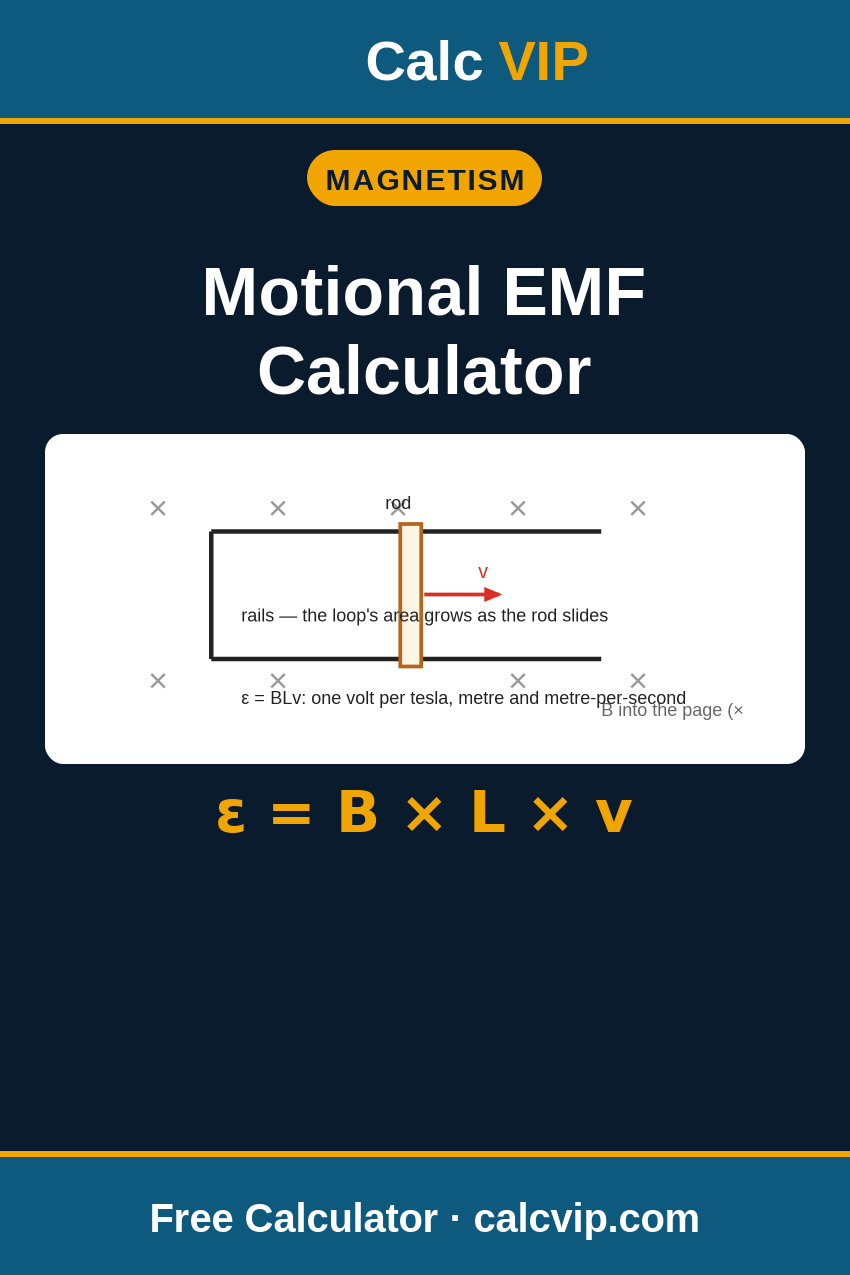
Motional EMF is also Faraday's law in disguise — the most instructive disguise in the subject. A rod sliding on rails enlarges the circuit's area at the rate Lv per second, so the flux grows at BLv per second, and ε = ΔΦ/Δt = BLv falls out. Two viewpoints, one answer: charges pushed along a rod, or flux swept by a growing loop. Whenever the conductor itself moves through a steady field, this is the formula; when instead the field changes around a stationary coil, its sibling ε = N ΔΦ/Δt takes over — and in machines like generators, both descriptions are used interchangeably by the same engineers.
Formula
ε = B × L × v • ε in volts (V), B in tesla (T), L the length of conductor moving across the field in metres (m), v its speed across the field in m/s. The formula assumes the field, the rod and the velocity are all mutually perpendicular — the usual rails arrangement.
If the rod crosses the field at an angle, only the velocity component across the field counts, and a sinθ appears as in the other formulas of this batch. The rearrangements plan experiments: v = ε ÷ (BL) finds the speed needed for a target voltage (Example 6); B = ε ÷ (Lv) turns a moving conductor into a field probe; L = ε ÷ (Bv) sizes the conductor. When the rod slides on rails of resistance R, the EMF drives a current I = ε/R, and that current — sitting in the same field — feels a braking force F = BIL opposing the motion. Mechanical power in then equals electrical power out, Fv = εI, exactly: the energy audit of the depth section below.
| Symbol | Meaning | Units |
|---|---|---|
| ε | motional EMF across the conductor | volts (V) |
| B | magnetic field strength | tesla (T) |
| L | length of conductor in the field (rail separation) | metres (m) |
| v | speed of the conductor across the field | m/s |
The energy audit: why you have to keep pushing
Connect the rails into a circuit and the EMF drives a current. That current flows along the rod, in the field, and so the rod feels F = BIL — directed, by Lenz's law, against its motion. Nothing is free: to keep the rod moving at constant v you must push with exactly that force, supplying mechanical power F × v. Run the numbers for Example 1's rod (ε = 0.3 V) on rails totalling 0.5 Ω: the current is I = 0.3 ÷ 0.5 = 0.6 A; the braking force is F = 0.5 × 0.6 × 0.2 = 0.06 N; the mechanical power is 0.06 × 3 = 0.18 W. The electrical power generated is εI = 0.3 × 0.6 = 0.18 W. The books balance to the last milliwatt — they must, because this identity is energy conservation, and it is the reason regenerative braking slows a car and a dynamo stiffens as you pedal harder.
Disconnect the circuit and the picture changes instructively: the EMF still appears across the rod's ends (the electrons still pile up until electric and magnetic forces balance), but no current flows, no braking force arises, and the rod glides on unopposed doing no work. Motional EMF is a voltage first and a power source only when a circuit lets it be one — the same distinction the induced-EMF page draws for coils.
How to use
- Enter the field strength B in tesla at the conductor's location.
- Enter L, the length of conductor that is both in the field and part of the circuit — for a rod on rails, the distance between the rails, in metres.
- Enter v, the speed at which the conductor moves across the field, in metres per second (90 km/h = 25 m/s; a cruising airliner ≈ 250 m/s).
- Click "Calculate" for the EMF in volts. The arrangement assumed is the square-on one: rod, field and motion mutually perpendicular.
- If the motion is angled, first multiply v by the sine of the angle between the velocity and the field direction's perpendicular plane — equivalently, use only the field-cutting component of the speed.
Worked examples
Example 1 — the bench rod on rails. A rod of length 0.2 m slides at 3 m/s across a 0.5 T field.
ε = BLv = 0.5 × 0.2 × 3 = 0.3 V.
Enough to light an LED dimly and to deflect a good voltmeter decisively — the standard school demonstration of induction without coils.
Example 2 — a bigger, faster rig. A conductor of 0.5 m crosses a 0.8 T field at 10 m/s.
ε = 0.8 × 0.5 × 10 = 4 V. Ten times Example 1's speed and twice the field and length multiply out to a flashlight-battery voltage from motion alone.
Example 3 — an airliner's wing. A jet's wingspan is about 30 m; at cruise, 250 m/s, it cuts the vertical component of the Earth's field, roughly 4 × 10⁻⁵ T.
ε = 4 × 10⁻⁵ × 30 × 250 = 0.3 V from wingtip to wingtip — the same voltage as the bench rod, assembled from a whisper of a field and an enormous length and speed. (It drives no current, because the airframe is not a closed loop through the field — voltage without a circuit, as the concept section describes.)
Example 4 — a slow, careful measurement. A short rod of 0.15 m is drawn at 0.5 m/s through a strong 1.2 T magnet gap.
ε = 1.2 × 0.15 × 0.5 = 0.09 V = 90 mV. Slow need not mean undetectable when the field is strong — the principle of electromagnetic flowmeters and velocity probes.
Example 5 — a space tether. A satellite trails a conducting tether 20 km long, orbiting at 7,600 m/s through the Earth's field of about 3 × 10⁻⁵ T at altitude.
ε = 3 × 10⁻⁵ × 20,000 × 7,600 = 4,560 V ≈ 4.6 kV. This is not hypothetical: a 1996 shuttle tether experiment generated several thousand volts (and currents of an amp class) before the tether broke — motional EMF as a spacecraft power supply, and, run in reverse, as a brake to de-orbit satellites without fuel.
Example 6 — how fast to light a lamp? What speed gives 1.5 V with B = 0.4 T and L = 0.25 m?
v = ε ÷ (BL) = 1.5 ÷ (0.4 × 0.25) = 15 m/s — a fast sprint, or a bicycle at 54 km/h. Hand-cranked torches cheat by gearing the motion and adding turns; raw BLv at human speeds is honest but modest.
Motional EMF in real life
Railguns. The armature bridging two rails is a motional-EMF machine read backwards: a huge current through the armature in the rails' field produces the force F = BIL that launches it. The same three variables, arranged for violence instead of measurement.
Electromagnetic flowmeters. Blood, water or chemicals flowing through a pipe cross a field; the fluid is the moving conductor, and ε = BLv across the pipe reads out the flow speed with no moving parts. Hospitals measure blood flow and water utilities measure mains flow this way (Example 4's regime).
Dynamic microphones. A coil attached to a diaphragm moves in a magnet's gap as sound arrives; the coil's motion through the field generates ε = BLv summed over its turns — the audio signal, generated by motion alone.
Space tethers. Example 5's system flies both ways: let the EMF drive current against the field and the tether drags, lowering the orbit without propellant; drive current the other way from solar panels and the same tether pushes the spacecraft up. BLv as an orbital throttle.
Seismic and vibration sensors. A geophone is a coil suspended in a magnet's field; ground motion moves the coil, and the motional EMF is the earthquake record. The sensitivity of oil-exploration surveys rests on this formula's clean proportionality to velocity.
Regenerative braking feel. The braking force F = BIL of the audit above is what a driver feels: press the pedal, more current is drawn, the opposing force grows. The energy audit's identity — mechanical power in equals electrical power out — is the entire business model of the hybrid car.
One law, two faces: motional EMF and Faraday's law
It is worth seeing the two induction formulas kiss. Slide Example 1's rod for one second: it advances 3 m, and the loop it forms with the rails grows by 0.2 m × 3 m = 0.6 m². The flux grows by ΔΦ = B × ΔA = 0.5 × 0.6 = 0.3 Wb in Δt = 1 s, so Faraday's law gives ε = ΔΦ/Δt = 0.3 V — the BLv answer, obtained by counting area instead of forces on electrons. The agreement is not a coincidence but a consistency requirement of physics; Einstein famously opened his 1905 relativity paper by worrying about exactly this pair of descriptions — magnet moving versus conductor moving — and concluding that only the relative motion can matter. A school-bench formula with a distinguished history.
The Faraday disc: motional EMF from rotation
The first electric generator ever built was a motional-EMF machine with no coils at all. Faraday's disc — a copper disc spinning between a magnet's poles — generates its EMF between the axle and the rim, because every radius of the disc is a rod cutting the field, with its outer end moving fastest. Adding up the contributions along the radius gives ε = ½BωR². For a disc of radius 0.1 m spun at 3,000 rpm (ω = 314 rad/s) in a 1 T field, ε = ½ × 1 × 314 × 0.1² = 1.57 V — a modest voltage, but deliverable at enormous current, because the "circuit" is a solid disc of copper with almost no resistance. Homopolar generators, the disc's industrial descendants, are still built where a few volts at a hundred thousand amps are wanted, for pulsed-power research and electromagnetic forming. It is the purest demonstration that ε = BLv is about charges in moving conductors, not about coils or loops: the disc has neither, and it generates anyway.
Quick reference: EMF of the Example 1 rig (B = 0.5 T, L = 0.2 m) vs speed
| Speed v | ε = BLv | Everyday equivalent |
|---|---|---|
| 1 m/s | 0.1 V | a slow hand slide |
| 3 m/s | 0.3 V | a brisk pull (Example 1) |
| 5 m/s | 0.5 V | a running pace |
| 10 m/s | 1.0 V | a sprinter / city cycling |
| 20 m/s | 2.0 V | a fast train through the station |
Perfectly linear, as the formula promises: BL = 0.1 V per (m/s) for this rig. Scale any row by your own B and L to get your rig's exchange rate between speed and volts.
Common mistakes
- Using the rod's full length instead of the in-field length. L is the separation the field actually spans — the distance between the rails, or the part of the conductor crossing the field. Rod sticking out beyond the magnet contributes nothing.
- Feeding the speed in km/h. v must be in m/s: divide km/h by 3.6. Entering 90 for a car-speed rig overstates the EMF 3.6-fold.
- Assuming a current must flow for the EMF to exist. The voltage appears across an open-circuited rod too; only the braking force and the power need a closed circuit. A voltmeter across a gliding rod reads BLv while drawing essentially nothing.
- Ignoring the angle. BLv assumes motion squarely across the field. A rod sliding partly along the field lines generates only the across-field component's worth — a rod moving parallel to B generates nothing, however fast.
- Mixing up the two EMF formulas. ε = BLv is for a conductor moving in a steady field; ε = N ΔΦ/Δt is the general law (and needs N and a flux change). They agree where both apply — but putting turns into BLv, or rails into Faraday's law without computing ΔΦ, produces hybrids that are neither.
FAQ
Why does a voltage appear across the rod?
The free electrons in the rod are moving charges in a magnetic field, so each feels a force F = qvB along the rod. They pile up at one end, leaving the other end positive — that separation of charge is the EMF. Use Fleming's right-hand rule (the generator rule) for the direction.
Is a current induced, or only an EMF?
The EMF always appears; a current flows only if the circuit is complete. On closed rails the current flows round the loop, and its own field then opposes the motion — you have to keep pushing the rod, which is where the electrical energy comes from.
Where is motional EMF used?
In railguns and linear generators, in some microphones and pickups, and even in aircraft: a plane's wings cut through the Earth's field in flight, inducing a tiny EMF from wingtip to wingtip.
Which end of the rod becomes positive?
The end the electrons are driven away from. Conventional current, if the circuit closes, flows out of that positive end, around the loop and back. Fleming's right-hand rule — thumb for motion, first finger for field, second finger for the induced current — gives the direction directly.
Why doesn't the pile-up of electrons grow forever?
Because the separated charge makes its own electric field along the rod, pushing electrons back. Equilibrium arrives when qE = qvB, i.e. when E = vB — and the EMF is that E multiplied by the rod's length, ε = BLv. The formula is the truce line between the two forces.
What if the rod moves parallel to the field?
No EMF. The magnetic force on the charges is then zero (they move along B, the θ = 0 case), no charge separates, and the rod might as well not be moving. Only field-cutting motion counts.
How is this different from the induced EMF in a coil?
It is the same law wearing work clothes. In a coil, flux changes because the field, area or angle changes; for a moving rod, the flux through its circuit changes because the rod sweeps new area. ε = BLv is Faraday's law specialised to that one moving side — with the bonus that you can also derive it from the force on individual electrons.
Can motional EMF power anything real?
Yes, with scale: the space tether of Example 5 generated kilowatts-class power in tests, flowmeters and geophones earn their living on millivolts of it, and every bicycle dynamo is motional EMF with a rotating magnet playing the rod's role. What it cannot do is beat the energy audit — the watts out are always paid for in watts of pushing.
Does the rod's material matter?
Only through its conductivity. The EMF ε = BLv is the same for copper, aluminium or a flowing liquid metal at the same B, L and v; the material decides how much current (and hence power and braking force) that EMF can drive through the circuit's resistance.
What happens if I double the speed and halve the field?
Nothing changes: ε depends on the product BLv, so the two changes cancel. It is a useful sanity check on the calculator — and on exam answers — that only the product matters.