 Calc
Ohm's Law Solver – Find Voltage, Current or Resistance (V = IR)
 Created by Michael Chen · Electronics Specialist · Last updated: November 2026
Use this free Ohm's Law Solver to find any one of voltage, current or resistance when you know the other two. Pick what you want to find, enter the two known values, and the calculator also shows the power used by the circuit.
Voltage, current and resistance are the three quantities that describe every electric circuit, and Ohm's law is the single rule that ties them together. Voltage is the electrical push a battery or power supply provides, measured in volts. Current is the rate at which charge flows around the circuit, measured in amps. Resistance is the opposition the circuit puts up against that flow, measured in ohms. Whenever two of the three are known, the third is already decided — there is no freedom left — and this solver simply reads off the value the law forces it to be.
The law is named after Georg Ohm, the German physicist who published it in 1827 after careful experiments with wires of different lengths and materials. His finding was disarmingly simple: for a metal conductor held at a steady temperature, the current through it is directly proportional to the voltage across it. Double the voltage and the current doubles; halve the resistance and the current doubles again. That proportionality is why the relationship fits in three letters — V = I × R — yet it underpins everything from choosing a fuse to designing a power station.
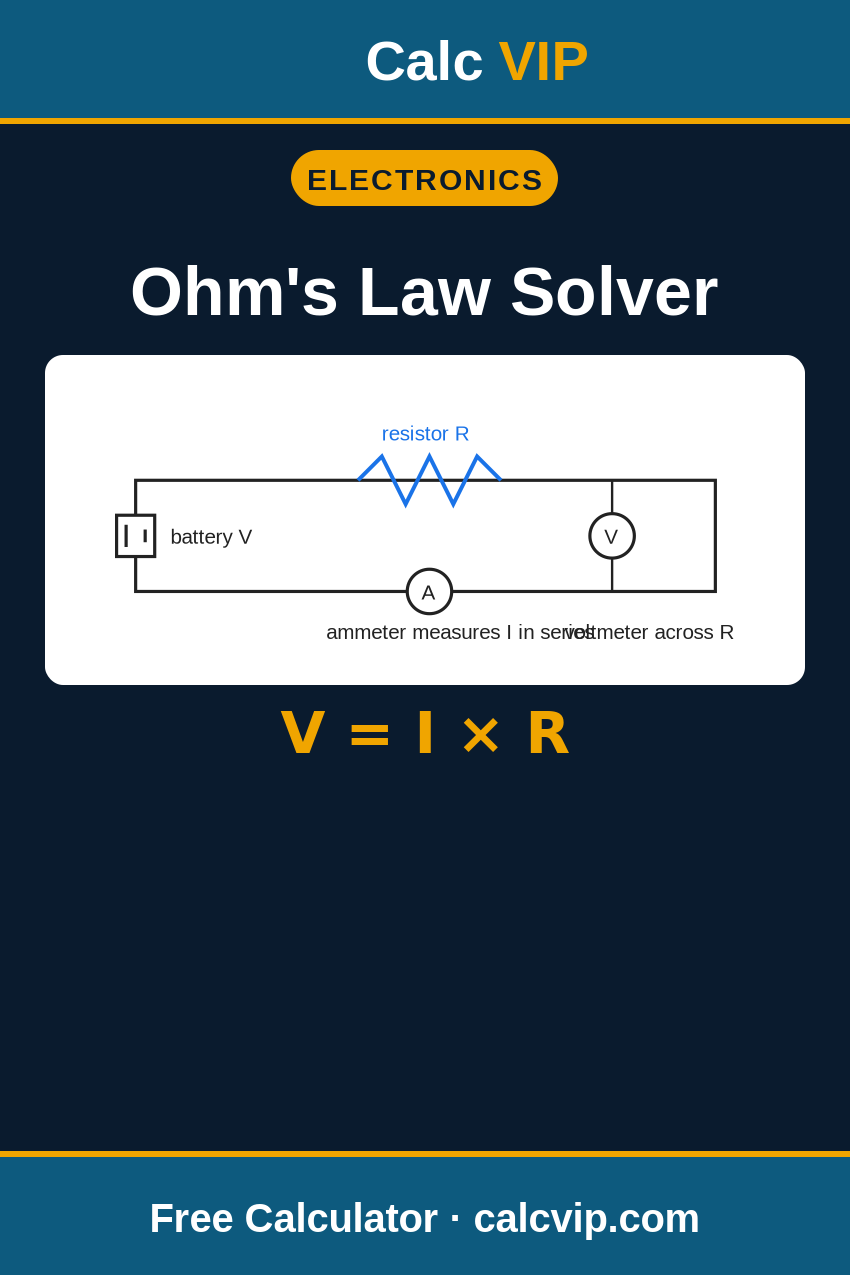
This solver works in all three directions. Set it to find current and it divides voltage by resistance; set it to find voltage and it multiplies current by resistance; set it to find resistance and it divides voltage by current. It also reports the power, P = V × I, because power is where Ohm's law meets the real world of hot components and electricity bills: power tells you how much energy the circuit converts each second, how large a resistor you must buy, and how much heat your design has to get rid of.
Formula
V = I × R • I = V ÷ R • R = V ÷ I • Power: P = V × I
The three forms are one law seen from three sides, and the triangle in the diagram above the calculator is the classic memory aid: cover the quantity you want and the positions of the other two show the operation — V sits over I × R, so I = V ÷ R and R = V ÷ I. Power has its own family of three equivalent forms, obtained by substituting Ohm's law into P = V × I: P = I² × R (best when you know current and resistance) and P = V² ÷ R (best when you know voltage and resistance). All three must always agree — in the worked example below, 12 × 3 = 36 W, 3² × 4 = 36 W and 12² ÷ 4 = 36 W — which makes them a handy self-check on any calculation. One unit warning: the law works in volts, amps and ohms only. Milliamps must become amps (20 mA = 0.02 A) and kilohms must become ohms (4.7 kΩ = 4700 Ω) before the numbers go in.
| Symbol | Meaning | Units |
|---|---|---|
| V | voltage — the electrical push across the component | volts (V) |
| I | current — the rate of flow of charge | amps (A) |
| R | resistance — opposition to the current | ohms (Ω) |
| P | power — energy converted per second | watts (W) |
Push, flow and opposition: what the three quantities really are
The water analogy makes the law intuitive. Voltage behaves like water pressure: it is the push that tries to drive charge around the circuit, supplied by a battery or power source the way a pump supplies pressure. Current behaves like the flow rate of the water — how much charge passes a point each second. Resistance behaves like a narrow or rough section of pipe: the narrower the passage, the less flow a given pressure can force through it. Raise the pressure and the flow rises in proportion; widen the pipe (lower the resistance) and the flow rises too. Every Ohm's law calculation is that picture turned into arithmetic.
Underneath the analogy, current is a drift of electrons through a material whose atoms keep getting in the way. Each collision converts a little of the electrons' energy into heat — which is exactly the power P. Resistance is therefore not a mysterious friction but a collision rate, and anything that changes the collisions changes R: a hotter metal vibrates more and resists more, a longer wire offers more collisions along the path, and a thicker wire offers more parallel paths so the collisions matter less. Those are the same dependencies the resistivity formula R = ρL/A captures on the resistivity page of this site.
The proportionality has a boundary, and knowing it prevents real mistakes. Ohm's law in its simple form holds while R stays constant — true for metal resistors near room temperature, false for many interesting components. A filament lamp's resistance climbs roughly tenfold as it heats to white heat, so its current grows more slowly than the voltage; a diode barely conducts at all until about 0.7 V and then conducts almost freely; a transistor's behaviour is controlled by a third terminal. For those devices "resistance" is still definable at each operating point as V ÷ I, but it is a moving target, and predictions must be made point by point rather than with one division.
How to use
- Choose the quantity you want to find — voltage, current or resistance — from the first list. The two input labels change to match.
- Enter the two values you already know, in volts, amps and ohms (convert milliamps and kilohms first: divide mA by 1000, multiply kΩ by 1000).
- Click "Calculate" — the solver shows all three values (V, I and R) plus the power P in watts.
- Use the power figure to choose component ratings: a resistor should be rated at least twice the calculated power for a comfortable safety margin.
- Sanity-check the result against the law's direction: if your resistance went up and the voltage stayed fixed, the current must have gone down. If it did not, an input is wrong.
Worked examples
Example 1 — finding current. A resistor of 4 Ω is connected across a 12 V battery.
I = V ÷ R = 12 ÷ 4 = 3 A. The power used is P = V × I = 12 × 3 = 36 W — a seriously warm resistor, needing a high-wattage part.
Example 2 — finding voltage. A current of 2.5 A flows through an 8 Ω heating element.
V = I × R = 2.5 × 8 = 20 V. Power: P = 20 × 2.5 = 50 W of heat.
Example 3 — finding resistance. A circuit connected to 24 V draws 0.5 A.
R = V ÷ I = 24 ÷ 0.5 = 48 Ω. Power: P = 24 × 0.5 = 12 W.
Example 4 — a PP3 battery. A 9 V battery is connected to a 27 Ω resistor.
I = 9 ÷ 27 = 0.333 A (333 mA), and P = 9 × 0.333 = 3 W. Small battery, noticeable drain — it would not last long.
Example 5 — a mains heater. A heater element measures 23 Ω on the 230 V mains.
I = 230 ÷ 23 = 10 A, and P = 230 × 10 = 2300 W — the familiar 2.3 kW of a typical fan heater, and the reason it needs a properly rated socket.
Example 6 — working backwards from power. A car headlamp bulb is rated 55 W on a 12 V system.
I = P ÷ V = 55 ÷ 12 = 4.583 A, and R = V ÷ I = 12 ÷ 4.583 = 2.618 Ω — the filament's hot resistance. Measured cold with a multimeter it would read far less, because the filament only reaches 2.618 Ω at full working temperature.
Ohm's law in real life
Choosing fuses. A fuse is picked from the current a device should draw, which Ohm's law predicts: a 2300 W heater on 230 V draws 10 A, so a 13 A fuse protects it — while a fault that drops the resistance sends the current soaring and blows the fuse before the cable overheats.
Sizing resistors for LEDs. Every LED circuit begins with this solver: the resistor must drop the surplus voltage at the chosen current, R = (Vs − Vf) ÷ If. The LED resistor page of this site automates exactly that calculation, including the standard value to buy.
Why birds sit safely on power lines. A bird's body bridges a few centimetres of cable, across which the voltage difference is a tiny fraction of a volt. V is nearly zero, so the current through the bird is nearly zero — the law explains the everyday mystery in one line.
Electric shock severity. What makes a voltage dangerous is the current it can drive through the body: 230 V across dry skin (around 10,000 Ω) drives about 23 mA — already hazardous — while the same voltage across wet skin, with far lower resistance, drives far more. Voltage hurts only through the current it creates.
Testing components with a multimeter. Resistance mode applies a small known voltage and measures the current — Ohm's law run in reverse inside the meter. It is also why resistance must be measured with the power off: an external voltage corrupts the meter's own calculation.
Voltage drop on long cables. Cable has resistance, so the load at the far end receives less than the supply voltage — the missing volts are I × R of the cable itself. Garden lights that dim along the run are Ohm's law made visible; the voltage drop page quantifies it.
The three power formulas — and picking the fastest one
Power questions appear in three costumes, and each has a shortcut. Given V and I, use P = V × I directly. Given I and R — common when a current is forced through a known resistor, as in a cable or a fuse — P = I²R avoids finding V first: 2 A through 10 Ω dissipates 2² × 10 = 40 W. Given V and R — the mains situation, where the voltage is fixed by the socket — P = V² ÷ R is fastest: the 4 Ω resistor of Example 1 on 12 V gives 12² ÷ 4 = 36 W, matching the other two routes. Notice what P = V² ÷ R reveals: on a fixed voltage, lower resistance means more power, which is why a short circuit (R near zero) is so violent, and why heater elements are deliberately made with low resistance while insulation is made with enormous resistance.
Quick reference: familiar circuits through Ohm's eyes
| Circuit | V | I | R | P |
|---|---|---|---|---|
| worked example resistor | 12 V | 3 A | 4 Ω | 36 W |
| USB fan | 5 V | 0.5 A | 10 Ω | 2.5 W |
| torch bulb | 3 V | 0.3 A | 10 Ω | 0.9 W |
| car headlamp (hot) | 12 V | 4.583 A | 2.618 Ω | 55 W |
| mains fan heater | 230 V | 10 A | 23 Ω | 2300 W |
Read any row across and the law checks itself: V always equals I × R, and P always equals V × I. The table also shows the law's range — the same three-letter rule describes a 0.9 W torch bulb and a 2300 W heater without changing a single symbol.
Internal resistance: why real batteries sag
The law's cleanest classroom form assumes the supply holds its voltage whatever the current. Real sources cannot: every battery and power supply has internal resistance in series with its ideal voltage, so the terminal voltage sags by I × r as current rises. A car battery with an internal resistance of just 0.02 Ω loses 2 V at the 100 A a starter motor demands — which is why headlights dim during cranking, and why a battery can read a healthy 12.6 V on a meter yet fail to start the car: the meter draws almost no current, so almost no voltage is lost inside. Ohm's law has not failed here; it has gained a component. Model the source as an ideal voltage behind a small resistor, apply V = I × R to the whole loop including that resistor, and every sag, dip and dimming light in this paragraph — and in the voltage drop page's starting-dip discussion — is accounted for.
Common mistakes
- Feeding milliamps into the formula as amps. 20 mA is 0.02 A. Using "20" makes the current a thousand times too big and every later answer nonsense. Convert first, calculate second.
- Assuming a lamp or LED has one fixed resistance. Filament resistance rises about tenfold from cold to hot, and an LED's V–I curve is a cliff, not a slope. Ohm's law still defines R at each point, but yesterday's R will not predict today's current.
- Using the supply voltage instead of the voltage across the component. In a series circuit the supply is shared. The V in the law is always the voltage across the particular component whose I and R you are using — measure or calculate that drop, not the battery's headline figure.
- Believing a bigger battery forces more current through everything. The load's resistance decides the current at a given voltage. A car battery and a watch battery can both be labelled in volts, but each circuit draws only what V ÷ R allows — capacity affects how long, not how hard, the push is.
- Ignoring the power answer. A correct current through an undersized resistor is still a burnt resistor. The P figure is part of the answer, not decoration: rate components at roughly twice the expected power.
FAQ
What is Ohm's law?
It says the current through a resistor is directly proportional to the voltage across it: V = I × R. Double the voltage and (for the same resistor) the current doubles too.
Does Ohm's law work for every component?
It works exactly for "ohmic" components such as metal resistors at a steady temperature. Lamps, diodes and transistors do not follow it exactly because their resistance changes.
Why does the calculator also show power?
Power tells you how fast electrical energy is turned into heat or light, and it decides the wattage rating of resistor you need. P = V × I = I²R = V² ÷ R.
How do I convert milliamps and kilohms for this calculator?
Divide milliamps by 1000 to get amps (250 mA = 0.25 A), and multiply kilohms by 1000 to get ohms (4.7 kΩ = 4700 Ω). The law itself only speaks volts, amps and ohms.
What happens to the current if I double the voltage but also double the resistance?
Nothing — the two changes cancel. I = (2V) ÷ (2R) = V ÷ R, the original current. Proportionality cuts both ways, which is why long-distance power lines raise voltage and effective resistance together.
Can resistance ever be zero?
In ordinary circuits, no — even good cable has a little. Superconductors below their critical temperature do reach true zero resistance, which is why they can carry persistent currents for years; in everyday work, treat zero as a short circuit and expect the current to be limited only by the supply.
Why does my multimeter show a different resistance for a bulb than Ohm's law suggests?
The meter measures the cold filament; Ohm's law with the rated power describes the white-hot filament, whose resistance is roughly ten times higher. Both are correct — at different temperatures. The resistance-and-temperature page shows how to convert between them.
Does Ohm's law apply to AC?
For resistors, yes, instant by instant and for RMS values. For coils and capacitors, AC meets reactance as well as resistance, and the combined opposition is called impedance — same triangle idea, wider cast.
What is a short circuit in Ohm's law terms?
A path with resistance close to zero across a supply. I = V ÷ R explodes as R shrinks, so the current is limited only by the wiring and the supply's internal resistance — hence sparks, heat and blown fuses.
Who was Ohm, and why did the unit take his name?
Georg Simon Ohm (1789–1854), a German schoolteacher whose 1827 experiments with wires established V = I × R. His work was initially dismissed in Germany and recognised first in Britain; the ohm was later adopted as the international unit of resistance in his honour.