 Calc
Resistance Temperature Calculator – R = R₀(1 + αΔT)
 Created by Michael Chen · Electronics Specialist · Last updated: November 2026
Use this free Resistance and Temperature Calculator to find how a resistor's value changes when it heats up or cools down. Enter the starting resistance, the temperature change and the material — the calculator uses R = R₀(1 + αΔT).
Resistance is not a fixed label printed on a component — for most materials it is a moving quantity that drifts with temperature. A copper motor winding measured on a cold morning and again after an hour's hard work will give two noticeably different readings, and neither measurement is wrong. The link between them is the temperature coefficient of resistance, α: the fractional change in resistance for each degree of temperature change. This calculator applies that link in its standard linear form, R = R₀(1 + αΔT), converting a resistance known at one temperature into the resistance at any other.
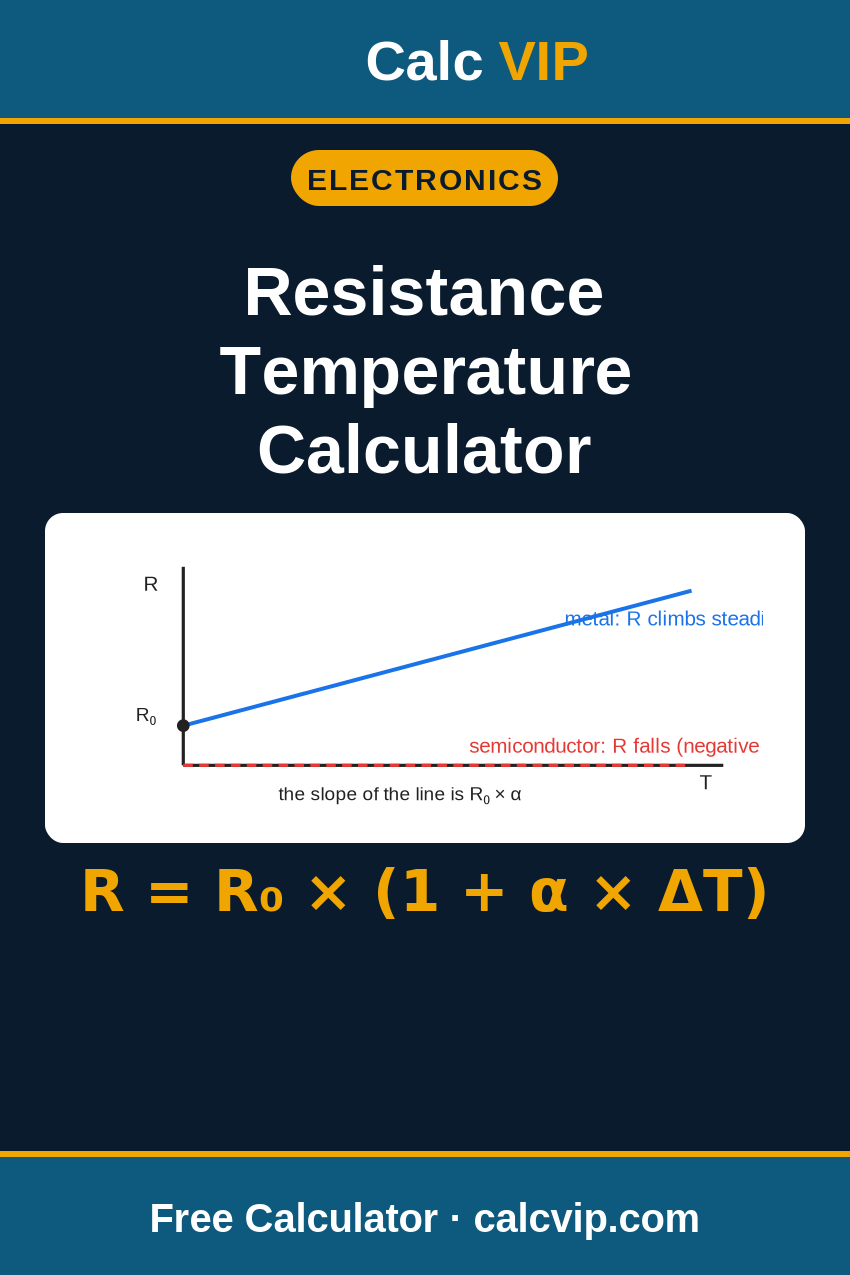
The size of the effect depends entirely on the material. For pure metals α is roughly +0.004 per degree — about +0.4% per °C — so a 50 °C rise lifts a copper coil's resistance by nearly 20%, a change far too big for motor designers, meter makers or fuse engineers to ignore. Alloys bred for stability, such as constantan, push α down to almost zero; carbon and semiconductors run the other way with a negative α, their resistance falling as they warm. One small coefficient, three very different engineering behaviours — and this calculator handles all of them, negative values included.
Choose the material and the calculator fills in α for copper, aluminium or tungsten, or select Custom and type any coefficient yourself — platinum's 0.00385 for sensor work, nichrome's tiny 0.0004 for heating elements, a negative value for a thermistor estimate. Enter the resistance at its starting temperature, the start and finish temperatures, and you get the new resistance, the absolute change, and the percentage change for the temperature step you chose.
Formula
R = R₀ × (1 + α × ΔT), where ΔT = T₂ − T₁ and α is the temperature coefficient of resistance of the material.
Read the formula as a sentence: the new resistance is the old resistance, plus a correction of α for every degree of change. α × ΔT is a pure fraction — for copper over 50 °C it is 0.00393 × 50 = 0.1965, a 19.65% rise — so the bracket (1 + αΔT) is simply "one plus the fractional change". The same formula rearranges to find the temperature from a resistance measurement: ΔT = (R ÷ R₀ − 1) ÷ α, which is precisely how resistance thermometers work, and to find the starting resistance from a hot measurement: R₀ = R ÷ (1 + αΔT). The linear form is an approximation that serves metals well over a few hundred degrees; across truly huge spans (a filament's 2700 °C) it gives good estimates rather than exact values, and cryogenic temperatures break it entirely as resistance flattens towards a residual floor.
| Symbol | Meaning | Units |
|---|---|---|
| R | resistance at the final temperature | ohms (Ω) |
| R₀ | resistance at the starting (reference) temperature | ohms (Ω) |
| α | temperature coefficient of resistance | per °C (/°C) |
| ΔT | temperature change, T₂ − T₁ | °C (same size as kelvin) |
Why heat resists: the physics inside α
In a metal, current is a drift of free electrons through a lattice of atoms. At absolute zero the lattice would sit still and the electrons would glide with little opposition beyond impurities and defects. Warm the metal and the atoms vibrate with growing energy, swinging into the electrons' paths ever more often. Each collision randomises an electron's drift and hands its ordered energy to the lattice as heat. More temperature means more violent vibration, more collisions per metre of travel, and therefore more resistance — a direct, almost mechanical explanation of why α is positive for every pure metal.
Semiconductors tell the opposite story because their bottleneck is different. They have few free charge carriers at room temperature, and heat's main effect is to liberate more carriers from their atoms — each degree adds far more new carriers than it adds collisions. With more carriers available, resistance falls steeply as temperature rises: a strongly negative α. That asymmetry is a gift to engineers. A bead of semiconductor with a large negative α is a thermistor, an exquisitely sensitive thermometer; a strip of platinum with a modest, very stable positive α is the RTD, the workhorse precision temperature sensor of industry. The same one-line formula calibrates both.
Alloys occupy the engineered middle. Stirring foreign atoms into a metal adds permanent scattering that dwarfs the thermal part, so α collapses towards zero: constantan's resistance barely notices a 100 °C swing. That is exactly what you want for a meter shunt or a standard resistor, whose whole job is to be the same resistance today, tomorrow, hot or cold. Material scientists treat α as a design variable — pure metal for sensors that must respond, disordered alloy for components that must not.
How to use
- Enter the resistance R₀ measured at the starting temperature — a multimeter reading, a datasheet value, or a nameplate figure.
- Pick the material (or choose "Custom" and type α yourself, negative if the material is a semiconductor or carbon).
- Enter the starting and final temperatures in °C, then click "Calculate".
- Read the new resistance plus the change in ohms and percent. To run the problem backwards — find a temperature from a hot resistance reading — rearrange as ΔT = (R ÷ R₀ − 1) ÷ α and add T₁.
Worked examples
Example 1 — a copper coil warming up. R₀ = 100 Ω at 20 °C, heated to 70 °C, α = 0.00393 /°C.
ΔT = 50 °C, so R = 100 × (1 + 0.00393 × 50) = 100 × 1.1965 = 119.65 Ω — an increase of 19.65 Ω, or 19.65%.
Example 2 — an aluminium winding at full load. R₀ = 50 Ω at 20 °C, running at 120 °C, α = 0.00403 /°C.
ΔT = 100 °C, so R = 50 × (1 + 0.00403 × 100) = 50 × 1.403 = 70.15 Ω. A designer who sized the current from the cold value would overload this winding by 40%.
Example 3 — a tungsten filament, cold to white-hot. R₀ = 30 Ω at 20 °C, filament at 2700 °C, α = 0.0045 /°C.
ΔT = 2680 °C, so R = 30 × (1 + 0.0045 × 2680) = 30 × 13.06 = 391.8 Ω. The thirteen-fold climb is why the switch-on surge is so much larger than the running current — and why bulbs die at the moment of switching.
Example 4 — cooling a copper coil. R₀ = 100 Ω at 20 °C, cooled to −20 °C.
ΔT = −40 °C, so R = 100 × (1 − 0.00393 × 40) = 100 × 0.8428 = 84.28 Ω. The formula handles cooling with nothing more than a negative ΔT — no special case needed.
Example 5 — a Pt100 platinum sensor. Platinum's α = 0.00385 /°C (use Custom), R₀ = 100 Ω at 0 °C, warmed to 100 °C.
R = 100 × (1 + 0.00385 × 100) = 138.5 Ω. That exact figure is printed in every Pt100 table — at 50 °C the same maths gives 119.25 Ω — and the sensor's steady 0.385 Ω per degree is what the measuring instrument reads.
Example 6 — nichrome barely moves. A heating element of R₀ = 20 Ω at 20 °C runs at 800 °C; nichrome's α ≈ 0.0004 /°C (use Custom).
R = 20 × (1 + 0.0004 × 780) = 20 × 1.312 = 26.24 Ω — only 31.2% up across a 780-degree climb. Compare tungsten's thirteen-fold rise: low α is precisely why nichrome, not a pure metal, makes heating elements predictable.
Resistance and temperature in real life
Resistance thermometers (RTDs). Industry measures temperature by measuring resistance: a Pt100 element, this calculator's Example 5, sits in pipes, ovens and engines worldwide, converting temperature into ohms with no moving parts and excellent stability. The instrument inverts the formula to display degrees.
Motor and transformer protection. A winding's resistance rise is a built-in thermometer. Test engineers measure a motor's winding cold, run it, measure again hot, and use ΔT = (R ÷ R₀ − 1) ÷ α to prove the internal temperature stayed within its insulation class — no sensor inside the machine required.
The cold-bulb surge. Example 3 explains a household mystery: bulbs almost always fail at switch-on. The cold filament's low resistance admits a current many times the running value for the first fraction of a second, thermally shocking the aged filament at its weakest point.
Thermistors in everyday gadgets. The strongly negative α of semiconductor beads guards battery packs (charging pauses if the pack gets hot), starts fridge compressors, and gives cheap digital thermometers their sensor. Their α is so large and so curved that the linear formula only sketches them — but the sign and the idea come from here.
Why fuses and breakers care about ambient heat. A fuse is a small resistance heated by its own current; on a hot day it starts closer to melting, so its effective rating sags. The same physics derates cables in hot roof spaces — current tables quietly assume the α of copper doing its work.
Superconductor surprises. Cool certain materials far enough and the gentle linear fall of resistance ends in a cliff: at the critical temperature resistance vanishes completely. MRI scanners live on that cliff edge; this calculator's straight line is the well-behaved world above it.
Quick reference: temperature coefficients
| Material | α (per °C) | Character |
|---|---|---|
| Silver | ≈ 0.0038 | pure metal — strong, steady rise |
| Copper | 0.00393 | windings, cables — the reference case |
| Aluminium | 0.00403 | slightly livelier than copper |
| Platinum | 0.00385 | very stable — the sensor metal |
| Tungsten | 0.0045 | filaments — huge cold-to-hot swing |
| Nichrome | ≈ 0.0004 | heating elements — deliberately dull |
| Constantan | ≈ 0.00002 | precision resistors — nearly zero |
| Carbon | ≈ −0.0005 | negative — falls as it warms |
The table reads as a design menu. Need a sensor? Pick a large, stable α. Need a component that ignores temperature? Pick an alloy whose α is a rounding error. Need a heater whose power stays put from cold start to glowing steady state? Nichrome's small α is the compromise that runs every kettle and toaster.
When the straight line bends
The linear formula is the first term of a truer curve, and two situations expose it. Over very wide spans, α itself drifts with temperature, so standards laboratories add a small quadratic term — the Callendar–Van Dusen equation for platinum sensors does exactly this, which is how RTDs stay honest from −200 °C to +850 °C. And at cryogenic temperatures, metal resistance stops falling altogether and levels at a residual value set by impurities, long before absolute zero. Within the everyday span of electronics — roughly −50 °C to +250 °C — the straight line in this calculator is accurate to a fraction of a percent for pure metals, which is why it remains the working formula of electricians and test engineers.
Self-heating: when the measurement changes the answer
There is a subtlety hiding in every resistance measurement: the current used to measure a resistor warms it. A multimeter's test current is tiny and the effect negligible for ordinary parts, but pass a working current through a component and its temperature — therefore its resistance — climbs until heat loss balances heat gain. This self-heating is why a filament lamp's cold resistance (measured in ohms on a meter) and its hot resistance (computed from its running voltage and current) differ tenfold, and why precision resistors carry power ratings that are really promises about how far self-heating may push them. It also gives engineers a deliberate tool: a small bead of negative-α material, warmed by its own current, becomes a self-regulating heater or an inrush limiter that starts resistive and relaxes as it warms. Whenever a measured resistance refuses to match the nameplate, ask first what temperature the part was at — including the temperature your own measurement just gave it.
The same effect explains the gentle drift in long-running equipment: a power supply's sense resistor warms over the first half hour, its value wanders by its α times its temperature rise, and the output it governs wanders with it. Designs that care — laboratory supplies, audio amplifiers, metering — either choose low-α parts for those positions, oversize them so self-heating stays small, or warm up before they are trusted. The straight line in this calculator, run with the part's working temperature rather than the room's, predicts the settled value.
Common mistakes
- Using the final temperature instead of the change. The formula wants ΔT, the difference. From 20 °C to 70 °C, ΔT is 50, not 70. Using 70 inflates the correction by 40% — the single most common error with this calculator.
- Quoting α from the wrong reference temperature. Published α values are usually stated at 20 °C. Applying a 20 °C coefficient to a resistance measured at 100 °C double-counts part of the rise. Chain the calculation in steps, or use a coefficient stated for your starting point.
- Expecting the formula to fit a thermistor precisely. NTC thermistors follow a steep exponential (the B-parameter law), not a straight line. A negative α in this calculator gives a rough local estimate only — fine for sketching, wrong for calibration.
- Measuring a winding "hot" after it has cooled. A motor winding sheds heat within minutes of switch-off, and its resistance falls with it. Temperature-rise tests extrapolate the cooling curve back to the instant of shutdown; a leisurely measurement understates the true hot resistance.
- Forgetting that the meter leads add resistance. On low-value windings the test leads' own fraction of an ohm rivals the change you are hunting. Use a four-wire measurement, or short the leads and subtract their reading first.
FAQ
Why does resistance rise with temperature in metals?
Heat makes the metal atoms vibrate more, so the moving electrons collide with them more often. More collisions mean more opposition to the current — a higher resistance.
Why is a light bulb's resistance low when it is cold?
A tungsten filament's resistance rises about 10–15 times from room temperature to its white-hot working temperature. That is why bulbs often blow at switch-on, when the cold filament draws a surge of current.
Do all materials behave this way?
No. Semiconductors and carbon have a negative α — their resistance falls as they warm up. The formula still works; just use a negative value of α.
Can I find the temperature if I know both resistances?
Yes — rearrange: ΔT = (R ÷ R₀ − 1) ÷ α, then add the starting temperature. A copper winding that rises from 100 Ω to 119.65 Ω has warmed by (1.1965 − 1) ÷ 0.00393 = 50 °C. This inversion is the entire principle of resistance thermometry.
Does it matter whether I work in °C or kelvin?
For the change, no: a step of 1 °C is exactly a step of 1 K, so ΔT is identical in both. Just be consistent — enter both temperatures on the same scale, and never convert only one of them.
Why does the calculator ask for the starting temperature at all?
Because α is defined relative to the temperature at which R₀ was measured. The pair (R₀, T₁) anchors the line; T₂ is where you slide along it. A resistance quoted without its temperature is only half a specification.
What α should I use for a material not in the list?
Look it up and choose Custom: platinum 0.00385, iron ≈ 0.005, nichrome ≈ 0.0004, constantan ≈ 0.00002, carbon ≈ −0.0005. Values vary slightly between sources and alloys, so treat the third decimal as approximate.
How much does a copper cable's resistance rise on a hot roof?
From 20 °C to 70 °C the rise is 19.65% (Example 1). That extra resistance drops extra voltage and wastes extra power, which is why wiring regulations derate cables installed in hot spaces.
Is the percentage change the same for any starting resistance?
Yes. The percentage change is α × ΔT × 100, independent of R₀: every copper component, from a 0.1 Ω shunt to a 10 kΩ coil, gains the same 19.65% between 20 °C and 70 °C. Only the ohmic change scales with size.
What happens at absolute zero?
The linear formula would predict resistance reaching zero at about −234 °C for copper, but nature disagrees: real metals level off at a small residual resistance set by impurities, and superconductors drop to true zero suddenly at their critical temperature instead. The formula is a working approximation for ordinary temperatures, not a law of the deep cold.