 Calc
Resistivity Solver – R = ρL/A, Solve for ρ, L or A
 Created by Michael Chen · Electronics Specialist · Last updated: November 2026
Use this free Resistivity Solver to work with the resistance formula R = ρL/A. You can find the resistance of a wire, or solve backwards for the resistivity ρ, the length L or the cross-section area A.
Resistance is a property of an object; resistivity is a property of a material. Two wires of copper, one long and thin, one short and fat, have very different resistances — but they share exactly the same resistivity, because resistivity describes the copper itself, not the shape it has been drawn into. The formula R = ρL/A separates the two ideas cleanly: ρ (the Greek letter rho) carries the material's nature, while L and A carry the geometry. Change the material and ρ changes; change only the shape and ρ stands still while R moves.
The numbers involved span an astonishing range. Silver, the best ordinary conductor, has a resistivity of about 1.59 × 10⁻⁸ Ω·m; copper follows at 1.68 × 10⁻⁸, barely 5% worse and far cheaper, which is why the world's wiring is copper. At the other end of the scale, glass and rubber sit around 10¹⁰–10¹⁴ Ω·m — some twenty orders of magnitude higher — and heating alloys such as nichrome sit deliberately in between at 1.1 × 10⁻⁶ Ω·m, about 65 times copper's value, turning electrical energy into heat exactly where it is wanted. One formula, one material constant, and the whole landscape of conductors, heating elements and insulators falls out.
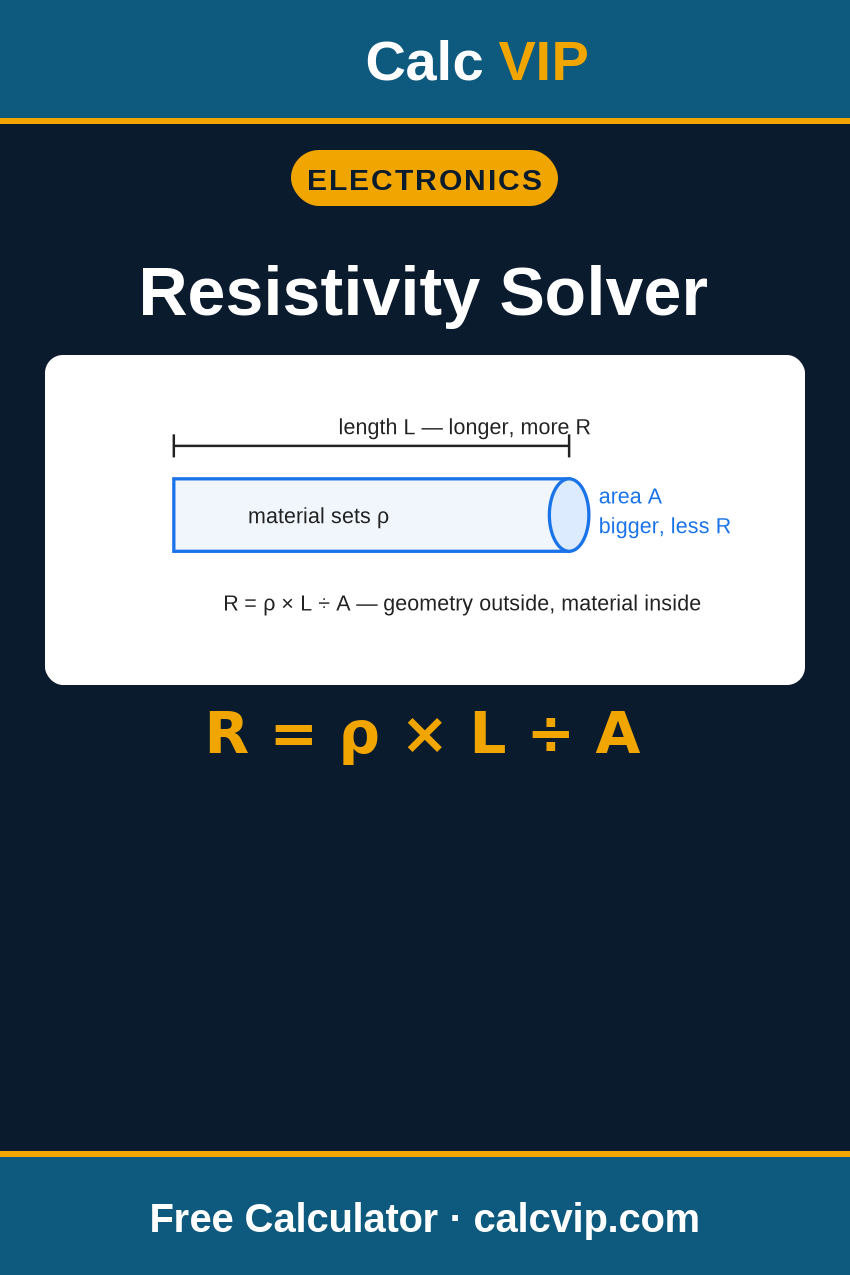
This solver turns the formula in all four directions. Most often you will find the resistance of a real wire from its material, length and cross-section. But the rearrangements earn their keep too: solve for ρ to identify an unknown wire from a measured resistance; solve for L to find how much cable a resistance budget allows; solve for A to choose the thinnest wire that still meets a specification. A material picker fills in ρ for copper, aluminium, iron and nichrome, or you can type any value of your own.
Formula
R = ρ × L ÷ A • ρ = R × A ÷ L • L = R × A ÷ ρ • A = ρ × L ÷ R
Each rearrangement is the same statement wearing a different hat: resistance grows in direct proportion to length and resistivity, and shrinks in inverse proportion to area. The unit discipline matters more here than in almost any other school formula. Length must be in metres and area in square metres for ρ to emerge in Ω·m — and since real wires are specified in square millimetres, the conversion 1 mm² = 10⁻⁶ m² does heavy lifting (this calculator performs it internally). Forget that factor of a million and the answer is wrong by exactly a million, an error large enough to notice but easy to make at speed. Resistivity itself is defined at a stated temperature, conventionally 20 °C, because ρ drifts as the material warms — the resistance-and-temperature page handles that correction.
| Symbol | Meaning | Units |
|---|---|---|
| R | resistance of the actual piece of wire | ohms (Ω) |
| ρ | resistivity — the material's own opposition | ohm·metre (Ω·m) |
| L | length of the conductor | metres (m) |
| A | cross-section area | m² (enter mm² in the calculator) |
Why geometry enters exactly this way
Picture the current as traffic. Doubling the length of the wire doubles the number of atoms an electron must negotiate on its journey — twice the collisions, twice the resistance; the proportionality to L is simply counting obstacles along the road. Doubling the area is different: it does not shorten anyone's journey, it opens a second identical road alongside the first. Two equal paths in parallel halve the total resistance, which is why R falls as 1/A rather than with any other power. The formula's shape is not a convention; it is the arithmetic of series obstacles and parallel paths applied to a uniform material.
That picture also explains the one conversion that trips everyone: area from diameter. Wires are sold by cross-section area, but measured with callipers by diameter, and the two are linked by A = πd² ÷ 4. A "2.5 mm²" cable has a conductor diameter of √(4 × 2.5 ÷ π) ≈ 1.78 mm; a 1.5 mm² conductor measures about 1.38 mm across. Because the diameter is squared, modest thickening buys a lot of area: doubling the diameter quadruples A and quarters the resistance — the cheapest way to fix an overheating or voltage-dropping cable run is usually one size up, not a exotic material.
Resistivity itself has a microscopic story. In a metal, a sea of free electrons drifts through a lattice of positive ions; ρ measures how effectively that lattice, its impurities and its thermal vibrations scatter the drift. Pure metals scatter least, which is why alloying — deliberately adding impurity atoms — raises ρ so reliably: constantan and nichrome are engineered scatterers. Semiconductors live by different rules (their carrier count, not just scattering, changes with conditions), and superconductors break the scale entirely with ρ = 0 below a critical temperature. The humble ρ in this formula is a fingerprint of everything happening at the atomic scale.
How to use
- Choose what to find: resistance, resistivity, length or area — the field you are solving for hides automatically.
- Pick a material to fill in ρ, or choose "Custom" and type your own value in Ω·m (use exponent form such as 1.68e-8 if you like).
- Enter the remaining values: length in metres, area in square millimetres, resistance in ohms as required.
- Click "Calculate" and read the answer in the matching unit — ohms, Ω·m, metres or mm².
- Cross-check with the doubling rules: doubling your length should double R; doubling the area should halve it. If the calculator disagrees, an input unit has slipped.
Worked examples
Example 1 — resistance of a copper wire. Copper (ρ = 1.68 × 10⁻⁸ Ω·m), L = 50 m, A = 2.5 mm² = 2.5 × 10⁻⁶ m².
R = ρL ÷ A = (1.68 × 10⁻⁸ × 50) ÷ (2.5 × 10⁻⁶) = 0.336 Ω. Small — but at 20 A it would still drop nearly 7 V, which is why cable resistance matters.
Example 2 — an aluminium overhead line. Aluminium (ρ = 2.82 × 10⁻⁸ Ω·m), L = 1000 m, A = 50 mm².
R = (2.82 × 10⁻⁸ × 1000) ÷ (50 × 10⁻⁶) = 0.564 Ω per kilometre. Aluminium's ρ is two-thirds higher than copper's, but it is far lighter — the reason pylons carry aluminium, not copper.
Example 3 — a nichrome heater element. Nichrome (ρ = 1.1 × 10⁻⁶ Ω·m), L = 5 m of wire with A = 0.5 mm².
R = (1.1 × 10⁻⁶ × 5) ÷ (0.5 × 10⁻⁶) = 11 Ω. On 230 V that draws 230 ÷ 11 ≈ 20.9 A and converts about 4800 W — kettle territory, from just five metres of the right alloy.
Example 4 — solving for length. How much 1.5 mm² copper cable gives exactly R = 1 Ω?
L = R × A ÷ ρ = (1 × 1.5 × 10⁻⁶) ÷ (1.68 × 10⁻⁸) = 89.29 m. A useful rule of thumb hides here: 1.5 mm² copper gains roughly 1 Ω every 89 metres.
Example 5 — solving for area. A 30 m copper run must not exceed R = 0.5 Ω.
A = ρ × L ÷ R = (1.68 × 10⁻⁸ × 30) ÷ 0.5 = 1.008 × 10⁻⁶ m² = 1.008 mm² — so the next standard size up, 1.5 mm², is the practical choice.
Example 6 — identifying an unknown wire. A coil measures R = 0.282 Ω; it is 10 m long with area 1 mm².
ρ = R × A ÷ L = (0.282 × 1 × 10⁻⁶) ÷ 10 = 2.82 × 10⁻⁸ Ω·m — aluminium, identified from one resistance measurement and a ruler.
Resistivity in real life
Why copper rules the walls. Silver beats copper's resistivity by only about 5%, at many times the price, so copper — second-best conductor, affordable, solderable, ductile — became the default for building wiring, with aluminium taking the overhead lines where weight matters more than the extra bulk.
Heating elements are resistivity on purpose. Kettles, toasters and hair dryers need a compact wire that resists strongly and survives glowing heat without oxidising away. Nichrome's ρ (65× copper's) plus its heat-proof oxide skin make it the near-universal choice — Example 3's arithmetic is every kettle ever made.
Fuses and current-limiting. A fuse wire is a calibrated weak link: its material and cross-section set a resistance that heats past melting exactly at the rated current. The same R = ρL/A that sizes cables sizes the sacrificial wire that protects them.
Precision resistors from alloys. Constantan and manganin have resistivities around 4.9 × 10⁻⁷ Ω·m that barely move with temperature — ideal for meter shunts and strain gauges, where the resistance must mean the same thing hot or cold.
Earth electrodes and soil. Resistivity is not only for metals: soil ρ (typically 10–1000 Ω·m depending on moisture) decides how well an earth rod works, and engineers survey it before designing an earthing system — the same formula, with dirt as the conductor.
Printed circuit tracks. A PCB trace is a very flat wire: 35 µm of copper, a millimetre wide, has an area of 0.035 mm², so a 10 cm track already holds about 0.048 Ω — enough to matter in high-current or precision circuits, and computed with this very formula.
Quick reference: resistivity of common materials at 20 °C
| Material | ρ (Ω·m) | Typical job |
|---|---|---|
| Silver | 1.59 × 10⁻⁸ | contacts, high-end RF parts |
| Copper | 1.68 × 10⁻⁸ | house wiring, motors, PCBs |
| Gold | 2.44 × 10⁻⁸ | connector plating (never corrodes) |
| Aluminium | 2.82 × 10⁻⁸ | overhead power lines |
| Tungsten | 5.6 × 10⁻⁸ | lamp filaments |
| Iron | 9.7 × 10⁻⁸ | — (rarely used as a conductor) |
| Constantan | 4.9 × 10⁻⁷ | precision resistors, thermocouples |
| Nichrome | 1.1 × 10⁻⁶ | heating elements |
| Seawater | ≈ 0.2 | — (an electrolyte, not a metal) |
| Glass / rubber | 10¹⁰ – 10¹⁴ | insulators |
Two lessons hide in the table. First, the good conductors cluster tightly — barely a factor of two separates silver from aluminium — so cost and weight, not conductivity, usually pick the winner. Second, the gulf between the worst conductor in the list and the best insulator is about twenty orders of magnitude: resistivity is the widest-ranging property in everyday physics, and R = ρL/A is the tool that navigates all of it.
Conductivity: the same story told upside down
Engineers sometimes quote the reciprocal, conductivity σ = 1 ÷ ρ, in siemens per metre. Copper's σ is about 5.95 × 10⁷ S/m — a figure the cable industry refines into the IACS scale, where annealed copper is defined as 100% and other conductors are graded against it (aluminium scores about 61%). Nothing new is being measured; σ simply makes "how well" rather than "how badly" the headline number. If a datasheet gives conductivity, invert it before using this calculator: ρ = 1 ÷ σ.
Stranded wire, solid wire and the skin effect
Real cables are rarely the perfect cylinder of the formula, and two refinements are worth knowing. First, stranding: a flexible cable's cross-section is the sum of its strands' areas, and the printed mm² rating already accounts for the small air gaps between strands — so use the printed figure in this calculator with confidence. Stranding changes flexibility, not resistivity; a 2.5 mm² stranded cable and a 2.5 mm² solid core have the same resistance per metre to within measurement error. Second, the skin effect: at high frequencies, alternating current crowds towards the conductor's surface, shrinking the effective area and raising the resistance above the DC value this formula gives. At mains frequency the effect is negligible for household sizes (the skin depth in copper at 50 Hz is about 9 mm), but in radio work it dominates — which is why RF coils are wound from tube or silver-plated wire, putting the metal exactly where the current insists on flowing.
There is also a floor below which the formula's neat geometry stops mattering: contact resistance. A corroded terminal or a loose screw can add more resistance than metres of cable, concentrated at one hot point. When a real circuit shows far more drop than this calculator predicts for its cable, the missing resistance is almost always at the ends, not along the run — a fact that has directed many a fault-finder straight to the one warm connector.
Common mistakes
- Entering the area in mm² as if it were m². The classic million-fold error. A 2.5 mm² wire is 2.5 × 10⁻⁶ m². This calculator accepts mm² directly — but if you compute by hand, convert before you multiply, not after.
- Using diameter where area belongs. The formula wants the cross-section area. A 2 mm diameter wire has area π × 1² ≈ 3.14 mm², not 2 mm². Square the radius, multiply by π, then proceed.
- Confusing resistance with resistivity. R belongs to one specific piece of wire and changes if you cut it; ρ belongs to the material and survives the cut. If a question gives a material name and a temperature, it is asking about ρ.
- Forgetting the return wire in circuit problems. This solver prices one length of conductor. A cable run to a load and back contains two lengths — which is why the voltage drop calculator on this site carries a factor of 2.
- Using 20 °C resistivity for a hot wire. A motor winding at 100 °C has a ρ roughly 31% above its 20 °C value (copper's α adds about 0.393% per degree). For hot-running equipment, correct ρ first or accept a noticeably wrong R.
FAQ
What is resistivity?
Resistivity ρ is a property of the material itself — how strongly it opposes current. Copper has a very low resistivity, which is why it is used for wires; nichrome's is about 65 times higher, which suits heating elements.
Why does a longer or thinner wire have more resistance?
A longer wire gives electrons a longer path of collisions, and a thinner wire gives them less room to flow — both raise R. Doubling the length doubles R; doubling the area halves it.
Does resistivity change with temperature?
Yes. For metals, ρ rises as the wire gets hotter. The values in the material list are for about 20 °C.
What are the units of resistivity, and why Ω·m?
From ρ = R × A ÷ L: ohms × m² ÷ m = Ω·m. The unit looks odd until you see it as "the resistance between opposite faces of a one-metre cube of the material" — a definition that makes ρ a pure material property, independent of any particular wire.
How do I get area from a wire's diameter?
A = π × d² ÷ 4. A 1.78 mm diameter conductor gives A ≈ 2.5 mm²; a 1.38 mm diameter gives ≈ 1.5 mm². Stranded cable is rated by the total copper area, not the overall bundle diameter, so use the printed mm² figure when you have it.
Why is aluminium used for overhead lines if its resistivity is higher?
Weight and cost. To match a copper line's resistance, aluminium needs about 1.68 times the area — but aluminium is so much less dense that the fatter cable still weighs about half as much, so towers can be lighter and spans longer.
What is the resistance of 1 km of 1 mm² copper wire?
R = (1.68 × 10⁻⁸ × 1000) ÷ (1 × 10⁻⁶) = 16.8 Ω. Thin wires over long distances stop being "just wire" and become significant resistors in their own right — the root of most voltage-drop problems.
Does resistivity depend on the current?
Not directly. ρ depends on the material and its temperature. But current heats the wire, and heat raises ρ for metals — so a heavily loaded cable's resistance creeps up as it warms, an indirect dependence that matters in motor and transformer design.
What material has zero resistivity?
Superconductors — certain metals and ceramics below a critical temperature (a few kelvin for classic alloys, up to about 130 K for special ceramics) — lose all resistance entirely. They carry MRI magnets and research magnets, but the refrigeration cost keeps them out of house wiring.
How is resistivity measured in a lab?
With the four-wire (Kelvin) method: a known current is passed through the sample by one pair of leads while a second pair measures the voltage, so the resistance of the test leads themselves never enters the result. Then ρ = R × A ÷ L with the sample's measured dimensions.