 Calc
Voltage Drop Calculator – Cable Voltage Drop 2ρLI/A
 Created by Rachel Novak · Senior Editor · All Topics · Last updated: November 2026
Use this free Voltage Drop Calculator to find how much voltage is lost along a cable run. Enter the cable length, the current and the wire size — the calculator counts both the go and return wires, as in a real circuit.
No cable is a perfect conductor. Every metre of wire has a small resistance, and when current flows through that resistance, some of the supply voltage is spent along the way — dropped, in the electrician's word, before the load ever sees it. The load at the far end receives the supply voltage minus the drop, and if the drop grows too large the symptoms are familiar: lamps that burn dim and yellow, motors that start reluctantly and run hot, electronics that reset when a pump kicks in. This calculator predicts the drop from the cable's material, length, size and current, so the problem can be designed out before a single metre is laid.
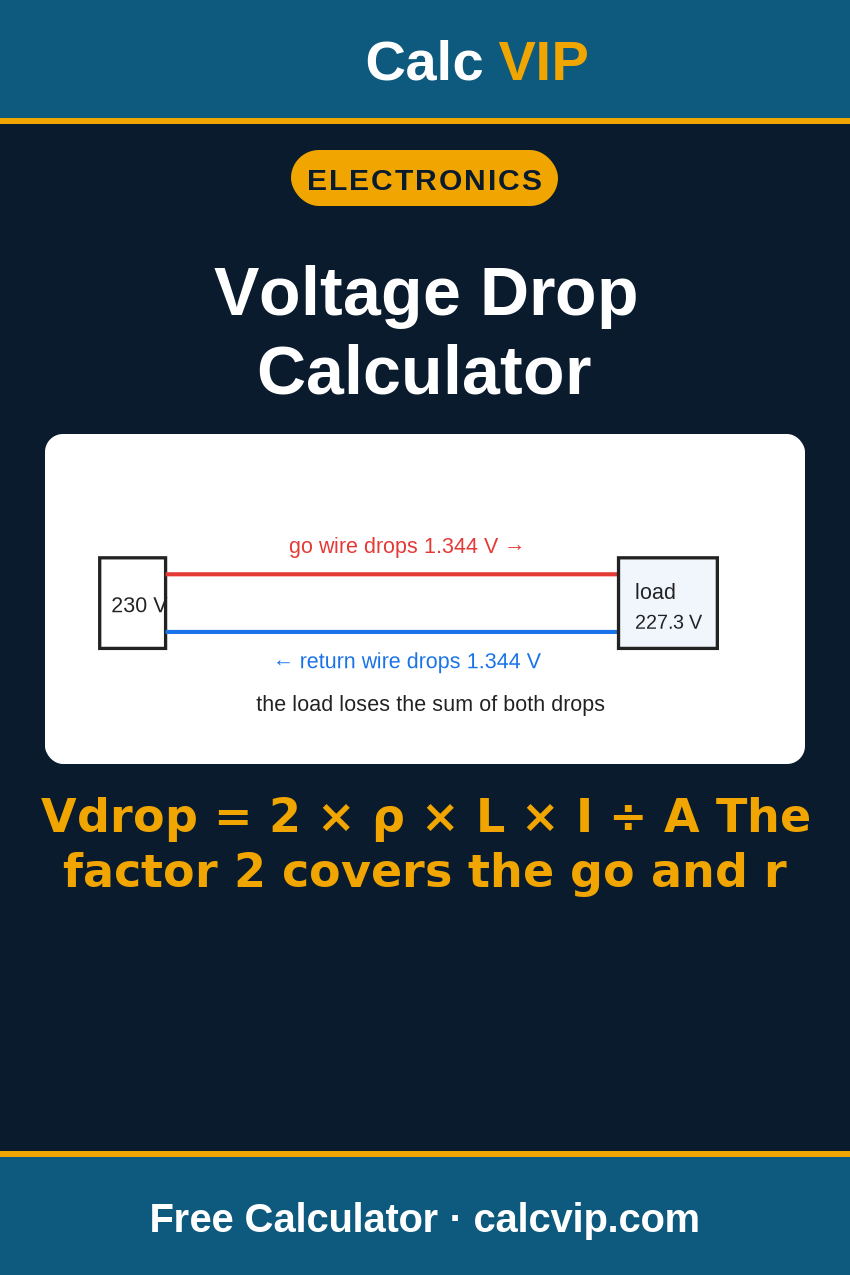
The drop obeys a disarmingly simple rule: it is the current multiplied by the loop resistance of the cable, and the loop resistance comes straight from R = ρL/A — with one twist. Current must travel out to the load and back again, through two lengths of wire, so the length that matters is twice the one-way distance. That factor of 2 in the formula Vdrop = 2ρLI/A is the most-forgotten detail in the whole subject, and the reason this calculator asks for the one-way length and doubles it for you.
Enter the material (copper or aluminium, or a custom resistivity), the one-way length in metres, the current in amps and the wire's cross-section in mm². Add the supply voltage if you want the two figures that turn a drop into a judgement: the percentage of the supply lost, and the actual voltage remaining at the load. Percentages are how wiring standards speak — roughly 3% is the customary ceiling for lighting circuits, 5% for an installation overall — and a percentage is what makes a 2.7 V drop trivial on a 230 V circuit yet ruinous on a 12 V one.
Formula
Vdrop = 2 × ρ × L × I ÷ A
The factor 2 covers the go and return wires. Each wire has resistance R = ρL/A, so the loop resistance is 2ρL/A and the drop is I × that resistance.
Every term in the formula is a lever you can pull. The drop grows in direct proportion to the current and to the length — double either and the drop doubles. It falls in inverse proportion to the area — double the wire size and the drop halves. And it scales with the material's resistivity, which is why an aluminium cable needs roughly 1.7 times the cross-section of a copper one to drop the same voltage. The percentage form is the same equation viewed relatively: % drop = Vdrop ÷ Vs × 100. Note what is absent: the supply voltage itself does not appear in the drop formula at all. A given cable at a given current drops the same volts on a 12 V system as on a 230 V system — which is precisely why low-voltage systems suffer so much more, as Example 2 shows.
| Symbol | Meaning | Units |
|---|---|---|
| Vdrop | voltage lost along the cable loop | volts (V) |
| ρ | resistivity of the cable material | Ω·m (Cu 1.68 × 10⁻⁸, Al 2.82 × 10⁻⁸) |
| L | one-way cable length (the formula doubles it) | metres (m) |
| I | current in the cable | amps (A) |
| A | wire cross-section area (enter mm²) | mm² (converted to m² inside) |
Dropped volts are also wasted watts
Voltage drop is usually discussed as a performance problem — the load underfed — but it is equally an efficiency problem. The dropped voltage multiplied by the current is power converted to heat inside the cable: in the worked example below, 2.688 V × 10 A = 26.88 W warming the walls instead of working at the load, hour after hour, for the life of the installation. A drop of 5% means roughly 5% of the delivered energy never arrives. On a heavily loaded circuit that runs all day — a workshop feed, an EV charger, a server supply — the wasted watts accumulate into real money, and upsizing the cable pays for itself in a way that a lighting circuit never would.
There is also a hidden interaction with temperature. A cable carrying current warms up; copper's resistivity climbs about 0.393% per degree (the subject of the resistance-and-temperature page); so a hot cable drops more voltage than the cold calculation promises, which wastes more power, which warms it further. Standards handle this with correction factors and by rating cables below their thermal limits. For the estimates this calculator makes, treat the answer as the cool-cable figure and allow a margin — ten to twenty percent more drop on a cable expected to run hot and fully loaded.
How to use
- Pick the cable material (copper or aluminium) — or choose "Custom" and type ρ in Ω·m.
- Enter the one-way cable length in metres — the distance from supply to load, not there-and-back; the calculator doubles it for you.
- Enter the current the cable will carry and the wire area in mm² (printed on the cable sheath: 1.5, 2.5, 4, 6, 10…).
- Optionally add the supply voltage to see the percentage drop and the voltage left at the load. Click "Calculate".
- Judge the percentage: under ~3% for lighting, under ~5% overall is the customary target. If you exceed it, step up one cable size and re-run — the drop falls in proportion to the area gained.
Worked examples
Example 1 — a mains run done right. Copper, L = 20 m, I = 10 A, A = 2.5 mm², supply 230 V.
Vdrop = 2 × 1.68 × 10⁻⁸ × 20 × 10 ÷ (2.5 × 10⁻⁶) = 2.688 V — just 1.169% of the supply, leaving 227.312 V at the load. Comfortably within limits.
Example 2 — 12 V garden lighting, the hard lesson. Copper, L = 15 m, I = 5 A, A = 1.5 mm², supply 12 V.
Vdrop = 2 × 1.68 × 10⁻⁸ × 15 × 5 ÷ (1.5 × 10⁻⁶) = 1.68 V — a modest-sounding drop that is 14% of a 12 V supply. The lamps receive 10.32 V and glow visibly dim. Low voltage forgives nothing.
Example 3 — fixing Example 2 with copper. Same run, cable stepped up to 4 mm².
Vdrop = 2 × 1.68 × 10⁻⁸ × 15 × 5 ÷ (4 × 10⁻⁶) = 0.63 V = 5.25%. Better — and the ratio is exactly the area ratio, 1.5 ÷ 4, applied to the original drop. One more size up would land near 3.5%.
Example 4 — an aluminium feed. Aluminium, L = 30 m, I = 16 A, A = 6 mm², supply 230 V.
Vdrop = 2 × 2.82 × 10⁻⁸ × 30 × 16 ÷ (6 × 10⁻⁶) = 4.512 V = 1.96%. Aluminium drops more per size than copper, and 6 mm² absorbs it comfortably at this length.
Example 5 — a solar DC run. Copper, L = 10 m, I = 8 A, A = 4 mm², on a 24 V battery system.
Vdrop = 2 × 1.68 × 10⁻⁸ × 10 × 8 ÷ (4 × 10⁻⁶) = 0.672 V = 2.8% — acceptable, and worth achieving: on the DC side of a solar system every dropped volt is harvested sunshine thrown away.
Example 6 — the long extension lead. Copper, L = 50 m, I = 13 A, A = 1.5 mm², supply 230 V.
Vdrop = 2 × 1.68 × 10⁻⁸ × 50 × 13 ÷ (1.5 × 10⁻⁶) = 14.56 V = 6.33% — over the customary limit before any other circuit adds its share. Long, thin and heavily loaded is the losing combination, and it is exactly what a fully-unrolled site extension lead is.
Voltage drop in real life
Why the far end of the garden is dim. Example 2 plays out in every low-voltage lighting scheme: 12 V leaves no headroom, so landscape lighting is designed backwards from the drop — fat cables, short runs, or lamps grouped near the transformer.
EV charging overnight. A home charger draws 32 A for hours. On a long run of undersized cable the drop wastes energy as heat all night and the car charges at reduced voltage; installers check this calculator's sum before choosing the cable, not after.
Boats and caravans. Marine wiring lives at 12 or 24 V with long runs in damp places — the harshest drop environment there is. Boat standards therefore specify generous cable sizes and tinned conductors, and voltage drop, not current rating, is usually what picks the size.
Solar and battery systems. Between panels, charge controller and battery, every run is DC, low-voltage and current-rich. Designers budget drop in tenths of a percent per run, because the whole system's efficiency is the product of its runs.
Motor starting dips. A motor draws several times its running current while starting, so the drop spikes several-fold for a second — lights dip, contactors chatter. If the dip bites, the cure is the same formula: the starting current is fixed by the motor, so shorten or fatten the cable.
Long rural feeds. Farms at the end of long supply lines live with chronic undervoltage at peak times. The physics is this page at national scale: kilometres of conductor, and the drop shared by every farm along the line.
Quick reference: drop per amp per metre (copper)
| Wire size | Loop resistance per metre | Drop per amp per metre |
|---|---|---|
| 1.5 mm² | 0.0224 Ω | 22.4 mV |
| 2.5 mm² | 0.01344 Ω | 13.44 mV |
| 4 mm² | 0.0084 Ω | 8.4 mV |
| 6 mm² | 0.0056 Ω | 5.6 mV |
| 10 mm² | 0.00336 Ω | 3.36 mV |
With this table the calculator's arithmetic becomes mental: multiply the table value by the current and by the one-way metres. Check Example 1: 13.44 mV × 10 A × 20 m = 2688 mV = 2.688 V — the same answer, because the table is just the formula pre-divided. Electricians carry these millivolt figures in their heads (they appear in wiring regulations as mV/A/m) and reach for the full formula only when the material or the geometry gets unusual.
A note on three-phase and AC
This calculator treats a single-phase or DC loop, where the current goes out on one wire and returns on another identical one. Three-phase circuits share the load across three conductors and the drop formula changes — a factor of √3 replaces the 2, and the current in each conductor is smaller for the same power, which is one reason industry prefers three-phase for big loads. AC adds two smaller effects the DC picture omits: inductance of the cable run (reactance) and, at high currents in steel conduit, magnetic losses. For domestic and small-workshop runs at 50/60 Hz, the resistive calculation on this page is the accepted first estimate, and it errs on the safe side for short runs.
Putting the two cable checks together
Real cable selection runs two independent tests, and it is worth seeing them side by side on one example. Suppose a 230 V workshop socket is to be fed 25 m from the consumer unit, carrying up to 20 A. The drop test, with 2.5 mm² copper: Vdrop = 2 × 1.68 × 10⁻⁸ × 25 × 20 ÷ (2.5 × 10⁻⁶) = 6.72 V, which is 2.92% — just inside the 3% lighting-style target and comfortably inside 5%. The heat test asks a different question: can 2.5 mm² carry 20 A in the way it will be installed (clipped to a wall, buried in insulation, grouped with other cables) without its insulation overheating? Installation tables answer that, with deratings this page does not attempt. A cable that passes both tests is a correct cable; the commonest real-world failure is a cable that passes the heat test easily — it is a short, fat run's usual result — while quietly failing the drop test, or the reverse on a long thin one. Run the drop half here, the rating half from the tables, and believe whichever demands the bigger cable.
One refinement belongs in any careful estimate: the ρ in the formula is the 20 °C value, but a cable at full load runs warm. At a conductor temperature of 70 °C, copper's resistivity has risen by about 0.393% × 50 ≈ 19.6%, and the drop rises with it — the 6.72 V above becomes about 8.04 V, or 3.5%. Wiring regulations fold this in by tabulating drops at working temperature. For the estimates on this page, add roughly a fifth to the drop of any cable you expect to run hot and heavily loaded, and the prediction will sit where the regulations sit.
Common mistakes
- Forgetting the return journey. Entering the full there-and-back distance into a formula that already doubles the length — or, worse, forgetting the factor 2 in hand calculations. Decide which convention you are using; this calculator wants the one-way length and supplies its own 2.
- Judging the drop in volts instead of percent. 2.688 V is excellent on 230 V (1.169%) and catastrophic on 3 V. Always convert to a percentage of the supply before deciding whether the cable is big enough.
- Sizing by current rating alone. A cable can be perfectly safe from overheating and still drop far too much voltage — the two checks are independent. Thin cable on a long run usually fails the drop check long before it fails the heat check.
- Ignoring the load's starting current. Motors, compressors and big power supplies draw a multiple of their running current at switch-on, and the drop multiplies with it. If the symptom is "resets when the pump starts", calculate with the starting current, not the nameplate run current.
- Leaving extension leads coiled. A coiled lead is the full length of cable in circuit (so the full drop applies) but cannot shed its heat — the worst of both worlds. Unroll fully for heavy loads; the drop figures in Example 6 assume you did.
FAQ
How much voltage drop is acceptable?
Wiring rules of thumb suggest keeping the drop under about 3% for lighting and 5% overall in an installation. Too much drop makes lamps dim, motors weak and electronics unreliable.
How can I reduce the voltage drop?
Use a thicker cable (bigger mm²), shorten the run, or reduce the current. Doubling the wire area halves the drop, because resistance falls as area rises.
Why is the factor 2 in the formula?
Current must travel to the load and back, so it passes through two lengths of cable. Each one drops voltage, and the load loses the sum of both drops.
What drop will my cable have per metre?
For copper, use the quick-reference table: 2.5 mm² drops 13.44 mV for every amp and every metre of one-way run. Multiply the three numbers — millivolts per amp-metre, amps, metres — and convert to volts.
Is voltage drop different for AC and DC?
The resistive part is identical, and it dominates on ordinary cable runs. AC adds a small inductive contribution that matters mainly on long, heavily loaded industrial runs — for household lengths, this calculator's figure is the one electricians use.
Why do my lights dip when the fridge starts?
The compressor's starting current is several times its running current, so the cable drop spikes for a fraction of a second and every lamp on the circuit feels it. It is normal in moderation; severe dips suggest an undersized or very long circuit.
Does a thicker cable also save energy?
Yes — drop × current is power wasted as heat in the cable, so halving the drop halves that waste. In Example 1 the loss is 26.88 W; on an all-day industrial circuit, upsizing can pay for itself.
How much bigger must aluminium be to match copper?
Area must rise in proportion to resistivity: 2.82 ÷ 1.68 ≈ 1.68 times. A run that needs 2.5 mm² in copper needs about 4 mm² in aluminium for the same drop — the standard sizes work out conveniently.
What if the drop is fine but the cable still gets hot?
Then the problem is current rating, not drop: too much current for the cable's insulation and installation method. The two checks are separate — a compliant installation passes both, and this calculator only performs one of them.
Can voltage drop damage equipment?
Chronic undervoltage makes motors draw more current and overheat, makes switch-mode supplies work harder, and can make contactors chatter and electronics reset. The drop itself is not dangerous to the cable — it is the load that suffers.