 Calc
Capacitor Energy Calculator – U = ½CV² Stored Energy
 Created by Michael Chen · Electronics Specialist · Last updated: November 2026
Use this free Capacitor Energy Calculator to find how much energy a charged capacitor stores, using U = ½CV². Capacitance is usually small, so scientific notation like 1e-4 is accepted.
Charging a capacitor is work. Every charge pushed onto the plates must be forced there against the repulsion of the charges already parked, and that work does not vanish — it is stored in the strained electric field between the plates, ready to be returned the moment a discharge path appears. The stored energy is U = ½CV², and it is the quantity that decides what a capacitor can actually do: how bright a flash, how strong a pulse, how long a memory survives a power cut.
Two features of the formula shape everything. The capacitance enters plainly — double C, double the energy — but the voltage enters squared, so doubling the voltage quadruples the store. That square is why energy capacitors are built to the highest safe voltage, why a modest capacitor at 300 V (a camera flash) holds joules while a huge one at 3 V holds millijoules, and why the voltage rating printed on the can is a hard survival limit: push past it and the dielectric fails, sometimes explosively, dumping the whole store at once.
The other half of the story is speed. A battery holds far more energy, but releases it at chemistry's pace; a capacitor can return its whole store in microseconds, which translates into enormous power — energy divided by a tiny time. Flash photography, defibrillators, pulse lasers and the smoothing reservoirs inside every power supply all exploit that combination of a modest store and a violent release. This calculator finds the stored energy from capacitance and voltage, and reports the stored charge alongside.
Formula
Stored energy = ½ × Capacitance × Voltage² → U = ½CV² (the stored charge is Q = CV)
The same store can be written three ways: U = ½CV², U = ½QV, and U = Q²/(2C) — all equivalent through Q = CV, and each convenient for different data. The units interlock: farads × volts² gives joules exactly. Practical hazards are the usual two: capacitance must enter in plain farads (100 µF = 1 × 10⁻⁴ F, not 100), and the voltage must be squared before multiplying, not after. This calculator reports the energy in joules (with millijoules for small stores) and the charge in coulombs and microcoulombs, so the two faces of the storage — energy and charge — can be compared at a glance.
| Symbol | Meaning | Units |
|---|---|---|
| U | energy stored in the electric field | joules (J) |
| C | capacitance | farads (F) |
| V | voltage the capacitor is charged to — squared in the formula | volts (V) |
| Q | stored charge, Q = CV | coulombs (C) |
Where the one-half comes from
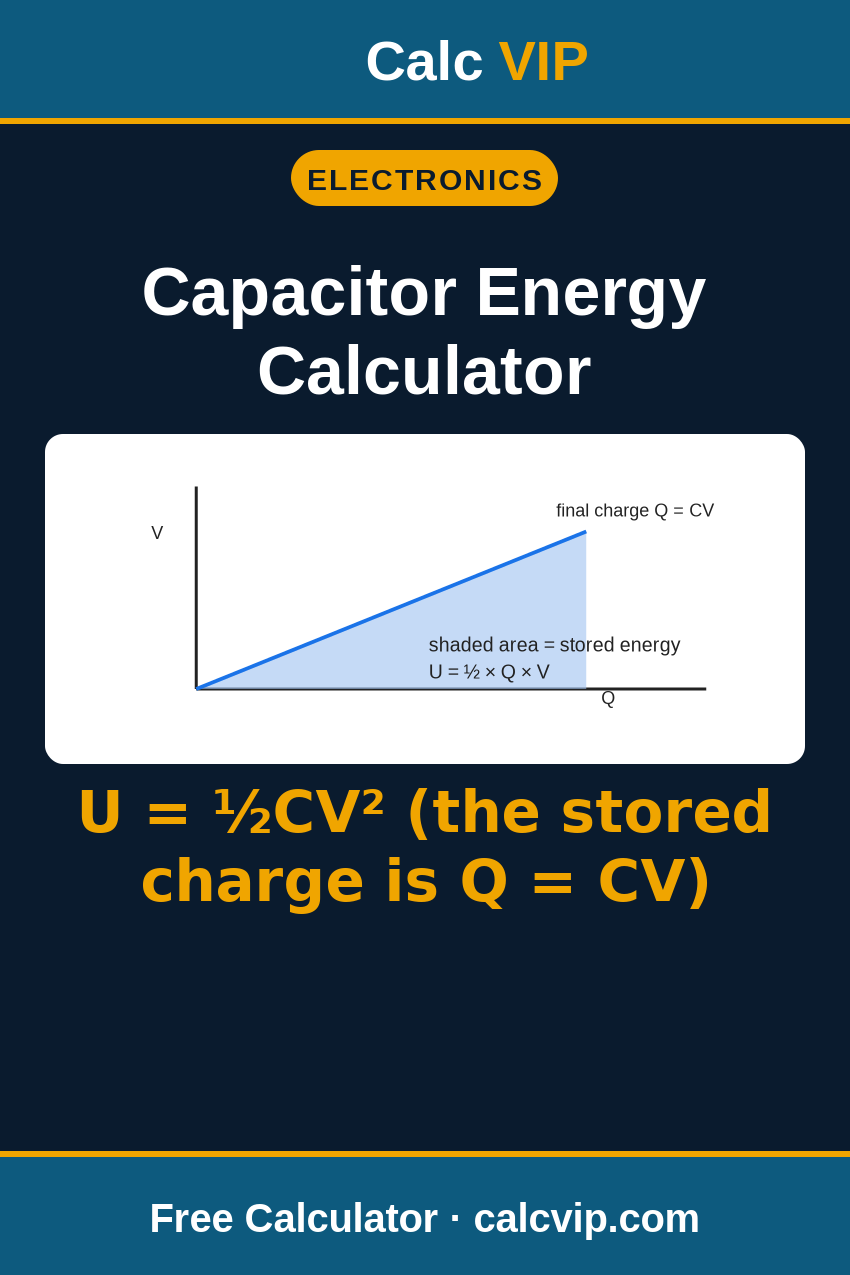
Students often suspect the ½ in U = ½CV² is a fudge. It is a honest average. Imagine charging the capacitor charge by charge: the first charges slip on against no opposition, at nearly zero voltage, costing almost no work. As charge accumulates, the capacitor's own voltage climbs in proportion, and each later charge must be pushed against that higher voltage — the last ones against the full V. The average voltage against which the whole charge Q was delivered is therefore V/2, and the total work is Q × (V/2) = ½QV. Substituting Q = CV gives the familiar ½CV². The shaded triangle in the first diagram is exactly this: the area under the line of voltage against charge, and area of a triangle is half base times height.
The half has a mischievous consequence explored further below: when a capacitor is charged from a fixed-voltage supply through a resistor, the supply does QV of work in total, half of which is stored and half of which is unavoidably lost as heat in the resistance — whatever value that resistance takes. The stored half, though, is fully real and fully recoverable in principle: discharge the capacitor through a load and the field collapses, returning its energy as current. How much of it a real circuit actually harvests depends on losses in the capacitor's own internal resistance, which is why energy applications favour parts built for low loss.
How to use
- Enter the capacitance in farads — scientific notation like 1e-4 (which is 100 µF) works fine, and is the sane way to type microfarad values.
- Enter the voltage the capacitor is charged to — the voltage it actually reaches, not merely the rating printed on the can.
- Click "Calculate" to get the stored energy in joules, plus the stored charge as a bonus.
- Compare like with like: to judge whether a store is big, set it beside the quick-reference table below rather than trusting that farads alone tell the story.
Worked examples
Example 1 — a small store. A 100 µF capacitor (C = 1 × 10⁻⁴ F) is charged to 12 V.
U = ½ × 1 × 10⁻⁴ × 12² = ½ × 1 × 10⁻⁴ × 144 = 0.0072 J — that is 7.2 mJ.
The stored charge is Q = CV = 1 × 10⁻⁴ × 12 = 0.0012 C. Millijoules sound like nothing, yet released in a microsecond they would briefly be kilowatts of power — the whole point of capacitive storage.
Example 2 — a camera flash. A flash capacitor of 330 µF is charged to 300 V.
U = ½ × 330 × 10⁻⁶ × 300² = ½ × 330 × 10⁻⁶ × 90,000 = 14.85 J. Fifteen joules dumped through a xenon tube in about a millisecond is a blinding burst — and the reason flash capacitors charge with an audible rising whine and a healthy respect from repair technicians.
Example 3 — a defibrillator. A defibrillator capacitor of 100 µF is charged to 2,000 V.
U = ½ × 1 × 10⁻⁴ × 2000² = ½ × 1 × 10⁻⁴ × 4,000,000 = 200 J — the familiar figure called out before a shock. The same capacitance as Example 1 stores nearly thirty thousand times the energy, purely because the voltage is squared: voltage is the lever of capacitive storage.
Example 4 — doubling the voltage. Example 1's capacitor charged not to 12 V but to 24 V.
U = ½ × 1 × 10⁻⁴ × 24² = ½ × 1 × 10⁻⁴ × 576 = 0.0288 J (28.8 mJ) — exactly four times the 12 V store, from twice the voltage. Had the capacitance doubled instead, the store would merely have doubled: the square outranks the straight proportion every time.
Example 5 — a supercapacitor. A 10 F supercapacitor charged to 2.7 V.
U = ½ × 10 × 2.7² = ½ × 10 × 7.29 = 36.45 J — more than the camera flash, from a component the size of a coin, though delivered at low voltage. Stores like this keep bus doors, emergency lights and memory systems alive through interruptions.
Example 6 — working backwards to voltage. A capacitor of 200 µF must store 1 J. What voltage is needed?
From U = ½CV², V = √(2U ÷ C) = √(2 ÷ 2 × 10⁻⁴) = √10,000 = 100 V. The rearranged formula is the designer's version: pick the energy, know the capacitance, and the required voltage — and hence the rating to buy — falls out.
Capacitor energy in real life
Camera flashes and studio strobes. The flash cannot draw its burst from batteries directly — no small battery can deliver kilowatts for a millisecond — so it spends seconds quietly charging a capacitor, then spends the store all at once. Example 2's 14.85 J is a small camera flash; studio strobes store hundreds of joules and warn you not to open the case.
Defibrillators. Medicine's most dramatic capacitor: charged over a few seconds to a chosen energy — 200 J in Example 3 — then discharged through the chest in milliseconds, with the dose set precisely by the charging voltage via this page's formula. The V² law is the dose dial.
Power-supply hold-up. The smoothing capacitors in a supply are also its lifeboat: when the mains blips, their stored energy carries the load for the missing cycles. Designers size them in joules per watt of load, and the slight warmth of a working supply is partly the toll of endlessly storing and returning this energy.
Regenerative braking and hybrid buses. Supercapacitor banks swallow the energy of a braking bus in seconds — energy a battery cannot accept so quickly — and return it for the next acceleration. The stores are thousands of farads at hundreds of volts: this formula scaled to megajoules.
Memory and clock backup. A small supercapacitor or large electrolytic keeps a clock chip or memory alive through battery changes and outages. The energy needed is tiny but the time can be days, and the slow leak of the store — not its size — is usually the design limit.
Pulsed power: welding, lasers and research. Spot welders, pulsed lasers, electromagnetic forming machines and fusion experiments all charge capacitor banks slowly and discharge them in violent unison. The bank of a large research facility stores megajoules — Example 3's arithmetic repeated across thousands of cans, with the same ½CV² on every one.
The curious case of the missing half
Charge a capacitor from a battery through a resistor and an accounting puzzle appears. The battery supplies charge Q at its full voltage V, doing work QV. The capacitor ends up storing only ½QV. Where did the other half go? Into heat in the resistor — and the remarkable part is that this split is exact whatever the resistance: a large resistor charges slowly and wastes the same total heat as a small one charges quickly. (Charging in gentle voltage steps, or through an inductor, can dodge the toll, which is how efficient power converters earn their keep.) The lesson for this page is bookkeeping discipline: the energy a source spends on a capacitor is always twice the energy the capacitor keeps, in the simple resistive case — a factor of two that has embarrassed many a first energy audit.
Capacitor or battery? Energy against power
A single AA battery stores on the order of ten thousand joules — hundreds of times the defibrillator's store, in something smaller. Chemistry is simply a denser warehouse than an electric field, by roughly two orders of magnitude per kilogram. So why capacitors at all? Because of the exit door. The battery releases its joules over hours; the capacitor can release its in microseconds, delivering power thousands of times greater per kilogram, and can do so a million times without wearing out. Engineers summarise it as: batteries for energy, capacitors for power — and increasingly pair them, the battery as the reservoir and the capacitor as the sprinter in front of it. When you use this calculator, you are measuring the sprinter's tank: small, but emptied at lightning speed.
Quick reference: stored energies compared
| Store | Values | Energy |
|---|---|---|
| signal capacitor | 100 µF at 12 V | 7.2 mJ |
| power-supply electrolytic | 4,700 µF at 25 V | 1.47 J |
| small supercapacitor | 1 F at 5 V | 12.5 J |
| camera flash | 330 µF at 300 V | 14.85 J |
| supercapacitor | 10 F at 2.7 V | 36.45 J |
| defibrillator | 100 µF at 2,000 V | 200 J |
Read down the table and watch the voltage column do the heavy lifting: the defibrillator, with the joint-smallest capacitance, tops the list purely through its 2,000 V — the square law made visible.
The clock inside every discharge: the RC time constant
A capacitor discharging through a resistor does not empty at a steady rate — it empties exponentially, fast at first while its voltage (and so its current) is high, then ever more slowly. The pace is set by the time constant τ = R × C: in each time constant, the voltage falls to about 37% of whatever it was at that interval's start, and after about five time constants the store is effectively gone. The numbers span the whole of practical electronics: Example 1's 100 µF discharging through 1 kΩ has τ = 1 × 10⁻⁴ × 1,000 = 0.1 s — a blink — while a 10 F supercapacitor leaking through a 100 Ω load has τ = 1,000 s, about 17 minutes, which is why supercapacitor backups are measured in minutes and battery backups in hours.
The energy view matches: since U follows V², the energy falls twice as fast as the voltage — after one time constant only about 14% of the energy remains (0.37² ≈ 0.14). Designers of flash units, timers and hold-up supplies all live by this clock: choose R and C, and you have chosen how long the store can speak before it falls silent.
Common mistakes
- Forgetting the half. U = CV² doubles the true store. The half is not decoration — it is the average-voltage argument of the concept section, and dropping it overstates every flash and defibrillator by a factor of two.
- Squaring the wrong quantity. The square belongs to V alone. ½C²V and other rearrangements are dimensionally wrong; if the units do not reduce to joules, the formula has been mistyped.
- Feeding microfarads as farads. Entering 100 for a 100 µF capacitor inflates the answer a millionfold. Convert first — 100 µF is 1e-4 — or use the scientific-notation entry the calculator accepts.
- Judging safety by voltage alone. A 12 V capacitor bank of large capacitance can deliver a spark-melting surge, because current and energy, not voltage alone, decide the violence of a discharge. Big stores deserve respect at any voltage.
- Assuming the nameplate energy is all usable. A capacitor's voltage falls as it discharges, so a load needing a minimum voltage can only use the top slice of the store; internal resistance (ESR) also skims a share as heat during fast discharges. Real harvested energy is always less than ½CV².
FAQ
Where is the energy actually stored?
In the electric field between the capacitor's plates. Charging the capacitor does work separating the positive and negative charges, and that work becomes stored energy, released when the capacitor discharges.
What happens to the energy if I double the voltage?
It goes up four times, because the formula has V² in it. Doubling the capacitance only doubles the energy.
What are capacitor energy stores used for?
Camera flashes and defibrillators dump a capacitor's energy in one quick burst. Capacitors also smooth out power supplies and back up memory in electronics — anywhere energy must be released very fast.
Why is there a ½ in the formula?
Because the voltage grows as the capacitor charges. The first charges arrive against almost no voltage and the last against the full voltage, so the average is V/2, and the work stored is charge × average voltage = ½QV = ½CV².
How fast can a capacitor release its energy?
Very fast — microseconds to milliseconds, limited mainly by the resistance in the discharge path and the capacitor's own internal resistance. That speed is the entire reason for capacitive storage: modest energy at enormous power.
Is a charged capacitor dangerous?
It can be. Large or high-voltage capacitors hold enough energy to give severe shocks or weld a slipped screwdriver, and they keep it after the equipment is switched off. Treat any big capacitor as live until you have discharged it safely through a resistor.
What is ESR and why does it matter here?
ESR — equivalent series resistance — is the small resistance built into every real capacitor. During fast discharges it wastes a share of the store as heat inside the component, limiting peak current and warming the part; low-ESR types are specified wherever energy must move quickly.
Why not run cars on capacitors instead of batteries?
Energy density and self-discharge. A capacitor bank storing a car's energy would be enormous and heavy next to a battery, and it would leak its charge away over days. Capacitors assist batteries in vehicles — catching braking energy — rather than replacing them.
How much energy does a phone battery hold compared with a supercapacitor?
A phone battery holds tens of thousands of joules; the 10 F supercapacitor of Example 5 holds 36.45 J — about a thousand times less. But the supercapacitor can deliver its store in a second and recharge just as fast, a million times over.
Can I find the voltage if I know the energy and capacitance?
Yes: rearrange to V = √(2U ÷ C), as in Example 6. It is the standard design calculation when an energy target — a flash brightness, a defibrillator dose — must be turned into a charging voltage.