 Calc
Charge Calculator – Q = It & Number of Electrons
 Created by Michael Chen · Electronics Specialist · Last updated: November 2026
Use this free Charge Calculator to work with Q = I × t. Find the charge that flows from a current and a time — or work backwards to the current or the time — and see how many electrons that charge represents.
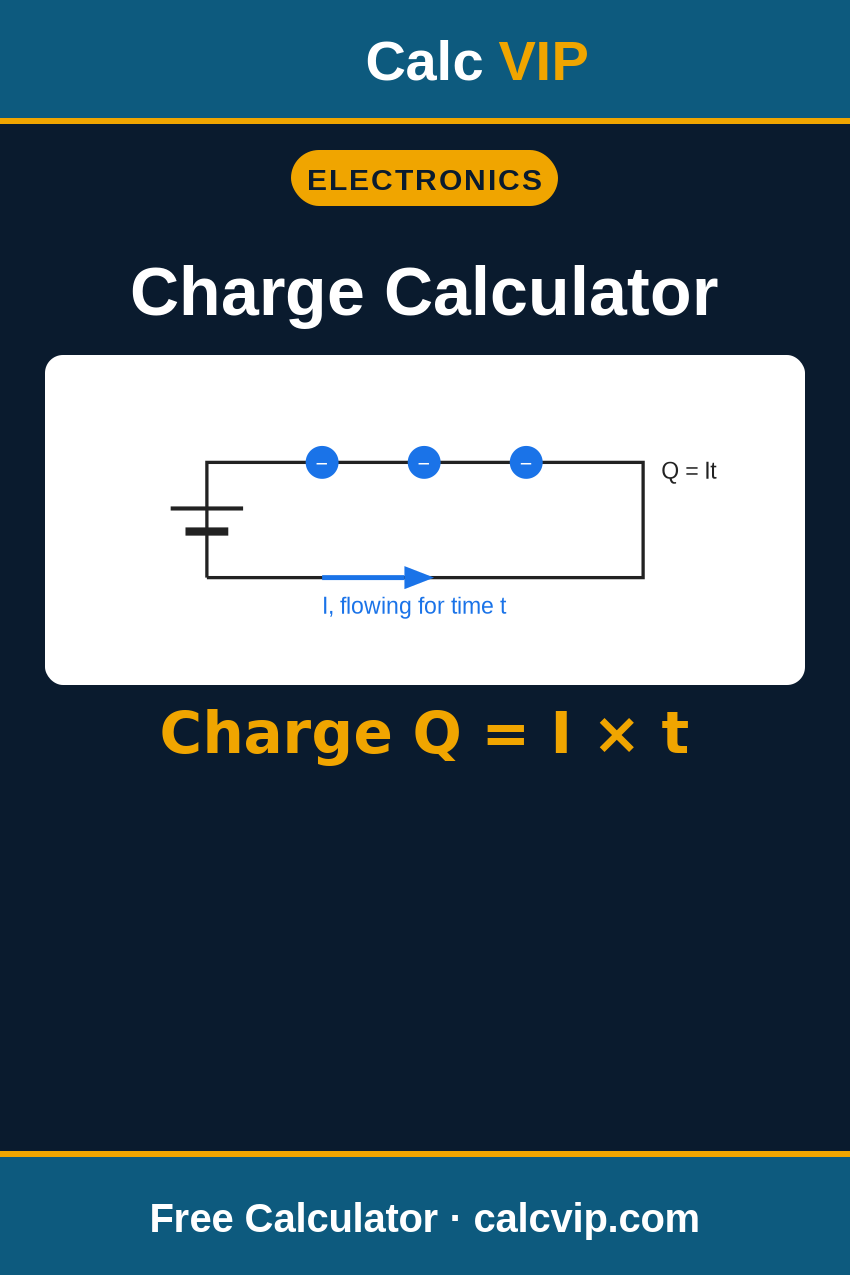
Charge is the quantity electricity is made of, and Q = I × t is its simplest ledger: a current is a rate of flow of charge, so the charge that has passed is the rate multiplied by the time. One amp for one second is one coulomb — by definition, not by measurement. This calculator runs the ledger in all three directions (find Q, find I, or find t), converts minutes and hours to seconds for you, and adds the figure that makes coulombs vivid: how many electrons the charge represents, at 6.25 × 10¹⁸ electrons per coulomb.
The coulomb is a human-scale unit built from an inhuman count. A single electron carries 1.6 × 10⁻¹⁹ C, so everyday charges involve numbers that defeat intuition: the 60 C of Example 1 is 375 billion billion electrons, yet it flowed quietly through a wire in half a minute. Charge bookkeeping matters wherever electricity is stored, budgeted or billed in bulk — battery capacities, electroplating baths, capacitor banks, lightning protection — and everywhere it matters, it is this multiplication, or its inverse, doing the work.
Notice what Q = It does not contain: voltage. Charge counts carriers, not the energy they carry. The same 60 C delivers 720 J from a 12 V battery and 13,800 J from a 230 V supply, because energy is Q × V. Confusing the two — charge with energy — is behind the most common battery misunderstandings ("a bigger mAh must mean more power"), and this page's depth section untangles them properly.
Formula
Charge Q = I × t • Current I = Q ÷ t • Time t = Q ÷ I • Electrons N = Q ÷ e, e = 1.6 × 10⁻¹⁹ C • Q in coulombs (C), I in amps (A), t in seconds (s)
Two unit conversions do most of the practical work. Battery people quote charge in amp-hours, and 1 Ah = 3600 C exactly (1 A × 3600 s), so a 70 Ah car battery holds 252,000 C of deliverable charge and a 4000 mAh phone battery holds 14,400 C. And the electron count runs through the elementary charge: N = Q ÷ (1.6 × 10⁻¹⁹), or equivalently one coulomb is 6.25 × 10¹⁸ electrons. A subtler rearrangement matters when the current is not steady: charge is the area under the current–time graph, Q = ∫I dt, which reduces to I × t for a steady current and to the average current × t for a varying one. The calculator assumes a steady (or average) current — feed it the average and the ledger still balances.
| Symbol | Meaning | Units |
|---|---|---|
| Q | charge that has flowed past a point | coulombs (C); 1 Ah = 3600 C |
| I | current — rate of flow of charge | amps (A) = coulombs per second |
| t | time for which the current flows | seconds (s) |
| N | number of electrons making up the charge | a pure count |
| e | elementary charge, 1.6 × 10⁻¹⁹ | coulombs (C) |
Charge is conserved — and it is counted, not created
Circuits do not manufacture charge; they move it in a loop. Every coulomb that leaves a battery's terminal returns to its other terminal, and the battery's job is to re-energise the same carriers, not to supply new ones. This is why Q = It can be evaluated at any point in a series circuit and give the same answer: charge has nowhere to hide. It is also why a battery "running out" is not running out of electrons — its chemistry runs out of the ability to push them with energy. The electrons in a dead battery are all still there, merely unpersuaded.
Underneath the bookkeeping sits a deeper fact: charge is quantised. It comes in lumps of e — electrons and protons carry exactly one lump each — so N = Q ÷ e is not an average but an audit: every coulomb really is 6.25 × 10¹⁸ discrete carriers, no fractions. Millikan measured the lump in 1909 by watching single charged oil droplets hang in an electric field; a century later the amp itself was redefined by fixing e exactly, so the coulomb is now, by definition, a counted number of electrons per second. The humblest formula on this page turned out to be the foundation of the unit system.
How to use
- Choose what you want to find: charge Q, current I or time t. The input labels change to match your choice.
- Enter the two values you know.
- If time is one of them, pick its unit — seconds, minutes or hours — and the calculator converts before computing.
- Click "Calculate". Along with the answer you get the number of electrons the charge represents.
- For a varying current, enter its average value: the charge is still average I × t, because charge is the area under the current–time graph.
Worked examples
Example 1 — the defining multiplication. A current of 2 A flows for 30 s.
Q = I × t = 2 × 30 = 60 C.
Number of electrons N = Q ÷ e = 60 ÷ (1.6 × 10⁻¹⁹) = 3.75 × 10²⁰ electrons — 375 billion billion of them, delivered by an unremarkable current in half a minute.
Example 2 — charging a phone. A charger pushes 3 A for one hour. In seconds the time is 3600 s, so Q = 3 × 3600 = 10,800 C, comprising 10,800 ÷ 1.6 × 10−19 = 6.75 × 10²² electrons. (Real charging tapers as the battery fills, so treat 3 A as the average for a rougher, smaller total — the formula takes whatever average you give it.)
Example 3 — lightning, timed. A lightning flash transfers about 20 C with an average current around 30,000 A. The duration is t = Q ÷ I = 20 ÷ 30,000 = 6.7 × 10⁻⁴ s — about 0.67 ms. Lightning is not a huge charge; it is an ordinary charge in a violent hurry, which is exactly why it is destructive.
Example 4 — finding a current. A plating bath must receive 450 C and the job is allotted 5 minutes (300 s). The required current is I = Q ÷ t = 450 ÷ 300 = 1.5 A. Run it at half that current and the same charge takes twice as long — the ledger does not negotiate.
Example 5 — what 2000 mAh really is. A power bank rated 2000 mAh stores 2 Ah of charge: Q = 2 × 3600 = 7200 C, or 7200 ÷ 1.6 × 10−19 = 4.5 × 10²² electrons worth of flow. The milliamp-hour is just the coulomb in a coat — multiply any Ah figure by 3600 to undress it.
Example 6 — electroplating patience. A current of 0.5 A runs through a plating bath for 2 hours (7200 s): Q = 0.5 × 7200 = 3600 C, N = 2.25 × 10²² electrons. Each pair of electrons can deposit one copper atom from a Cu²⁺ solution, which is how platers turn this charge count directly into a coating thickness — Faraday's laws are Q = It wearing a chemist's hat.
Charge in real life
Battery capacity. The mAh on every battery is a charge rating: it promises how much charge the battery can deliver before its chemistry is spent. A 4000 mAh phone battery holds 14,400 C; runtime is then capacity ÷ current — a phone drawing 400 mA averages ten hours, because t = Q ÷ I is the same formula with a shopkeeper's accent.
Electroplating and refining. Faraday's laws make deposited mass proportional to charge passed, full stop. Platers set current and time to hit a target Q, and therefore a target thickness — Example 6's 3600 C deposits a precisely computable mass of copper. Industrial electrorefining is run, literally, by counting coulombs.
Static electricity. A doorknob spark transfers on the order of a microcoulomb — perhaps a millionth of Example 1's charge — but at thousands of volts, so its energy (Q × V) is enough to feel. Static is the mirror of lightning: tiny charge, enormous voltage, brief event.
Capacitors and defibrillators. A capacitor's stored charge Q = CV is delivered in one rush. A defibrillator's capacitor — roughly a hundred microfarads charged to a few thousand volts — holds only a few tenths of a coulomb, but releases it in milliseconds; the dose is prescribed as energy, computed from the charge and the voltage together. Camera flashes do the same trick at harmless scale.
Coulomb counting in battery gauges. The percentage icon on a phone is produced by a coulomb counter: a chip that integrates current over time, adding charge in and subtracting charge out, Q = ∫I dt done in silicon. Voltage alone cannot gauge a lithium battery — its voltage barely moves across most of the discharge — so the industry counts coulombs instead.
Lightning protection. Air terminals and down-conductors are sized to carry a flash's charge — tens of coulombs in under a millisecond, per Example 3 — without melting. The design numbers come straight from this page: a known Q, a known I, and a conductor cross-section chosen so the brief, enormous current survives the trip to earth.
Charge is not energy: the Q × V distinction
The most expensive misunderstanding in home electricity is treating charge as if it were energy. Charge is the amount of electricity; energy is amount × push, E = Q × V. A coulomb through a 1.5 V cell carries 1.5 J; the same coulomb through the 230 V mains carries 230 J — 150 times more energy from the identical count of electrons. This is why battery comparisons by mAh alone mislead: a 10,000 mAh power bank at 3.7 V stores less energy than a 6,000 mAh pack at 7.4 V, and why honest specifications quote watt-hours, Wh = Ah × V. It is also why static shocks (microcoulombs, kilovolts) sting but do not kill, while a car battery (a quarter of a million coulombs available, 12 V) can weld a spanner: energy and danger live in the product, not in either factor alone.
The Faraday constant: a mole of electrons
Chemists count particles in moles, and the bridge between their counting and this page is one multiplication: a mole of electrons carries e × NA ≈ 96,485 C — the Faraday constant, F. With it, Example 6's electroplating arithmetic finishes: 3600 C is 3600 ÷ 96,485 ≈ 0.037 moles of electrons, and since each copper ion needs two electrons, about 0.019 moles of copper — roughly 1.19 g — plates out. Every electroplating schedule, battery chemistry calculation and industrial electrowinning plant runs on this exchange rate between coulombs and grams. It also quietly explains battery capacities: a lithium cell's amp-hours are just the count of lithium ions its electrodes can shuttle, expressed in coulombs per mole of host material.
Quick reference: charges you can picture
| Thing | Charge | In electrons |
|---|---|---|
| One coulomb | 1 C | 6.25 × 10¹⁸ |
| Static spark from a doorknob | ≈ 0.000001 C (1 µC) | ≈ 6 × 10¹² |
| Lightning flash | ≈ 20 C | ≈ 1.25 × 10²⁰ |
| 1 amp-hour (1 Ah) | 3600 C | 2.25 × 10²² |
| Phone battery, 4000 mAh | 14,400 C | 9 × 10²² |
| Car battery, 70 Ah | 252,000 C | 1.6 × 1024 |
Read the electron column slowly: even the humblest entry counts in trillions. Electricity feels smooth only because its grains are so fine — the same reason a beach feels smooth from a distance.
Common mistakes
- Leaving the time in minutes or hours. Q = It needs seconds. Two amps for 30 minutes is 3600 C, not 60 C. The calculator converts for you when you pick the unit; a hand calculation must multiply minutes by 60 and hours by 3600 first.
- Treating mAh as energy. Milliamp-hours measure charge only. Comparing batteries of different voltages by mAh is comparing buckets without asking how high each is lifted — convert to watt-hours (Ah × V) before declaring a winner.
- Assuming Q = It holds for a surging current. For a varying current, charge is the area under the I–t graph. A current that ramps linearly from 0 to 4 A over 10 s delivers the triangle's area, ½ × 4 × 10 = 20 C — not the 40 C that blindly using 4 A would claim. Use the average current.
- Dropping the sign conventions in electron counts. Electrons carry −e each; the count N = Q ÷ e uses magnitudes. A charge of −60 C is the same 3.75 × 10²⁰ electrons — the minus sign records their polarity, not a negative crowd.
- Believing charge gets used up. A lamp does not consume coulombs; it consumes the energy each coulomb carries. The same 60 C that enters a bulb leaves it, poorer in joules but identical in count — which is why series circuits pass the same current everywhere.
FAQ
What is one coulomb in everyday terms?
One coulomb is the charge carried by about 6.25 × 10¹⁸ electrons. A current of 1 amp means exactly 1 coulomb of charge passes each point every second.
Why does the electron count come out so huge?
A single electron carries a tiny charge (1.6 × 10⁻¹⁹ C), so an enormous number of them must flow to make up even one coulomb.
Does Q = It work for changing currents?
Strictly it is for a steady current. If the current varies, Q is the area under the current–time graph — equivalently, use the average current in Q = It.
How many electrons are in one amp?
An amp is a rate, not an amount: 1 A means one coulomb per second, i.e. 6.25 × 10¹⁸ electrons passing a point every second. Ask "how many electrons in an amp-hour" and the answer is 3600 times that: 2.25 × 10²².
Is charge the same as electricity?
Charge is the substance-like quantity; current is its flow; energy is what it can deliver when pushed by voltage. Everyday language merges all three, but calculations keep them separate: Q in coulombs, I in amps, E = QV in joules.
Can charge be negative?
Yes — electrons carry negative charge, so a surplus of electrons is a negative charge and a deficit is positive. Currents in wires are flows of negative charge moving opposite to the conventional current direction; the magnitudes in Q = It are unaffected.
What is the biggest charge in everyday technology?
Battery banks. A home storage battery of 10 kWh at 48 V holds about 208 Ah ≈ 750,000 C of deliverable charge, and grid-scale installations reach hundreds of millions of coulombs. At the other end, the charge on a single electron, 1.6 × 10⁻¹⁹ C, is the smallest free charge that exists.
Why do phones report battery in mAh instead of coulombs?
Because at a roughly fixed battery voltage, charge is proportional to runtime, and mAh keeps the numbers friendly (thousands instead of tens of thousands). It is a marketing-friendly unit doing honest work — as long as you only compare batteries of the same voltage.
Does Q = It work for AC?
Over any whole number of cycles the net charge transferred by pure AC is zero — charge sloshes back and forth. But the formula still applies instant by instant, and the average absolute flow is what heats wires and plates baths in AC plating. Rectifiers exist precisely to stop the backward half undoing the forward half's charge.
How is charge related to capacitance?
A capacitor stores separated charge: Q = C × V. The 60 C of Example 1 would need a 5 F capacitor charged to 12 V — which is why supercapacitors, with farads by the hundred, are described as charge reservoirs, and why their datasheets speak this page's language.