 Calc
Capacitor Energy Solver – Find Capacitance or Voltage from Stored Energy
 Created by Michael Chen · Electronics Specialist · Last updated: November 2026
Use this free Capacitor Energy Solver to work backwards from the energy stored in a capacitor: find the capacitance needed to store a given energy at a given voltage, or find the voltage a known capacitor must reach to store a target energy.
Most capacitor calculations run forwards: given C and V, find the stored energy. Design runs backwards. A camera flash needs a fixed punch of energy delivered in a millisecond; a defibrillator must store a precise dose; a backup circuit must hold a chip alive for exactly so many joules' worth of milliseconds. In each case the energy is the requirement and the components are the unknowns — which capacitance, charged to which voltage, stores precisely U joules? This solver inverts the most famous formula in capacitor physics, U = ½CV², in both directions.
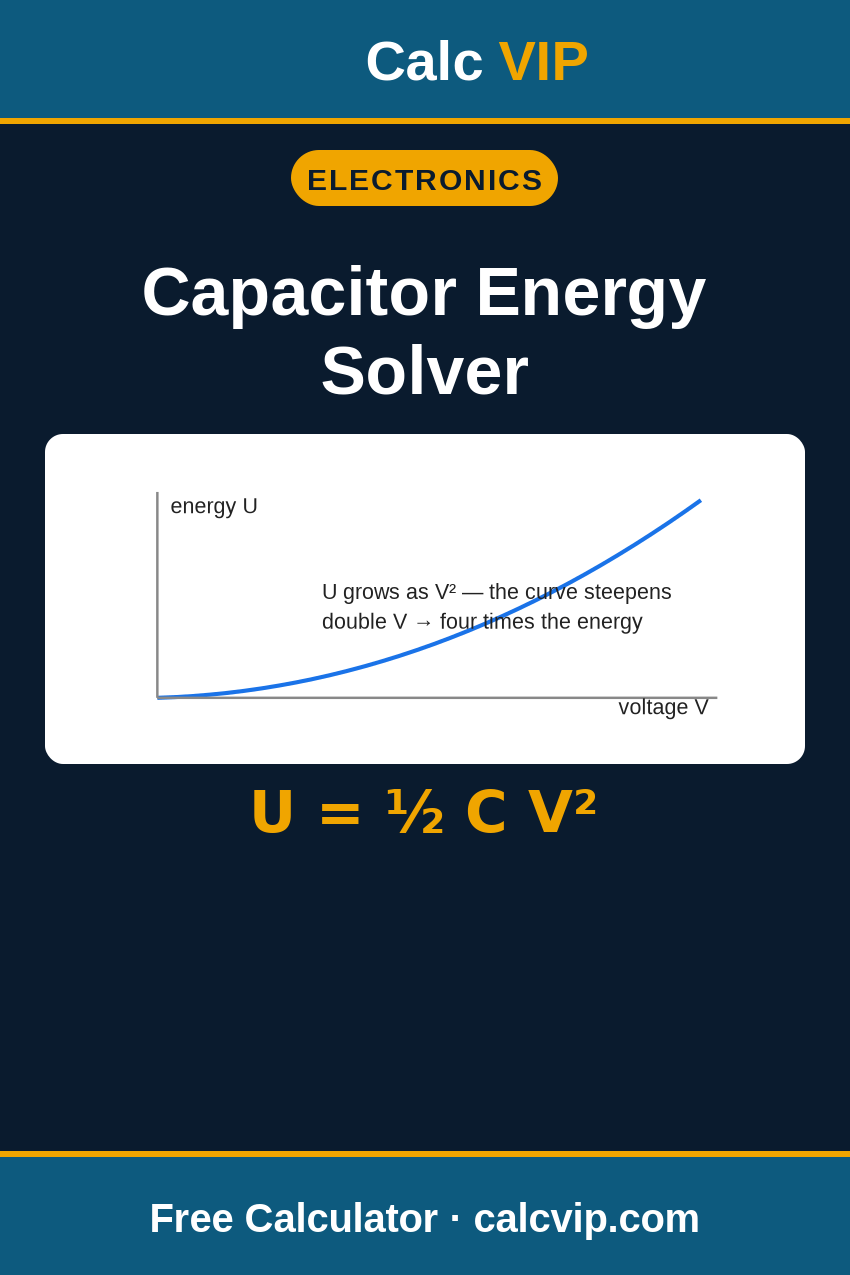
The inversion reveals the formula's personality. Because energy depends on the square of voltage but only the first power of capacitance, voltage is the strong lever: doubling V quadruples the stored energy, while doubling C merely doubles it. That single asymmetry shapes whole industries — it is why flash capacitors are small but charged to hundreds of volts, why supercapacitors with thousands of farads still store modest energies at their 2.7 V ceiling, and why the solver's two modes, though mathematically mirror images, lead to very different shopping lists.
The tool also reports the stored charge Q = CV, and it is worth watching. Energy and charge are the two currencies a capacitor holds, and they do not scale together: at fixed energy, a high-voltage design stores its joules with surprisingly little charge, while a low-voltage, high-capacitance design sloshes with coulombs. Which currency your circuit spends — a flash tube spends energy, a sample-and-hold spends charge — decides which mode of this solver is your friend.
Formula
Stored energy: U = ½ C V² • solve for capacitance: C = 2U / V² • solve for voltage: V = √(2U / C) • stored charge: Q = C × V • energy from charge: U = Q² / (2C) = ½ Q V.
| Symbol | Meaning | Unit |
|---|---|---|
| U | energy stored in the electric field | joule, J |
| C | capacitance | farad, F (tool accepts/reports µF) |
| V | voltage across the capacitor | volt, V |
| Q | charge on the positive plate | coulomb, C |
| ½ | the charging-average factor (see concept section) | — |
Where the energy actually lives
It is tempting to picture the stored energy sitting on the plates with the charge. Physicists picture it in the space between them: the electric field itself carries energy, with density u = ½εE² joules per cubic metre of field. Charging a capacitor is the work of building that field — each new packet of charge must be pushed onto a plate that is already repelling it, against a voltage that grows from zero to the final V. The average opposition is V/2, and that humble average is the entire origin of the factor ½ in U = ½CV²: energy equals charge moved times average voltage, Q × V/2.
The quadratic in V then stops being a formula quirk and becomes a design law. Field energy density grows with E², and E is V divided by plate spacing — so thin dielectrics and high voltages pack energy ferociously, right up to the field strength where the dielectric breaks down. Every capacitor's voltage rating is really a breakdown rating, and every energy-storage design is a negotiation with it. Supercapacitors cheat differently: enormous effective plate area (thousands of square metres per gram of activated carbon) gives thousands of farads, but their chemistry caps V near 2.7 V, and the V² term collects its tax regardless — 3000 F at 2.7 V stores about 10,935 J, less than a AA cell, as Example 3 shows.
The charge view completes the picture. U = Q²/(2C) says that at fixed charge, a smaller capacitance stores more energy — the same charge squeezed onto a smaller capacitor stands at a higher voltage. Designers of pulsed systems think in these terms daily, choosing whether their joules arrive as high voltage and low charge, or the reverse.
How to use
- Choose the mode: solve for capacitance C (you know the energy and the voltage), or for voltage V (you know the energy and the capacitance).
- Enter the stored energy U in joules. For scale: a camera flash is a few joules, a defibrillator a few hundred.
- Enter the second quantity as prompted — voltage in volts, or capacitance in microfarads (µF).
- Click "Calculate" for the unknown, plus the stored charge Q.
- Before building, add margin: choose a capacitor whose voltage rating exceeds the computed V by at least 20–30%.
Worked examples
Example 1 — the two modes agree. Solve for C: a flash unit must store U = 0.5 J at V = 100 V.
C = 2 × 0.5 / 100² = 1 / 10 000 = 0.0001 F = 100 µF.
Solve for V: the same 0.5 J in a 100 µF capacitor needs V = √(2 × 0.5 / 0.0001) = √10 000 = 100 V — the two modes agree, as they must.
Stored charge: Q = C × V = 0.0001 × 100 = 0.01 C.
Example 2 — a defibrillator's dose. A defibrillator stores U = 200 J and charges to 2000 V. C = 2 × 200 / 2000² = 0.0001 F = 100 µF — the same capacitance as Example 1, storing 400 times the energy purely through the V² lever (20× the voltage, 400× the energy). Its charge is Q = 100 µF × 2000 = 0.2 C, delivered to the patient in milliseconds under strict control.
Example 3 — the supercapacitor bargain. A 3000 F supercapacitor at its 2.7 V ceiling stores U = ½ × 3000 × 2.7² = 10,935 J — about 3 watt-hours' worth of joules in energy terms is not reached; it is roughly the energy in a few seconds of a kettle's operation, despite a capacitance thirty million times Example 1's. Run the solver the other way: to hold just 125 J, a 10 F supercapacitor needs only V = √(2 × 125/10) = 5 V — two cells in series territory. Enormous C, tiny V: the V² tax in full view.
Example 4 — a studio flash. A studio strobe stores U = 8 J at 330 V. C = 2 × 8 / 330² = 146.9 µF, so a standard 150 µF photo-flash capacitor fits. Q = C × V = 0.048 C. Note how little capacitance buys serious energy once the voltage climbs past 300 V.
Example 5 — how far must a known capacitor be pushed? A 470 µF capacitor must store 1 J for a pulsed LED driver. V = √(2 × 1 / 470 × 10−6) = √4255 = 65.23 V. A 470 µF part rated at 63 V is not enough — the solver's number, compared honestly against the rating, just saved the prototype. Choose the 100 V version.
Example 6 — the small end of the scale. A 100 nF ceramic at 50 V stores U = ½ × 100 × 10−9 × 50² = 125 µJ. Trivial as energy — yet discharged in a nanosecond-scale glitch it is a 100-watt-class transient, which is why tiny decoupling capacitors still bite in fast circuits. Scale in capacitor physics is always relative to time.
Capacitor energy in real life
- Photography flashes: the entire product category is Example 1 and 4 — a fixed energy budget, a high-voltage charge pump, and a capacitor chosen by C = 2U/V².
- Medical defibrillators: dose is prescribed in joules, so the stored-energy calculation is the prescription, verified before every discharge.
- Backup and ride-through: hold-up capacitors in power supplies are sized backwards from the joules a load needs to survive a mains gap.
- Pulsed lasers and railguns: research systems bank kilojoules in capacitor rooms, all designed mode-one of this solver at terrifying scale.
- Energy harvesting: a vibration or solar harvester trickles charge into a capacitor until U reaches the threshold a radio burst needs — the solver sets the capacitance.
- Supercapacitor buses and tools: regenerative braking and cordless tools trade in the Example 3 bargain — huge C, low V, honest joules counted one by one.
The charging loss nobody can repeal
Charge a capacitor from an ideal voltage source through any resistor and a quiet scandal occurs: the source supplies Q × V = CV² joules, the capacitor stores exactly half of that, and the other half heats the resistor — regardless of the resistor's value. Halve the resistance and the same energy is lost, just faster. This "half is always lost" result follows directly from the ½ in U = ½CV² and surprises every generation of students. Practical chargers dodge it with inductors and switching converters that shuttle energy rather than burn it, which is why flash chargers whine (they are little switch-mode supplies) and why supercapacitor banks are never charged through plain resistors at scale. The solver's U is the energy you keep; budget roughly twice it from a naive resistive charger, or design a switching one.
Quick reference: one capacitor, many voltages (C = 100 µF)
| Voltage | Stored energy | Stored charge |
|---|---|---|
| 10 V | 0.005 J (5 mJ) | 0.001 C |
| 50 V | 0.125 J | 0.005 C |
| 100 V | 0.5 J | 0.01 C |
| 400 V | 8 J | 0.04 C |
Energy multiplies by 4 at each doubling of voltage; charge only doubles. The table is the V² lever in its purest form.
Capacitors versus batteries: the honest comparison
Why not store everything in capacitors, if they charge in seconds and discharge in microseconds? Run the numbers with this solver and the answer is brutal. A single lithium-ion 18650 cell stores about 3.6 V × 3 Ah = 10.8 Wh = 38,880 J. To hold the same energy at 400 V — already an aggressive voltage — a capacitor needs C = 2U/V² = 2 × 38,880/400² = 0.486 F at a 400 V rating: a cabinet-sized film bank costing orders of magnitude more than the cell. Batteries win energy per kilogram and per pound by roughly a hundredfold, because chemistry stores energy in bulk matter while a capacitor stores it in a surface field.
Capacitors win the rematch on every other axis. Power: the 18650 sags and heats delivering 10 A; the capacitor bank can dump its 38,880 J in milliseconds — megawatt-class pulses no battery survives. Lifetime: a battery is tired after a thousand deep cycles; a film capacitor laughs at a million. Efficiency at speed, temperature range, and safety of failure all lean capacitive too. Real systems therefore marry the two: batteries or the grid supply the joules, capacitors deliver the violence — hybrid buses, flash units, and regenerative drives are all this compromise with wiring. The solver's role in that marriage is exact: it prices the capacitor side of the bargain in farads before a single part is ordered.
Reading what the part actually says
The solver is only as good as the capacitance you feed it, and small capacitors rarely print their value plainly. Ceramic and film parts use a three-digit code: the first two digits are the value's leading figures and the third is the multiplier in picofarads — 104 means 10 × 10⁴ pF = 100,000 pF = 100 nF, and 472 means 4700 pF. A following letter gives tolerance (J = ±5%, K = ±10%, M = ±20%). Electrolytics print µF and voltage directly on the can, negative stripe marking the lead. Feeding the solver a misread code — treating a 104 part as "104 µF" — inflates an energy estimate a thousandfold, which is why this humble decoding skill appears on a page about joules: every formula in physics is one misread label away from nonsense.
One more rearrangement worth keeping
The three forms of the energy law form a complete toolkit, and the third is the one designers reach for when charge is the known quantity: U = Q²/(2C). A charge pump or a switched-capacitor converter moves fixed packets of charge, so its energy per packet follows this form directly. Together the trio — U = ½CV², U = ½QV, U = Q²/(2C) — means any two of the three quantities C, V and Q determine the energy, and the solver's two modes plus its reported Q cover every combination you are likely to meet on a bench.
Common mistakes
- Leaving capacitance in µF inside the raw formula. U = ½CV² demands farads. Entering 100 (µF) instead of 0.0001 inflates energy a million-fold. The solver converts; hand calculations must too.
- Forgetting the square. Computing C = 2U/V instead of 2U/V² undersizes a flash capacitor by a factor of V — a hundredfold in Example 1.
- Designing to the exact voltage rating. Example 5's 65.23 V requirement on a 63 V part is a failure scheduled, not a rounding issue. Ratings are ceilings, not targets; keep 20–30% headroom.
- Confusing charge with energy. A supercapacitor's huge Q at 2.7 V can still be modest joules. Circuits that spend energy need the energy number; circuits that move charge need Q. Know which you are buying.
- Ignoring the charging loss. A resistive charger delivers only half its drawn energy to the capacitor. Energy budgets drawn from the supply side must roughly double the solver's U.
FAQ
Why does voltage matter more than capacitance for stored energy?
Energy grows with the square of voltage but only linearly with capacitance. Doubling V stores four times the energy, while doubling C only doubles it — which is why camera flashes charge small capacitors to hundreds of volts.
Where does the factor ½ come from?
As the capacitor charges, the voltage rises from 0 to V, so the average voltage during charging is V/2. Energy = charge × average voltage = Q × V/2 = ½CV².
What units should I watch out for?
Capacitance must be in farads for the raw formula. This tool accepts microfarads (µF) in voltage mode and reports farads and µF in capacitance mode — 1 F = 1 000 000 µF, an easy factor to miss by hand.
How much energy is dangerous?
Context rules: a 0.5 J flash discharge is a nip; tens of joules across the chest can be lethal, and defibrillators deliver 200–360 J deliberately under medical control. Treat any capacitor charged above ~50 V with respect and discharge it before handling.
Why do two identical capacitors in parallel store twice the energy?
Parallel capacitances add, so C doubles at the same V and U = ½CV² doubles. In series at the same voltage, C halves and so does U — though the series pair withstands twice the voltage, whereupon it can store twice the energy at that higher voltage.
Does a bigger physical capacitor always store more?
Not necessarily — size tracks voltage rating and construction as much as capacitance. A physically large 100 µF/400 V film capacitor stores far more at full voltage than a coin-sized 100 µF/6.3 V electrolytic, because of V².
How fast can the stored energy be released?
As fast as the circuit's resistance and the capacitor's internal ESR allow — microseconds for film types, which is why modest joules make formidable peak powers. Energy sets the total; ESR sets the rate.
What is ESR's role in energy calculations?
ESR does not change the stored energy ½CV², but it skims the delivered energy during discharge and caps the peak current. For pulsed work, a low-ESR part delivers more of its stored joules to the load.
Can I recover the energy used to charge?
Half of it, with a plain resistor charger — the stored half. Switching chargers recover most of the difference by moving energy through an inductor instead of dissipating it.
Why does the solver ask for µF in one mode and report both units?
Because µF is the unit capacitors are actually bought in, while farads are what the formula speaks. Reporting both keeps the purchase order and the physics in the same sentence.