 Calc
Capacitors in Series Calculator – Total Capacitance
 Created by Michael Chen · Electronics Specialist · Last updated: November 2026
Use this free Capacitors in Series Calculator to find the total capacitance of up to four capacitors connected in a chain. Enter the values you have in microfarads (µF) and leave the rest blank — series capacitors always combine to less than the smallest one.
Series capacitors break the intuition that adding components adds capability. Wire two capacitors in a chain and the combination stores less charge per volt than either one alone — the total always lands below the smallest member. The rule that produces this, adding reciprocals (1/C = 1/C1 + 1/C2 + …), is the mirror image of resistors in parallel, and it confuses generations of students precisely because capacitors in parallel do the friendly thing and simply add. This page keeps the two straight, explains why the chain behaves as it does, and shows the two jobs series connection is genuinely for: sharing voltage and synthesising awkward values.
The calculator accepts up to four values in microfarads and ignores any boxes left blank, so two-, three- and four-capacitor chains are all one calculation. Behind the scenes it sums the reciprocals and inverts — but notice that it also reports the smallest value you entered. That is your sanity check: if the answer is not smaller than that smallest value, something has been typed into the wrong page, because in series the total is smaller than the smallest, always, without exception.
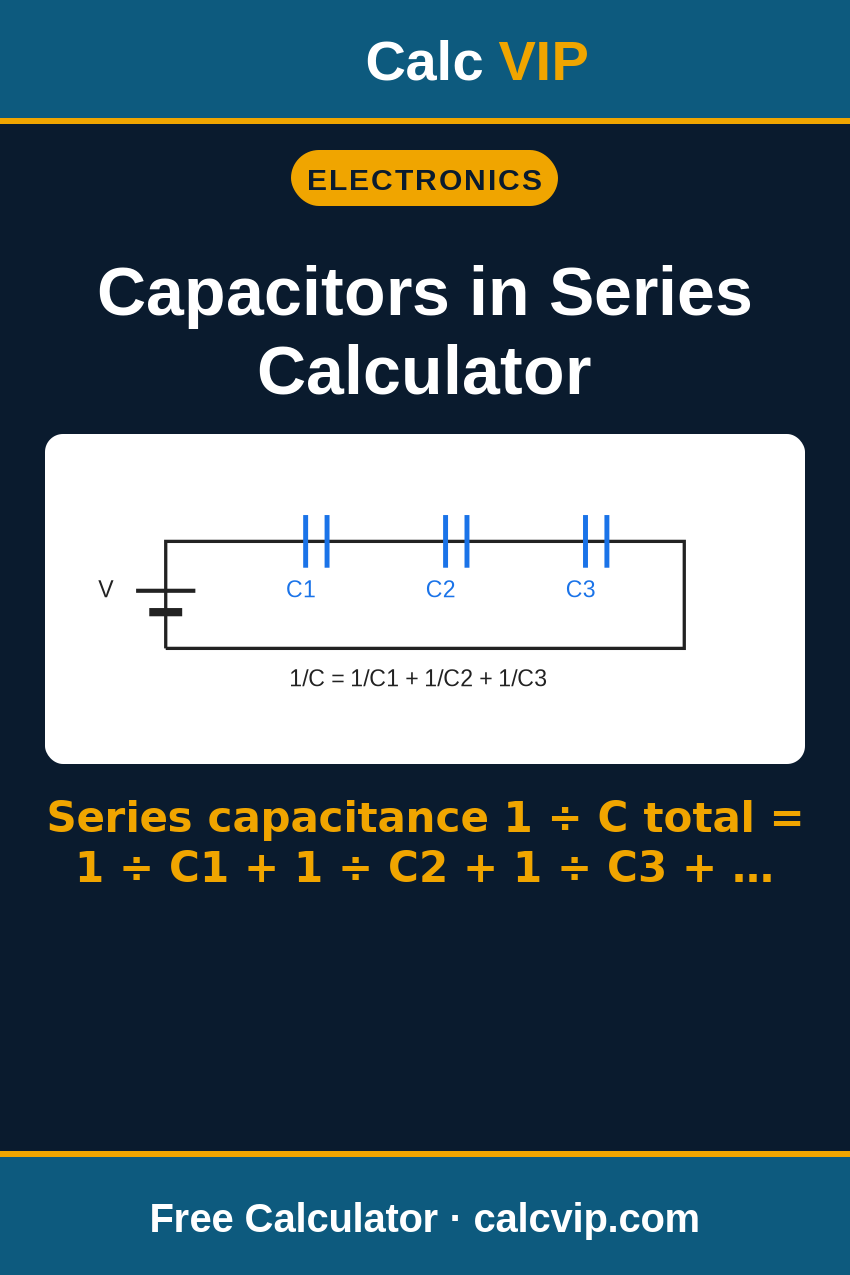
Why would anyone accept a smaller capacitance? Because series connection buys voltage. Each capacitor in the chain takes only a share of the total voltage, so a string of modest parts can stand off a supply that would puncture any one of them. High-voltage power supplies, defibrillator-style pulse circuits and the capacitor banks of old valve equipment all exploit the trade: capacitance is the price, voltage rating is the purchase.
Formula
Series capacitance 1 ÷ Ctotal = 1 ÷ C1 + 1 ÷ C2 + 1 ÷ C3 + … • all capacitances in the same unit (µF here), voltages in volts, charge in coulombs
For exactly two capacitors the reciprocal rule collapses into the product-over-sum shortcut, C = (C1 × C2) ÷ (C1 + C2) — the same shape as parallel resistors. For n equal capacitors it collapses further: C = Cone ÷ n. The supporting relations are where the insight lives: every capacitor in the chain carries the same charge Q (explained below), the voltages add, V = V1 + V2 + …, and each voltage is its capacitor's share computed as Vi = Q ÷ Ci — which means the smallest capacitor takes the largest voltage, a fact with sharp practical teeth. Total stored energy is still ½ Ctotal V², and it equals the sum of the individual ½ Ci Vi² energies, as energy bookkeeping demands. Units: any consistent capacitance unit works — µF, nF or pF — provided every value uses the same one.
| Symbol | Meaning | Units |
|---|---|---|
| Ctotal | equivalent capacitance of the series chain | µF (or any consistent unit) |
| C1, C2, … | the individual capacitances in the chain | µF |
| Q | charge stored on each capacitor — the same for all | coulombs (C), often µC here |
| V, Vi | supply voltage; voltage across one capacitor | volts (V) |
Why series capacitors share charge — and shrink
Picture the chain charging. The supply pushes charge +Q onto the first plate of C1. That charge attracts −Q onto C1's second plate — but that plate is wired only to C2's first plate, an isolated island of conductor. The −Q there must have come from somewhere: it left +Q behind on the island's other side, which is C2's first plate. The same argument marches down the chain: every capacitor ends up holding exactly the same Q, not by coincidence but because the islands between them cannot create or destroy charge. One current flowed, one charge was displaced, and every link in the chain registered it identically.
Now the shrinkage is arithmetic. The supply voltage is spent across the chain: V = Q ÷ C1 + Q ÷ C2 + …, so V ÷ Q — which is 1 ÷ Ctotal — equals the sum of the 1 ÷ Ci. The physical picture matches: connecting capacitors in series is like building one capacitor whose plate separation is the sum of all the individual separations, and wider separation means less capacitance. The smallest capacitor dominates the sum of reciprocals just as the narrowest section dominates a pipe — the total can never exceed it, and usually sits well below it.
How to use
- Enter at least two capacitor values in µF, in any order — the chain total does not depend on the sequence.
- Leave unused boxes blank; blank boxes are ignored rather than treated as zero (a real zero would be a wire, and would break the rule).
- Click "Calculate" to get the total capacitance.
- Check the answer against the smallest value you entered: the total must be smaller. If it is not, you have probably used the parallel calculator's rule by mistake.
- For chains of more than four, combine them in groups: total the first group, then treat that result as one capacitor in series with the next group.
Worked examples
Example 1 — three in a chain. Capacitors of 10 µF, 20 µF and 30 µF are connected in series.
1 ÷ C = 1/10 + 1/20 + 1/30 = 11/60.
C = 60 ÷ 11 = 5.45 µF — smaller than the smallest capacitor (10 µF), as it must be. Three capacitors totalling 60 µF of parts deliver less than a tenth of that in series; the reciprocal rule is ruthless.
Example 2 — two equal capacitors. Two 100 µF capacitors in series give C = 100 ÷ 2 = 50 µF by the equal-values shortcut, confirmed by product over sum: (100 × 100) ÷ 200 = 50 µF. This pairing appears in audio crossovers and coupling stages where a non-polarised 50 µF is needed and two polarised 100 µF parts, wired back to back, fake one.
Example 3 — an awkward pair. A 22 µF and a 33 µF in series: C = (22 × 33) ÷ (22 + 33) = 726 ÷ 55 = 13.2 µF. Neither standard value is close to 13.2, and the chain synthesises it from stock — one of the quiet reasons series pairs appear on real boards, where the exact value matters more than the lost capacitance.
Example 4 — how the voltage splits. Put 10 µF and 20 µF in series across 30 V. The chain totals 6.67 µF, so the shared charge is Q = C × V = 6.67 × 30 = 200 µC. The 10 µF capacitor takes V = Q ÷ C = 200 ÷ 10 = 20 V; the 20 µF takes 10 V. The smaller capacitor carries the larger voltage — the opposite of the resistor divider's habit, and the fact that decides voltage ratings in series design.
Example 5 — three equal capacitors. Three 9 µF capacitors in series give 9 ÷ 3 = 3 µF. On a 90 V supply each takes exactly 30 V — equal capacitors share voltage equally, the one comfortable case for voltage-rating design, and the reason series strings are usually built from identical parts.
Example 6 — buying voltage rating. Two 10 µF capacitors, each rated 25 V, in series give 5 µF — and, if the voltage shares evenly, the pair withstands 50 V. In practice leakage differences unbalance the sharing, so engineers add equalising (balancing) resistors across each capacitor to force the split; the rating is bought honestly only with those resistors fitted.
Series capacitors in real life
High-voltage power supplies. When a circuit must smooth or filter hundreds of volts and no single affordable capacitor is rated for it, designers stack capacitors in series and split the voltage between them. The lost capacitance is simply bought back by starting with bigger parts.
Non-polarised substitutes. Film capacitors for audio and motor work can be pricey in large values; two polarised electrolytics wired back-to-back in series imitate a non-polarised part at half the pair's capacitance — Example 2's arithmetic doing a convincing impression.
Capacitive voltage dividers. For AC signals, series capacitors divide voltage by the inverse-capacitance rule of Example 4. Capacitive droppers and the capacitive dividers inside high-voltage probes use the effect deliberately, because unlike resistors they waste almost no power as heat.
Touch screens and capacitive sensing. Your finger and the sensor form two capacitances in series — glass dielectric plus contact — and the tiny resulting total is what the controller measures. The reciprocal rule explains why thick screen protectors desensitise touch: they lengthen one link of a series chain whose total is ruled by its smallest member.
Supercapacitor banks. Supercapacitor cells are rated around 2.7 V each, so every 12 V or 48 V module is a series string with active or passive balancing. The bank's capacitance is the cell value divided by the count — the equal-capacitor rule from Example 5, at industrial scale.
Snubbers and timing tweaks. When a design needs 13 µF and the drawer holds 22s and 33s, a series pair closes the gap (Example 3). Technicians synthesise values this way constantly, in both directions — series to go down, parallel to go up.
Balancing: the fine print on series strings
The tidy theory says identical capacitors share voltage equally. Real capacitors leak — each passes a slightly different trickle of current through its dielectric — and in a series string the leakage, not the capacitance, eventually decides the DC voltage split. The capacitor with the least leakage charges toward more than its share and can be pushed past its rating while its partners loaf. The fix is a balancing resistor across each capacitor, chosen to pass several times the worst leakage current so the resistive divider, not the leakage lottery, sets the voltages. Any series string built for voltage rating — electrolytic stacks, supercapacitor banks — either fits balancing resistors or uses active balancing circuits. Skip them, and Example 6's honest 50 V rating quietly becomes a hope rather than a specification.
Measuring a finished string is reassuringly direct: a capacitance meter connected across the whole chain reads the series total, because the meter applies its own small test signal and measures the chain's combined response. Compare the reading with the total predicted from the individual parts measured beforehand. Agreement within tolerance confirms the wiring; a reading suspiciously equal to one member's value betrays a shorted neighbour inflating the total, and a reading near zero exposes an open joint. In a long string, measuring section by section localises a fault to a single link — the reciprocal rule doubling as a diagnostic map.
What tolerance does to a series string
Catalogue capacitors are not their labels: an electrolytic marked 10 µF may honestly measure anywhere in a ±20% window. Series connection amplifies the consequences, because both the total and the voltage split follow the actual values. Take two nominal 10 µF parts that happen to measure 8 µF and 12 µF. The total is 1 ÷ (1/8 + 1/12) = 4.8 µF, not 5 µF. Worse, on a 30 V supply the shared charge is Q = 4.8 × 30 = 144 µC, so the 8 µF part takes 144 ÷ 8 = 18 V while the 12 µF part takes 12 V — a 60/40 split where the design assumed 50/50. If each part was rated exactly 15 V on the strength of the tidy theory, the smaller one is already over its limit. Series strings for voltage duty are therefore built from matched, measured parts with generous rating margins — the reciprocal rule is exact, but it is exact about the values you actually have, not the values printed on the cans.
Quick reference: series pairs
| C1 | C2 | Series total |
|---|---|---|
| 10 µF | 10 µF | 5 µF |
| 10 µF | 20 µF | 6.67 µF |
| 10 µF | 30 µF | 7.5 µF |
| 20 µF | 20 µF | 10 µF |
| 100 µF | 100 µF | 50 µF |
| 1 µF | 1000 µF | 0.999 µF |
The last row teaches the rule in its purest form: chain a giant to a dwarf and the total is the dwarf, minus a whisker. In series, the smallest capacitor is not a participant — it is the ceiling.
Common mistakes
- Adding the values. 10 + 20 + 30 = 60 µF is the parallel answer. In series the reciprocals add and the same parts give 5.45 µF. The two rules are exact opposites; checking "smaller than the smallest" catches the mix-up instantly.
- Assuming voltage splits evenly. It splits as Q ÷ C — inversely with capacitance. The smallest capacitor in an unequal string takes the largest voltage and is the first to fail. Rate every member for its own computed share, not for V ÷ n.
- Forgetting balancing resistors. Leakage differences unbalance real strings over minutes to hours. A string designed on capacitance arithmetic alone can quietly park most of the supply across one capacitor (see the balancing section).
- Mixing units in the boxes. Entering one value in µF and another in nF breaks the reciprocal sum just as surely as it breaks any formula. Convert everything to µF first — the calculator assumes one unit throughout.
- Wiring polarised capacitors carelessly. In a series string each electrolytic must face the right way for the voltage it actually sees, and back-to-back pairs for AC service must be oriented as a pair. A reversed electrolytic in a string leaks heavily, unbalances the voltages and vents — in that order.
FAQ
Why does the total get smaller in series?
Connecting capacitors in series is like increasing the gap between one pair of plates: the same charge sits on each, the voltages add up, and the combination stores less charge per volt than any single capacitor.
What is the shortcut for two equal capacitors in series?
Two equal capacitors C in series give C ÷ 2. In general, n equal capacitors in series give C ÷ n.
Do all series capacitors carry the same charge?
Yes. Each capacitor in the chain stores the same charge Q; it is the voltages across them that differ and add up to the supply voltage.
Is the series rule the same as resistors in parallel?
Identical in form: reciprocals add, and for two components both collapse to product over sum. Capacitors in series behave like resistors in parallel, and capacitors in parallel behave like resistors in series — the great mirror-swap of basic circuits.
What happens if one capacitor in the chain fails short-circuit?
The chain's capacitance rises to the series total of the survivors — and the full supply voltage redistributes across fewer capacitors, raising each survivor's share. In a voltage-rated string, one shorted member can cascade the rest past their ratings; that is why such strings are fused and monitored.
What if one capacitor fails open-circuit?
The chain is broken: no charging current can flow, and the combination stores nothing. Series strings trade reliability for voltage rating — every member is a single point of failure for the whole chain.
Does the order of the capacitors matter?
Not to the total: addition of reciprocals is commutative, so the chain computes the same in any sequence. Order matters only for practicalities — which physical capacitor sits at the high-voltage end and sees what share.
Can I mix capacitor types in series, like ceramic and electrolytic?
Electrically the rule still applies, but the voltage split follows the capacitances while leakage and temperature behaviour follow the types. Mixed strings are common in filtering (where the point is frequency behaviour, not voltage rating) and rare in high-voltage stacking, where matched parts and balancing are the norm.
Why is the energy less than the sum of the parts' best?
Because the chain's charge is limited to the shared Q while its voltage is the sum — the combination behaves as one smaller capacitor. Energy ½ Ctotal V² for Example 1's chain on 60 V is ½ × 5.45 × 3600 ≈ 9.8 mJ, exactly the sum of the three individual ½CV² energies at their own voltage shares. Nothing vanishes; the geometry simply stores less per volt.
How do I handle five or more capacitors?
The rule does not change: add all the reciprocals. This calculator takes four at a time, so combine four into their total, then put that total in series with the remainder using a second pass — series combination is associative, so grouping is legitimate.