 Calc
DC Motor Calculator – Input Power, Output Power, Efficiency & Losses
 Created by Michael Chen · Electronics Specialist · Last updated: November 2026
Use this free DC Motor Calculator to work out a motor's efficiency. Enter the supply voltage and current for the electrical input power, and the torque and speed for the mechanical output power — the calculator shows both powers, the efficiency and the losses.
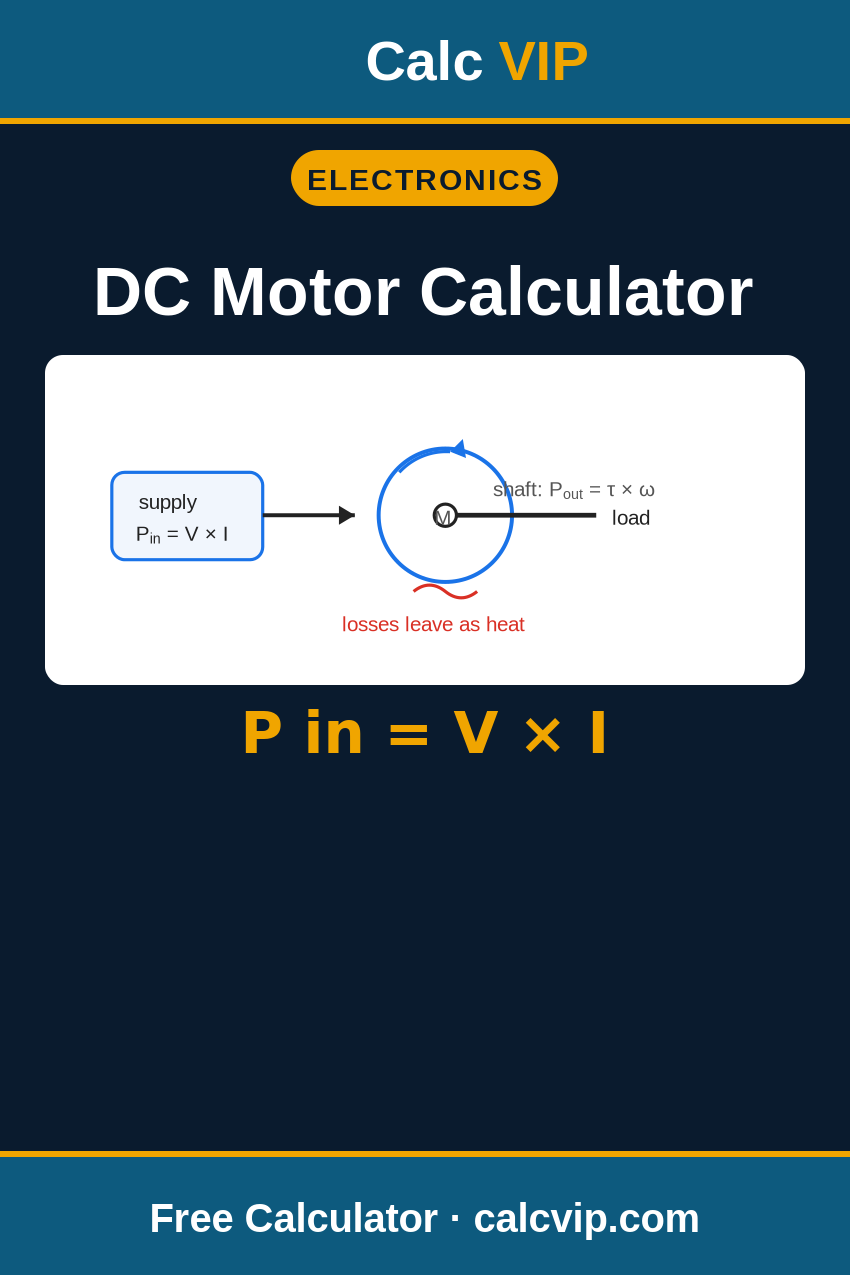
A DC motor is a bargain struck between two kinds of power. On one side, electricity flows in: voltage times current, the simplest product in electronics. On the other side, mechanical work flows out: torque times angular speed, the rotational twin of force times velocity. The two are never equal. Some of the input is always diverted — into heating the windings, scrubbing the bearings, churning the magnetic core — and the efficiency η is the scorecard of that bargain: what fraction of the electrical power actually emerges as useful turning effort at the shaft.
Efficiency is not a vanity metric. It decides how hot the motor runs (every lost watt is a watt of heat to get rid of), how long a battery lasts, how much of your electricity bill becomes motion rather than warmth, and whether a design is even viable — a drone motor at 50% efficiency wastes half its battery heating the air it flies through. The calculator's fourth number, the losses, is often the most actionable: it is the size of the cooling problem and the budget that better bearings, thicker windings or a better operating point could reclaim.
To use the tool you need both halves of the bargain measured at the same operating point: the electrical input under load, and the shaft's torque and speed at that same load. Datasheets, a dynamometer, or a torque arm and tachometer all provide them. The worked examples below span a hobby motor, an e-bike-class machine and an EV-scale drive, and the depth sections explain where the losses hide, why efficiency peaks at a particular load, and the back-EMF that quietly governs the whole machine.
Formula
Electrical input: Pin = V × I • mechanical output: Pout = τ × ω with ω = 2π × rpm / 60 • efficiency η = Pout / Pin × 100% • losses = Pin − Pout.
The only step that ever trips people is ω: the torque formula needs angular speed in radians per second, and the conversion is ω = 2π × rpm ÷ 60 (one revolution is 2π radians; one minute is 60 seconds). Every other quantity goes in exactly as measured. Two rearrangements earn their keep: given a target output power and speed, the required torque is τ = Pout/ω; and given an efficiency and an input, the output is Pout = η × Pin. Note what the calculator protects you from: if your numbers imply Pout > Pin — an efficiency over 100% — it refuses, because that always means a measurement or unit error, never a miracle motor.
| Symbol | Meaning | Units |
|---|---|---|
| V | supply voltage at the motor terminals | volts (V) |
| I | current drawn under load | amps (A) |
| τ | shaft torque | newton-metres (N·m) |
| ω | angular speed, ω = 2π × rpm/60 | rad/s |
| η | efficiency, Pout/Pin | % (or 0–1) |
Back-EMF: the invisible governor inside every DC motor
A spinning DC motor is simultaneously a generator. Its coils rotate through the magnetic field and generate a voltage — the back-EMF — that opposes the supply. This single fact explains almost everything about how the motor behaves. At standstill there is no back-EMF, so the current is limited only by the winding resistance: a 24 V motor with 2 Ω windings would try to draw 24 ÷ 2 = 12 A at the instant of switch-on. As the motor speeds up, the back-EMF grows in proportion to speed, the net voltage across the resistance falls, and the current settles. In Example 1's motor drawing 5 A through (say) 2 Ω windings, the back-EMF must be 24 − 5 × 2 = 14 V — the supply's remaining 10 V is what the resistance drops.
Back-EMF is also the motor's self-regulation. Load the shaft and the motor slows slightly; the back-EMF dips; more current flows; torque rises to meet the load. Unload it and the reverse happens, which is why an unloaded DC motor races to a speed where back-EMF nearly equals the supply — and why the efficiency calculation must always use the current drawn at the load you are analysing, not the nameplate's no-load or stall figures. The current, the torque and the speed are a matched set, joined by the back-EMF, and mixing values from different operating points is the surest way to compute an impossible efficiency.
How to use
- Enter the motor's supply voltage and the current it draws under load.
- Enter the shaft torque in N·m and the speed in rpm (from a dynamometer, datasheet or tachometer).
- Click "Calculate" for input power, output power, efficiency and losses.
- Make sure all four numbers describe the same operating point — same load, same moment. If the result claims over 100% efficiency, one of the four belongs to a different condition.
Worked examples
Example 1 — the reference motor. A DC motor runs on 24 V and draws 5 A, producing 0.4 N·m of torque at 2000 rpm.
Pin = 24 × 5 = 120 W.
ω = 2π × 2000 / 60 = 209.44 rad/s, so Pout = 0.4 × 209.44 = 83.78 W.
Efficiency η = 83.78 / 120 × 100% = 69.81%, and the losses are 120 − 83.78 = 36.22 W.
Example 2 — a hobby motor. A small motor on 6 V draws 1.2 A and delivers 0.015 N·m at 3000 rpm: Pin = 6 × 1.2 = 7.2 W; ω = 314.16 rad/s; Pout = 0.015 × 314.16 = 4.71 W; η = 65.45%, losses 2.49 W. Respectable for its size — small motors suffer proportionally larger friction and brush losses.
Example 3 — an EV-scale drive. A traction motor at 400 V drawing 150 A with 100 N·m at 5000 rpm: Pin = 60,000 W; ω = 523.60 rad/s; Pout = 100 × 523.60 = 52,359.88 W; η = 87.27%, losses 7,640.12 W. Note the losses: 7.6 kW of heat is a serious cooling system, even at an efficiency a hobby motor cannot approach.
Example 4 — a pump motor working hard. A 12 V motor draws 8 A and makes 0.3 N·m at 1500 rpm: Pin = 96 W; ω = 157.08 rad/s; Pout = 47.12 W; η = 49.09%, losses 48.88 W. Half the battery's energy becomes heat — a sign the motor is overloaded or undersized for the pump, since a well-matched motor should sit near its efficient region.
Example 5 — a quality industrial motor. At 48 V and 20 A, with 3 N·m at 2800 rpm: Pin = 960 W; ω = 293.22 rad/s; Pout = 879.65 W; η = 91.63%, losses just 80.35 W. Size, good bearings and generous copper buy exactly this: the same physics, with the loss column shrunk.
Example 6 — working backwards to torque. A motor draws 120 W and is known to run at 75% efficiency at 1500 rpm. Its output is 0.75 × 120 = 90 W, and with ω = 157.08 rad/s the torque must be τ = 90 ÷ 157.08 = 0.573 N·m. The rearranged formula answers the sizing question — "will this motor turn my load?" — before any hardware is bought.
DC motors in real life
Electric vehicles. Range is efficiency made visible: at Example 3's 87%, roughly one joule in eight becomes heat instead of distance. EV drivetrains are engineered (and liquid-cooled) around exactly this calculation.
Drones and model aircraft. Flight time is a direct efficiency budget. A motor-propeller combination tested on a thrust stand is characterised with this tool: electrical watts in, mechanical watts at the shaft out.
Pumps and fans. A pump motor's efficiency at its duty point decides the running cost for years. Example 4's 49% would trigger a resize in any professional review — the losses are paid for every hour the pump runs.
Power tools. A cordless drill that stalls its motor draws the stall current (back-EMF zero) and converts nearly all input to heat in the windings — the fastest way to cook a tool, and a direct application of the back-EMF section above.
Robotics. Joint motors are chosen by working backwards (Example 6): the load's torque and speed set Pout, an assumed η sets the electrical budget, and the battery is sized from that.
Cooling design. The losses figure is the heatsink specification. Example 1's 36.22 W needs a finned case or airflow; Example 5's 80 W from a much bigger motor is proportionally trivial — which is why big motors run cooler per watt than small ones.
Where the losses go: an anatomy
The losses figure is a sum of distinct thieves, and knowing their shares tells you what to fix. Copper loss is I²R in the windings: with 5 A through 1 Ω of winding it is 25 W — already most of Example 1's 36.22 W — and it grows with the square of the current, which is why efficiency collapses under heavy load. Iron losses (eddy currents and hysteresis in the core) grow with speed and are present whenever the motor turns, even unloaded. Friction and windage — bearings, brushes, air drag on the rotor — also tax every revolution. Finally stray losses collect the remainder. The classic efficiency curve follows from the mix: at light load the roughly constant iron and friction losses dominate the small output, so η is poor; at heavy load the I²R term explodes, so η falls again; in between sits the peak, usually near the rated load — which is why motors should be sized to cruise near their rating, not at its extremes. A useful diagnostic: the no-load current measures the constant losses directly, because at no load essentially all input power is loss.
Quick reference: rpm to rad/s
| Speed (rpm) | ω (rad/s) | Pout at τ = 1 N·m |
|---|---|---|
| 500 | 52.36 | 52.36 W |
| 1000 | 104.72 | 104.72 W |
| 1500 | 157.08 | 157.08 W |
| 2000 | 209.44 | 209.44 W |
| 3000 | 314.16 | 314.16 W |
| 5000 | 523.60 | 523.60 W |
| 10,000 | 1047.20 | 1047.20 W |
The third column is a handy mental shortcut: at 1 N·m of torque, watts equal the rad/s figure. Scale linearly — 0.4 N·m at 2000 rpm is 0.4 × 209.44 = 83.78 W, Example 1's answer by inspection.
Matching motor to load: the operating point
A motor never runs at a speed it chooses; it runs where its torque–speed line crosses the load's. The motor's line falls steadily from stall torque at standstill to zero torque at the no-load speed, because the back-EMF grows with speed and starves the current. The load's curve has its own shape: constant for a hoist, rising linearly for a viscous drag, rising with the square of speed for a fan or propeller. Where the two curves cross, motor torque exactly balances load torque and the speed settles — the operating point. If the load curve steepens (a fan's duct blocks, a pump's fluid thickens), the crossing slides down the motor's line: the motor slows, draws more current, and converts the difference to heat, which is why a stalled or overloaded motor cooks even though its shaft does no work at all.
This picture also explains starting behaviour. At switch-on the motor sits at the far left of its line — maximum torque, maximum current — and accelerates the load along the line as back-EMF builds. A well-matched system crosses quickly to a modest operating current; a mismatched one (too large a fan, too steep a hill) parks itself at high current and low speed. When you size a motor, you are really choosing a line whose crossing with your load lands at the speed you want with current — and therefore losses — the windings can live with forever. The efficiency this calculator reports is a property of that crossing point, not of the motor alone.
Common mistakes
- Multiplying torque by rpm directly. τ × rpm is not power. The 2π/60 conversion to rad/s is compulsory — skipping it inflates the output by a factor of about 9.55 and manufactures impossible efficiencies.
- Mixing operating points. Nameplate voltage, a stall torque from one test and a no-load speed from another do not belong in the same calculation. Efficiency exists only at a single, simultaneous operating point.
- Using the no-load current as I. Unloaded, almost all the input is loss, so the formula returns η near zero — correctly, but uselessly. Measure the current while the motor does the work you care about.
- Believing an efficiency over 100%. It cannot be a discovery; it is a diagnostic. Usual culprits: torque read in N·cm or lb·ft, speed in rev/s instead of rpm, or current measured on a different supply rail.
- Ignoring the losses as a thermal problem. An efficiency figure is also a heating figure. 36 W of losses in a sealed small motor will overheat it even though 70% efficiency sounds respectable — always ask where the lost watts go.
FAQ
Where do the losses go?
Mostly heat: resistance in the windings (I²R copper loss), friction in the bearings and brushes, and magnetic (iron) losses in the core. That is why a hard-working motor gets warm.
What efficiency should I expect?
Small hobby DC motors are often only 50–75% efficient, while large industrial motors exceed 90%. Efficiency is worst at very light loads and near stall, and best near the motor's rated operating point.
Why convert rpm to rad/s?
The formula P = τω needs ω in radians per second to give watts directly. One revolution is 2π radians and one minute is 60 seconds, hence ω = 2π × rpm / 60.
Why does the current surge when a DC motor starts?
At standstill there is no back-EMF, so only the winding resistance limits the current: I = V/R. A 24 V motor with 2 Ω windings surges to 12 A at switch-on, settling as speed and back-EMF build. Starters and soft-start controllers exist to tame exactly this.
Can efficiency be improved by running the motor faster?
Sometimes — efficiency peaks where the speed-dependent and load-dependent losses balance, often at moderately high speed and near-rated torque. But the load usually dictates the operating point; gearing is how designers move the motor to its efficient island while the load turns at its own speed.
What is stall torque, and why is efficiency zero there?
Stall is the maximum torque, produced at zero speed with maximum current. Since Pout = τ × ω and ω = 0, the output power is zero and η = 0% — every input watt becomes heat. Prolonged stall is the classic way to burn out a small motor.
Does this calculator work for brushless (BLDC) motors?
The power bookkeeping is identical — electrical watts in, τω out — but the V and I must be the true input to the controller (or the motor's electrical input), and BLDC torque/speed figures usually come from the drive's telemetry or a dyno. The efficiency you get then includes or excludes the controller depending on where you measure V and I.
How do I measure torque without a dynamometer?
The Prony brake method: let the shaft wind a cord that lifts a known weight, or clamp a lever arm of known length against a scale. Torque is force × arm length — a 0.25 m arm pressing with 16 N gives 4 N·m. Crude, but accurate enough to expose a bad efficiency figure.
Why does efficiency fall at light loads?
Iron losses and friction are roughly constant whenever the motor spins. At light load the useful output is small but those constant losses are undiminished, so they consume a large fraction of the input. The same motor that hits 90% at full load may manage only 40% turning almost nothing.
What does the losses figure mean for battery life?
Battery life is set by Pin, not Pout. A load needing 83.78 W of shaft power from Example 1's motor drains the battery at 120 W — the efficiency gap is paid in minutes of runtime, which is why high-η motors dominate battery-powered design.