Calc
Charles's Law Calculator – V1/T1 = V2/T2 Solver
 Created by Anna Kowalski · Physics Editor · Heat & Atoms · Last updated: November 2026
Use this free Charles's Law Calculator to solve any one value in V1/T1 = V2/T2 for a gas kept at constant pressure. Choose what to solve for, then enter the other three values — temperatures must be in kelvin.
Charles's law is one of the oldest quantitative laws in science, and one of the most intuitive: warm a gas up while letting it expand freely, and it swells; cool it down, and it shrinks — in exact proportion to its absolute temperature. Double the kelvin temperature and the volume doubles. Halve it, and the volume halves. The law is named after Jacques Charles, the French balloonist who noticed the pattern in the 1780s while preparing hydrogen balloons, though Joseph Gay-Lussac published it first, in 1802, crediting Charles's unpublished work. Behind the simple ratio sits the whole kinetic picture of gases: temperature is molecular speed, and faster molecules push a movable wall further out.
The condition that makes the law work is freedom. The gas must be able to expand or contract against a constant pressure — inside a balloon, under a frictionless piston, in a syringe with a free plunger. Seal the same gas in a rigid box instead and heating produces no volume change at all; the pressure rises instead, which is the territory of Gay-Lussac's law. Charles's law also quietly assumes the amount of gas stays fixed: no leaks in, no leaks out. Given those two conditions — constant pressure, fixed amount — the ratio V/T is a constant of the gas sample, as reliable as its mass.
Because the law is a pure proportion, it is unusually forgiving about units. Volumes may be litres, millilitres or cubic metres, as long as V1 and V2 share the same unit, because only their ratio matters. Temperature enjoys no such freedom: it must be measured from absolute zero, in kelvin, or the proportion collapses. That single demand — kelvin, always — is responsible for nearly every wrong answer this calculator's users would otherwise produce, and it is why the deep sections below return to it from several angles.
Formula
Charles's law V1/T1 = V2/T2 — for a fixed mass of gas at constant pressure, the volume is directly proportional to the absolute temperature. Solving for each value: V2 = V1T2/T1 · T2 = T1V2/V1 · V1 = V2T1/T2 · T1 = T2V1/V2. Temperatures must be in kelvin; volumes just need consistent units.
The same statement in its shortest form is V = kT, where k = V/T is a constant for the sample — the number this calculator effectively carries from state 1 to state 2. It is one slice of the ideal gas law: set P and n constant in PV = nRT and V/T = nR/P falls out, which is why Charles's law inherits the ideal gas law's limits — it is excellent at everyday pressures and temperatures, and drifts only when a gas is squeezed hard or cooled close to liquefying.
| Symbol | Meaning | Units |
|---|---|---|
| V1, V2 | volume before and after the change | any unit, but the same for both (L, mL, m³) |
| T1, T2 | absolute temperature before and after | kelvin (K) — never °C inside the formula |
| P | pressure — held constant, so it cancels out | any (kPa, atm, bar) |
| n | amount of gas — also held constant | mol |
Why volume follows temperature: the molecular story
Picture the gas as a swarm of molecules bouncing inside a container with one movable wall — a piston. Pressure is the drumming of molecular collisions on that wall. Heat the gas and every molecule moves faster on average; the collisions grow harder and more frequent, and the piston is pushed outward. As the volume grows, the molecules have further to travel between collisions, so the drumming rate falls — until it exactly balances the outside pressure again. The piston settles at a new, larger volume. Cool the gas and the whole film runs backwards: gentler collisions, the outside pressure wins, the piston slides in.
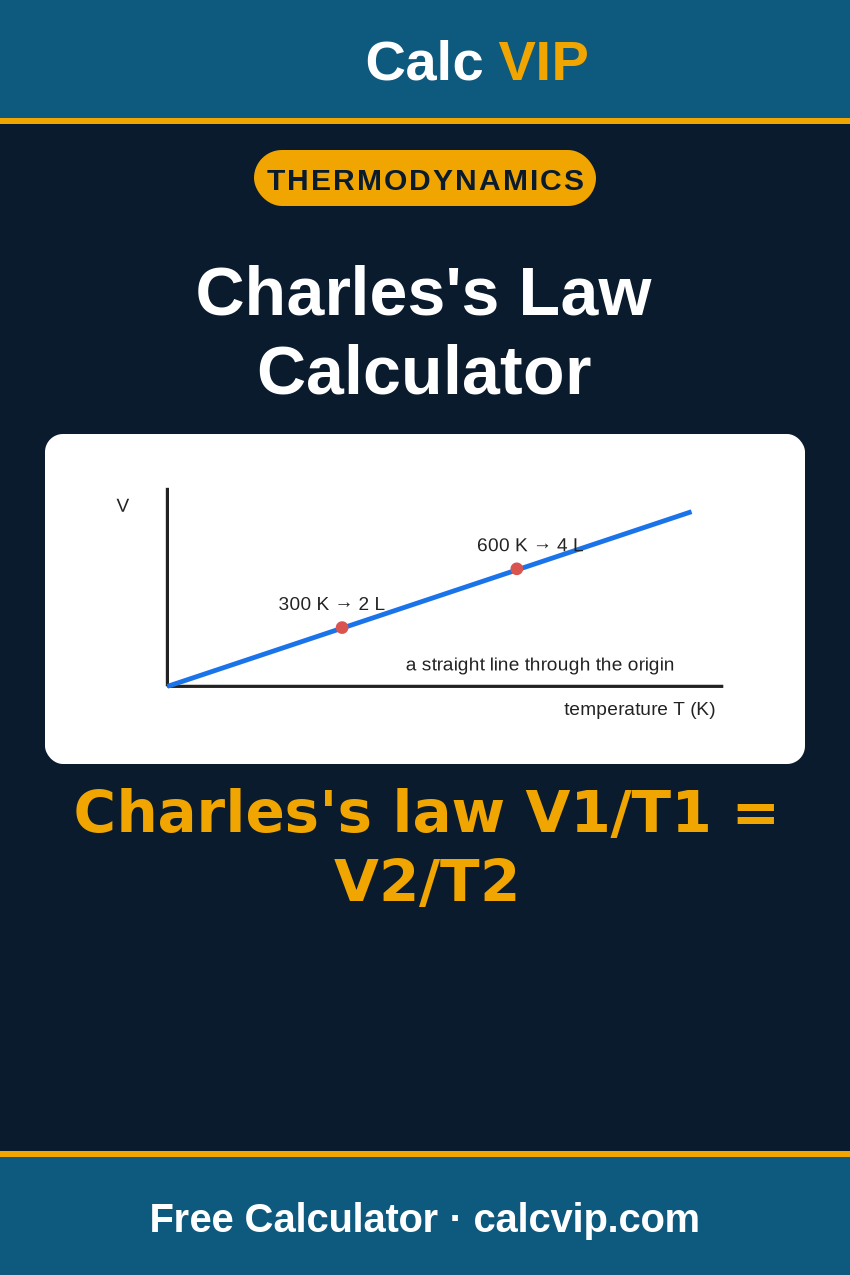
The beautiful part is the exactness of the proportion. Temperature in kelvin is directly proportional to the average kinetic energy of the molecules, and the balancing act above converts that energy ratio into a volume ratio with nothing left over. That is why a graph of V against T is a dead-straight line through the origin — and why extending that line backwards, as the next-but-one section shows, points at one of the most important numbers in physics: absolute zero itself.
How to use
- Pick the unknown from the "Solve for" drop-down.
- Enter the other three values — the box for the unknown can be left blank (it is ignored).
- Convert temperatures to kelvin first: K = °C + 273.15.
- Use the same volume unit for V1 and V2. Click "Solve".
- Sanity-check the direction: heating (T2 > T1) must give a larger volume; cooling must give a smaller one. If your answer moves the wrong way, a value has been entered in the wrong box.
Worked examples
Example 1 — the classic doubling. A gas occupies V1 = 2 L at T1 = 300 K. It is heated at constant pressure to T2 = 600 K. Find V2.
V2 = V1T2/T1 = 2 × 600 / 300 = 4 L
Doubling the absolute temperature exactly doubles the volume — the heart of Charles's law.
Example 2 — a balloon indoors and out. A balloon holds 0.5 L of air at 20 °C (293.15 K). Brought against a radiator at 60 °C (333.15 K), what is its new volume?
V2 = 0.5 × 333.15 / 293.15 = 0.57 L — a modest 14% swell, not the tripling a careless Celsius calculation (0.5 × 60/20 = 1.5 L) would promise.
Example 3 — solving for the temperature. A gas at 280 K fills 3 L. Under the same pressure it expands to 3.6 L. How hot did it get?
T2 = T1V2/V1 = 280 × 3.6 / 3 = 336 K (about 63 °C).
Example 4 — cooling and shrinking. A flexible container holds 750 mL of gas at 350 K. It is cooled to 250 K at constant pressure.
V2 = 750 × 250 / 350 = 535.71 mL — the gas gives up nearly 30% of its volume.
Example 5 — working backwards to V1. After heating to 400 K, a gas occupies 5 L. What did it occupy at 300 K?
V1 = V2T1/T2 = 5 × 300 / 400 = 3.75 L.
Example 6 — the hot-air balloon's lift budget. Air inside a balloon envelope is heated from 288 K (a cool morning) to 373 K. The volume it wants to occupy grows by the factor 373/288 = 1.30 — about 30% more. The excess spills from the mouth of the envelope, so the air that remains has only 288/373 = 0.77 of its original density: roughly 23% lighter than the air outside, and that difference is the lift.
Charles's law in real life
Hot-air balloons. The burner heats the envelope's air at (nearly) constant pressure; the air expands, some escapes, and the lighter remainder lifts the basket — Charles's law with a wicker basket attached, exactly as its discoverer, a balloonist, would have appreciated.
The dented table-tennis ball. Lower a dented ball into hot water and the trapped air expands, pushing the dent out. The ball is a tiny constant-pressure chamber (until the plastic resists), and the repair is pure V ∝ T.
Bread and baking. Gas bubbles in dough expand as the oven heats them — from about 300 K to 470 K is a factor of 1.57 — which, together with steam, gives the loaf its rise before the crust sets and ends the expansion.
Weather balloons. A radiosonde balloon launched nearly limp swells enormously as it climbs into cold but very low-pressure air; its ground crew must also reckon with Charles shrinkage in the cold stratosphere when choosing how much the envelope will stretch before it bursts.
Shrink-wrapped science demos. A balloon placed in liquid nitrogen (77 K) collapses to a fraction of its room-temperature size — the temperature ratio 77/293 ≈ 0.26 — and re-inflates as it warms, the classroom's most dramatic proof that volume tracks kelvin.
Engine intake air. On a hot day (313 K versus 273 K) air is about 13% less dense than on a freezing one; engines and aircraft notice the missing molecules, which is part of why take-off rolls lengthen in summer heat.
The line that discovered absolute zero
Plot volume against Celsius temperature for any gas at constant pressure and you get a straight line that does not pass through the origin — it crosses zero volume at −273.15 °C. Every gas, measured carefully, aims at the same intercept. That convergence was a revelation: there is a floor to temperature, a point where molecular motion reaches its minimum, and the Celsius scale simply starts its counting 273.15 degrees above it. The kelvin scale is nothing more than the Celsius scale re-zeroed at that floor, which is why Charles's law — and every gas proportion — only balances in kelvin. In practice a real gas liquefies long before reaching the intercept, so the line is an extrapolation, never a journey; but as a piece of detective work, reading the universe's lowest possible temperature off a ruler line drawn through balloon measurements remains hard to beat.
Charles's law inside the ideal gas law
The three classical gas laws are one law viewed from three sides. Boyle's law fixes temperature and links P and V; Charles's law fixes pressure and links V and T; Gay-Lussac's fixes volume and links P and T. All three are special cases of PV = nRT: hold the right variables constant and each falls out in a line of algebra. That parentage also tells you when to stop trusting the simple ratio. Charles's law assumes molecules are point-like and never attract each other. Near a gas's boiling point the attractions stop being negligible, volumes shrink faster than the law predicts, and the gas departs from the line — politely at first (a percent or so for air near liquefaction), then completely, as it condenses. For the gases of daily life at ordinary conditions, though, the law is accurate to well within the precision of the temperatures you will type into it.
Quick reference: what a temperature change does to volume
| Change (from 300 K) | T ratio | Volume change |
|---|---|---|
| 300 K → 310 K | 1.033 | +3.3% |
| 300 K → 330 K | 1.10 | +10% |
| 300 K → 450 K | 1.50 | +50% |
| 300 K → 600 K | 2.00 | doubled |
| 300 K → 150 K | 0.50 | halved |
| 293 K → 77 K (liquid nitrogen) | 0.26 | shrinks to about a quarter |
Read the table as a habit of mind: gas volumes respond to the kelvin change, so a 10-degree warming near room temperature is always a small single-digit percentage — never the dramatic doubling that Celsius arithmetic suggests.
One more subtlety hides in the law's simplicity: it assumes the amount of gas is truly fixed. A party balloon is not a sealed ampoule — warm it enough and gas slips past the knot while the envelope stretches and thins — and a tyre warmed by driving also changes its pressure, which the pure Charles picture deliberately ignores. The calculator's sealed-system idealisation is the right first model for all of them; where the seal is doubtful, treat the result as the boundary of what can happen rather than a promise of what will.
Engineers exploit the same boundary deliberately in superpressure balloons — the long-duration research balloons that float for months in the stratosphere. Their envelopes are sealed and nearly inextensible, so instead of expanding freely at constant pressure, the helium inside swings between Charles behaviour by day (warming, pressing outward) and contraction by night. The envelope, the ballast plan and the mission length are all designed around the size of that daily breathing — a direct, unforgiving application of V/T = constant to a vehicle that cannot afford surprises at 35 km.
Working balloonists fly the law with a burner and a vent: add heat and the envelope's air expands and spills from the mouth, lightening the craft; let it cool and the contraction must be answered with more heat or the balloon descends. Every flight is a continuous negotiation with V/T = constant, conducted with a propane burner.
Common mistakes
- Using Celsius in the ratio. The single most common error. 20 °C → 40 °C is not a doubling of anything: in kelvin it is 293.15 → 313.15, a 6.8% rise, and the volume follows the kelvin figure. Convert first, always: K = °C + 273.15.
- Applying the law to a sealed rigid container. If the volume cannot change, Charles's law has nothing to say — the pressure changes instead (Gay-Lussac's law). Check that something is free to move: a piston, a balloon skin, an open mouth.
- Letting gas leak in or out unnoticed. The law assumes a fixed amount of gas. A balloon that vents as it warms (as real hot-air balloons do) ends with a different n, and its final volume reflects both effects at once.
- Mixing volume units between V1 and V2. Litres against millilitres slips a factor of 1,000 into the answer. The units cancel only if they match.
- Expecting the law to survive liquefaction. Cool a gas close to its condensation point and it stops behaving ideally; cool it past that point and the "volume" collapses by orders of magnitude as it turns to liquid. The proportion is a gas-only promise.
FAQ
Why must the temperature be in kelvin?
Charles's law is a proportionality, V ∝ T, which only works from true zero. On the Celsius scale 0 °C is not "no thermal energy", so doubling from 10 °C to 20 °C would wrongly suggest the volume doubles — in kelvin that change is only 283 K → 293 K, a 3.5% rise.
What has to stay constant for Charles's law?
The pressure and the amount of gas. The container must be free to expand or contract (like a piston or balloon) so the pressure can stay the same while the volume changes.
Where do we see Charles's law in real life?
A hot-air balloon: heating the air inside makes it expand, some air leaves, and the remaining air is less dense so the balloon rises. A dented table-tennis ball also pops back into shape in hot water as the air inside expands.
Does Charles's law work for liquids too?
Not in this clean proportional form. Liquids expand when heated, but only slightly (water grows by about 0.02% per kelvin near room temperature, against a gas's 0.33% per kelvin) and not in proportion to absolute temperature. The law is a property of gases, whose molecules are free to roam.
What happens to the volume at absolute zero?
The straight V–T line extrapolates to zero volume at 0 K, but no real gas gets there as a gas — it liquefies and then solidifies on the way down, and quantum effects take over. The intercept is a signpost to absolute zero, not a reachable destination.
Who actually discovered the law?
Jacques Charles found the relationship in the 1780s but never published it. Gay-Lussac printed it in 1802 and credited Charles, which is why it carries Charles's name — a rare case of scientific generosity being rewarded by history.
Can I use Fahrenheit if I convert properly?
Only via kelvin. Fahrenheit has its own absolute scale, the rankine (°R = °F + 459.67), and the proportion works in rankine too — but the safe, universal route is to convert to kelvin and use this calculator.
Why does the pressure stay constant in a balloon?
The balloon skin is flexible and barely resists stretching, so the inside pressure settles at (very nearly) the outside atmospheric pressure. Heat the air and it is volume, not pressure, that gives way — exactly the arrangement the law describes.
How accurate is Charles's law for air?
Very. At pressures near atmospheric and temperatures well above air's liquefaction point, deviations from V ∝ T are far below 1% — smaller than the error in most temperature measurements you would feed into it.
What if both the pressure and temperature change?
Then one law is not enough: use the combined gas law, P1V1/T1 = P2V2/T2, which is Charles's law and Boyle's law applied together. If the amount of gas changes too, go straight to the full ideal gas law, PV = nRT.