 Calc
Entropy Change Calculator – ΔS = Q/T and ΔS = mc ln(T2/T1)
 Created by Anna Kowalski · Physics Editor · Heat & Atoms · Last updated: November 2026
Use this free Entropy Change Calculator in two ways: for heat transferred at a constant temperature use ΔS = Q/T, and for a mass heated from T1 to T2 use ΔS = mc ln(T2/T1). All temperatures must be in kelvin.
Entropy is the quantity that gives time its direction. Energy is conserved — the first law guarantees the books always balance — but entropy is not: it grows, and its growth is what separates past from future. Formally, entropy measures how spread out energy has become: concentrated in one hot place, energy is low in entropy and rich in possibilities; smeared thinly and evenly through everything, it is high in entropy and good for nothing further. The second law of thermodynamics — the total entropy of the universe never decreases — is the quiet rule behind why heat flows from hot to cold, why engines must waste heat, and why no one has ever watched a puddle un-spread itself into an ice cube.
This calculator handles the two situations in which entropy change can be counted exactly. When heat Q crosses into a body whose temperature stays put — a melting solid, a boiling liquid, a vast reservoir — the entropy change is simply ΔS = Q/T: the heat divided by the absolute temperature at which it arrived. When a mass warms up as it absorbs heat, each joule arrives at a slightly higher temperature than the last and so buys slightly less entropy; adding up that sliding scale (integrating, in calculus language) produces the second formula, ΔS = mc ln(T2/T1), with the natural logarithm doing the adding. Between them, the two modes cover most textbook and engineering entropy accounting.
Two habits keep the arithmetic honest. Temperatures must be kelvin, because entropy is anchored to absolute zero — the state of perfect order from which all spreading is measured; a Celsius figure would corrupt both formulas at once. And signs carry the physics: heat entering a body or a rising temperature gives positive ΔS (more spread), while heat leaving or cooling gives negative ΔS for that body. A negative answer is not an error — it is a local tidying, always paid for by a larger increase somewhere else. The calculator reports the sign and reads it aloud; what it cannot do is find you a process whose total, system plus surroundings, comes out negative. There are none.
Formula
At constant temperature: ΔS = Q/T — the entropy change equals the heat transferred reversibly divided by the absolute temperature.
Heating a mass: ΔS = mc ln(T2/T1) — where m is mass (kg), c is specific heat capacity (J/kg·K) and T1, T2 are the starting and final temperatures in kelvin. Entropy is measured in J/K.
The two formulas are one formula seen at two zoom levels. The definition of entropy change is ΔS = ∫ dQ/T — every small packet of heat dQ, divided by the temperature at the moment it crosses. Hold T constant and the division comes outside the integral, leaving Q/T. Let T climb steadily as a mass warms, with dQ = mc dT, and the integral of mc dT/T from T1 to T2 is mc ln(T2/T1) — the logarithm is simply the shape of "dividing by a steadily growing temperature". Two practical consequences follow. Entropy changes care about ratios of temperatures, not differences: warming from 300 K to 600 K (doubling) always gives mc ln 2, whatever the substance's starting point. And the same joule counts for more entropy in a cold place than a hot one — cold is where energy is most concentrated, so spreading it there changes the most.
| Symbol | Meaning | Units |
|---|---|---|
| ΔS | entropy change of the body | J/K |
| Q | heat transferred (at constant T) | J |
| T | absolute temperature of the transfer | K |
| m | mass being heated or cooled | kg |
| c | specific heat capacity | J/kg·K |
| T1, T2 | starting and final temperatures | K |
| ln | natural logarithm (base e) | — |
Entropy counts arrangements: Boltzmann's idea
Behind the bookkeeping stands a picture, carved on Ludwig Boltzmann's tombstone: S = k ln W. Entropy counts W — the number of microscopic arrangements (positions and speeds of particles) that look identical from outside. A gas with all its particles corralled in one corner has few arrangements; let it spread through the whole box and the arrangements multiply beyond counting. Heat a body and its particles gain access to faster speeds and wider wanderings: W explodes, and S with it. Entropy is not vaguely "disorder" — it is a census of possibilities, and the formulas on this page are that census kept in joules and kelvin instead of in raw counts.
The census explains the second law's one-wayness without any force pushing it. Systems wander randomly from arrangement to arrangement; the high-W arrangements so vastly outnumber the low-W ones that a system left alone is essentially certain to drift towards them and never, in the age of the universe, to wander all the way back. A gas released into an empty chamber doubles its volume because there are more ways to be spread out — for one mole doubling its volume, ΔS = R ln 2 ≈ 5.76 J/K, a number this calculator's logic reaches by counting rather than by heat. Nothing forbids the gas from re-corraling itself; the odds merely make "forbidden" the honest word.
This statistical view also softens a common misunderstanding. Entropy is not mess, dirt or decay in the moral sense — a crystal forming in a supersaturated solution is entropy-defying to the eye, yet the heat it releases raises the surroundings' entropy by more than the crystal's falls. What the second law audits is only the total count, everywhere, and it is perfectly happy to fund local order — snowflakes, engines, living cells — out of larger disorder elsewhere. Life on Earth runs exactly this way, as the applications below describe.
How to use
- Choose the mode that matches your problem from the drop-down.
- For Q/T mode, enter the heat transferred and the (constant) temperature in kelvin — use this for melting, boiling and reservoirs.
- For the mass mode, enter m, c and the two temperatures in kelvin (add 273.15 to convert from °C).
- Click "Calculate Entropy Change" — a positive result means entropy increased, a negative result means it decreased.
- For a whole process, repeat for each part (system and surroundings) and add the ΔS values: the total is the universe's verdict, and it cannot be negative.
Worked examples
Example 1 — heat into a reservoir. Constant temperature: 900 J of heat flows into a reservoir at T = 300 K.
ΔS = 900 / 300 = 3 J/K
Example 2 — warming water. Heating a mass: 1 kg of water (c = 4186 J/kg·K) warms from 300 K to 350 K.
ΔS = 1 × 4186 × ln(350/300) = 4186 × 0.15415 = 645.27 J/K — a big number, because water's large c means a great deal of heat moved during the warm-up.
Example 3 — melting ice. Half a kilogram of ice melts at 273 K, absorbing Q = mL = 0.5 × 334,000 = 167,000 J at constant temperature.
ΔS = 167,000 / 273 = 611.72 J/K — melting is an entropy feast: the rigid crystal becomes a liquid with vastly more arrangements, and the entropy books show it.
Example 4 — cooling water (negative ΔS). Two kilograms of water cool from 350 K to 300 K.
ΔS = 2 × 4186 × ln(300/350) = 8372 × (−0.15415) = −1,290.55 J/K. The water's entropy genuinely falls — legitimately, because the heat it shed raised the surroundings' entropy by more.
Example 5 — the universe's ledger for one heat flow. 1,000 J conducts from a reservoir at 400 K to one at 300 K. The hot reservoir loses ΔS = −1000/400 = −2.5 J/K; the cold one gains ΔS = +1000/300 = +3.33 J/K.
Total: −2.5 + 3.33 = +0.83 J/K — positive, as the second law insists. This tiny surplus is the deep reason heat flows this way and never spontaneously back: the reverse journey would total −0.83 J/K, and the universe declines.
Example 6 — heating a metal. A 0.5 kg block of aluminium (c = 897 J/kg·K) is heated from 293 K to 373 K.
ΔS = 0.5 × 897 × ln(373/293) = 448.5 × 0.24141 = 108.27 J/K — far less than water's figure in Example 2 for a similar warming, because aluminium's specific heat is a fifth of water's: fewer joules moved, fewer new arrangements bought.
Entropy in real life
Why your drink stays cold — briefly. Ice in a drink melts by absorbing heat at 273 K, gaining entropy at the rate of Example 3. The drink cools, its entropy falls — but by less than the ice's rises, so the total climbs and the process runs. When everything reaches one temperature, the entropy is maxed out for the available energy, and nothing further happens: equilibrium is entropy's ceiling.
The refrigerator's bargain. A fridge lowers the entropy of its contents by pumping heat out — a local decrease the second law permits only because the compressor's work ends up as extra heat in the kitchen, raising the room's entropy by more. The fridge is not defying the law; it is paying it, in electricity, with the kitchen as the receipt.
Why engines must have exhausts. An engine's working fluid must return to its starting state each cycle, so any entropy that flowed in with the heat must flow out again — carried by the rejected heat Qout to the cold reservoir. Waste heat is not (only) carelessness: it is the entropy drain without which the cycle cannot close. The Carnot calculator on this site prices exactly that obligation.
Mixing is forever. Stir milk into tea and the entropy of the mixture exceeds the sum of its parts; no process in the kitchen will unmix it, because unmixing would require the universe's entropy to fall. The same irreversibility governs perfume spreading through a room, pollutants dispersing, and gases mixing in the atmosphere.
Earth's entropy budget — why life is allowed. Sunlight arrives as concentrated, low-entropy energy from a 5,800 K surface; Earth re-radiates the same energy as diffuse infrared from 255 K — the same joules spread over far more, higher-entropy radiation. The planet exports entropy wholesale, and everything here — weather, oceans, forests, you — is funded by the difference. Local order is not the exception to the second law; exported entropy is its business model.
The arrow of time. Every other law of physics works equally well backwards; entropy alone picks a direction. Eggs break but never unbreak, not because a force prevents it, but because the unbroken egg is one arrangement among uncountable broken ones. When physicists speak of time's arrow, the quantity on this page is the arrowhead.
Entropy of phase changes: the constant-temperature mode at work
Melting and boiling are the Q/T mode's home ground, and comparing them is instructive. Vaporising 1 kg of water at 373 K carries ΔS = 2,260,000/373 ≈ 6,059 J/K; melting 1 kg of ice at 273 K carries 334,000/273 ≈ 1,223 J/K. The boiling figure is about five times the melting one, echoing the latent heats themselves (vaporisation costs about 6.8 times fusion's energy) slightly softened by the higher temperature of the boil. Physically the ranking makes sense: melting loosens a crystal into a liquid — a modest gain in arrangements — while boiling explodes a liquid into a gas occupying roughly a thousand times the volume, an avalanche of new possibilities that the entropy column records faithfully.
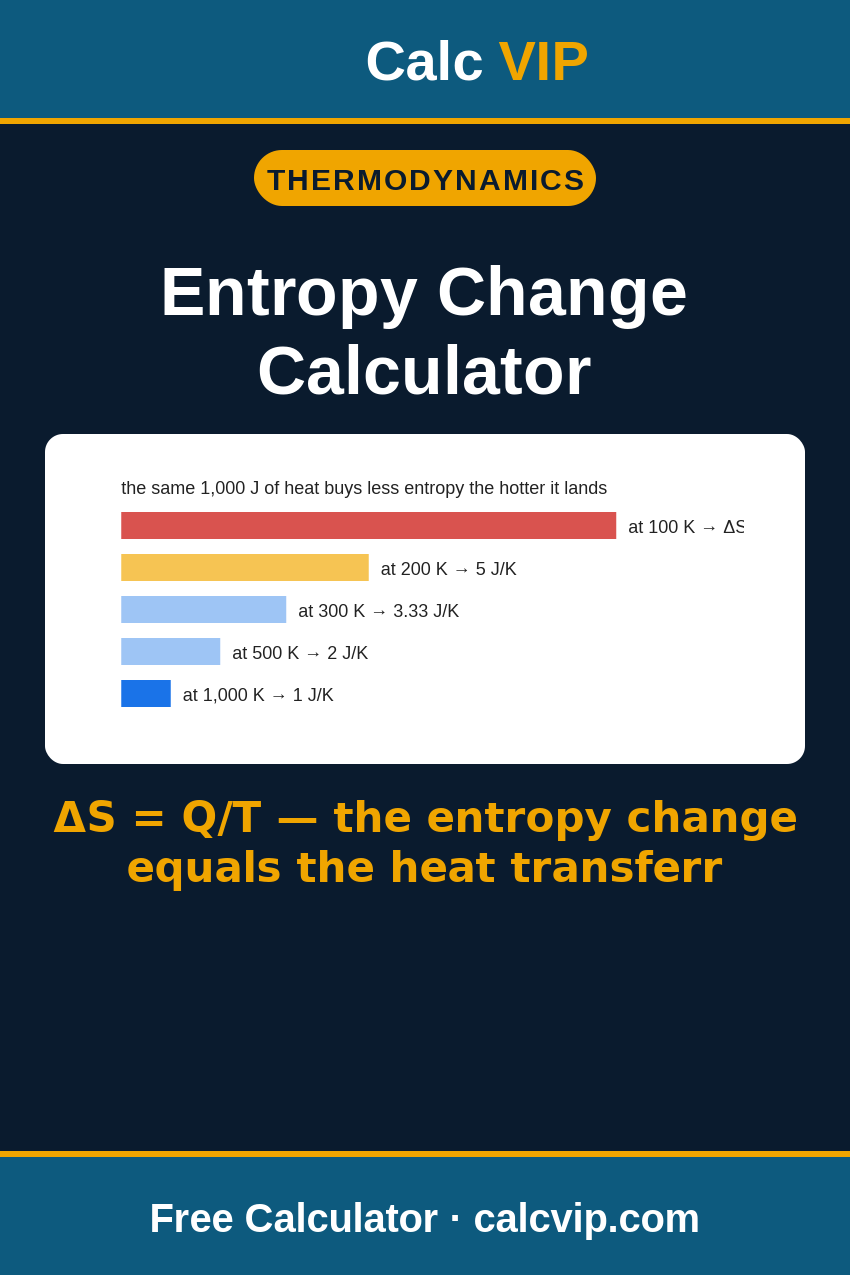
Quick reference: what 1,000 J buys at different temperatures
| Temperature of arrival | ΔS = Q/T | Situation |
|---|---|---|
| 100 K | 10 J/K | cryogenic equipment |
| 200 K | 5 J/K | a hard winter's night, high altitude |
| 300 K | 3.33 J/K | room temperature |
| 500 K | 2 J/K | a hot oven, engine coolant at pressure |
| 1,000 K | 1 J/K | a furnace, combustion gases |
The pattern is the economics of the whole subject: entropy is cheap at high temperature and dear at low. That is why dumping waste heat into a cold environment generates entropy so efficiently (and why engines are irreversible in practice), and why the last degrees of cooling towards absolute zero cost fortunes — down there, every joule moved carries an enormous entropy price tag.
Common mistakes
- Using Celsius. Both formulas are anchored to absolute zero. Warming water from 27 °C to 77 °C is a ratio of 350/300 in kelvin — but 77/27 in Celsius, giving an entropy change more than five times too large. Convert to kelvin before anything else.
- Using Q/T while the temperature is changing. If the body warms as it absorbs heat, there is no single T to divide by; the honest calculation is the mc ln(T2/T1) mode. Q/T with an "average" temperature is an approximation that examiners — and careful engineers — do not accept.
- Declaring a negative ΔS impossible. A body's entropy falls whenever it cools or sheds heat (Example 4). The law constrains only the total of system plus surroundings. Marking every negative answer wrong misunderstands the second law's actual statement.
- Using log₁₀ instead of ln. The mass formula needs the natural logarithm. A calculator's "log" button gives log₁₀, which is smaller by a factor of 2.303 — every answer comes out less than half the true value. Look for the "ln" key.
- Forgetting the surroundings. Computing the system's ΔS and stopping there invites false paradoxes ("the fridge violates the second law!"). Always run the ledger for both sides, as Example 5 does; the universe's total is the only figure the law pronounces on.
FAQ
What is entropy?
Entropy is a measure of how spread out energy is — often described as the disorder of a system. The second law of thermodynamics says the total entropy of the universe never decreases.
Why does the mass formula use a logarithm?
Because the temperature rises as heat is added, each extra joule is added at a slightly higher temperature and counts a little less toward ΔS. Adding up (integrating) Q/T over the whole warm-up gives the mc ln(T2/T1) result.
Can entropy change be negative?
Yes — for one part of a system. If heat leaves a body or it cools down, its entropy falls. But the surroundings gain at least as much, so the total for the universe still increases.
Is entropy just "disorder"?
It is a useful first picture but an imprecise one. Entropy precisely counts the number of microscopic arrangements consistent with what you see, weighted by how the energy is spread among them. A tidy-looking process can raise entropy (a crystal dissolving) and a messy-looking one can accompany a local fall (frost feathering a window, paid for by the room). The counting definition never misleads; the tidiness metaphor sometimes does.
Can ΔS ever be exactly zero?
Yes, in two honourable ways. A perfectly reversible process leaves the universe's entropy unchanged — the Carnot cycle's working fluid ends each loop with ΔS = 0, its gains and losses cancelling exactly. And an isolated system already at equilibrium has nowhere to drift: its entropy sits at the maximum, constant. Real processes always add a little; zero is the ideal limit they approach.
Why is entropy measured in J/K?
Because it is defined as heat divided by temperature — joules per kelvin. The unit is a fossil of the definition, and a handy check: if your calculation ends in joules alone, a division by temperature has gone missing.
Does the entropy of the universe really never decrease?
That is the second law, and no exception has ever been observed — not in a laboratory, not in a star. Individual systems decrease their entropy constantly (freezers, crystals, embryos), always by exporting more than they shed. The law is statistical at heart: a decrease for the whole universe is not forbidden by a force, but by odds so extreme that "never" is the practical word.
How is entropy related to the Carnot efficiency?
Directly. In a Carnot cycle the entropy flowing in with the heat, Qin/Th, must flow out with the rejected heat, Qout/Tc — setting them equal gives Qout/Qin = Tc/Th, and the efficiency formula falls out in one line. The entropy viewpoint is not an alternative to Carnot's result; it is the reason for it.
What is the entropy change when a gas expands freely into a vacuum?
No heat flows and no work is done, yet the entropy rises, because the particles gain a larger volume to arrange themselves in: ΔS = nR ln(V2/V1) for n moles. Doubling the volume of one mole gives R ln 2 ≈ 5.76 J/K. It is the cleanest proof that entropy counts arrangements, not heat — here it grew with Q = 0.
Will the universe's entropy really end everything?
Extrapolating the second law, yes — the far-future "heat death" is the state of maximum entropy: no temperature differences, no flows, no work, no events. It is not a fiery end but a perfectly even lukewarm (in fact, near-absolute-zero) stillness, trillions of years away. Every process on this page, from melting ice to burning fuel, is a small step of the universe down that one-way slope.