 Calc
Conduction Calculator – Heat Flow Rate Q/t = kAΔT/d
 Created by Anna Kowalski · Physics Editor · Heat & Atoms · Last updated: November 2026
Use this free Conduction Calculator to find the rate of heat flow through a slab or wall, using Q/t = kAΔT/d. Enter the material's thermal conductivity, the area, the temperature difference and the thickness — and optionally a time to get the total heat transferred.
Heat conducts through a solid the way water flows downhill: always from hot to cold, at a rate set by how steep the slope is and how open the path. The conduction law — Fourier's law, written down by Joseph Fourier in 1822 — puts four levers on that rate, and this calculator is simply those four levers in a box. Push the temperature difference ΔT up and the flow grows in proportion. Enlarge the area A and more heat gets through, in proportion. Double the thickness d and the flow halves. And presiding over all of it is k, the thermal conductivity, a property of the material itself that spans an astonishing range — copper conducts heat some fifteen thousand times faster than the still air in a foam.
Almost every thermal decision in daily life is this equation wearing a disguise. The heating bill of a house is the sum of Q/t over every wall, window and roof. A saucepan is a deliberate conduction machine — a thick, high-k base to spread the flame's heat evenly, married to a low-k handle that refuses to pass it on. The heat sink on a computer processor, the lagging on a hot-water tank, the oven glove, the double-glazed window: each is an exercise in choosing k, A, ΔT and d to make heat go where it is wanted, at the rate it is wanted, and nowhere else.
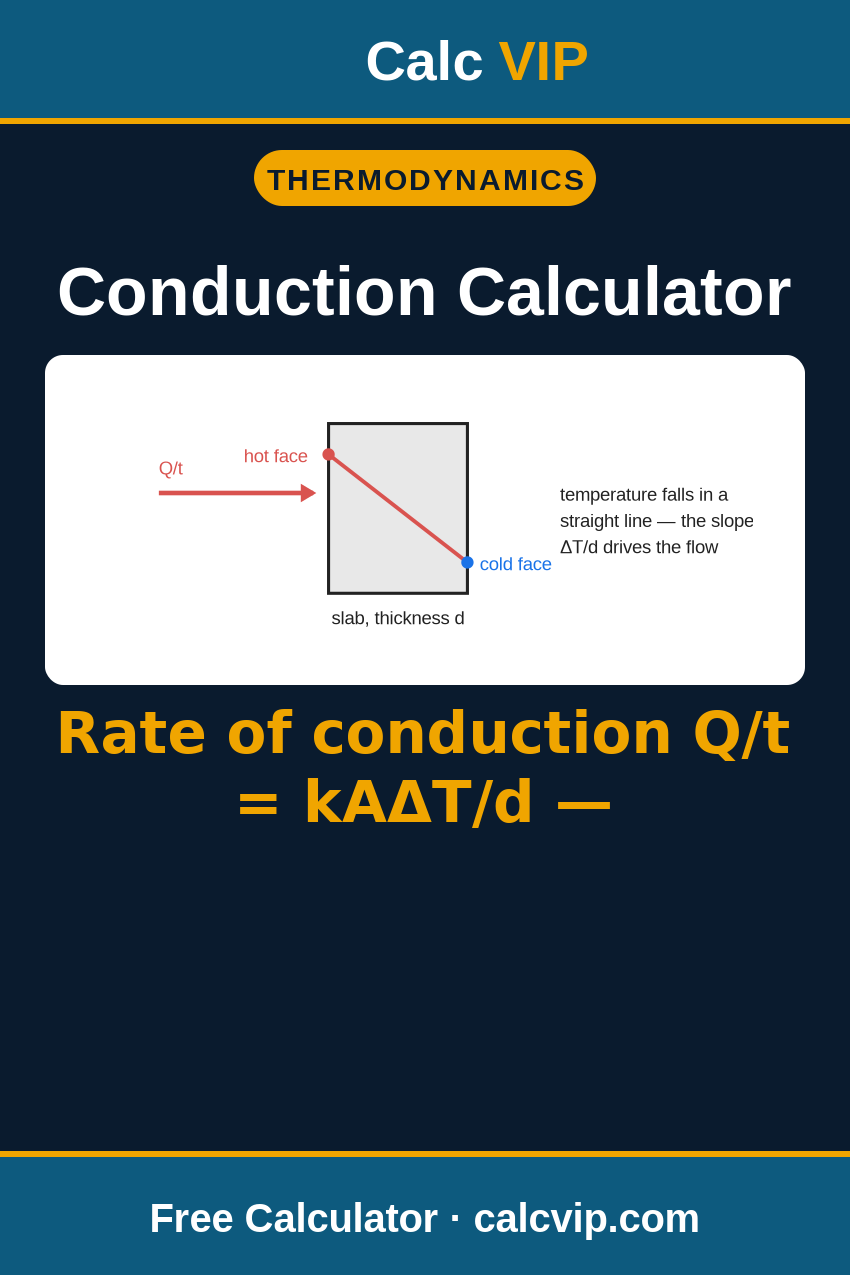
The law describes steady state — the settled condition after the slab's own temperature profile has stabilised, when the same watts enter one face as leave the other. In that state the temperature falls in a straight line from the hot face to the cold one, and the flow never changes with time, which is why an optional time input converts the rate into a total: Q = (Q/t) × t. Real walls warm up first and only then obey the law exactly, but for anything that has been sitting between two temperatures for a while — a house wall in winter, a furnace lining, an igloo — the steady law is the right tool, and it is the foundation on which all building insulation standards are built.
Formula
Rate of conduction Q/t = kAΔT/d — where k is the thermal conductivity (W/m·K), A is the area (m²), ΔT is the temperature difference across the slab (K) and d is its thickness (m). The total heat in time t is Q = (Q/t) × t.
The equation rearranges to expose any one of its parts: the conductivity k = (Q/t)d/(AΔT) (the job of this site's thermal conductivity solver), the thickness needed for a target flow d = kAΔT/(Q/t), or the temperature drop a given flow produces, ΔT = (Q/t)d/(kA). Notice the combination ΔT/d — the temperature gradient, how many kelvin the temperature falls per metre of material. Double the thickness at the same face temperatures and you halve the gradient, which is the deep reason the flow halves: conduction is driven not by temperature, nor by difference alone, but by difference per metre.
| Symbol | Meaning | Units |
|---|---|---|
| Q/t | rate of heat flow through the slab | watts (W) = joules per second |
| k | thermal conductivity of the material | W/m·K |
| A | area through which the heat flows | m² |
| ΔT | temperature difference between the faces | K (same size in °C) |
| d | thickness of the slab | m |
Inside the slab: a relay race of vibrations
No particle in a solid travels from the hot face to the cold one. Instead, heat crosses by relay. The atoms at the hot face jiggle violently; each one shoulders its neighbour into livelier motion, which shoulders the next, and the disturbance — not the matter — crosses the slab. In non-metals that relay of vibrations (physicists call the packets phonons) is the whole story, and its speed depends on how stiffly the atoms are bonded and how orderly the crystal is. Disorder, gaps and softness all fumble the baton, which is why foams and fibres, mostly air and tangle, conduct so feebly.
Metals run a second, faster relay in parallel. Their electrons are not tied to individual atoms but form a shared sea that can drift through the whole piece; electrons heated at the hot face carry their energy bodily across and deliver it at the cold face. This is why the league table of thermal conductors is almost identical to the league table of electrical conductors — silver and copper top both — the same electrons are running both races. It is also why a metal spoon in hot soup burns your fingers while a wooden one in the same soup does not: identical ΔT, identical geometry, but k differs by a factor of thousands.
The straight-line temperature profile in the first diagram is the relay in equilibrium: every layer passes on exactly the energy it receives, so the temperature steps down evenly, metre by metre. Where two materials meet — brick against foam, say — the profile kinks: the temperature plunges across the good insulator and barely slopes across the conductor, because the same flow must squeeze through both and each layer's gradient adjusts to its own k. That kink is the working principle of every composite wall, and the next-but-one section turns it into arithmetic.
How to use
- Enter k for your material: brick ≈ 0.8, glass ≈ 1.0, wood ≈ 0.15, copper ≈ 400 W/m·K.
- Enter the area in square metres, the temperature difference between the two faces, and the thickness in metres (20 cm = 0.2 m).
- Optionally enter a time in seconds to also get the total heat transferred.
- Click "Calculate Heat Flow Rate" to get the rate in watts.
- To compare designs, change one lever at a time — the rate responds in exact proportion to k, A and ΔT, and in inverse proportion to d.
Worked examples
Example 1 — the brick wall. A brick wall (k = 0.8 W/m·K) of area 10 m² and thickness 0.2 m has a temperature difference of 15 K across it.
Q/t = 0.8 × 10 × 15 / 0.2 = 600 W
In one hour (3600 s): Q = 600 × 3600 = 2,160,000 J = 2.16 MJ of heat escapes.
Example 2 — a single-glazed window. A pane of glass (k = 1.0) of area 2 m² is only 0.005 m (5 mm) thick, with 20 K between the room and a winter's night.
Q/t = 1.0 × 2 × 20 / 0.005 = 8,000 W — eight kilowatts through one window. Glass is not a dreadful conductor; it is the thinness that betrays it, which is precisely the wound double glazing bandages with a trapped layer of air.
Example 3 — a copper bar. A copper rod (k = 400) of cross-section 0.002 m² and length 0.05 m joins a hot block to a cold one, 100 K apart.
Q/t = 400 × 0.002 × 100 / 0.05 = 1,600 W — a kettle's worth of heat down a rod the size of a finger. Metals do not merely conduct; they conduct extravagantly.
Example 4 — a foam-insulated roof. Foam boards (k = 0.03) cover a roof of 50 m², 0.1 m thick, with 25 K between the warm rooms and the winter sky.
Q/t = 0.03 × 50 × 25 / 0.1 = 375 W for the entire roof — less than the single window of Example 2 loses through a fraction of the area. Low k, generously thick, is a powerful combination.
Example 5 — a wooden cold-store wall, over a working day. Wood (k = 0.15), area 5 m², thickness 0.05 m, ΔT = 10 K.
Q/t = 0.15 × 5 × 10 / 0.05 = 150 W. Over 8 hours (28,800 s) the total is Q = 150 × 28,800 = 4,320,000 J = 4.32 MJ — the heat the refrigeration must quietly remove, every day, just to stand still.
Example 6 — doubling the brick. Rebuild Example 1's wall twice as thick, d = 0.4 m, everything else unchanged.
Q/t = 0.8 × 10 × 15 / 0.4 = 300 W — exactly half, as the 1/d law demands. Thickness buys its savings at a fair, predictable rate: each doubling halves the loss, with no diminishing-return trickery in the pure conduction part of the story.
Conduction in real life
Loft insulation and heating bills. A house is a box of warm air wrapped in slabs, and its heating bill is this calculator summed over every slab. Fibreglass and foam win not by exotic chemistry but by trapping air — k ≈ 0.026, among the lowest of any common material — inside a tangle that stops the air itself from circulating and convecting the heat away.
Double glazing. Example 2's 8,000 W disaster is fixed by inserting a centimetre of still air (or argon) between two panes: the air layer's tiny k and the doubled path cut the loss by well over half. The glass was never the insulator; the gap is.
Saucepans and oven gloves. A good pan is a sandwich of decisions: aluminium or copper (k in the hundreds) where the heat must spread, steel or silicone (k a hundred times smaller) where hands must go. The oven glove is the same trick as the loft — trapped air in a quilted tangle — worn on the hand.
Heat sinks and processors. A computer chip is a tiny, furious hot face that must shed tens of watts through a few square centimetres. Aluminium fins answer with high k and a huge A — the two levers multiplied — while the fan handles the separate problem of carrying the heat away from the fins' surfaces.
Why igloos work. Snow is mostly trapped air in an ice scaffold, with a k nearer to wood than to solid ice. Thick snow walls, a small volume, and the steady state of Fourier's law let a lamp and body heat hold the inside near 0 °C while the outside sits at −40 °C: a ΔT of 40 K carried by a very forgiving slab.
Cold bridges. One steel bolt or concrete lintel crossing an insulated wall is a high-k short circuit: its own Q/t, though small in area, can rival whole square metres of insulation and shows up on thermal cameras as a glowing stripe — and on the wall inside as a cold stripe where mould gathers. Designers hunt these bridges precisely because the equation says they matter.
Walls in series: thermal resistance
Real walls are layer cakes, and conduction handles them with one elegant idea: thermal resistance, R = d/k for each layer, measured in m²·K/W. Layers stacked in series add their resistances, exactly like electrical resistors, and the flow through the whole sandwich is Q/t = A × ΔT ÷ Rtotal. Watch it transform Example 1: the brick alone has R = 0.2/0.8 = 0.25, passing 600 W. Add just 5 cm of foam (R = 0.05/0.03 ≈ 1.67) and the total resistance becomes 0.25 + 1.67 ≈ 1.92, so the same wall now passes Q/t = 10 × 15 / 1.92 ≈ 78 W — an 87% cut from a layer a quarter of the brick's thickness, because the foam's resistance dwarfs the brick's. Building scientists quote the reciprocal, the U-value (U = 1/R, in W/m²·K): our upgraded wall has U ≈ 0.52, against the bare brick's 4.0. When regulations demand U-values below 0.3 for new walls, they are legislating this paragraph.
Quick reference: thermal conductivities
| Material | k (W/m·K) | Character |
|---|---|---|
| silver | 429 | the best common conductor |
| copper | 400 | pans, heat sinks, wiring |
| aluminium | 237 | lightweight heat spreading |
| steel | ≈ 50 | structure — and cold bridges |
| ice | 2.2 | solid water conducts modestly |
| glass | 1.0 | windows rely on thinness, sadly |
| brick | 0.8 | the classic wall |
| water | 0.6 | but it convects, which dominates |
| wood | 0.15 | handles, floors, cold stores |
| fibreglass / foam | 0.03–0.04 | trapped air doing the work |
| still air | 0.026 | the benchmark insulator |
The table spans a factor of more than 16,000 from silver to still air — no other everyday property of materials ranges so widely, which is why material choice, lever k, is usually the first and biggest decision in any thermal design.
Common mistakes
- Entering thickness in centimetres. The formula wants metres. A 20 cm wall entered as d = 20 instead of 0.2 understates the flow a hundredfold — the commonest conduction error by far, and the reason the calculator's examples keep repeating the conversion.
- Using a temperature instead of a difference. ΔT is the gap between the faces — 15 K for a wall between 20 °C and 5 °C rooms. Feeding in "20" because the room is 20 °C inflates the answer by a third and misunderstands what drives the flow.
- Quoting the flow per square metre as the whole flow. With A omitted (or set to 1) the result is the loss through one square metre only. A 40 m² roof loses forty times the per-metre figure; area is a lever, not a detail.
- Giving a layered wall a single k. Brick-plus-foam has no honest single conductivity; averaging the k values gives nonsense. Add the resistances R = d/k layer by layer, then divide once, as the series section shows.
- Forgetting the surfaces. Pure conduction covers the solid itself. Real walls also exchange heat with room air and the outdoors by convection and radiation, adding surface resistances in series — which is why measured losses differ a little from the bare-slab calculation, and why still air films on a wall are worth real money.
FAQ
Why does doubling the thickness halve the heat flow?
The rate is proportional to 1/d: a thicker slab gives the heat a longer path through the material, so energy escapes more slowly. That is exactly how thicker loft insulation keeps a house warm.
What makes a good insulator?
A very small k. Still air is one of the best (k ≈ 0.026 W/m·K), which is why foams and fibreglass — mostly trapped air — insulate so well, while metals like copper (k ≈ 400) conduct rapidly.
Is ΔT in °C or K?
Either — only the size of the difference matters, and a difference of 1 °C is the same as a difference of 1 K.
Why does a metal railing feel colder than a wooden bench on the same frosty morning?
Both are at the same temperature; your hand is not a thermometer but a heat-flow meter. Metal's high k drains heat from your skin hundreds of times faster than wood's low k, and your nerves report the rate of loss, not the temperature. The same effect makes a marble floor feel colder than carpet in the same room.
What is a U-value, and how does it relate to this calculator?
The U-value is the heat flow per square metre per kelvin for a whole construction: U = (Q/t)/(A ΔT) = k/d for a single layer, or 1/Rtotal for layers in series. It is the number building regulations quote; lower is better insulated. The bare brick wall of Example 1 has U = 4.0 W/m²·K; with 5 cm of foam, about 0.52.
Does conduction happen in liquids and gases too?
Yes, but there it usually loses to convection: warm fluid physically moves and carries its heat with it, far faster than the molecular relay. Conduction rules in solids, and in fluids only when movement is suppressed — the thin, still air trapped in foam cannot circulate, so conduction is all it has left, and it is wonderfully bad at it.
Why does the temperature fall in a straight line through a slab?
In steady state every layer must pass on exactly what it receives, so the flow is the same everywhere; since flow is proportional to the local gradient, the gradient is the same everywhere too — a constant slope is a straight line. If the line bends, the slab is still warming up or cooling down, and the steady law has not yet taken hold.
Can conduction ever flow from cold to hot?
Never by itself — that is the second law of thermodynamics in its everyday clothes. Refrigerators move heat from cold to hot, but only by spending work and by dumping even more heat at the hot side; the conduction steps inside them still each run downhill.
How is k measured?
By running this equation backwards: clamp a sample between a measured heat source and a cold plate, wait for steady state, record the rate, area, thickness and ΔT, and solve for k — the method of this site's thermal conductivity solver, and of laboratory standards such as the guarded hot plate.
Why are houses insulated in the loft first?
Warm air rises, so the roof faces the largest ΔT in the house, and it is usually the easiest large area to treat. The equation rewards it directly: the roof's A is big, and adding low-k thickness there cuts one of the largest single Q/t terms in the whole building's sum.