 Calc
Combined Gas Law Calculator – P1V1/T1 = P2V2/T2 Solver
 Created by Anna Kowalski · Physics Editor · Heat & Atoms · Last updated: November 2026
Use this free Combined Gas Law Calculator to solve any one value in P1V1/T1 = P2V2/T2 for a fixed mass of gas when pressure, volume and temperature all change. Choose what to solve for, then enter the other five values — temperatures must be in kelvin.
Most real gas problems refuse to hold anything constant. A tyre warms as it is pumped up, a balloon is squeezed by the sea while the water cools it, a cylinder of gas is compressed and heated in the same stroke of an engine. Boyle's law handles squeezing alone, Charles's law handles heating alone — the combined gas law handles everything at once. For a fixed mass of gas, the quantity PV/T never changes: whatever a gas does, as long as none of it escapes, the pressure times the volume divided by the absolute temperature is a constant of that sample, as faithful as a fingerprint.
The law is really three laws wearing one coat. Freeze the temperature and the T's cancel, leaving Boyle's P1V1 = P2V2. Freeze the pressure and it becomes Charles's law, volume proportional to temperature. Freeze the volume and pressure becomes proportional to temperature — the reason a sealed aerosol can is a small bomb in a fire. The combined form remembers all three at once, which is why it is the working tool for everything from checking a scuba tank that has cooled in the water to predicting whether a rising weather balloon will burst before it reaches the stratosphere.
Two disciplines make it work. First, temperatures must be absolute — kelvin, counted from the true zero of thermal energy — because the law's proportions are anchored at that zero; a Celsius temperature would shift every ratio and can even conjure negative pressures out of harmless numbers. Second, the mass of gas must be genuinely fixed: no leaks, no topping up, no chemical reaction creating or destroying gas particles. Honour those, keep pressure and volume units consistent, and any one unknown — a final pressure, a starting temperature, a volume you never measured — falls out of the other five, which is exactly what the calculator above is for.
Formula
Combined gas law P1V1/T1 = P2V2/T2 — for a fixed mass of gas, PV/T stays constant. Solving for each value: P2 = P1V1T2/(T1V2) · V2 = P1V1T2/(T1P2) · T2 = P2V2T1/(P1V1) · P1 = P2V2T1/(T2V1) · V1 = P2V2T1/(T2P1) · T1 = P1V1T2/(P2V2). Temperatures must be in kelvin; pressure and volume just need consistent units.
Read the structure of each rearrangement and the law becomes hard to misremember: the unknown is always the old value corrected by two ratios — a pressure-or-volume ratio and a temperature ratio. Squeeze the volume down and the pressure climbs by V1/V2; heat the gas and it climbs again by T2/T1. The two effects simply multiply, which is why Example 1's pressure more than doubles: halving the volume doubles it, and heating from 300 K to 400 K multiplies by a further 4/3. When a combined-law answer surprises you, factor it this way and the surprise usually resolves into one ratio you had underestimated.
| Symbol | Meaning | Units |
|---|---|---|
| P1, P2 | pressure before and after the change (absolute) | kPa, atm, bar — one unit throughout |
| V1, V2 | volume before and after the change | L, mL, m³ — one unit throughout |
| T1, T2 | absolute temperature before and after | kelvin (K) — never °C |
| PV/T | the constant of the sample, equal to nR | e.g. kPa·L/K |
One constant, three famous laws
The combined law is not a fourth discovery alongside Boyle's, Charles's and the pressure law — it is the single truth of which those three are shadows. Each of the older laws describes a gas shepherded along a path where one variable is pinned. Pin the temperature and the gas trades pressure against volume along Boyle's hyperbola. Pin the pressure and volume tracks temperature in Charles's straight line. Pin the volume and pressure tracks temperature instead. Unpin everything, as real life insists on doing, and only the combination PV/T survives as constant — the three pinned paths are just the edges of the surface the free gas moves on.
Kinetic theory shows why the combination, of all possible combinations, is the conserved one. Pressure measures how hard the particles batter the walls — proportional to how many there are per unit volume (n/V) and how fast they move. Temperature, in kelvin, measures that very speed: the average kinetic energy of the particles. Multiply pressure by volume and the crowding cancels out, leaving a quantity proportional to (number of particles) × (energy per particle) — the total thermal energy content of the sample, in disguise. Divide by T and even the energy per particle cancels, leaving just the count of particles, n, times a universal constant. PV/T is constant because the gas neither gains nor loses particles; the law is bookkeeping for molecules.
That reading also marks the law's frontiers. Let gas leak, burn, condense or react and the particle count changes — the constant moves, and the problem belongs to the full ideal gas law PV = nRT with n allowed to vary. Push to extreme pressures or down towards liquefaction and the particles' own size and stickiness intrude, bending every gas law at once. Within the wide middle ground of everyday engineering — engines, balloons, tanks, tyres, weather — the combined law is effectively exact.
How to use
- Pick the unknown from the "Solve for" drop-down.
- Enter the other five values — the box for the unknown can be left blank (it is ignored).
- Convert temperatures to kelvin first: K = °C + 273.15.
- Use the same pressure unit for P1 and P2, and the same volume unit for V1 and V2.
- Make sure pressures are absolute — add atmospheric pressure (about 101 kPa) to any gauge reading.
- Click "Solve" to get the missing value in the matching unit (temperatures come out in kelvin).
Worked examples
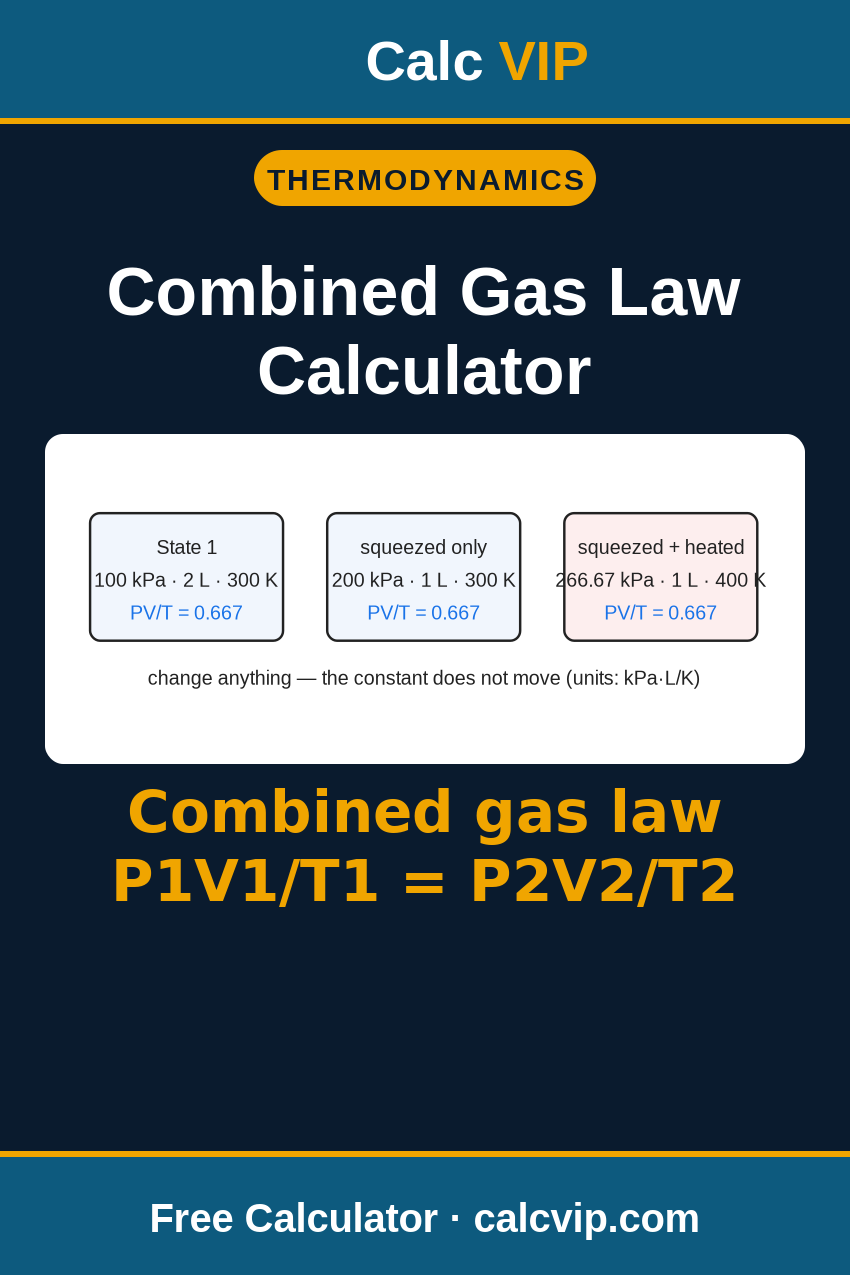
Example 1 — squeezed and heated together. A gas starts at P1 = 100 kPa, V1 = 2 L, T1 = 300 K. It is compressed to V2 = 1 L and heated to T2 = 400 K. Find P2.
P2 = P1V1T2 / (T1V2) = 100 × 2 × 400 / (300 × 1) = 80,000 / 300 = 266.67 kPa
Example 2 — solving for the final temperature. A gas at 200 kPa and 3 L starts at 300 K. After a change it sits at 300 kPa in 2.5 L. What is T2?
T2 = P2V2T1 / (P1V1) = 300 × 2.5 × 300 / (200 × 3) = 225,000 / 600 = 375 K — the gas has warmed by 75 K, as the pressure rising faster than the volume fell already hinted.
Example 3 — solving for the final volume. Air at 101 kPa, 4 L and 290 K moves to a state at 95 kPa and 310 K.
V2 = P1V1T2 / (T1P2) = 101 × 4 × 310 / (290 × 95) = 125,240 / 27,550 ≈ 4.55 L — both the pressure drop and the warming push the volume up, and it grows by about a seventh.
Example 4 — solving backwards for P1. A process ends at P2 = 500 kPa, V2 = 1.2 L, T2 = 350 K. It began at V1 = 6 L and T1 = 280 K.
P1 = P2V2T1 / (T2V1) = 500 × 1.2 × 280 / (350 × 6) = 168,000 / 2,100 = 80 kPa — the gas began below atmospheric pressure, in a partial vacuum.
Example 5 — solving backwards for T1. A sample now at 100 kPa, 2.4 L and 320 K was earlier at 150 kPa in 2 L. How hot was it then?
T1 = P1V1T2 / (P2V2) = 150 × 2 × 320 / (100 × 2.4) = 96,000 / 240 = 400 K — it has since cooled by 80 K while expanding.
Example 6 — a balloon in the stratosphere. A balloon holds 10 L at 100 kPa and 300 K at launch. Aloft, the pressure is 70 kPa and the temperature 250 K.
V2 = 100 × 10 × 250 / (300 × 70) = 250,000 / 21,000 ≈ 11.90 L — the cold shrinks the balloon even as the thin air lets it grow; here the pressure effect wins, but only just. This tug-of-war decides the altitude at which real balloons burst.
The combined gas law in real life
Tyre pressures on a hot drive. A tyre sealed at 240 kPa (absolute) on a 290 K morning warms to 320 K after motorway driving, its volume nearly fixed. P2 = 240 × 320/290 ≈ 264.83 kPa — a rise of about 25 kPa with no air added. This is why pressures are specified "cold": measuring after a drive reads the combined law, not a leak or an overfill.
The aerosol can warning. "Do not expose to temperatures exceeding 50 °C" is this law printed on a label. A can at 300 kPa and 300 K taken to 350 K reaches 300 × 350/300 = 350 kPa; thrown on a fire at 600 K it would head for 600 kPa — beyond the seams, which is why the can bursts rather than merely hisses.
Scuba tanks in cold water. A tank filled to 200 bar at 300 K on the boat reads lower in 280 K water before a fin is kicked: P2 = 200 × 280/300 ≈ 186.7 bar. Nothing has leaked — the gas has simply cooled — and experienced divers budget for the difference instead of suspecting the gauge.
Hot-air balloons. The envelope is open at the mouth, so pressure inside stays atmospheric and Charles's corner of the law rules: air heated from 300 K to 400 K expands by a factor of 400/300 — each 2 L parcel wants 2.67 L — so in a fixed envelope a quarter of the air, by mass, spills out of the mouth. The air that remains is only three-quarters as dense as the air outside, and that lightness is the lift.
Diesel ignition. A diesel engine compresses air to about a twentieth of its volume; the combined law says the temperature multiplies by roughly (pressure ratio)/(volume ratio) — in practice the air passes 800 K, hot enough that injected fuel ignites on contact with no spark plug. Petrol engines compress less and stay below the mixture's self-ignition point, by design.
Your lungs, again — but with temperature. Air drawn into the body at 290 K is warmed to 310 K in the airways; at the nearly constant pressure of breathing it expands by 310/290, about 7%. Spirometers that measure lung volumes correct for exactly this, converting the volume of cool exhaled air back to warm in-body conditions using the combined law.
From the combined law to PV = nRT
The constant PV/T has a name and a meaning: it equals nR, the amount of gas (in moles) times the universal gas constant. For the gas of Example 1, PV/T = 100 × 2 / 300 = 0.667 kPa·L/K, and since R = 8.314 kPa·L/(mol·K), the sample holds n = 0.667 / 8.314 ≈ 0.080 mol of gas. The combined law is the ideal gas law with the particle count frozen; unfreeze it — let gas flow in, leak out, or be created by a reaction — and PV = nRT is the form to reach for. Every formula on this page and the Boyle's law page is a special case of that one line, which is why physicists treat it as the real law and the others as convenient shortcuts.
Quick reference: the three special cases
| Held constant | Law | Mini-example (start: 100 kPa, 2 L, 300 K) |
|---|---|---|
| temperature | Boyle: P1V1 = P2V2 | squeeze to 1 L → P2 = 100 × 2/1 = 200 kPa |
| pressure | Charles: V1/T1 = V2/T2 | heat to 400 K → V2 = 2 × 400/300 = 2.67 L |
| volume | pressure law: P1/T1 = P2/T2 | heat to 400 K → P2 = 100 × 400/300 = 133.33 kPa |
| nothing | combined: P1V1/T1 = P2V2/T2 | squeeze to 1 L and heat to 400 K → P2 = 266.67 kPa |
The last row is the first three multiplied together — the squeeze doubles the pressure, the heating multiplies by 4/3, and 100 × 2 × 4/3 = 266.67 kPa. Whenever a combined-law problem looks tangled, solve it as a Boyle step followed by a heating step; the arithmetic is the same and the reasoning stays visible.
Common mistakes
- Using Celsius temperatures. The most destructive error available here. Ratios of kelvin temperatures are the law's moving parts; 27 °C and 127 °C look like a factor of 4.7 apart but are 300 K and 400 K — a factor of only 1.33. Answers can come out negative, inverted or wildly inflated. Convert first, always.
- Forgetting the mass must be fixed. Pump more air into the tyre mid-problem, or let the balloon leak, and PV/T changes with the particle count. If gas enters or leaves, switch to PV = nRT and track n explicitly.
- Mixing units between states. P1 in bar with P2 in kPa, or V1 in litres with V2 in cubic metres, corrupts every ratio. One unit per quantity, on both sides, no exceptions — the law forgives any unit except inconsistency.
- Reaching for Boyle when the temperature moved. If the gas was heated or cooled during the change, the temperatures do not cancel and Boyle's law will quietly under- or over-state the pressure. The combined law costs nothing extra and covers both cases.
- Using gauge pressure. As with Boyle's law, the P in this law is absolute. A gauge reading of 240 kPa means about 341 kPa absolute — and ratios built on gauge numbers are wrong from the first step, especially when the pressures are low.
FAQ
Why must temperature be in kelvin here?
The law comes from PV/T being constant, which only works on an absolute scale where zero means no thermal energy. Using °C can even produce negative "temperatures" and nonsense answers — always add 273.15 first.
How is this different from Boyle's law?
Boyle's law is the special case where temperature stays constant (T1 = T2), so the temperatures cancel and P1V1 = P2V2. The combined law also covers changes where the gas is heated or cooled at the same time.
What must stay the same for this law to apply?
The amount of gas — no gas may leak in or out, and no chemical reaction may change the number of particles.
Can the calculator solve for two unknowns at once?
No — one equation can only pin down one unknown. With two unknowns there is a whole family of states satisfying the law, and you would need a second fact (for instance, that the volume stayed constant) to choose between them. Solve one, then use the answer as a known value for the next step if needed.
What is the constant PV/T, physically?
It equals nR: the amount of gas in moles times the gas constant 8.314. Its size tells you how much gas you have — double the gas at the same conditions and the constant doubles. The combined law is the ideal gas law PV = nRT viewed by someone whose sample never changes.
Does the combined gas law work for steam or other vapours?
Only while the vapour stays comfortably gaseous. Near condensation, particles begin sticking together and dropping out of the gas phase, the particle count falls, and the law drifts. Well above the boiling point, steam obeys it as well as air does.
Why do gas problems always start at 300 K?
Because 300 K is a pleasant room temperature (about 27 °C) and a round number in kelvin — textbook shorthand for "ordinary conditions". Real problems use whatever the thermometer says; the law does not care, as long as the scale is kelvin.
What happens at very low temperatures?
The law predicts the volume of a gas would shrink towards zero as T approaches 0 K — but every real gas liquefies first, abandoning the law on the way down. The straight-line behaviour survives only as an idealisation; absolute zero itself is unattainable.
Can I use the law for a gas being pumped into a tank?
Not directly — pumping changes n, the very thing the law holds fixed. Use PV = nRT for each state instead. If the tank is rigid and you know the temperatures, the pressure ratio still tracks the mole ratio: P2/P1 = n2T2/(n1T1).
Who were Boyle and Charles?
Robert Boyle published the pressure–volume law in 1662; Jacques Charles found the volume–temperature proportionality in the 1780s (published later by Gay-Lussac, who also established the pressure–temperature law). The combined law is the three results fused — a century and a half of careful glassware distilled into one line of algebra.