Calc
Gay-Lussac's Law Calculator – P1/T1 = P2/T2 Solver
 Created by Anna Kowalski · Physics Editor · Heat & Atoms · Last updated: November 2026
Use this free Gay-Lussac's Law Calculator to solve any one value in P1/T1 = P2/T2 for a gas sealed in a rigid container at constant volume. Choose what to solve for, then enter the other three values — temperatures must be in kelvin.
Gay-Lussac's law is the pressure twin of Charles's law. Seal a gas in a container that cannot stretch — a steel cylinder, a pressure cooker, a spray can — and its volume is imprisoned. Heat it, and the energy has nowhere to go: the molecules simply batter the walls faster and harder, and the pressure climbs in exact proportion to the absolute temperature. Double the kelvin temperature and the pressure doubles. The law is named for Joseph Louis Gay-Lussac, who published it in 1802 (the underlying observations reach back to Guillaume Amontons in the 1690s, whose air thermometer worked on precisely this principle).
That sealed-container condition is what separates this law from its siblings, and it is why the law carries a safety edge the others lack. A balloon heated on a stove can swell and relieve itself; a sealed can cannot. Its pressure ratio is set by the kelvin ratio alone, indifferent to how strong the can is — and when the ratio outruns the metal, the container fails suddenly. Nearly every "keep away from heat" warning on pressurised products is Gay-Lussac's law translated into a label.
Like Charles's law, this is a pure proportion, so the pressure units are free — kPa, bar, atm or psi all work, provided P1 and P2 match. Temperature, again, is not free: it must be kelvin, measured from absolute zero, because the proportionality lives there. The calculator solves for any one of the four values, which makes it as useful backwards (what pressure was this cylinder filled at?) as forwards.
Formula
Gay-Lussac's law P1/T1 = P2/T2 — for a fixed mass of gas at constant volume, the pressure is directly proportional to the absolute temperature. Solving for each value: P2 = P1T2/T1 · T2 = T1P2/P1 · P1 = P2T1/T2 · T1 = T2P1/P2. Temperatures must be in kelvin; pressures just need consistent units.
In compact form, P = kT with k = P/T fixed by the sample and its container. The law is the ideal gas law with V and n held constant — PV = nRT collapses to P/T = nR/V — so it inherits ideal behaviour's limits: superb at ordinary conditions, drifting only under extreme compression or near liquefaction. One refinement matters in practice and returns in the mistakes section: the P in this law is the absolute pressure, while most gauges report pressure above atmosphere. Ratios taken on gauge readings are quietly wrong by the atmosphere's contribution.
| Symbol | Meaning | Units |
|---|---|---|
| P1, P2 | absolute pressure before and after | any unit, but the same for both (kPa, bar, atm) |
| T1, T2 | absolute temperature before and after | kelvin (K) — never °C inside the formula |
| V | volume — held constant, so it cancels out | any (L, m³) |
| n | amount of gas — also held constant (sealed) | mol |
Why pressure follows temperature: collisions with nowhere to hide
Pressure is the combined push of countless molecular collisions against the container walls. Each collision transfers momentum; billions per second merge into the steady force we read on a gauge. Temperature, at the molecular level, is average kinetic energy — heat a gas and its molecules move faster. In a vessel free to expand, that extra speed buys volume (Charles's law). In a rigid vessel it can buy nothing but impact: faster molecules strike the walls more often and harder per strike, and both effects scale with the molecular speed in a way that makes the total pressure exactly proportional to absolute temperature.
There is a quiet elegance in the exactness. Kinetic theory shows pressure equals two-thirds of the kinetic-energy density of the gas, and kinetic energy per molecule is proportional to kelvin temperature — so P ∝ T is not an empirical coincidence but a theorem about bouncing particles. Amontons exploited it three centuries ago: measure the pressure of a sealed bulb of air and you have measured its temperature, which made the gas thermometer one of the most precise temperature instruments of its era and a stepping stone towards defining absolute zero itself.
Real containers cheat slightly on the "constant volume" condition: a steel vessel warmed by 150 K expands by a fraction of a percent, gifting the gas a little extra room and shaving the pressure rise just below the ideal prediction. For the vessels in these examples the correction is smaller than the rounding of the inputs, which is why the law is used uncorrected in practice — but in precision gas thermometry, where the law itself defines the measurement, the container's expansion is measured and subtracted. Every idealisation has a custodian somewhere, keeping its accounts honest.
How to use
- Pick the unknown from the "Solve for" drop-down.
- Enter the other three values — the box for the unknown can be left blank (it is ignored).
- Convert temperatures to kelvin first: K = °C + 273.15.
- Use the same pressure unit for P1 and P2. Click "Solve".
- If your pressures come from a gauge, add atmospheric pressure (≈ 101.3 kPa) to each reading first — the law works on absolute pressure.
Worked examples
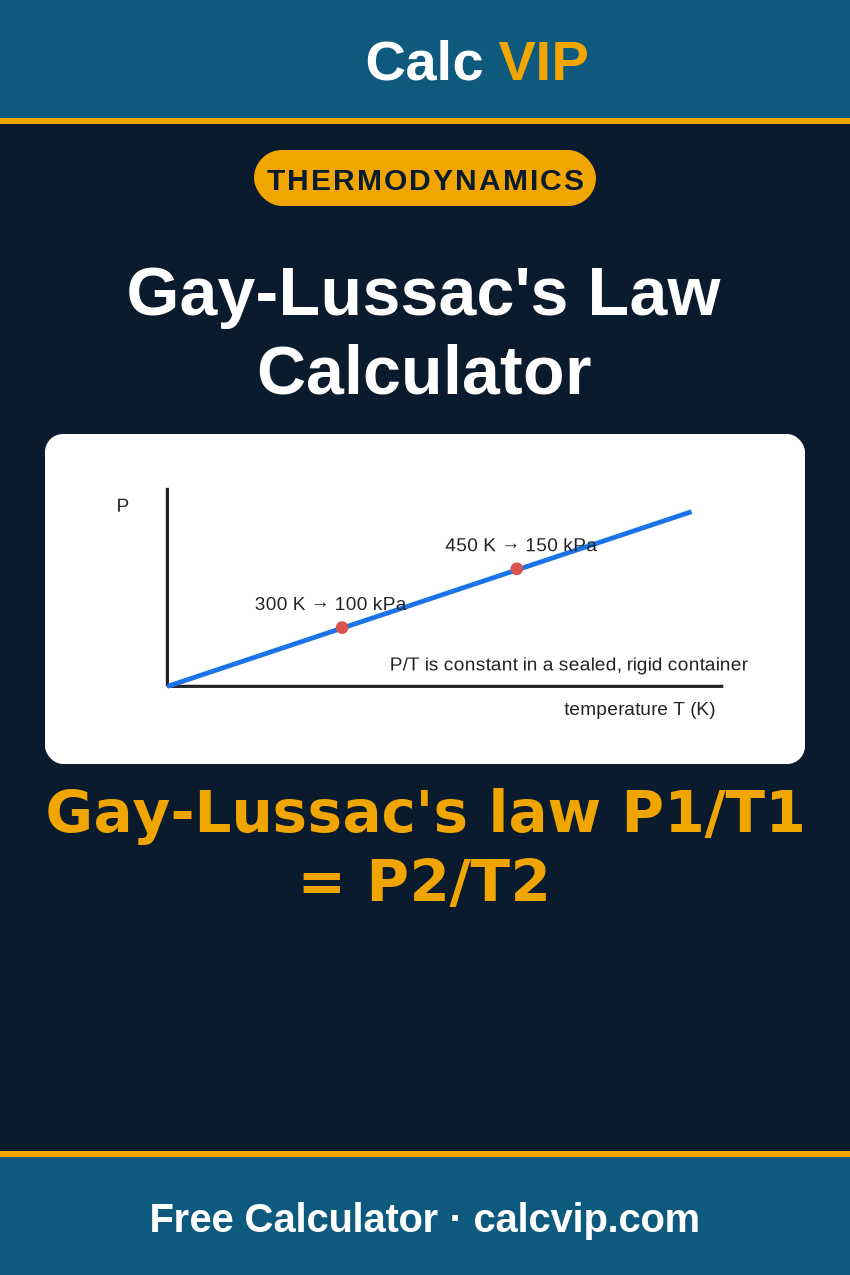
Example 1 — the sealed can. A sealed can holds gas at P1 = 100 kPa and T1 = 300 K. The can is heated to T2 = 450 K. Find P2.
P2 = P1T2/T1 = 100 × 450 / 300 = 150 kPa
The temperature rose by a factor of 1.5, so the pressure rose by exactly the same factor — this is why sealed cans carry "do not heat" warnings.
Example 2 — the car tyre after a drive. A tyre's air sits at 220 kPa (absolute) at 20 °C (293.15 K) in the morning. After a motorway run the air inside reaches 50 °C (323.15 K) at nearly fixed volume.
P2 = 220 × 323.15 / 293.15 = 242.51 kPa — a rise of about 10%, which is why tyre pressures are specified "cold": the hot reading is supposed to be higher.
Example 3 — solving for temperature. Gas in a rigid bulb at 273.15 K shows 101.325 kPa. The pressure doubles to 202.65 kPa. What is the temperature?
T2 = T1P2/P1 = 273.15 × 202.65 / 101.325 = 546.3 K — double the pressure, double the kelvin temperature. This is the gas-thermometer principle in one line.
Example 4 — the aerosol in a hot car. A spray can's contents sit at 500 kPa at 25 °C (298.15 K). Left on a dashboard at 60 °C (333.15 K):
P2 = 500 × 333.15 / 298.15 = 558.70 kPa. A 35-degree warming bought a 12% pressure rise — modest here, but cans are filled close to their limits, and a fire's 600 K would aim the pressure at double, far beyond the seam.
Example 5 — the cooling cylinder. A steel cylinder reads 15,000 kPa at 300 K. Overnight in the cold it falls to 250 K.
P2 = 15,000 × 250 / 300 = 12,500 kPa. Nothing leaked — the gauge simply reports the kelvin ratio, a fact that has sent many engineers hunting for phantom leaks in winter.
Example 6 — working backwards to P1. At 350 K a sealed vessel's gas shows 175 kPa. What was its pressure at 250 K?
P1 = P2T1/T2 = 175 × 250 / 350 = 125 kPa.
Gay-Lussac's law in real life
Tyre pressures, summer and winter. A tyre inflated to specification on a mild day reads low on a frosty morning and high after a long drive — the air inside obeys P ∝ T at nearly constant volume. The seasonal top-up at the garage is this law being serviced.
Pressure cookers. Seal steam and water in a rigid pot and heat: the pressure climbs with temperature, and the higher pressure raises water's boiling point to around 120 °C, which is why the food cooks faster. The weighted valve caps the pressure by venting — a mechanical limit on the law's ratio.
Aerosol and gas-cylinder safety. "Store below 50 °C, do not incinerate" is a Gay-Lussac instruction. The contents' pressure is chained to kelvin temperature, and a fire multiplies it beyond any seam's strength, turning the can into shrapnel.
The constant-volume gas thermometer. For two centuries the most trustworthy thermometers were sealed bulbs whose pressure, read on a manometer, reported temperature through this law — precise enough to help fix the value of absolute zero.
Aircraft and scuba cylinders. A scuba tank filled to 200 bar on a hot dock reads lower after cooling in the sea, and a sun-baked wing tank vents or swells; fill calculations in both worlds quietly convert with P/T before anyone trusts the gauge.
Autoclaves and sterilisers. Hospital autoclaves seal steam in steel and use the pressure–temperature lockstep of a saturated system to guarantee sterilising conditions — the gauge and the thermometer must agree, because the physics says they cannot disagree.
The law's most consequential industrial use is the one nobody wants to test: a pressure vessel caught in a fire. Heat the outside of a tank of liquefied gas and two of this page's effects compound — the liquid's vapour pressure climbs along Gay-Lussac's line while the steel weakens — until either the relief valve vents fast enough or the vessel fails catastrophically, the event firefighters call a BLEVE. Design codes therefore size relief valves for the fire case explicitly: the valve must discharge vapour at the rate the fire's heat generates it, at the pressure the heated contents reach. It is the aerosol-can warning written at the scale of a rail tanker, and it begins with the same P₁/T₁ = P₂/T₂.
The gauge-pressure trap
Most pressure gauges answer a different question from the one this law asks. A gauge reports how far the pressure sits above the surrounding atmosphere; the law needs the total, absolute pressure, atmosphere included. At high pressures the distinction fades (a 15,000 kPa cylinder barely notices an extra 101), but at gentle pressures it dominates. Take a tyre at 220 kPa gauge: the absolute pressure is about 321 kPa. Warm it by the ratio 323.15/293.15 and the absolute pressure becomes about 354 kPa — a gauge rise of 33 kPa, not the 22.5 kPa you would predict by ratioing the gauge numbers directly. Worked Example 2 sidesteps the trap by treating 220 kPa as absolute; with real gauge readings, add ≈ 101.3 kPa to each side before you ratio, and subtract it at the end if you want the new gauge reading.
Amontons, absolute zero, and the pressure line
Plot pressure against Celsius temperature for a sealed gas and, as with Charles's volumes, the straight line dives to zero pressure at −273.15 °C. Amontons saw the hint of that intercept around 1699 with nothing more than a sealed bulb and a mercury column — arguably the first experimental glimpse of absolute zero, a century before the kelvin scale existed. The logic is the same as for Charles's law and just as unanswerable: pressure is molecular battering, battering is temperature, and a temperature at which the battering would cease entirely is a floor no cooling can pass through. Every gas law proportion on this site is, at heart, a measurement taken from that floor.
For over a century the constant-volume gas thermometer — Gay-Lussac's law turned into an instrument — was the primary standard of temperature itself. Seal a gas at fixed volume, measure its pressure, and P/T gives the temperature by definition; national laboratories used exactly this device to realise the kelvin before modern radiation thermometry took over. The arrangement survives wherever a pressure gauge is easier to protect than a thermometer: infer the temperature of a sealed process vessel from its pressure, and you have a thermometer with no probe in the fluid at all.
Quick reference: pressure response to heating (sealed container)
| Temperature change | Kelvin ratio | Pressure change |
|---|---|---|
| 300 K → 310 K | 1.033 | +3.3% |
| 293 K → 323 K (cool morning → hot tyre) | 1.102 | +10.2% |
| 300 K → 450 K | 1.50 | +50% |
| 300 K → 600 K | 2.00 | doubled |
| 300 K → 250 K (cold snap) | 0.833 | −16.7% |
| 298 K → 873 K (can in a fire) | 2.93 | nearly tripled — burst territory |
The last row is the one printed, in effect, on every aerosol: ordinary warmth nudges pressure by percent, but fire temperatures multiply it, and no household container is built for a factor of three.
Common mistakes
- Using Celsius in the ratio. Heating from 27 °C to 177 °C looks like a 6.6× jump in Celsius but is 300 K → 450 K, a 1.5× rise — and the pressure follows kelvin. Convert first: K = °C + 273.15.
- Ratioing gauge pressures. Gauges omit the atmosphere's ≈ 101.3 kPa. At low pressures that omission wrecks the ratio (see the gauge-trap section). Add it back before calculating.
- Applying the law to a container that can expand. If a piston can move or a balloon can swell, the pressure stays near constant and Charles's law governs instead. Gay-Lussac needs a genuinely rigid, sealed vessel.
- Forgetting the seal. A slow leak breaks the "fixed amount of gas" condition: a tyre losing air while it warms may show no pressure rise at all, and the law will look broken when the tyre is.
- Mixing pressure units. Bar against kPa slips a factor of 100 into the result. The units cancel only when P1 and P2 share one.
FAQ
Why must the temperature be in kelvin?
Pressure is proportional to the absolute temperature, measured from true zero. Using Celsius breaks the proportion: heating from 27 °C to 177 °C looks like a 6.6× jump in °C but is really 300 K → 450 K, a 1.5× rise — and the pressure follows the kelvin ratio.
What has to stay constant for Gay-Lussac's law?
The volume and the amount of gas. The container must be rigid and sealed, so the faster-moving hot molecules have nowhere extra to go and simply hit the walls harder and more often.
Where does this law matter in everyday life?
Car tyres: pressure rises on a hot day or after a long drive as the air inside warms at nearly fixed volume. It is also why aerosol cans and gas cylinders must be kept away from heat — pressure climbs in direct proportion to kelvin temperature.
What is the difference between Gay-Lussac's law and Charles's law?
They are the same physics with a different variable locked. Lock the volume and pressure tracks temperature (Gay-Lussac); lock the pressure and volume tracks temperature (Charles). Both are the ideal gas law with two variables held still.
Why do my tyre pressures drop in winter?
The air inside cools at nearly fixed volume, so its pressure falls with the kelvin ratio — a drop from 293 K to 273 K costs about 7%. The tyre has not necessarily leaked; top it up to the placard value, measured cold.
Can a heated sealed container really explode?
Yes. Pressure follows kelvin without limit while the container's strength is fixed. A can at 500 kPa and 298 K aims at roughly 1,465 kPa in an 873 K fire — beyond its seams — which is why incinerating aerosols is genuinely dangerous.
Does the law work for cooling as well as heating?
Perfectly symmetrically: pressure falls by the same proportion as temperature. It is why a sealed bottle taken from a warm room into a freezer can panel inward, and why cylinder gauges sag on cold mornings.
What pressure unit should I use?
Any, as long as P1 and P2 match — the calculator returns the answer in whatever unit you entered. Kelvin is the only non-negotiable unit in the law.
How accurate is the law for real gases?
At everyday pressures and temperatures, deviations are well under 1%. Under extreme compression or near the gas's liquefaction point, real-gas corrections grow — the same limits as the ideal gas law it comes from.
What if the volume and the temperature both change?
Then use the combined gas law, P1V1/T1 = P2V2/T2. Gay-Lussac's law is its constant-volume special case, just as Charles's law is the constant-pressure one.