 Calc
Heat Calculator – Q = mcΔT Thermal Energy Calculator
 Created by Anna Kowalski · Physics Editor · Heat & Atoms · Last updated: November 2026
Use this free Heat Calculator to find the thermal energy needed to change the temperature of a substance, using Q = mcΔT. Enter the mass, the specific heat capacity and the temperature change.
Every time you boil a kettle, warm a bath or leave a car in the sun, the same accounting question appears: how much energy does it take to change this thing's temperature by that much? Q = mcΔT is the answer, and it is one of the hardest-working formulas in everyday physics. Three properties of the material and the situation — how much of it there is, what it is made of, and how far its temperature must move — completely determine the energy bill. Nothing else matters: not the shape of the container, not the make of the stove, not how fast you heat it.
The middle letter, c, does the heavy lifting. Specific heat capacity is a fingerprint of the substance itself: the joules needed to raise one kilogram by one degree. For water it is a remarkable 4186 J/kg·°C — among the highest of any common material — while metals cluster far lower (copper 385, aluminium 900, lead just 128). That single ranking explains a surprising share of the world: why coastal towns have gentler climates than inland deserts, why a hot-water bottle stays warm for hours, and why the sand on a beach scorches your feet while the sea beside it is still cold, though both have baked under the same sun all morning.
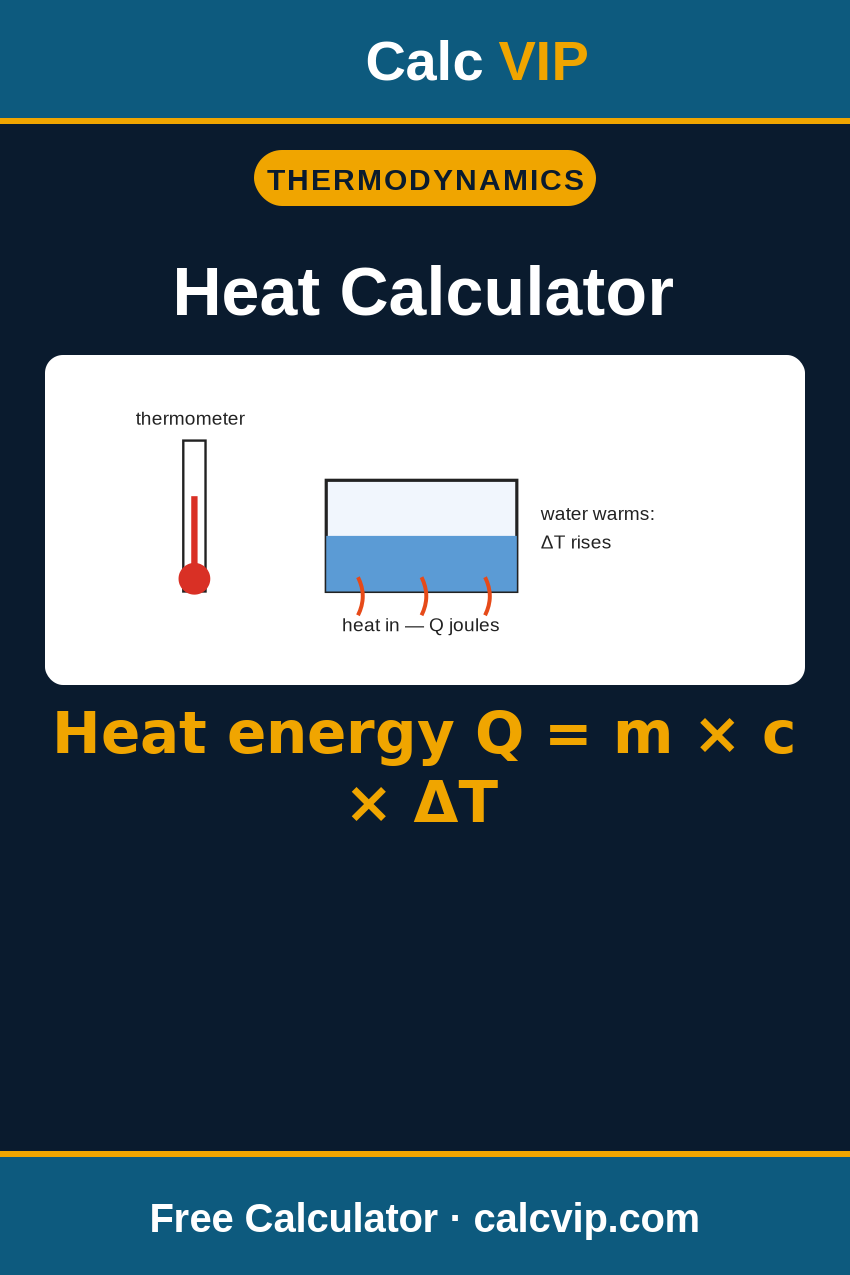
The formula also draws a clean boundary around itself. It prices temperature changes within one state of matter — solid warming, liquid warming, gas warming. The moment ice starts to melt or water starts to boil, the temperature pins itself in place and a different formula (latent heat) takes over the accounting. Knowing which regime you are in is half the skill of using this calculator well, and the mistakes section below returns to it.
Formula
Heat energy Q = m × c × ΔT • Q in joules (J), m in kilograms (kg), c in joules per kilogram per degree (J/kg·°C), ΔT in °C or K (a step of 1 °C is the same size as a step of 1 K, so no conversion is needed for the change).
The formula solves for any one of its four quantities. Rearranged: ΔT = Q ÷ (m × c) if you know the energy and want the temperature change; m = Q ÷ (c × ΔT) if you know how much energy a process can supply and want the mass it can warm; and c = Q ÷ (m × ΔT) — the form used in calorimeter experiments to identify an unknown material from its measured warming. Two habits prevent most errors: work in kilograms (a 500 g sample is 0.5 kg), and take ΔT as final minus initial temperature, so cooling comes out negative — the sign is information, not a mistake: negative Q means the substance released that much heat.
| Symbol | Meaning | Units |
|---|---|---|
| Q | heat energy transferred | joules (J) |
| m | mass of the substance | kilograms (kg) |
| c | specific heat capacity — a property of the material | J/kg·°C |
| ΔT | temperature change (final − initial) | °C or K (same step size) |
Why water's specific heat is so high — and why it matters
At the particle level, temperature measures how fast molecules move — but not all the energy you pour into a substance goes into faster motion. In water, much of it is spent stretching and breaking the hydrogen bonds that link the molecules into a loose, shifting network. Only the leftover energy shows up as a temperature rise, so the temperature climbs grudgingly: joule after joule is absorbed by the bond network before the thermometer moves far. Metals have no such network to feed — nearly every joule goes straight into particle motion — which is why a metal spoon in a hot drink becomes too hot to touch while the drink itself is still warming up.
This reluctance to change temperature is called thermal inertia, and water's is enormous. It is why the sea is coldest in early spring, weeks after the shortest day, and warmest in early autumn: the ocean is still paying off, and then still spending, a colossal heat account. Land, mostly rock and dry soil with specific heats around a fifth of water's, settles its account in hours — hot by noon, cold by midnight. The daily sea breeze, the mild winters of islands, and the brutal temperature swings of deserts are all, at bottom, this one number c expressing itself at planetary scale.
How to use
- Enter the mass of the substance in kilograms (500 g = 0.5 kg; a litre of water is almost exactly 1 kg).
- Enter the specific heat capacity c for your material — water 4186, aluminium 900, iron 450, copper 385 J/kg·°C; the quick-reference table below lists more.
- Enter the temperature change ΔT in °C: final minus initial (20 °C up to 70 °C is ΔT = 50; cooling from 70 °C to 20 °C is ΔT = −50).
- Click "Calculate Heat" to get Q in joules. A negative result means the substance releases that much heat as it cools.
Worked examples
Example 1 — warming water. How much heat is needed to warm 2 kg of water by 30 °C? (c = 4186 J/kg·°C)
Q = 2 × 4186 × 30 = 251,160 J = 251.16 kJ
Example 2 — a light metal warms easily. A 0.5 kg aluminium pan (c = 900 J/kg·°C) is heated through 40 °C:
Q = 0.5 × 900 × 40 = 18,000 J = 18 kJ. The same temperature rise for 0.5 kg of water would need 0.5 × 4186 × 40 = 83,720 J — over four and a half times as much, which is why the empty pan heats fast and the water in it takes its time.
Example 3 — cooling gives heat back. A 1.5 kg iron casting (c = 450 J/kg·°C) cools from 200 °C to 50 °C, so ΔT = −150 °C:
Q = 1.5 × 450 × (−150) = −101,250 J. The minus sign says the casting releases about 101 kJ into its surroundings as it cools — enough to warm a kilogram of water by roughly 24 °C. Foundries and blacksmiths plan around this stored heat.
Example 4 — the kettle, timed. Boiling 1 kg of water from 20 °C (ΔT = 80 °C) needs Q = 1 × 4186 × 80 = 334,880 J. A 2,000 W kettle supplies 2,000 J every second, so the wait is 334,880 ÷ 2,000 ≈ 167 seconds — about 2.8 minutes, matching real life. This is the rearrangement ΔT and Q are famous for in reverse: energy ÷ power = time, the bridge between this formula and your electricity bill.
Example 5 — solving for the temperature change. A heater delivers 50,000 J to a 2 kg copper block (c = 385 J/kg·°C). How much warmer does it get?
ΔT = Q ÷ (m × c) = 50,000 ÷ (2 × 385) = 50,000 ÷ 770 ≈ 64.9 °C. Copper's low c means modest energy buys a big temperature jump — one reason copper bottoms respond so quickly on a stove.
Example 6 — the beach, explained. By mid-afternoon, 5 kg of dry sand (c = 830 J/kg·°C) has warmed by 25 °C, absorbing Q = 5 × 830 × 25 = 103,750 J. Pour exactly that energy into 5 kg of seawater instead: ΔT = 103,750 ÷ (5 × 4186) ≈ 5 °C. Same sun, same energy — the sand's surface is scorching and the sea is still cool, purely because their c values differ five-fold.
Heat in real life
Kettles, showers and bills. Almost all domestic energy goes into Q = mcΔT for water: a 40-litre shower warmed by 35 °C swallows 40 × 4186 × 35 ≈ 5.86 million joules ≈ 1.63 kWh. Once you can price hot water, energy-saving advice (shorter showers, cooler washes) stops being nagging and becomes arithmetic.
Car cooling systems. An engine throws away roughly two-thirds of its fuel energy as heat, and the coolant — mostly water — is chosen for its unmatched c. Each kilogram of coolant leaving the engine 10 °C hotter than it entered has carried away about 41,860 J to the radiator.
Climate and coastlines. Oceans are the planet's heat buffer. Because water's c is about five times that of rock and soil, coastal regions warm and cool slowly and gently, while continental interiors swing violently between seasons. Britain, at the latitude of Siberia, has mild winters largely thanks to an ocean that refuses to change temperature quickly.
Hot-water bottles and heat packs. A litre of hot water cooling from 80 °C to 40 °C in bed releases 1 × 4186 × 40 ≈ 167,440 J over the night — a slow, safe trickle of heat. Gel heat packs use materials chosen for the same job: high c, so a small pack stores a long evening of warmth.
Cooking. Preheating a heavy pan, resting a steak, the carry-over cooking of a roast — all are mcΔT in action. A cast-iron pan's large mc means its stored heat finishes the job gently and evenly after the flame is off.
Buildings that store the sun. Thick masonry walls, adobe, and modern phase-change panels all exploit thermal mass: absorb the day's heat with a barely noticeable ΔT, then release it through the cool night. Passive-solar design is this formula applied to architecture.
Heat capacity vs specific heat capacity
Two close cousins are easily confused. The specific heat capacity c belongs to the material — it is per kilogram, and it is what tables list. The heat capacity C of a particular object is C = m × c: the joules that whole object needs per degree. A teaspoon of water and a lake share the same c (4186 J/kg·°C) but wildly different C. Engineers sizing a thermal store work with C; chemists identifying a substance work with c. This calculator uses c, with the mass entered separately — which is exactly the split that keeps the two ideas straight.
Where Q = mcΔT stops: melting and boiling
Heat a pan of ice and the temperature climbs steadily — until 0 °C, where it stops dead even though the flame keeps pouring in energy. That energy is no longer raising temperature; it is dismantling the ice's crystal structure. This is latent heat, priced by Q = mL. Melting 1 kg of ice takes L = 334,000 J — almost exactly the 334,880 J needed to then heat that kilogram of water from 0 °C all the way to 80 °C (Example 4's kettle load, spent without the thermometer moving a single degree). Boiling is costlier still: vaporising 1 kg of water takes about 2,260,000 J. Any heating problem that crosses a melting or boiling point must be priced in stages: warm the solid with mcΔT, melt with mL, warm the liquid with mcΔT again — never with one mcΔT straight through.
Quick reference: specific heat capacities
| Substance | c (J/kg·°C) |
|---|---|
| water | 4186 |
| ethanol | 2440 |
| ice | 2100 |
| steam | ≈ 2010 |
| aluminium | 900 |
| glass | 840 |
| dry sand / soil | ≈ 830 |
| iron / steel | 450 |
| copper | 385 |
| silver | 235 |
| lead | 128 |
Read the table as a league table of stubbornness: the higher the number, the more energy a kilogram can absorb while barely warming — which is why water tops the list of coolants and lead sits at the bottom, warming almost 33 times faster than water for the same energy per kilogram (4186 ÷ 128 ≈ 32.7).
Common mistakes
- Entering the mass in grams. The formula expects kilograms. 500 g of water warmed by 10 °C needs 0.5 × 4186 × 10 = 20,930 J — enter 500 instead of 0.5 and your answer is a thousand times too big, a kettle's worth of energy apparently needed for a thimble.
- Converting ΔT as if it were a temperature. A change of 30 °C is a change of 30 K — do not add 273 to a difference. (Actual temperatures must be converted before use in the gas laws, but differences never.) Adding 273 to ΔT inflates Q absurdly.
- Using one c across a change of state. Ice (2100), water (4186) and steam (≈2010) are three different substances to this formula, and melting/boiling plateaus are not covered by mcΔT at all — they belong to Q = mL. A single mcΔT from −10 °C ice to 110 °C steam is wrong in three separate ways.
- Taking ΔT as the final temperature. Heating water "to 80 °C" from a 20 °C tap is ΔT = 60, not 80. Always subtract the starting temperature; the formula prices the journey, not the destination.
- Discarding the minus sign when cooling. A negative Q is a correct and useful answer: it states how much heat the substance gives out. Dropping the sign turns a cooling calculation into a heating one and breaks any energy balance built on top of it.
FAQ
What is specific heat capacity?
It is the energy needed to raise 1 kg of a substance by 1 °C. Water has a very high value (4186 J/kg·°C), which is why it heats up and cools down slowly.
Does this work for cooling too?
Yes. If ΔT is negative the substance is cooling, and Q is negative — meaning that much heat energy is released.
Does Q = mcΔT cover melting or boiling?
No. During a change of state the temperature stays constant and a different formula is used: Q = mL (latent heat). This calculator is only for temperature changes within one state.
How much energy does it take to boil a litre of water in a kettle?
Heating 1 kg (one litre) of water from 20 °C to 100 °C is a temperature rise of 80 °C, so Q = 1 × 4186 × 80 = 334,880 J. In electricity units that is 334,880 ÷ 3,600,000 ≈ 0.093 kWh — under a tenth of a unit, which is why a single boil costs only a few cents even though the kettle draws a hefty 2,000 W while it runs.
What is the difference between heat and temperature?
Temperature measures how hot something is — the average kinetic energy of its particles. Heat (Q) is energy in transit, measured in joules, that flows because of a temperature difference. A bathtub of warm water at 40 °C holds far more thermal energy than a cup of boiling water at 100 °C, even though the cup has the higher temperature, because the bath has so much more mass.
What is a calorie in this context?
The calorie was defined through this very formula: 1 calorie is the heat that raises 1 gram of water by 1 °C, which works out to 4.186 J. The food Calorie (with a capital C) is a kilocalorie — 1,000 of those, or 4,186 J. The specific heat of water, 4186 J/kg·°C, is just the same definition scaled up to kilograms.
If I double the mass, does the heat needed double?
Yes. Q = mcΔT is linear in every variable: twice the mass needs twice the heat for the same temperature rise, and twice the temperature rise needs twice the heat for the same mass. That simple proportionality is what makes the formula so easy to sanity-check — if your answer does not scale sensibly, an input is wrong.
How is heat measured in practice?
With a calorimeter: an insulated container that traps the heat being measured so it all goes into a known mass of water (or another known substance). Measure the water's temperature rise, apply Q = mcΔT, and you have the heat released by a burning fuel, a chemical reaction or a hot object cooling inside. School calorimeters lose some heat to the room, which is why their answers usually come out a little low.
Why is water used in car radiators and cooling systems?
Because kilogram for kilogram it carries away more heat than almost any other cheap, safe liquid: c = 4186 J/kg·°C, roughly nine times that of iron and four times that of most oils. A litre of water warmed by 10 °C removes about 41,860 J from the engine. The same property makes water the coolant in power stations and the heating medium in household radiators.
Why do chefs like heavy cast-iron pans?
Thermal mass. A heavy pan stores a large amount of heat (its total heat capacity, mass × c, is big), so its temperature barely dips when cold food lands in it — the sear continues instead of the food steaming in its own juice. A thin pan holds little stored heat and its temperature crashes on contact. The same physics, run in reverse, is why a pizza stone improves a home oven.