Calc
Dam Force Calculator – Total Hydrostatic Force on a Dam Wall
 Created by Elena Petrova · Physics Editor · Fluids & Rotation · Last updated: November 2026
Use this free Dam Force Calculator to find the total force that still water exerts on a vertical dam wall. Enter the water depth, the width of the wall and the water density — the calculator adds up the hydrostatic pressure over the whole face of the dam.
Still water is not gentle. Every metre of depth adds 9,810 pascals of pressure, and a dam face is a very large area over which to collect it. Ten metres of water against a 50 m wall presses with a total force of 24.5 million newtons — the weight of about 2,500 cars — delivered silently, continuously, forever. The dam's entire architecture, its massive curved or triangular bulk, exists to answer that one number and its overturning leverage. This calculator computes it: the total hydrostatic force on a vertical wall, the force per metre of width, and the height at which the resultant acts.
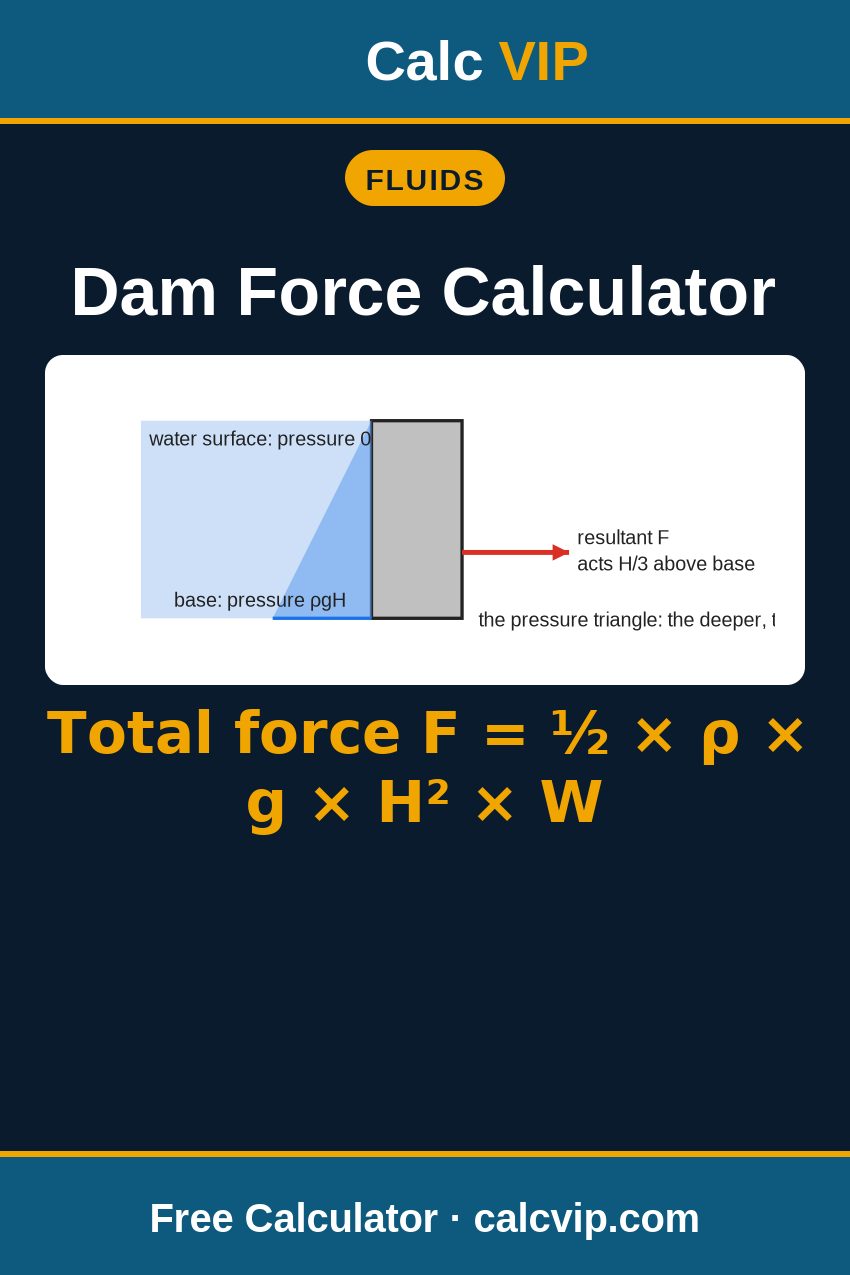
The physics is a single integral done once and for all. Pressure grows linearly with depth, zero at the surface and ρgH at the base, so the average pressure on the wall is the pressure at half-depth, and the total force is that average times the wall's area: F = ½ρgH²W. The square on H is the fact that runs dam engineering — double the depth and the force quadruples, because you have doubled both the area and the average pressure. It is why the great dams are not twice as strong as small ones but ten times as massive, and why raising a reservoir "just a metre or two" is a structural decision, not an administrative one.
The resultant's address matters as much as its size. Because pressure is weighted towards the bottom, the total force acts not at half-depth but at two-thirds down — H/3 above the base, as the calculator reports. That low line of action is what tries to tip the dam over and slide it downstream, and the dam resists with the only tools available: its own weight, friction on its foundations, and in arch dams, the canyon walls themselves. Everything in this page flows from the triangle of pressure behind the wall.
Formula
Total force F = ½ × ρ × g × H² × W • F in newtons (N), ρ in kg/m³, H and W in metres, g = 9.81 m/s²
The formula is the area of the pressure triangle times the width: pressure at depth h is ρgh, the average over the face is ½ρgH, and multiplying by the face area H × W gives the result. The companion facts the calculator reports: force per metre = ½ρgH² (divide F by W), and the line of action is H/3 above the base — the centroid of the pressure triangle, where a single equivalent push would have the same effect. Rearranged, the formula also answers the designer's question: the depth a wall of given strength can hold grows only with the square root of the allowed force, H = √(2F/(ρgW)), which is why modest strength increases buy disappointingly little extra depth.
| Symbol | Meaning | Units |
|---|---|---|
| F | total hydrostatic force on the wall | N (also MN) |
| H | water depth against the wall | m |
| W | width of the wall (into the page's span) | m |
| ρ | water density (1000 fresh, 1025 sea) | kg/m³ |
Overturning, sliding, and the weight of concrete
A dam fails in two classical ways, and this force drives both. It can overturn: the resultant pushes at H/3 above the base, creating a moment that tries to rotate the dam about its downstream toe, resisted only by the moment of the dam's own weight acting through its base. And it can slide: the horizontal push must be held by friction and cohesion along the foundation, μ times the weight. Both checks collapse into one design instinct — make the dam heavy and wide at the bottom. A gravity dam's triangular profile is not an aesthetic: it places material exactly where the pressure triangle demands it, thick at the base where the push and the leverage are greatest, thin at the crest where the water barely presses. The rule of thumb that a gravity dam's base width runs at 0.7–0.8 of its height is this formula, fossilised into practice.
Arch dams escape the arithmetic by refusing to carry the load themselves: curved in plan, they pass the water's push sideways into the canyon walls as compression, the way a stone arch passes a cart's weight into its abutments. That is why an arch dam can be startlingly thin — and why it can only exist where the rock is trustworthy. Buttress dams split the difference. All three families begin their design life with the same number from this page: ½ρgH²W, and the H/3 point through which it acts.
How to use
- Enter the water depth H in metres — the vertical distance from the water surface to the base of the wall.
- Enter the wall width W in metres (the length of wall the water presses against).
- Enter the density ρ: 1000 kg/m³ for fresh water, 1025 for sea water.
- Click "Calculate" to see the total force in N and MN, the force per metre of width, and the height above the base at which the resultant acts (H/3).
Worked examples
Example 1 — a small reservoir dam. H = 10 m, W = 50 m, fresh water.
F = ½ × 1000 × 9.81 × 10² × 50 = 24,525,000 N = 24.53 MN, acting 3.33 m above the base. Per metre of width that is 490,500 N — the weight of about 50 tonnes pressing on every single metre of wall.
Example 2 — a garden pond wall. H = 2 m, W = 10 m: F = ½ × 1000 × 9.81 × 4 × 10 = 196,200 N, acting 0.67 m above the base. Even ornamental water pushes with the weight of twenty cars — the reason retaining walls for ponds are engineered, not improvised.
Example 3 — a farm dam. H = 5 m, W = 20 m: F = ½ × 1000 × 9.81 × 25 × 20 = 2,452,500 N = 2.45 MN, acting 1.67 m above the base. Half Example 1's depth, a tenth of its force — the H² law in action (the width also halved).
Example 4 — a large dam's scale. H = 100 m, W = 380 m: F = ½ × 1000 × 9.81 × 100² × 380 = 18,639,000,000 N ≈ 18.6 GN, acting 33.3 m above the base. Ten times Example 1's depth over 7.6 times the width multiplies the force 760-fold — the arithmetic that makes great dams among the largest structures humans build.
Example 5 — a sea wall. H = 8 m, W = 30 m, sea water (ρ = 1025): F = ½ × 1025 × 9.81 × 64 × 30 = 9,653,040 N = 9.65 MN, acting 2.67 m above the base. The sea's extra 2.5% of density adds a quarter of a meganewton compared with fresh water — small, but coastal engineers do not get to ignore it. (Storm waves add dynamic loads on top of this still-water figure.)
Example 6 — doubling the depth. Raise Example 1's reservoir to H = 20 m over the same 50 m wall: F = ½ × 1000 × 9.81 × 400 × 50 = 98,100,000 N = 98.1 MN — exactly four times the force, now acting 6.67 m above the base, where its overturning leverage is also doubled. Depth is the most expensive variable in dam design, twice over.
Dam forces in real life
Gravity dam design. The profile of every gravity dam — Hoover, Grand Coulee, Bhakra — is drawn by balancing this force's overturning moment against the moment of the concrete's weight, with safety factors for uplift and earthquakes added on top.
Flood walls and levees. Temporary and permanent flood barriers are rated by the depth they can hold; the rating is this formula, and the H² growth is why a barrier rated for 2 m cannot be trusted with 3 m "just this once" — the load rises by 125%.
Lock gates and dry docks. A canal lock gate holding back a full chamber, or a dry-dock gate keeping out the sea, is a small dam that moves; its hinges and sills are sized by the same ½ρgH²W and the H/3 resultant.
Tank and silo walls. Liquid storage — water tanks, oil tanks, grain silos (with modified pressure laws) — designs its wall thickness and hoop tension from the same linear pressure growth with depth.
Basement and retaining walls. A flooded excavation or a high water table presses on basement walls exactly as on a dam; waterproofing failures are usually structural surprises from underestimating ½ρgH² per metre.
Dam safety inspection. Inspectors track reservoir level because the force is a pure function of it: a dam at full supply level lives under a known, computed load, and drawdown is the fastest way to unload a dam in trouble.
What this formula leaves out — uplift, ice, earthquakes
The clean ½ρgH²W is the still-water load on a vertical face, and real dams carry more. Uplift is the quiet saboteur: water seeps under the dam and presses up on its base, effectively lightening the structure and weakening both its overturning and sliding resistance — modern dams drain their foundations to bleed this pressure away. Ice on a frozen reservoir expands and thrusts horizontally with forces that can rival the water's. Earthquakes add the water's own inertia as a dynamic pressure (the hydrodynamic load), and silt accumulating against the face adds a heavier-than-water layer at the bottom. The formula on this page is the foundation load case — the one every other case is added to, and the one that never goes away, even in an earthquake: the water is always pushing.
Quick reference: force per metre of wall (fresh water)
| Depth H | Base pressure | Force per metre | Acts above base |
|---|---|---|---|
| 1 m | 9.81 kPa | 4,905 N/m | 0.33 m |
| 3 m | 29.4 kPa | 44,145 N/m | 1.00 m |
| 10 m | 98.1 kPa | 490,500 N/m | 3.33 m |
| 30 m | 294 kPa | 4,414,500 N/m | 10.0 m |
| 100 m | 981 kPa | 49,050,000 N/m | 33.3 m |
The middle column is the one to feel: at 30 m depth, every metre of wall carries 4.4 MN — the weight of about 450 tonnes — applied a full 10 m above the foundation. Dams are thick because this table is unforgiving.
The same triangle everywhere: gates, windows and flood walls
Once seen, the pressure triangle appears everywhere water is held back. A public aquarium's great viewing window, 2 m wide with 3 m of water against it, carries F = ½ × 1000 × 9.81 × 3² × 2 = 88,290 N — nine tonnes of push on a sheet of acrylic, acting 1 m above its bottom edge, which is why such windows are tens of centimetres thick and seated like bridge bearings. A canal lock gate holding a 4 m difference in levels is a dam that must also swing open, so its hinges are placed to be unloaded by draining first. A demountable flood wall across a shopfront, rated to 1 m, must quietly resist 4,905 N per metre — the weight of a small car on every metre — delivered by water that arrived politely and rose in the night. The formula does not care whether the wall is a national monument or a garden pond: give it H, W and ρ and it returns the push, the whole push, with the H² warning built in.
A pocket check: one lock gate leaf
For a number you can carry: a canal lock gate leaf 5 m wide holding back 4 m of water carries F = ½ × 1000 × 9.81 × 4² × 5 = 392,400 N — forty tonnes of push, acting 1.33 m above the sill. Gate paddles are opened to equalise the levels before the gate moves precisely because no hinge crew, human or hydraulic, argues with ½ρgH²W at full difference. If you can run this one case from memory, every dam, tank and flood wall on this page is the same sentence with different nouns.
Common mistakes
- Using the base pressure times the whole area. Pressure is not uniform: it averages half the base value. F = ρgH × HW doubles the true force; the ½ in the formula is the triangle, not a safety factor.
- Placing the resultant at half-depth. It acts at H/3 above the base (two-thirds down), not H/2. Using the midpoint understates the overturning moment by a quarter.
- Measuring H from the wrong place. H is the depth of water against the wall — from the surface to the wall's base — not the dam's total height if the reservoir is drawn down, nor the height above the riverbed downstream.
- Forgetting the width is linear but depth is squared. Extending a dam sideways adds force in proportion; raising it adds force as the square. The two changes are not interchangeable in a safety argument.
- Ignoring density for sea water or silt-laden water. Sea water adds 2.5%; water heavy with suspended silt can add more, and settled silt adds its own earth-pressure-like load at the base. Small percentages of meganewtons are still large forces.
FAQ
Why does the force grow with the square of the depth?
Doubling the depth doubles both the wall area under water and the average pressure (which is set by the half-depth). Two doublings multiply together, so the force goes up four times.
Why are dams thicker at the bottom?
Pressure — and therefore the push per square metre — is greatest at the base, and the overturning effect of the force acting at H/3 must be resisted there. A thick base gives the weight and strength needed.
Does the length of the lake behind the dam matter?
No. Hydrostatic force depends only on depth, width and density — a dam across a small pond of the same depth feels exactly the same force as one holding back a huge reservoir.
Why does the force act at H/3 and not at the middle?
Because the pressure distribution is a triangle, not a rectangle: there is more push near the bottom, so the average push — the resultant — sits at the triangle's centroid, one third of the height up from its base.
What about the water on the downstream side?
Tailwater pushes back and genuinely helps: the net load is the upstream force minus the downstream force computed the same way. Many dams are analysed with both triangles; this calculator gives one side at a time.
How much force does the Hoover Dam hold back?
At its full depth of about 221 m over a crest length of 379 m, the simple vertical-wall formula gives roughly ½ × 1000 × 9.81 × 221² × 379 ≈ 9.1 × 10¹⁰ N. The real structure is curved and the reservoir face is not a simple rectangle, so treat that as scale, not design — but it shows why the dam is 201 m thick at its base.
What is uplift and why do engineers fear it?
Water seeping beneath the dam presses upward on the base, reducing the effective weight that resists overturning and sliding. Drainage galleries and grout curtains exist to keep uplift small; several historical dam failures involved uplift that the designers had underestimated.
Does a curved (arch) dam change the force?
The water's total push is the same — it is set by depth and the area it presses. What changes is where the force goes: an arch dam delivers it sideways into the canyon walls as compression, instead of resisting it with the dam's own weight.
Can this formula be used for a tank wall?
Yes — a vertical tank wall is a small dam. Use the liquid's density and the depth of liquid; the force per metre and its H/3 line of action size the wall's thickness and its base fixing.
What happens if the reservoir freezes?
Ice adds its own horizontal thrust as it expands against the face, on top of the water force below it. Northern dams carry an ice-load allowance in design, and operators sometimes bubble air along the face to keep a slot of open water.