 Calc
Drift Velocity Calculator – v = I/(nAq) for Wires
 Created by Michael Chen · Electronics Specialist · Last updated: November 2026
Use this free Drift Velocity Calculator to find how fast the electrons in a wire actually drift. You may be surprised — even with a healthy current, the electrons crawl along at a fraction of a millimetre per second. The number density n is pre-filled for copper; you can type another value (scientific notation like 8.5e28 works).
Here is the strangest bargain in everyday physics: flip a switch and the light responds instantly, yet the electrons whose motion is the current are barely moving. In a typical household wire they drift at a few tenths of a millimetre per second — a snail would win the race by a factor of thousands. The current is large not because the electrons are fast, but because there are so staggeringly many of them: every cubic millimetre of copper holds about 85 billion billion free electrons, and even a crawl, multiplied by that crowd, delivers coulombs by the second.
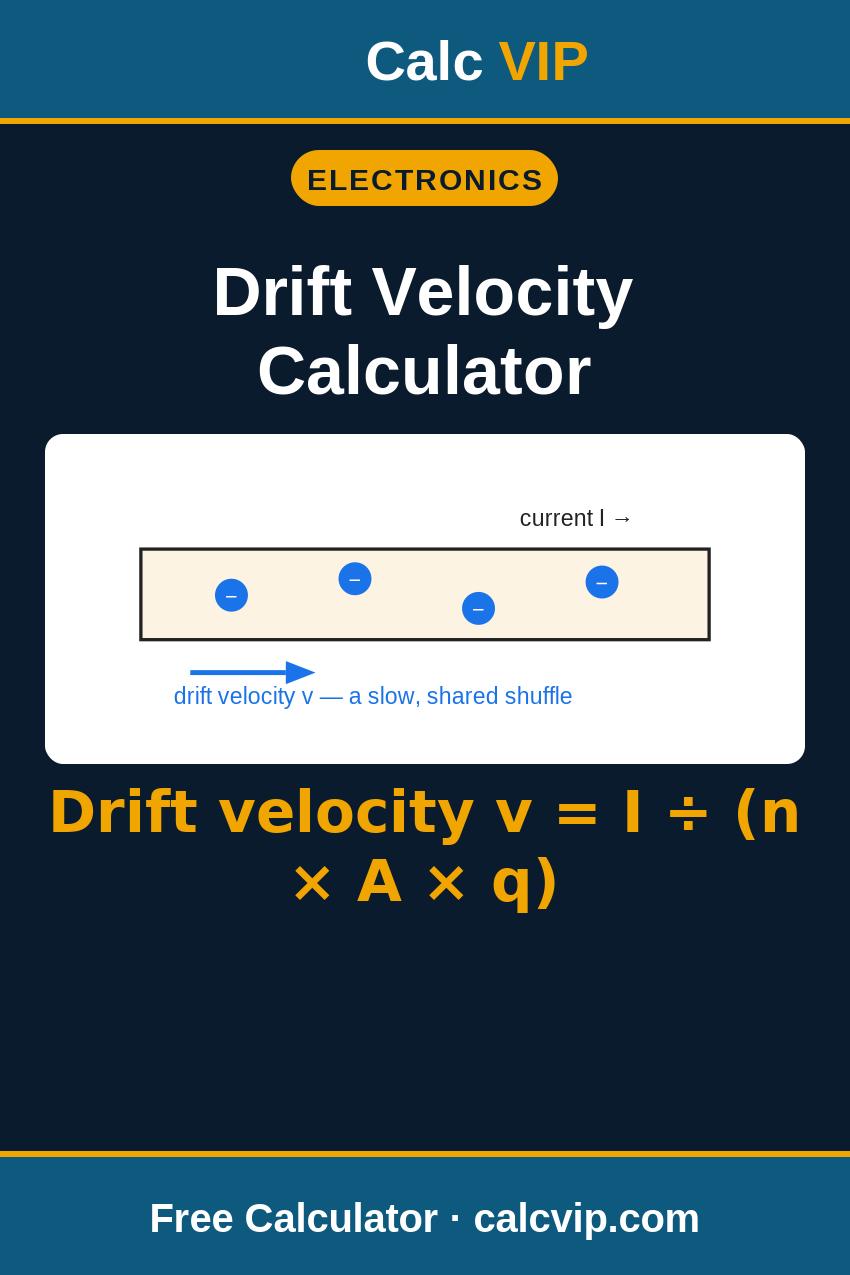
The formula v = I ÷ (nAq) is a bookkeeping identity before it is anything else. In one second, every electron within distance v of a cross-section drifts through it; the charge in that slab is n × A × v × q; and charge per second is, by definition, the current. Turn the bookkeeping around and the drift speed falls out of any current, wire and material. The calculator needs the number density n — the free electrons per cubic metre — which is pre-filled with copper's 8.5 × 1028, and the wire's cross-sectional area, which it converts from mm² to m² for you.
Drift velocity is not a curiosity; it is the quantity that connects the tidy circuit world of amps and volts to the atomic world underneath. It sets how much kinetic energy the electron stream carries (almost none), how wires heat (through collisions, not speed), why thick cables are needed for big currents (more carriers per slice, not faster ones), and what changes when a conductor is a semiconductor, where carriers are millions of times scarcer and must move millions of times faster to carry the same current.
Formula
Drift velocity v = I ÷ (n × A × q) • v in metres per second (m/s), I in amps (A), n in electrons per m³, A in m², q = 1.6 × 10⁻¹⁹ C
The formula rearranges to give the current itself, I = nAq v — the form in which it explains the world: current is carrier density × area × charge × drift speed, four factors that can trade against each other. Halve the area and the same current demands double the drift speed; swap in a material with half the carriers and the same happens. It also inverts for design work: the area needed to keep drift below a chosen value is A = I ÷ (nq v). One warning about units, the classic error source here: A must be in square metres inside the formula. One mm² is 10−6 m², and forgetting that factor of a million is the difference between a drift speed and a fantasy. This calculator takes the area in mm² and converts it for you — but if you ever compute by hand, convert first.
| Symbol | Meaning | Units |
|---|---|---|
| v | drift velocity — the average net speed of the electrons | m/s (often quoted in mm/s) |
| I | current in the wire | amps (A) |
| n | number density — free electrons per cubic metre | per m³ (m−3) |
| A | cross-sectional area of the wire | m² (calculator accepts mm²) |
| q | charge on one electron, 1.6 × 10⁻¹⁹ | coulombs (C) |
Drift is not the motion — it is the bias in the motion
Left alone, the free electrons in a wire are anything but still: they ricochet between atoms at speeds around a million metres per second, in completely random directions. That frantic motion carries no current because it averages to exactly zero — for every electron heading left, another heads right. Switching on a current does not replace this chaos; it merely biases it. The electric field adds a tiny shared drift on top of the random storm, like a breeze over the sea: the waves still crash in every direction, but the surface water slowly, net-ly, moves downwind. The drift velocity this calculator finds is that breeze — an average of millimetres per hour hiding inside motion a billion times faster.
This picture also explains resistance and heating honestly. Between collisions each electron accelerates slightly along the field, gaining a little directed energy; then it crashes into the lattice and hands that energy over as vibration — heat. The drift speed stays tiny because the acceleration is interrupted millions of billions of times per second. A superconductor removes the collisions, and with them the whole story changes: no lost energy, no heating, and currents that persist for years. Ordinary wires, though, are collision machines, and v = I ÷ (nAq) is the speed of the stately procession that survives them.
How to use
- Enter the current I in amps.
- Enter the wire's cross-sectional area A in mm² — for a round wire, A = π × (diameter ÷ 2)², so a 1.13 mm diameter wire has an area of about 1 mm².
- Leave n at the copper value (8.5e28), or type another material's number density — the quick reference table below lists common values, and scientific notation such as 1.8e29 is accepted.
- Click "Calculate" to get the drift velocity in m/s and mm/s.
- Sanity-check: for copper house wiring the answer should be a fraction of a millimetre per second. If you get metres per second, an area conversion has almost certainly gone wrong.
Worked examples
Example 1 — copper wire, everyday current. A copper wire of cross-section 1 mm² carries a current of 5 A. For copper, n = 8.5 × 1028 m−3 and A = 1 × 10⁻⁶ m².
v = 5 ÷ (8.5 × 1028 × 1 × 10−6 × 1.6 × 10−19) = 5 ÷ 13600 = 3.68 × 10⁻⁴ m/s — only about 0.37 mm/s. At that pace an electron needs about 45 minutes to drift a single metre along the wire.
Example 2 — a thicker cable. A 2.5 mm² copper cable carries 10 A. The carrier charge per metre rises to nAq = 34,000 C/m, so v = 10 ÷ 34,000 = 2.94 × 10⁻⁴ m/s ≈ 0.29 mm/s. Double the current of Example 1, yet a slower drift — the extra area more than compensates. Thick cables are not about speed; they are about sharing the load among more carriers.
Example 3 — aluminium. Aluminium has more free electrons per cubic metre than copper (n ≈ 1.8 × 1029, roughly three per atom). The same 5 A in a 1 mm² aluminium wire gives v = 5 ÷ 28,800 = 1.74 × 10⁻⁴ m/s ≈ 0.17 mm/s — half the copper drift, because twice the carriers each need to do half the work. (Aluminium still has the higher resistivity; drift speed and resistance are different stories, told by collisions as well as counts.)
Example 4 — a thin fuse wire. Squeeze 1 A through a fine copper fuse wire of 0.05 mm²: nAq falls to 680 C/m, and v = 1 ÷ 680 = 1.47 × 10⁻³ m/s ≈ 1.47 mm/s — four times Example 1's speed from one-fifth of its current. Narrow places are where electrons hurry, and where the collision heating concentrates; that is precisely why the fuse, the deliberate narrow place, is the part designed to melt.
Example 5 — the 45-minute electron. Example 1's drift of 3.68 × 10⁻⁴ m/s means one metre takes 1 ÷ 3.68 × 10⁻⁴ ≈ 2,720 s ≈ 45 minutes. The electron that lights your desk lamp when you flip the switch tonight was already in the lamp filament — the ones leaving the switch now will arrive around the time you finish your chapter. Current is a relay, not a delivery.
Example 6 — a semiconductor plays by different numbers. Doped silicon might have n ≈ 1022 per m³ — ten million times fewer carriers than copper. A modest 1 mA through a 1 mm² silicon path then needs v = 0.001 ÷ 0.0016 = 0.63 m/s: electrons strolling at walking pace, a million times faster than in the copper examples, just to carry a thousandth of the current. Scarce carriers must hurry — the deep reason semiconductor devices behave so differently from wires.
Drift velocity in real life
Why cables are sized by area. Every cable rating table is secretly this formula. Keeping current density (and therefore drift speed and collision heating per metre) within safe limits is what "this cable is good for 20 A" means. Undersize a cable and the electrons must drift faster through fewer carriers — the wire heats until insulation softens or worse.
The instant light, honestly explained. The signal that tells electrons to start drifting is an electromagnetic wave in the space around the wire, travelling at a good fraction of light speed. It reaches every electron in the circuit almost simultaneously, so the lamp lights at once even though each electron moves a hair's breadth. Push on one end of a full hosepipe and water leaves the other end immediately — the pressure signal is fast, the water is not.
AC: the electrons that go nowhere. In alternating current the drift reverses 100 times a second (on 50 Hz mains). At Example 1's drift speed, an electron's oscillation amplitude is only about 1.2 µm — it spends its whole life shuttling across a distance smaller than a bacterium, delivering energy without ever travelling. Energy in AC is carried by the fields, handed along; the electrons are just the medium that trembles.
Electromigration in chips. Inside processors, wires are so fine that current densities reach millions of amps per square centimetre — and at those densities the electron wind physically pushes metal atoms along, thinning wires until they fail. Drift, negligible in a house, is a lifetime-limiting wear mechanism in a chip, and chip designers budget for it explicitly.
Hall effect sensors. The drift of carriers through a slab in a magnetic field produces a measurable sideways voltage, proportional to I ÷ (n q × thickness). Because the effect grows as n shrinks, Hall sensors are made from semiconductors, not copper — and the same physics, run backwards, is how n itself is measured for new materials.
Superconducting magnets. Remove collisions and the drift picture transforms: currents in MRI coils circulate for years with no supply attached, their drift unopposed. The contrast makes the normal-metal case clear — drift velocity is small in copper not because electrons are lazy but because the lattice keeps confiscating their momentum.
Three speeds in one wire — do not confuse them
A live wire hosts three wildly different speeds at once. The random speed of the electrons is around 10⁶ m/s — a million metres per second of directionless crashing. The signal speed — how fast the "start drifting" instruction spreads — is a substantial fraction of the speed of light, roughly 2 × 10⁸ m/s in typical cabling. And the drift speed, the only one this calculator computes, is around 10−4 m/s. Ten orders of magnitude separate the fastest from the slowest, and each answers a different question: the random speed sets how often electrons collide (hence resistance), the signal speed sets when things happen, and the drift speed sets how much charge actually gets delivered. Exam questions and pub arguments alike are usually one of these speeds wearing another's clothes.
Quick reference: number density n of common conductors
| Material | n (free electrons per m³) | Electrons contributed per atom |
|---|---|---|
| Copper | 8.5 × 1028 | about 1 |
| Aluminium | 1.8 × 1029 | about 3 |
| Silver | 5.9 × 1028 | about 1 |
| Gold | 5.9 × 1028 | about 1 |
| Iron | 1.7 × 1029 | about 2 |
| Doped silicon (for contrast) | ≈ 1021–1023 | set by doping, not chemistry |
Values are standard room-temperature textbook figures. Notice that the best conductors do not win on n alone — silver and copper have unremarkable carrier counts; their advantage lies in how rarely their electrons collide, which is a story about the lattice, not the crowd.
Common mistakes
- Using mm² as if it were m². The single most common drift error. A = 1 mm² is 10−6 m²; skipping the conversion inflates v by a factor of a million and turns a crawl into a fantasy. This calculator converts for you — hand calculations must convert by hand.
- Confusing drift speed with signal speed. "Electricity travels at the speed of light" refers to the field signal, not the electrons. The electrons' net motion is the drift — millimetres per second. Both statements are true; they are about different things.
- Thinking a bigger current must mean faster electrons. Only if n and A stay fixed. In practice bigger currents are carried by bigger cables — more carriers per slice — and the drift speed may barely change, or even fall, as Example 2 showed.
- Using the total electron count for n. n counts only the free (conduction) electrons. Copper atoms hold 29 electrons each, but only about one per atom joins the drifting crowd; using all 29 overstates n — and understates v — by that factor.
- Expecting drift direction to match conventional current. Electrons drift opposite to the conventional current arrow, because their charge is negative. The formula gives the magnitude; the direction is towards the positive terminal, against the arrow on the circuit diagram.
FAQ
If electrons drift so slowly, why does a light come on instantly?
The electric field spreads through the wire at close to the speed of light, so every electron in the circuit starts drifting at almost the same moment — like water already filling a pipe when the tap opens.
What happens to the drift velocity in a thicker wire?
For the same current, a bigger area A gives a smaller drift velocity: a thicker wire has more electrons available in every slice, so each one needs to move more slowly to carry the same total charge per second.
Does drift velocity depend on the material?
Yes, through n. Materials with more free electrons per cubic metre (higher n) need a lower drift velocity for the same current and area.
How long would an electron take to travel a whole circuit?
At Example 1's 0.37 mm/s, one metre takes about 45 minutes, so a 10 m loop of cable is a half-day journey — and in AC the electron never completes the trip at all, oscillating over micrometres. Circuits work because every electron moves at once, not because any electron gets anywhere.
Why is drift velocity so much smaller than the electrons' real speed?
Because drift is an average of a near-perfect cancellation. The random motion is around 10⁶ m/s but directionless; the field adds a bias of about one part in ten billion. Averaging a hurricane with a breath of bias gives a very small net number — that number is v.
Does a hotter wire change the drift velocity?
Not directly: for a fixed current, v = I ÷ (nAq) has no temperature in it. Heat raises the collision rate, which raises resistance, so a fixed-voltage source delivers less current when hot — and then the drift falls with the current. The formula is innocent; the circuit around it is not.
What drift speeds occur in power lines?
Overhead lines run at modest current densities, so drift stays in the familiar tenths of a millimetre per second — but the currents are hundreds of amps, delivered by sheer conductor bulk and carrier count. At the other extreme, chip interconnects push drift-equivalent current densities a million times higher in relative terms, which is why electromigration lives there and not in pylons.
Can drift velocity be measured?
Indirectly, yes — through the Hall effect. A magnetic field across a current-carrying slab produces a sideways voltage that depends on v directly; measuring it gives the drift speed and, with the current and area known, the carrier density n. It is the standard way n is found for new materials.
Do positive charges ever drift?
In electrolytes and plasmas, yes — ions of both signs drift, in opposite directions, and both contribute to the current. In semiconductors, "holes" (absent electrons) behave as positive carriers drifting with the field. In metal wires, only the electrons move; the positive ions are locked in the lattice.
Why does the calculator use q = 1.6 × 10⁻¹⁹ C?
That is the magnitude of the electron's charge (the elementary charge), rounded to two significant figures — plenty for drift calculations, where n itself is rarely known better. Using the fuller value 1.602 × 10⁻¹⁹ C changes results by about a tenth of a percent.