 Calc
Electric Power Calculator – P = VI, I²R & V²/R
 Created by Michael Chen · Electronics Specialist · Last updated: November 2026
Use this free Electric Power Calculator to find the power used by any electrical device. You can start from voltage and current, current and resistance, or voltage and resistance — whichever pair you know.
Power is the speed of electricity at work. Where voltage tells you how hard charge is being pushed and current tells you how much of it is flowing, power combines the two into the quantity that actually does things: the rate at which electrical energy is turned into heat, light, movement or sound. Its unit, the watt, is one joule of energy per second — so a 460 W heater is converting 460 joules every single second, and the number on every appliance label in your home is a promise about how fast that device spends energy.
Three formulas describe this one quantity, and they are not three separate laws. Start with P = V × I, substitute Ohm's law into it either way, and the other two fall out: replace V with IR and you get P = I²R; replace I with V/R and you get P = V²/R. Which one you use is purely a matter of which two values you happen to know — the physics is identical, and this calculator accepts any of the three pairs. The trio is worth learning as a set, because each form reveals something the others hide: I²R exposes why losses explode when current rises, and V²/R explains why a heater designed for one country's voltage is feeble or dangerous on another's.
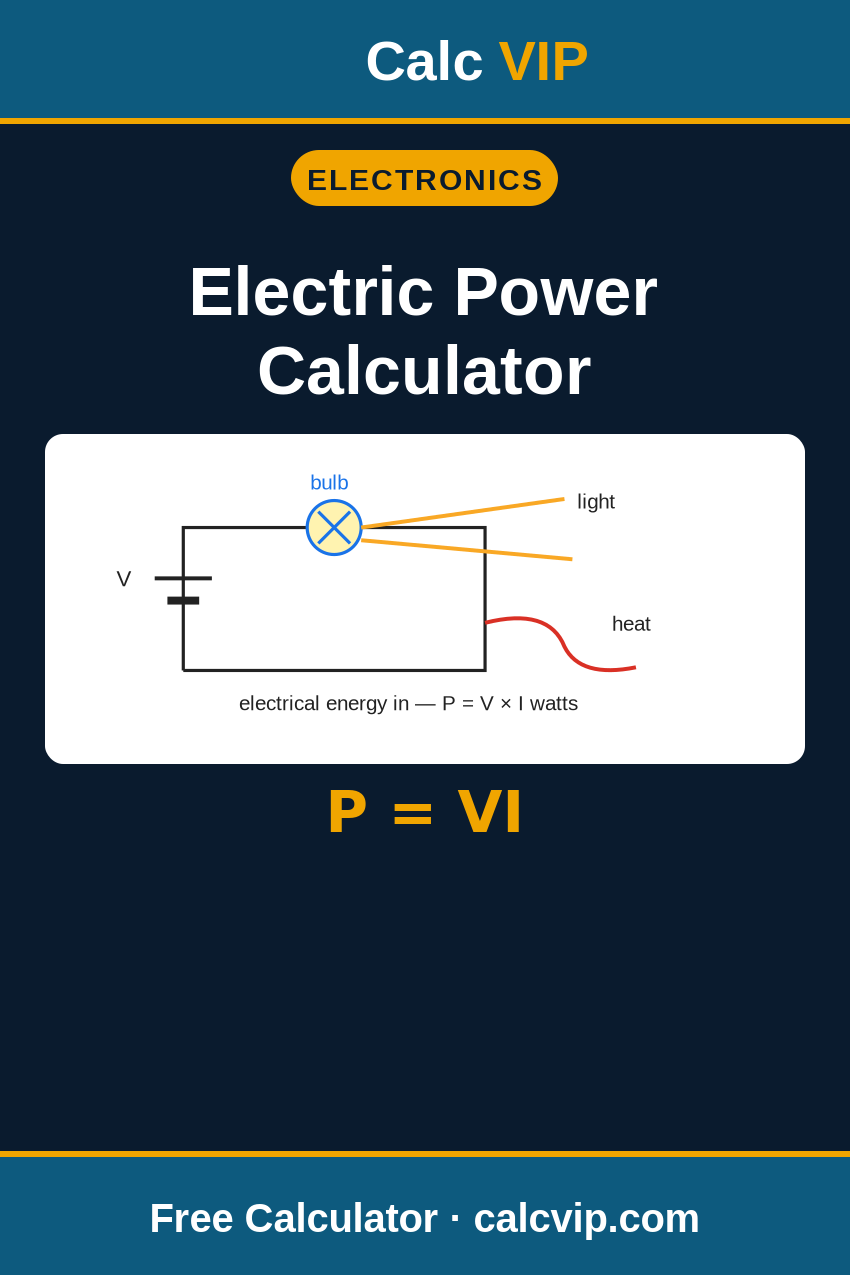
Power is also where physics meets your wallet. Electricity is sold by energy — power multiplied by time, packaged as the kilowatt-hour — so the wattage of a device and the hours it runs together decide what it costs you. Power decides whether a fuse holds or blows, whether a cable runs cool or dangerously warm, how bright a bulb can be and how quickly a battery drains. Almost every practical electrical question, from "why did the breaker trip?" to "why is this solar panel rated 400 W?", is a power question in disguise.
Formula
Power = Voltage × Current → P = VI • P = I²R • P = V² / R
All three forms are Ohm's law wearing a power badge. P = VI is the definition — it works for every device, always. P = I²R comes from substituting V = IR into it, and P = V²/R from substituting I = V/R; those two apply where a resistance is involved. Energy joins the family through E = P × t: run P watts for t seconds and you have used P × t joules, or, in the units of the electricity bill, run P kilowatts for t hours and you have used P × t kilowatt-hours. Units must be plain — watts, volts, amps, ohms — with milliamp and kilo-ohm prefixes converted before they enter any of the three formulas.
| Symbol | Meaning | Units |
|---|---|---|
| P | power — rate of converting electrical energy | watts (W) |
| V | voltage across the device | volts (V) |
| I | current through the device | amps (A) |
| R | resistance of the device | ohms (Ω) |
| E | energy used, E = P × t | joules (J) or kilowatt-hours (kWh) |
One law, three faces: where the power formulas come from
Power begins as a definition from mechanics: the rate of doing work. In a circuit, the work is done by the supply pushing charge through a voltage, and the arithmetic of that push gives P = V × I directly — volts are joules per coulomb, amps are coulombs per second, and multiplying them cancels the coulombs to leave joules per second: watts. This form needs nothing about the device at all, which is why it is universal: motor, LED, heater or phone charger, if you know the voltage across it and the current through it, you know its power.
The other two forms appear when the device is a resistor and Ohm's law can be folded in. P = I²R is the heating form: it says the warmth generated in any resistance grows with the square of the current, which is why doubling a current quadruples the heating in cables and why power engineers fear current above all else. P = V²/R is the design form: it says that for a fixed supply voltage, power is bought by lowering resistance — a 230 V heater element of 26.45 Ω delivers 2,000 W precisely because 230² ÷ 26.45 = 2,000. It also carries a warning: run that same element on 460 V and the power does not double, it quadruples, to 8,000 W, briefly and destructively.
How to use
- Choose the pair of values you know from the dropdown: voltage & current, current & resistance, or voltage & resistance.
- Enter the two values — the input labels change to match your choice. Use plain volts, amps and ohms.
- Click "Calculate" to get the power in watts, plus the third value (resistance, voltage or current) as a bonus.
- To turn the answer into energy or cost, multiply kilowatts by hours: a result of 460 W is 0.46 kW, so two hours of use is 0.92 kWh.
Worked examples
Example 1 — from voltage and current. A heater runs on 230 V and draws a current of 2 A.
P = V × I = 230 × 2 = 460 W.
Its resistance is R = V ÷ I = 230 ÷ 2 = 115 Ω.
Example 2 — from current and resistance. A current of 3 A flows through a 10 Ω resistor.
P = I²R = 3² × 10 = 90 W, and the voltage across the resistor is V = I × R = 3 × 10 = 30 V. Ninety watts in a resistor is serious heat — a part doing this job is built like a small heater, with a body designed to shed warmth.
Example 3 — from voltage and resistance. A 12 V supply is connected across a 6 Ω load.
P = V² ÷ R = 144 ÷ 6 = 24 W, drawing I = V ÷ R = 12 ÷ 6 = 2 A. This is the calculation behind car accessories: a 24 W load is a 2 A load, and the fuse for the circuit must be chosen above that figure.
Example 4 — from watts to the bill. A 2 kW fan heater runs for 3 hours on a winter evening.
Energy = 2 × 3 = 6 kWh — six "units" on the bill. The same warmth from a 460 W heater (Example 1) would take over thirteen hours to deliver; power is speed, energy is the total, and the bill charges for the total.
Example 5 — a phone charger. A charger delivers 5 V at 2 A to a phone.
P = 5 × 2 = 10 W. Two hours of charging uses 10 × 2 = 20 Wh = 0.02 kWh — about a fiftieth of a unit. Charging a phone nightly for a year costs less energy than running the Example 4 heater for a single evening, a comparison that surprises most people.
Example 6 — why the breaker trips. A kitchen circuit protected at 13 A on 230 V can supply at most P = 230 × 13 = 2,990 W — call it 3 kW. A 2,200 W kettle plus the 2 kW heater of Example 4 would demand 4,200 W, well past the limit, so the breaker trips and the tea waits. Breaker arithmetic is just P = VI read from the fuse's point of view.
Electric power in real life
The electricity bill. Your supplier does not charge for watts but for kilowatt-hours — energy. This page's formulas give the watts; multiply by hours and divide by 1,000 and you have the kWh that appear on the bill. The biggest numbers on the bill almost always belong to heating and cooling devices run for hours, not to the small electronics that worry people.
Appliance labels and running costs. The wattage printed on a kettle, microwave or heater is a direct invitation to calculate: a 2,200 W kettle boils for about three minutes, using 2.2 × 0.05 = 0.11 kWh per boil — cheap per cup, while an electric shower at several kilowatts is among the most expensive minutes in the house.
Fuses, breakers and cable choice. Every protective device is rated in amps, and P = VI translates that into the watts a circuit may carry — Example 6's 3 kW kitchen limit. Cables are chosen the same way in reverse: the expected power sets the current, and the current sets the thickness of copper that can carry it without overheating.
Why pylons carry such high voltages. The I²R form explains the entire design of the grid. Delivering 100 kW at 1,000 V needs 100 A; delivering it at 10,000 V needs only 10 A — and since cable losses go as I²R, the higher voltage wastes one hundred times less energy as heat along the way. Power is sent across countries at hundreds of thousands of volts for exactly this reason, then stepped down near homes.
LED lighting. An LED bulb producing the light of an old 60 W incandescent bulb draws about 8 W, because the incandescent spent most of its 60 W making invisible infrared heat while the LED converts a far larger share into visible light. Same service, a seventh of the power — multiplied by every bulb in a building, the saving is enormous.
Solar panels and generators. A solar panel rated at 400 W delivers that only in strong, direct sunshine squarely facing the panel — its rating is a peak power, and the day's energy is the area under a curve that rises and falls with the sun. Generators and power stations scale the same idea up: a large power station produces around 1,000 MW, the output of two and a half million such panels at their peak.
Quick reference: typical power of everyday devices
Ratings vary by model and country, but these typical values give a feel for the landscape — and a set of sanity checks for your own calculations. Notice the pattern: anything whose job is heat sits at the top of the table; anything whose job is information sits at the bottom.
| Device | Typical power |
|---|---|
| LED bulb | about 8 W |
| phone charger (while charging) | about 10 W |
| laptop | about 65 W |
| television | about 100 W |
| fridge (while the motor runs) | about 150 W |
| microwave oven | about 1,000 W |
| hair dryer | about 1,800 W |
| electric kettle | about 2,200 W |
| electric shower | about 8,500 W |
The table also explains household mysteries: the shower and kettle dominate a home's peak demand, while a week of phone charging barely registers. When a bill looks wrong, audit the top of this table first.
The watts you never switch off: standby power
Some power is drawn by devices that appear to be off. A television on standby, a charger left in the socket, a games console waiting for a wake-up signal — each draws a small continuous power, typically between half a watt and five watts, to keep sensors, clocks and remote-control receivers alive. Individually trivial, the arithmetic of time is merciless: a single 5 W standby load runs for all 8,760 hours of a year, using 5 × 8,760 = 43,800 Wh — 43.8 kWh a year, more than many a kettle manages in months of daily use. Even a perfect 1 W standby, the target of modern efficiency rules, quietly consumes 8.76 kWh annually.
Multiply by the dozens of devices in a modern home and standby can account for a noticeable slice of a household bill — energy bought to power nothing but readiness. The physics offers no loophole: the only cure is less power or less time, which is why regulations now cap standby draw, why switched sockets exist, and why the honest way to read a "small" wattage is always to ask the question this page exists to answer — small power, multiplied by how long?
Common mistakes
- Confusing watts with kilowatt-hours. Watts are speed; kilowatt-hours are quantity. A 2,000 W heater is not "using 2,000 units" — it uses 2 kWh per hour it runs. This single confusion accounts for most wrong guesses about electricity bills.
- Assuming a device always draws its rated power. Ratings are usually maxima. A fridge rated at 150 W cycles its motor on and off, averaging far less across a day; a laptop's 65 W charger delivers that only while charging a flat battery under load.
- Fitting a bigger fuse "to stop it blowing". The fuse is sized to the cable, not the appliance's wishes. A larger fuse lets the cable itself become the heating element — P = I²R applied to your walls. Repeated blowing is a symptom to diagnose, never a fuse to uprate.
- Forgetting the square in I²R. Doubling the current through a cable or component quadruples its heating, not doubles it. Many overheating puzzles — a plug that only gets hot with two appliances running — are this square law announcing itself.
- Using DC formulas blindly on AC motors. For heaters and lamps, P = VI works directly. Motors and other inductive loads draw current that is partly out of step with the voltage (a power factor below 1), so their true power is less than V × I suggests. The formulas here assume resistive or DC loads, as stated.
FAQ
What is a watt?
One watt (1 W) is one joule of electrical energy used per second. A device rated at 460 W uses 460 joules every second it runs.
What is the difference between watts and kilowatt-hours?
Watts measure power — how fast energy is used. Kilowatt-hours (kWh) measure total energy: a 460 W (0.46 kW) heater running for 2 hours uses 0.92 kWh, which is what your electricity bill charges for.
Which power formula should I use?
They are all the same law rearranged. Use whichever pair of values you actually know — the answer is identical.
How do I work out what an appliance costs to run?
Convert its watts to kilowatts, multiply by the hours used to get kWh, then multiply by your price per kWh. A 2,200 W kettle used for 3 minutes costs 2.2 × 0.05 = 0.11 kWh times your unit price — the method matters more than the tariff, which varies.
How many watts are in a horsepower?
One mechanical horsepower is 746 W — just under three quarters of a kilowatt. A 2 hp motor therefore delivers about 1,492 W of mechanical power, and draws somewhat more electrical power than that because no motor is perfectly efficient.
Why do LED bulbs use so much less power for the same light?
Efficiency. An incandescent bulb converts only a small share of its input into visible light and the rest into heat; an LED converts a far larger share into light. The service — brightness — is the same, so the LED needs roughly a seventh of the watts.
What does a 60 W bulb use if left on for an hour?
60 Wh of energy — 0.06 kWh. Power (60 W) multiplied by time (1 h) gives energy; leave it on for ten hours and it has used 0.6 kWh, the same as a 600 W device run for one hour.
Why are solar panels rated in "peak" watts?
Because their output depends on sunlight, angle and temperature. The rating is measured under standard bright test conditions, so a 400 W panel delivers 400 W only at solar noon on a clear day, and much less under cloud or at an angle — its daily energy, in kWh, is what actually matters.
Can a device use negative power?
In circuit theory, yes — the sign just shows direction. A battery being charged absorbs power like a load; the same battery discharging delivers power, which the maths records as negative consumption. Generators, solar panels and regenerative brakes all "use" negative power in this bookkeeping sense.
What is a megawatt, and how big is it?
A megawatt is a million watts — the output of a medium wind turbine or a small power station. A gigawatt (a billion watts) is a large power station, enough for roughly a million homes at an average kilowatt each, though real demand rises and falls through the day.