 Calc
Electricity Bill Calculator – Appliance Running Cost in kWh
 Created by Michael Chen · Electronics Specialist · Last updated: November 2026
Use this free Electricity Bill Calculator to find what one appliance costs to run. Enter its power in watts, how many hours a day you use it, the number of days, and your electricity rate per kWh — the calculator shows the energy used and the total cost.
Every electricity bill is, at heart, a count of kilowatt-hours — and every appliance in your home is quietly adding to that count at a rate set by its power and the hours it runs. This calculator isolates one appliance and prices it: enter its watts, the hours per day it runs, the number of days, and the rate your supplier charges per kWh, and it returns the energy consumed and what that energy costs, per period and per day. Run it for the heater, the air conditioner and the old fridge, and the mystery of the monthly bill usually dissolves into two or three hungry appliances and a long tail of cheap ones.
The kilowatt-hour deserves a moment, because it is a unit of energy disguised as a unit of billing. One kWh is the energy a 1000 W appliance uses in one hour — or, equivalently, a 100 W bulb in ten hours, or a 2000 W kettle in half an hour. Power tells you how fast an appliance spends; time tells you for how long; the bill multiplies them. That is the entire formula: energy in kWh = kilowatts × hours, and cost = kWh × rate. Everything surprising about electricity costs comes from the inputs — from how many watts things really draw, and how many hours they really run — never from the arithmetic.
The wattage you need is printed on every appliance's label or in its manual, though with a caveat this page will repeat: for appliances that cycle on and off — fridges, air conditioners, washing machines — the label shows the running watts, and the honest hours figure is the equivalent full-power hours, not the clock hours. A fridge whose compressor runs a third of the time is entered as its watts times eight hours a day, not twenty-four. With that one discipline, the estimates from this calculator track real bills closely enough to make decisions: what to replace, what to ration, and what to stop worrying about.
Formula
Energy (kWh) = Power (kW) × hours per day × days • Cost = Energy × rate per kWh
(Power in kW = watts ÷ 1000.)
Two divisions hide inside the tidy formula. First, watts become kilowatts — divide by 1000 — because the kWh is defined around the kilowatt; a 1500 W heater is 1.5 kW, and forgetting the division inflates the answer a thousandfold. Second, the "hours" that multiply are total hours across the whole period, hours-per-day × days, which is why the calculator takes them separately: people think in "about 4 hours a day" and "a month", not in "120 hours". The cost line then applies the rate — the price of one kWh on your tariff, found on your bill, often labelled the unit rate or energy charge. The calculator also divides the total back into a cost per day, because daily figures are the ones that change behaviour: a heater at 1.80 a day is a decision; the same heater at "54 a month" is a surprise.
| Symbol | Meaning | Units |
|---|---|---|
| P | appliance power (running watts) | watts (W); kW = W ÷ 1000 |
| t | time — hours per day × days | hours (h) |
| E | energy consumed | kilowatt-hours (kWh) |
| Rate | price of one kWh on your tariff | currency per kWh |
Watts are not all equal: heaters versus electronics
The single most useful instinct this calculator builds is a feel for the wattage landscape. Anything whose job is to make heat spends electricity by the kilowatt: kettles and heaters at 1500–3000 W, ovens and irons in the same league. Anything whose job is to move air or light a room spends moderately: fans, washing machines and air conditioners in the hundreds of watts. And anything whose job is information — phones, laptops, LED lamps, routers — spends in single or double digits of watts. A 2000 W heater running one hour costs as much as a 10 W LED bulb running for two hundred hours. This is why energy advice concentrates so relentlessly on heating, cooling and hot water, and why the phone charger left plugged in is a rounding error wearing a villain's costume.
The second instinct is about hours. Cost is watts × hours, and the hours column quietly dominates for anything left on around the clock. A modest 100 W load that never sleeps uses 72 kWh a month — more than a 2000 W kettle used for a quarter-hour a day (15 kWh). The always-on tail of modern homes — routers, set-top boxes, standby supplies, the fridge — is invisible precisely because each item is small; this calculator, run patiently over the tail, is how households find the extra 10–20% hiding in their bills.
How to use
- Find the appliance's wattage on its label or manual and enter it. For cycling appliances (fridge, AC), plan to enter running watts and equivalent full-power hours in step 2.
- Enter how many hours a day it runs — for a fridge, use the compressor's typical running hours (about 8 of the 24); for most things, your honest daily average — and the number of days (30 for a typical month).
- Enter the rate per kWh from your electricity bill and click "Calculate".
- Read the energy in kWh, the total cost, and the cost per day. Repeat for your other appliances and add the totals to reconstruct your whole bill.
- For a quick cost-per-hour of any appliance, set hours to 1 and days to 1 — or check the quick-reference table below at a 0.30 rate.
Worked examples
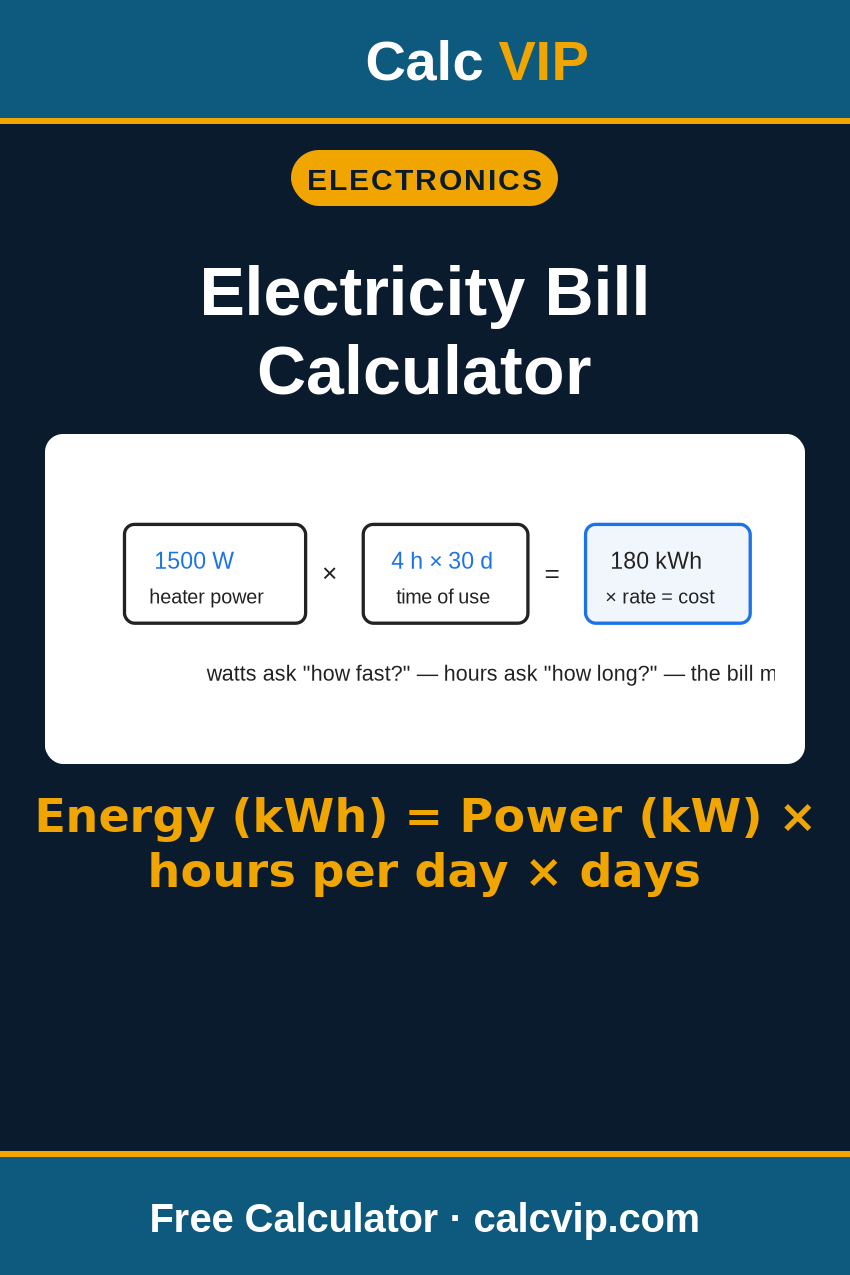
Example 1 — the room heater. A 1500 W heater runs 4 hours a day for 30 days, at a rate of 0.30 per kWh.
Energy = 1.5 kW × 4 × 30 = 180 kWh. Cost = 180 × 0.30 = 54.00 — the single biggest line in many winter budgets, at 1.80 per day.
Example 2 — the LED bulb. A 10 W LED bulb lights a room 6 hours a day for 30 days at 0.30.
Energy = 0.01 × 6 × 30 = 1.8 kWh; cost = 0.54 for the month. Thirty-three such bulbs cost what the one heater costs — the wattage landscape in a single comparison.
Example 3 — the kettle. A 2000 W kettle is used a total of 15 minutes (0.25 h) a day for 30 days.
Energy = 2 × 0.25 × 30 = 15 kWh; cost = 4.50. Fearsome watts, tiny hours, modest bill — though boiling only the water you need still trims it further.
Example 4 — air conditioning. A 1200 W AC unit runs 8 hours a day for 30 days at 0.30.
Energy = 1.2 × 8 × 30 = 288 kWh; cost = 86.40. In hot climates this is the bill — and why each degree on the thermostat, trimming the compressor's hours, pays so visibly.
Example 5 — the fridge, honestly entered. A fridge rated 150 W whose compressor runs about a third of the time: enter 150 W and 8 equivalent hours a day.
Energy = 0.15 × 8 × 30 = 36 kWh; cost = 10.80 a month. Entered naively as 24 hours it would claim 108 kWh — the cycling-appliance trap, and the commonest way this calculator gets misused.
Example 6 — the gaming PC. A 400 W PC (tower plus monitor) used 5 hours a day for 30 days.
Energy = 0.4 × 5 × 30 = 60 kWh; cost = 18.00. Serious money — a third of the heater — which surprises everyone who files computers under "cheap electronics".
Electricity costs in real life
The bill autopsy. When a household's bill jumps, this calculator is the diagnostic: price the suspects one by one. The culprit is almost never the new gadget; it is a heater, a failing fridge running non-stop, or an immersion heater left on a timer nobody remembers setting.
Replacement decisions. An old fridge at 36 kWh a month against a new one at half that is a calculable payback; so is swapping a 100 W incandescent bulb (18 kWh over the same 6 h × 30 days) for the 10 W LED of Example 2 — a saving of 16.2 kWh a month from one socket.
Landlords and shared houses. Pricing a lodger's heater or a tenant's AC fairly starts here: watts × hours × the tariff rate is an estimate both sides can check, which defuses most arguments before they start.
Solar and battery planning. A home battery or solar array is sized in kWh — the same currency. Totalling your appliances' daily kWh with this calculator is step one of knowing what a system must supply, long before anyone quotes panel counts.
Standby hunting. A 5 W standby load — a TV and box asleep — runs 24 hours a day: 3.6 kWh a month, about 1.08 at our example rate. Trivial alone; multiplied by a houseful of sleepy devices and a year of nights, it becomes the 26 or so that a 10 W always-on load quietly spends annually (87.6 kWh).
Business equipment. The same arithmetic prices a shop's display lighting, a café's espresso machine or a server's monthly appetite — and feeds directly into the prices those businesses must charge. Watts × hours × rate is universal small-business maths.
Quick reference: cost per hour at a 0.30 rate
| Appliance power | Energy per hour | Cost per hour | Typical examples |
|---|---|---|---|
| 10 W | 0.01 kWh | 0.003 | LED bulb, phone charger in use |
| 100 W | 0.1 kWh | 0.03 | TV, laptop under load, old bulb |
| 500 W | 0.5 kWh | 0.15 | washing machine (heat cycle peaks higher) |
| 1000 W | 1 kWh | 0.30 | iron, microwave, small heater |
| 2000 W | 2 kWh | 0.60 | kettle, fan heater, oven element |
| 3000 W | 3 kWh | 0.90 | large kettle, immersion heater, tumble dryer |
Scale the table to your own tariff by proportion: at a rate of 0.45, multiply every cost by 1.5; at 0.15, halve them. The shape never changes — heat at the top, information at the bottom, and hours quietly deciding everything.
Reading your real tariff
The rate to enter is the per-kWh energy price, not the bill total divided by kWh — that quotient smuggles in the standing charge and taxes and overstates the marginal rate. Find the line on your bill that prices a unit of energy ("unit rate", "energy charge", sometimes split into peak and off-peak prices). If your tariff has time-of-use pricing, run this calculator twice — once at the peak rate for daytime hours, once at the off-peak rate — and add the results; appliances that can be shifted (washing machines, dishwashers, EV charging) are priced by whichever run applies to them. Tiered tariffs, where the rate rises after a monthly threshold, need the rate of the tier your extra usage lands in. The calculator is deliberately dumb about all of this — one rate at a time — because tariffs are local and changeable, while watts × hours is forever.
From kilowatt-hours to carbon and back
The kWh you price here is also the unit of carbon accounting. Grid electricity carries an emissions factor — very roughly 0.2–0.5 kg of CO₂ per kWh depending on how your grid generates — so the heater of Example 1, at 180 kWh a month, is responsible for something like 36–90 kg of CO₂ monthly, while the LED bulb's 1.8 kWh is well under a kilogram. The range is wide because grids differ and change by the hour, but the multiplication is the same one this page teaches: find your grid's factor, multiply by the kWh column, and appliance decisions become environmental decisions with numbers attached. It is also why saving kWh at peak times counts double in practice — the marginal generator at peak is usually the dirtiest one — even though your bill's single rate cannot show it.
Common mistakes
- Entering watts where kilowatts belong — or skipping the division. Hand calculations that forget W ÷ 1000 produce bills a thousand times too large. This calculator takes watts directly; if you check its work by hand, convert first.
- Charging a fridge for 24 hours at full watts. The compressor cycles. Use equivalent full-power hours (Example 5) or measure with a plug-in energy meter for a week — the difference is a factor of three.
- Using the maximum wattage of variable appliances. A washing machine's label peaks during its heating phase; most of the cycle sips. Label watts × clock hours overstates such loads badly. Manufacturers' "kWh per cycle" figures, where given, beat any estimate.
- Dividing last month's bill by its kWh to get "the rate". That average includes fixed charges spread over your usage, so it overstates the price of saving one more kWh. Use the printed unit rate for decisions about saving.
- Forgetting that savings scale with hours, not watts alone. Replacing the 2000 W kettle saves little (it runs minutes a day); replacing the always-on 100 W load saves more. Rank appliances by kWh, never by watts — which is to say, run this calculator before buying anything "efficient".
FAQ
What is a kWh?
A kilowatt-hour is the energy used by a 1000 W appliance running for one hour. Electricity companies bill you for the number of kWh you use, which is why it is also called a "unit" of electricity in many countries.
Why is my real bill higher than this estimate?
This calculator covers one appliance's energy charge only. Real bills add standing charges, taxes, fuel adjustments and meter rent — and you run many appliances, not just one.
Which appliances cost the most to run?
Anything that makes heat: heaters, kettles, ovens, irons and old air conditioners draw 1000–3000 W. LED lights (5–15 W) and phone chargers (5–20 W) cost almost nothing by comparison.
How do I find my electricity rate per kWh?
Look for the unit rate or energy charge line on your bill — a price per kWh, separate from the standing charge and taxes. If the bill only shows a total, your supplier's tariff page or app lists the unit rate; use that, not the bill total divided by usage.
What does it cost to run a 100 W appliance for 10 hours?
100 W × 10 h = 1000 Wh = exactly 1 kWh, so the cost is one times your rate — 0.30 at the example tariff. This is the handiest benchmark in home energy: a hundred watts for ten hours is a unit.
Why does my supplier call kWh "units"?
Historical shorthand: one "unit" of electricity has meant one kilowatt-hour since the early days of public supply in Britain and the countries that followed its practice. The meter counts units; the physics counts kWh; they are the same number.
Is it cheaper to leave heating on all day or heat only when needed?
For the same comfort, heating only when needed almost always wins: a heater's kWh are proportional to its running hours, and a house loses heat in proportion to how warm it is kept. Run the two scenarios through this calculator with honest hours and compare — the "keep it ticking over" myth rarely survives the arithmetic.
How accurate is the label wattage?
Labels state maximum or rated draw, accurate for resistive heaters and kettles, generous for electronics (a laptop adapter marked 65 W may average 20 W in use). For a true figure, a plug-in energy meter measuring over days beats every estimate — then this calculator turns its kWh reading into money.
What uses more: a kettle or a fridge?
Per hour, the kettle by thirteen-fold (2000 W against 150 W). Per month, the fridge in our examples: 36 kWh against the kettle's 15 kWh — because it runs 8 equivalent hours a day against the kettle's quarter-hour. Hours beat watts over any long period.
Can I price a whole house with this calculator?
Yes, appliance by appliance, added up — the methodical route. Shortcut: read your meter a week apart, and the difference is your true weekly kWh; price appliances individually only for the ones you are deciding about.