 Calc
Heat Engine Calculator – Work Done & Efficiency from Qin and Qout
 Created by Anna Kowalski · Physics Editor · Heat & Atoms · Last updated: November 2026
Use this free Heat Engine Calculator to find the work done and the efficiency of any heat engine from the heat it takes in and the heat it rejects, using W = Qin − Qout and η = W/Qin.
Every heat engine ever built — every steam turbine, car engine, jet and power station — keeps the same simple ledger. Heat Qin flows in from something hot. Heat Qout flows out to something cold. The difference, and only the difference, is available as work: W = Qin − Qout. That subtraction is the first law of thermodynamics doing bookkeeping, and it admits no exceptions and no cleverness. This calculator is the ledger in its purest form: two heats in, the work and the efficiency out. If you can measure or estimate what an engine absorbs and what it throws away, you know exactly what it did for you.
The efficiency η = W/Qin is the figure of merit that two centuries of engineering have been chasing uphill. The first steam engines converted barely 1% of their coal's heat into work; a modern combined-cycle power station passes 60%. Between those numbers lies the entire industrial revolution — better boilers, higher pressures, superheated steam, turbines, diesels, gas turbines — each generation defined by how much of Qin it could rescue from Qout. And over the whole climb stands the Carnot ceiling, η = 1 − Tc/Th, fixing how much rescue is even possible between given temperatures: the heat engine calculator tells you where an engine is; the Carnot calculator tells you how far it could ever go.
One flexibility is worth knowing before you start: the ledger does not care about the time window. Feed it joules per cycle and it returns work per cycle; feed it joules per second — watts of heat — and it returns watts of power, with the same efficiency either way. A car engine "taking in" 100 kW of fuel power at cruising speed and rejecting 72 kW through exhaust and radiator is doing 28 kW of work, at η = 28%, whether you count one firing of one cylinder or an hour on the motorway. Efficiency is a ratio, and ratios are scale-free — which is why this modest two-input calculator describes both a lawnmower and a gigawatt power station without modification.
Formula
Work done W = Qin − Qout, and efficiency η = W / Qin — where Qin is the heat absorbed from the hot reservoir and Qout is the heat rejected to the cold reservoir, both in joules. Energy conservation guarantees the work out is exactly the difference.
Substituting the first equation into the second gives the form engineers reach for most: η = 1 − Qout/Qin. Efficiency is one minus the fraction thrown away — a definition with a moral built in, since it says the only route to a better engine is rejecting a smaller share of what you take in. The pair rearranges just as easily the other way: given a target efficiency, the heat you must supply for a desired work output is Qin = W/η, and the cooling system you must build has to handle Qout = Qin × (1 − η). That last form is not academic: radiators, cooling towers and exhaust systems are all sized by it, and in low-efficiency machines the cooling plant must shed more energy than the engine delivers as work — often much more.
| Symbol | Meaning | Units |
|---|---|---|
| Qin | heat absorbed from the hot reservoir (fuel energy released) | J (or W if per second) |
| Qout | heat rejected to the cold reservoir (exhaust, coolant, condenser) | J (or W if per second) |
| W | work done by the engine = Qin − Qout | J (or W if per second) |
| η | efficiency = W/Qin | decimal or % |
Why the rejected heat is not a design flaw
It is tempting to read Qout as failure — energy the engineers failed to catch. The second law of thermodynamics says otherwise: Qout is a structural necessity, the toll every heat engine pays for existing. Lord Kelvin's statement of the law is precisely this: no engine, however perfect, can take heat from a reservoir and convert it entirely into work in a cycle. Some heat must be passed down to a colder reservoir to complete the loop. An engine claiming Qout = 0 is not an invention; it is a contradiction, on a par with a perpetual-motion machine — and indeed "perpetual motion of the second kind" is exactly what patent offices call it.
The entropy ledger shows the mechanism. Heat arriving from the hot reservoir carries entropy Qin/Th into the engine. The engine's working fluid must end each cycle exactly as it began — same state, same entropy — so that entropy has to be carried out again, and the only exit is the rejected heat: Qout/Tc must be at least Qin/Th. Since Tc is smaller than Th, Qout must be a substantial fraction of Qin; solving the balance gives Qout ≥ Qin × Tc/Th, and the efficiency ceiling η ≤ 1 − Tc/Th falls straight out — the Carnot limit, derived from nothing but the requirement that entropy has somewhere to go. Work is what remains after the entropy has been paid out of the building.
Seen this way, the history of engine improvement is a history of negotiating with the toll, never abolishing it. Raise Th and the incoming entropy per joule falls, so less heat must be rejected to carry it away. Lower Tc and each rejected joule carries more entropy, so fewer joules need rejecting. Every real advance — hotter steam, colder condensers, combined cycles that run a steam engine off a gas turbine's exhaust — is one of those two moves in disguise. The calculator's two inputs are humble, but they are the two numbers the entire negotiation is about.
How to use
- Enter the heat taken in from the hot reservoir, Qin, in joules.
- Enter the heat rejected to the cold reservoir, Qout, in joules (it must be less than Qin).
- Click "Calculate Work & Efficiency" to get the work done and the efficiency as a percentage.
- For a running engine rather than a single cycle, enter both heats as rates (joules per second): the work comes out in watts and the efficiency is unchanged.
- Sanity-check the result: η must sit below the Carnot limit 1 − Tc/Th for the engine's temperatures — if it does not, one of the heats is wrong.
Worked examples
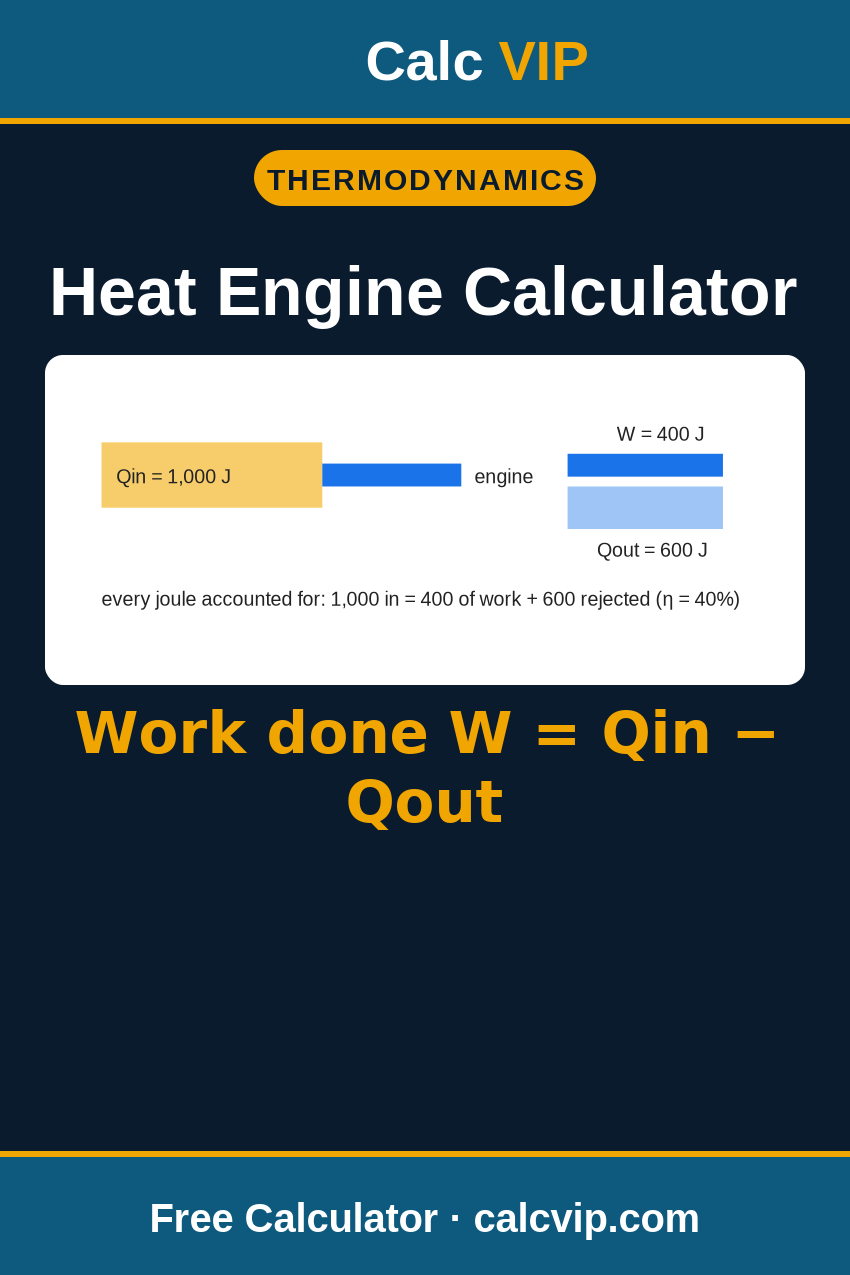
Example 1 — the reference cycle. An engine takes in Qin = 1000 J and rejects Qout = 600 J each cycle.
W = 1000 − 600 = 400 J
η = 400 / 1000 = 0.4 = 40%
Example 2 — a power station, per second. A generating plant absorbs 2,500 MW of heat from its boilers and rejects 1,500 MW to its cooling water.
W = 2500 − 1500 = 1,000 MW of electrical power, at η = 1000/2500 = 40%. The rejected 1,500 MW — half as much again as the entire electrical output — is why power stations need rivers, seas or those vast cooling towers: the Qout stream is the bigger river of energy.
Example 3 — a car journey. On a trip, a petrol engine burns fuel releasing 100 MJ of heat and delivers 28 MJ of work to the wheels.
Qout = 100 − 28 = 72 MJ, and η = 28/100 = 28%. Nearly three-quarters of the fuel's energy left through the exhaust pipe and radiator — a fact anyone who has felt the heat shimmering off a bonnet in traffic has measured by hand.
Example 4 — an early steam engine. A heritage locomotive's engine takes in 5,000 J per cycle and rejects 4,600 J.
W = 5000 − 4600 = 400 J, η = 400/5000 = 0.08 = 8%. The same work as Example 1, bought with five times the heat — the difference between 1820s engineering and a modern plant, written in one subtraction.
Example 5 — designing to a target. A backup generator must deliver W = 700 J per cycle and its design efficiency is η = 35%. What heat must the fuel supply, and what must the cooling shed?
Qin = W/η = 700 / 0.35 = 2,000 J; Qout = 2000 − 700 = 1,300 J — nearly twice the useful output, which is why the generator's fan and exhaust are sized so generously.
Example 6 — a modern diesel. A truck engine absorbs 1,800 J per cycle and rejects 1,080 J.
W = 1800 − 1080 = 720 J; η = 720/1800 = 40% — diesel's high compression buys it a clear lead over the petrol engine of Example 3, at the price of a heavier, stronger block to survive that compression.
Heat engines in real life
Combined heat and power: refusing to waste Qout. A power station's rejected heat is low-grade but not useless — it is still warm. CHP plants pipe it into district heating and industrial processes, so a plant at 35% electrical efficiency can reach 80–90% total utilisation. The work ledger does not change; the definition of "waste" does. The next section does this arithmetic.
Why your car's radiator is so big. Example 3's ledger, scaled: at motorway cruise a family car's engine rejects roughly twice the power it delivers to the wheels, and the radiator must shed all of it to a slipstream of air. Undersize the cooling and the engine does not become more efficient — it becomes a kettle.
Combined cycles: an engine on an engine. A gas turbine's exhaust leaves at 500–600 °C — hot enough to be another engine's hot reservoir. Combined-cycle plants run a steam turbine off that Qout, lifting overall efficiency from ~40% to ~60%: the second engine lives entirely on the first one's rejected heat, the most elegant recycling in engineering.
Ships and slow diesels. The largest marine diesels are among the most efficient heat engines on Earth, exceeding 50%: enormous cylinders, slow revolutions, and every waste stream — exhaust, cooling water — harvested for steam and heating. Scale and patience are efficiency strategies the two-input ledger rewards.
The human engine. Your muscles are not heat engines (they convert chemical energy directly, Carnot-free), but the bookkeeping still bites: cycling at about 20–25% mechanical efficiency, a rider producing 100 W at the pedals burns roughly 400–500 W of food power and sheds the rest as heat — which is why exercise makes you hot, and why the "engine" needs its own cooling system of sweat.
Heritage steam and the romance of 8%. Example 4's locomotive wasted 92% of its coal — and still transformed the world, because coal was cheap and the alternative was horses. Efficiency only became the obsession it is when fuel grew dear and carbon costly; the physics never changed, the economics did.
Beating the bookkeeping: combined heat and power
Efficiency η = W/Qin grades an engine on work alone — but a joule of Qout at 80 °C is worthless for work and perfectly good for heating a building. Combined heat and power (CHP) exploits that grading loophole honestly. Take an engine with Qin = 1,000 J, W = 350 J and Qout = 650 J: as an engine, η = 35%. Now capture 500 J of the rejected heat for space heating and hot water. The total useful output is 350 + 500 = 850 J from the same 1,000 J of fuel — an 85% utilisation that no work-only engine between those temperatures could ever reach, achieved without breaking a single law, merely by refusing to call warm water "waste". Universities, hospitals and whole Scandinavian districts heat this way; the calculator above still grades the engine part, and the CHP bonus is added by hand — as it should be, since the physics and the accounting are separate questions.
Quick reference: who achieves what
| Engine | Typical η | Out of every 1,000 J of heat… |
|---|---|---|
| early steam engine (c. 1800) | ≈ 3% | 30 J of work, 970 J rejected |
| steam locomotive | 5–8% | ≈ 65 J of work, ≈ 935 J rejected |
| petrol car engine | 25–30% | ≈ 280 J of work, ≈ 720 J rejected |
| diesel car / truck engine | 35–40% | ≈ 380 J of work, ≈ 620 J rejected |
| coal / nuclear steam plant | 33–40% | ≈ 370 J of work, ≈ 630 J rejected |
| combined-cycle gas plant | 55–60% | ≈ 580 J of work, ≈ 420 J rejected |
| large marine diesel | ≈ 50% | 500 J of work, 500 J rejected |
Two lessons hide in the table. First, even the champions reject a third to a half of their heat — the second law's toll is visible in every row. Second, the ranking is not the ranking of cleverness but of temperatures and scale: the winners burn hotter, reject colder, and waste less to friction because they are big and slow or run a second engine on the exhaust.
Common mistakes
- Getting η above 1 (or above 100%). If the efficiency comes out over 100%, the heats have been swapped or one is mis-measured — work cannot exceed the heat taken in; that is the first law, and it does not negotiate. Check that Qout is the smaller number.
- Calling Qout "lost energy". No energy is lost — it is all in the exhaust and cooling water, accounted to the joule. What is lost is usefulness: the energy has been degraded to a low temperature where it can do no more work. Keeping the two ideas separate prevents most confused thinking about engines.
- Mixing per-cycle and per-second figures. Qin per cycle with Qout per second gives an efficiency from two different ledgers. Both heats must describe the same engine over the same interval; then W and η are both meaningful.
- Assuming the Carnot value is the expected value. This calculator measures the engine you have; the Carnot formula sets the best any engine between those temperatures could do. A real engine at 60–70% of its Carnot limit is excellent, not defective — friction and finite-rate heat flow always take their share.
- Forgetting the fuel's other losses. Qin is the heat actually absorbed by the engine's working fluid. Fuel energy that escapes up a chimney without ever heating the fluid, or fuel that leaves unburnt, never enters this ledger — plant-level efficiency (electricity out ÷ fuel energy in) is always a few points lower than the engine's own η.
FAQ
Where does the rejected heat go?
Into the cold reservoir — for a car engine that is the exhaust gases and the air flowing through the radiator. It cannot be avoided entirely: no heat engine can turn all the heat it takes in into work.
Can efficiency ever be 100%?
No. That would require Qout = 0, which the second law of thermodynamics forbids. The best possible efficiency between two temperatures is the Carnot limit, η = 1 − Tc/Th.
Does this calculator work for a car engine?
Yes, if you know the heat energy taken from the fuel and the heat wasted per cycle (or per second — then the same numbers give power in watts). Typical petrol engines manage roughly 25–30%.
How is this different from the Carnot efficiency calculator?
This one grades a real engine from its actual heats — Qin and Qout you could, in principle, measure. The Carnot calculator grades the temperatures and returns the best efficiency any engine could achieve between them. Use both: the gap between the two numbers is the room physics leaves for better engineering.
How much work does a litre of petrol actually do?
A litre of petrol releases about 34 MJ of heat. At a typical 28% efficiency, that is about 9.5 MJ of work — the rest, some 24.5 MJ, warms the exhaust, the coolant and ultimately the street. The same arithmetic in reverse is how engineers estimate fuel consumption from a required power.
Why do engines get more efficient as they get bigger?
Several losses refuse to scale. Friction and heat leakage grow roughly with surface area while output grows with volume, so a bigger engine wastes a smaller fraction on both. Large engines can also afford extras — turbochargers, exhaust-heat recovery, a second engine on the exhaust — that small ones cannot carry. Hence a ship's diesel at 50% and a lawnmower at perhaps 15%, from the same basic ledger.
Is work the same as power?
No — work is energy (joules); power is its rate (joules per second, watts). Enter per-cycle heats and W is per cycle; multiply by cycles per second for power. Enter heats already as rates and W arrives in watts directly. Efficiency, being a ratio of like quantities, is the same either way.
Can the rejected heat be put to work in another engine?
Yes — that is the combined-cycle trick, and also what a turbocharger and a thermoelectric generator do on a smaller scale. The catch is temperature: the second engine's hot reservoir is the first engine's cold side, so its Carnot ceiling is low and it harvests only part of the stream. Each cascade step takes a thinner slice, which is why two stages are common and five are not.
Why does a car waste more fuel idling and in town?
At idle the engine does zero useful work while still absorbing heat — η = 0 by definition, all Qin leaving as Qout. In town, part-throttle operation lowers the effective temperatures and pressures, shrinking the efficiency the ledger allows; hybrids dodge the trap by switching the engine off and letting a motor handle the inefficient moments.
Who first wrote down this ledger?
The energy bookkeeping is the first law, assembled in the 1840s by Mayer, Joule and Helmholtz. The efficiency question — how much of Qin can possibly become W — is Carnot's, from 1824, and the impossibility of Qout = 0 was sharpened into the second law by Kelvin and Clausius around 1850. This calculator stands on all of their shoulders at once.