 Calc
Fresnel Reflectance Calculator – Reflection at a Surface (Normal Incidence)
 Created by David Okafor · Physics Writer · Waves & Light · Last updated: November 2026
Use this free Fresnel Reflectance Calculator to find what fraction of light reflects off a surface at normal incidence (straight-on) — the reason plain glass reflects about 4% per surface — plus the percentage that gets through.
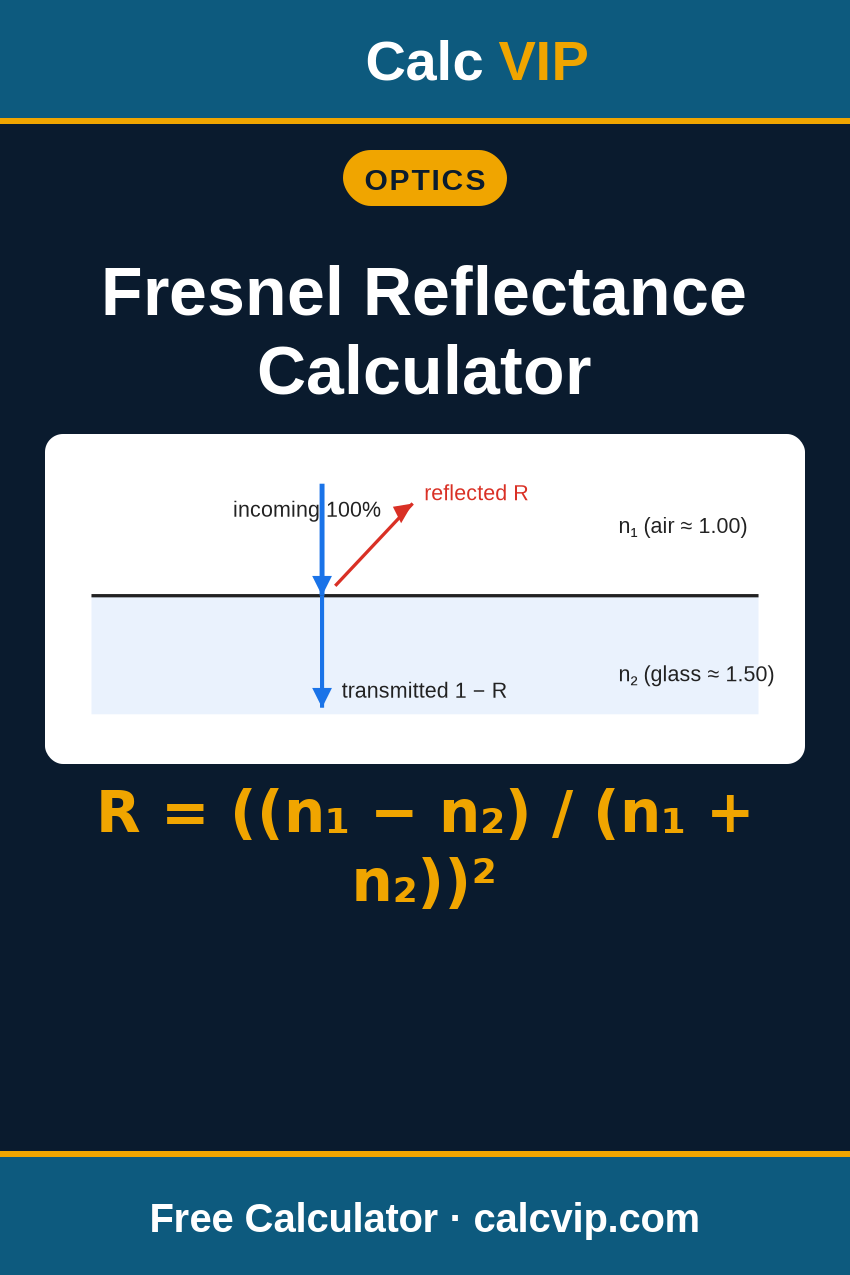
Every boundary between two transparent materials is a part-time mirror. Light arriving at a surface where the refractive index changes cannot simply continue: the wave on one side must match the wave on the other, and the only way the mathematics can reconcile two different wave speeds is to split the energy — most crosses into the new material, and a definite fraction is turned back as a reflection. The Fresnel reflectance R = ((n₁ − n₂)/(n₁ + n₂))² prices that split for light arriving straight-on. It contains no wavelength, no angle and no thickness — only the size of the index step. Double the mismatch and the reflection grows roughly as its square, which is why the formula's answers range from a whisper (0.01% between nearly matched materials) to a shout (36% at germanium).
The 4% figure for glass is one of those numbers that quietly shapes everyday life. It is why you can see a faint ghost of yourself in a shop window while still seeing the display behind it; why a camera lens with ten glass surfaces would lose a third of its light — and flare badly — without anti-reflection coatings; why a solar panel's silicon, left bare, would throw away nearly a third of the sunlight it exists to collect. Wherever light crosses between materials — windows, spectacles, fibre-optic connectors, microscope slides — this calculator's one-line formula is the toll charged at the border.
It is worth being clear about the formula's territory. This is the normal-incidence case: light striking the surface square-on. Tilt the arrival and the single number splits into two — one for each polarisation — and both climb, reaching 100% at grazing angles no matter how small the index step. That grazing behaviour is why a still lake at sunset mirrors the sky almost perfectly even though water reflects only 2% of overhead light at noon. The straight-on value computed here is the floor of the reflectance, the reference against which all the angled drama is measured.
Formula
R = ((n₁ − n₂) / (n₁ + n₂))² • transmitted fraction (ignoring absorption): T = 1 − R
This is the normal-incidence case of the Fresnel equations. Only the mismatch between the two indices matters: the bigger the jump in n, the stronger the reflection. Matched indices (n₁ = n₂) give no reflection at all. The formula is symmetric — light going from glass to air reflects exactly the same 4% as light going from air to glass — because the squared term erases the sign of the step. It is often handy inverted: if you measure R for light arriving from air, the unknown index follows as n₂ = (1 + √R) ÷ (1 − √R), which is how the reflectance of an unknown material becomes a measuring instrument for its refractive index. What the formula deliberately leaves out is absorption: it assumes both materials are transparent, so every photon not reflected is transmitted. Metals and semiconductors at some wavelengths absorb strongly, and their full story needs the complex refractive index.
| Symbol | Meaning | Units |
|---|---|---|
| R | reflectance — fraction of incoming power reflected | — (or %) |
| T | transmittance — fraction transmitted, T = 1 − R | — (or %) |
| n₁ | refractive index of the material the light starts in | — |
| n₂ | refractive index of the material beyond the surface | — |
Where the formula comes from: waves must match at the border
The Fresnel equations are not an empirical fit; they fall out of demanding that Maxwell's equations hold on both sides of the boundary at once. The electric field of the incoming wave, the reflected wave and the transmitted wave must join smoothly at the surface — the fields cannot tear. For a wave arriving straight-on, satisfying that joining condition with two different wave speeds forces the reflected amplitude to be (n₁ − n₂)/(n₁ + n₂) of the incoming amplitude. Intensity goes as the amplitude squared, which is why the formula squares the ratio — and why the reflectance is always positive and identical in both directions even though the amplitude changes sign when light reflects off a higher-index material (a phase flip that matters enormously in thin-film interference, even though it is invisible in the brightness).
That amplitude view explains the formula's personality. When n₂ barely exceeds n₁, the numerator is a small difference of two nearly equal numbers, and squaring makes it tiny: glass under immersion oil of n = 1.47 reflects ((1.47 − 1.50)/(1.47 + 1.50))² ≈ 0.01%, essentially nothing — the boundary all but vanishes, which microscopists exploit to kill stray reflections. When the step is huge, the ratio approaches 1 and the surface becomes mirror-like. The whole of anti-reflection technology is the art of cheating this formula: interpose a layer whose index sits between the two, splitting one big step into two small ones whose reflections can be made to cancel by interference.
How to use
- Enter the refractive index of the material the light is travelling in (n₁) — usually air, 1.00.
- Enter the refractive index of the material it meets (n₂) — water 1.33, window glass about 1.50, sapphire 1.77, diamond 2.42.
- Click "Calculate Reflectance" for the reflected and transmitted percentages at straight-on incidence.
- For a window or lens element, remember each surface charges the same toll: run the calculation once per boundary and multiply the transmitted fractions together.
Worked examples
Example 1 — air to glass. Light in air (n₁ = 1.00) hits glass (n₂ = 1.50) straight-on. R = ((1.00 − 1.50) ÷ (1.00 + 1.50))² = (−0.5 ÷ 2.5)² = (−0.2)² = 0.04 = 4% reflected, so 96% is transmitted through the surface. This single result explains the faint double image you see in a window at night: 4% from the front surface, and a second, dimmer contribution from the back.
Example 2 — air to water. For a lake surface viewed from directly above, n₂ = 1.33: R = ((1 − 1.33) ÷ (1 + 1.33))² = (0.33 ÷ 2.33)² = 2.01%. Only a fiftieth of the overhead light bounces off — which is why, looking straight down from a bridge, you see the riverbed clearly. The mirror-like lake of postcards is the grazing-angle case, where this calculator's straight-on floor no longer applies.
Example 3 — diamond's fire starts here. With n₂ = 2.42, R = (1.42 ÷ 3.42)² = 17.24% at each surface — over four times glass's toll. Combined with diamond's small critical angle (24.4°, against glass's 41.8°), which traps light inside the stone for multiple bounces, this high surface reflectance is the physics behind a diamond's adamantine lustre: it looks metallic-bright because, by dielectric standards, it nearly is.
Example 4 — the boundary that disappears. A glass slide (n = 1.50) under cedar oil (n = 1.47), as used in oil-immersion microscopy: R = (0.03 ÷ 2.97)² = 0.01%. The interface reflects essentially nothing and refracts almost nothing, so the slide, oil and objective front lens behave as one continuous piece of glass. Index matching is the Fresnel formula driven to zero — the same trick used to make fibre-optic connectors and to reveal inclusions inside gemstones.
Example 5 — why solar cells cannot be bare silicon. Silicon's index is about 3.48, so R = (2.48 ÷ 4.48)² = 30.64%: an uncoated cell would reflect nearly a third of the sunlight before any electricity could be made. Real cells fight back with textured surfaces that give reflected rays a second chance to enter, plus anti-reflection coatings — together cutting the effective reflectance to a few percent. Few industrial technologies owe so much to one schoolbook formula.
Example 6 — the whole window. A single pane has two air–glass surfaces. The first transmits 96%; the second transmits 96% of what reaches it: 0.96 × 0.96 = 0.9216, so about 92.16% of the light gets through and roughly 7.84% is lost to reflection (ignoring the small multiple-bounce contribution). Double glazing pays the toll four times — one reason low-emissivity and anti-reflection treatments matter to window engineers as much as insulation values.
Fresnel reflectance in real life
Camera lenses and coatings. A modern zoom may have 15 or more air–glass surfaces. At 4% each, bare glass would pass only 0.96¹⁵ ≈ 54% of the light and drown the image in flare. Multi-coating — thin layers engineered so reflections cancel — cuts each surface below 0.5% and is one of the great invisible technologies of photography.
Spectacles. The reflections that make a wearer's eyes hard to see and cause night-driving glare are the 4% toll at each lens surface. Anti-reflective spectacle coatings exist purely to defeat this formula, and the faint green-purple sheen they show is the interference signature of the defeat.
Solar power. Beyond the silicon itself (Example 5), the glass cover of a panel charges its own 4% per surface. Panel makers use low-iron glass and coatings because a few percent of a gigawatt-scale industry is an enormous amount of electricity.
Fibre optics and displays. An unpolished fibre end reflects 4% back toward the laser — enough to destabilise some sources — so connectors are polished at an angle or index-matched. Meanwhile the shimmering colours of an oil film on wet tarmac are Fresnel reflections from two close surfaces interfering, the thin-film cousin of this calculation.
Remote sensing. Satellites measuring ocean colour must subtract "sun glint" — Fresnel reflection off the sea surface — from the light that actually entered the water and carries information. The 2% straight-on value and its growth with angle are built into the correction models.
Gemology. A reflectivity meter is a standard gem-testing instrument precisely because R is a fingerprint of refractive index: diamond at 17%, cubic zirconia close behind, glass far below at 4%. One bounce, measured well, narrows the stone's identity before any other test is run.
At an angle: two reflectances, and the road to 100%
Tilt the incoming light and the tidy single formula becomes a pair. Light polarised in the plane of incidence (p) and light polarised across it (s) reflect differently: the s-reflectance climbs steadily with angle, while the p-reflectance first falls — touching exactly zero at Brewster's angle (53.1° for water, 56.3° for glass) — before both soar to 100% at grazing incidence. The numbers show the drama: water reflecting an unpolarised beam returns about 2% straight-on, 5.9% at 60°, and an average of 58.3% at 85°, split unevenly between the polarisations (67.2% s, 49.3% p). Three everyday sights are this curve in action: the mirrored lake at sunset (grazing angles), the polarised glare that sunglasses are built to cut (near Brewster's angle the reflection is purely s-polarised), and the fact that you can see into a stream from a bridge but not from the bank. The straight-on value from this calculator is where that whole curve begins — its anchor at zero degrees.
Quick reference: reflectance from air at normal incidence
| Material (n₂) | Index | Reflectance R |
|---|---|---|
| Water | 1.33 | 2.01% |
| Magnesium fluoride (coating) | 1.38 | 2.55% |
| Fused silica | 1.46 | 3.50% |
| Crown glass | 1.52 | 4.26% |
| Flint glass | 1.62 | 5.60% |
| Sapphire | 1.77 | 7.73% |
| Diamond | 2.42 | 17.24% |
| Silicon | 3.48 | 30.64% |
| Germanium | 4.00 | 36.00% |
Two lessons hide in the table. First, ordinary transparent materials cluster at a few percent — noticeable, manageable. Second, the semiconductors used for solar cells and infrared optics live in a different world entirely, above 30%: an uncoated germanium lens would reflect more than a third of the infrared it exists to transmit, which is why such optics are always coated and why the coatings are a substantial part of their price.
Common mistakes
- Forgetting the square. The amplitude ratio (n₁ − n₂)/(n₁ + n₂) for glass is 0.2, but reflectance is its square, 0.04. Reporting 20% for glass is the classic slip — intensity is amplitude squared, always.
- Applying the straight-on value at steep angles. This formula is the zero-degree floor. At 60° water already reflects about three times its normal value, and at grazing angles everything reflects almost totally. A lakeside photo is not a counterexample; it is the angled equations at work.
- Counting a pane of glass once. A window has two surfaces and loses roughly 8%, not 4%. Every interface in a system — lens elements, filters, cover slips — charges its own toll, and the transmissions multiply.
- Assuming T = 1 − R when the material absorbs. The complement rule needs transparency. For metals, tinted glass or silicon in the ultraviolet, much of the non-reflected light is absorbed rather than transmitted, and R alone cannot tell you how much gets through.
- Expecting direction to matter. Glass-to-air gives the same 4% as air-to-glass at normal incidence (the square removes the sign). What does differ by direction is what happens at angles — total internal reflection exists only on the high-to-low-index side.
FAQ
Why does a window lose about 8% of the light, not 4%?
A pane has two surfaces. Roughly 4% reflects at the front surface, and about 4% of what remains reflects at the back surface — together around 8% never makes it through, which anti-reflection coatings are designed to recover.
Why does diamond sparkle so much?
Diamond's very high index (2.42) gives R = ((1 − 2.42)/(1 + 2.42))² ≈ 17% at each surface — and combined with total internal reflection inside the cut stone, far more light is thrown back at your eye.
Does the formula change at an angle?
Yes. Away from normal incidence the reflectance splits into two different values for the two polarisations (the full Fresnel equations), and both grow towards 100% at grazing angles — which is why a calm lake mirrors the sky at sunset.
Can reflectance ever be zero without a coating?
Yes — when the indices match. If n₁ = n₂ the numerator vanishes and the boundary optically disappears: a glass rod dipped in a liquid of the same index becomes invisible. It is the purest demonstration that reflection is caused by the index step alone, not by the physical surface itself.
What index should an ideal single-layer coating have?
The geometric mean of the two sides: √(n₁n₂). For glass (1.50) in air that is √1.5 ≈ 1.22 — a material that barely exists in durable form, which is why real coatings use magnesium fluoride (1.38) as a compromise, applied a quarter-wavelength thick so the two reflections it produces cancel by interference.
Why do reflections from glass sometimes look coloured?
Because the index depends slightly on wavelength, R does too — but the strong colours on coated lenses and oil films come from thin-film interference, where reflections from two surfaces add or cancel wavelength by wavelength. The single-surface Fresnel value is the ingredient; interference is the recipe.
Does the formula work for light leaving a material, like inside a fibre?
Identically, at normal incidence — R is the same from either side. Inside a fibre, though, the useful rays strike the boundary at grazing angles, where the angled Fresnel equations (and beyond the critical angle, total internal reflection) take over. The straight-on case governs the fibre's end faces, where its 4% back-reflection is a real engineering concern.
Why are metals so much more reflective than any value in the table?
Metals absorb: their refractive index is complex, with a large imaginary part describing how fast light dies inside them. The Fresnel machinery still works with the complex index and returns reflectances of 90%+ for polished silver and aluminium. Dielectrics reflect from a speed mismatch; metals reflect because the wave cannot enter at all.
How is reflectance measured in practice?
Shine a known beam straight at the surface and compare the bounced power with the incoming power — a reflectometer. Gem testers use a version of this to infer refractive index from R via the inverted formula, and coating manufacturers monitor R during deposition to hit their target curves.
What happens to the reflected light's phase?
Reflecting off a higher-index material flips the wave's phase by half a cycle (the amplitude ratio is negative); reflecting off a lower-index material does not. Brightness measurements like R hide the flip, but it is the reason a thin film's two reflections can cancel or reinforce — the engine behind soap-film colours and anti-reflection coatings alike.