 Calc
Laser Spot Size Calculator – Beam Diameter, Area & Intensity at a Distance
 Created by David Okafor · Physics Writer · Waves & Light · Last updated: November 2026
Use this free Laser Spot Size Calculator to find how wide a laser beam spreads at a target: the spot diameter is simply the beam divergence (in milliradians) times the distance. Add the laser power to also get the spot area and intensity.
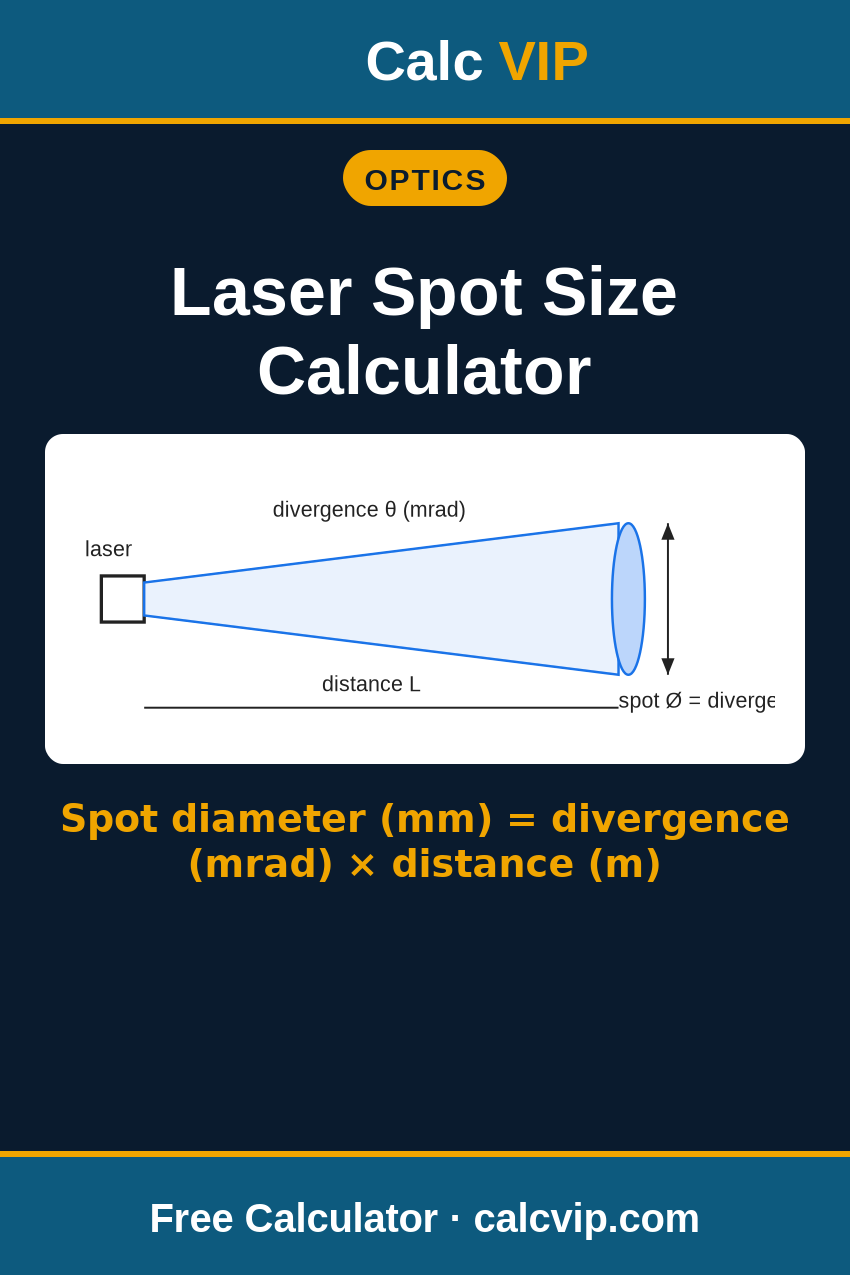
A laser beam is not a geometric line; it is a cone. Even the most parallel-looking beam leaves the aperture with a slight spread — its divergence, measured in milliradians — and from then on geometry takes over: the spot grows by the same amount for every unit of distance travelled. The milliradian is a gift of a unit here, because 1 mrad means exactly 1 mm of growth per metre of travel (1 mm per metre is 1/1000, and a radian's small-angle arithmetic makes the proportion exact for any practical beam). Multiply divergence by distance and you have the spot diameter; the rest of this calculator — area and intensity — is bookkeeping on that one product.
The intensity is where the consequences live. Because the diameter grows in proportion to distance, the illuminated area grows with distance squared, and the same laser power is smeared thinner and thinner: ten times further away means one hundredth of the intensity. This square law explains why a laser pointer that dazzles across a room is a harmless glow on a distant wall, why laser light shows must be carefully terminated, why free-space optical communication links budget their power so anxiously, and why the returning signal from the Moon reflectors is measured in single photons. Spot size is not a cosmetic detail of a laser system; it is the system's power budget written in geometry.
One honest caveat belongs at the start. Real beams leave the laser with a finite starting diameter as well as a divergence, so the true spot is roughly the starting width plus the divergence growth — near the laser, the starting width dominates; far away, the growth swamps it. This calculator computes the growth term, which is the right approximation for the distances lasers are usually projected over, and the worked examples note where the starting width would matter. Within that understanding, the arithmetic below is exact enough to plan experiments, check safety and debunk a few myths about lasers reaching the Moon.
Formula
Spot diameter (mm) = divergence (mrad) × distance (m) • Area = π × (diameter ÷ 2)² • Intensity = power ÷ area
The units work out neatly because a milliradian is 1/1000 of a radian: spreading at 1 mrad adds exactly 1 mm of diameter for every metre travelled. Real beams also start with a small exit diameter, so treat this as the growth of the spot — for long ranges it dominates. The formula rearranges for design work: divergence = spot diameter ÷ distance tells you how good a beam you must buy to hold a given spot at a given range, and distance = spot diameter ÷ divergence tells you how far a beam stays within a target size. Watch the area step: the diameter comes out in millimetres, so convert to centimetres (divide by 10) before squaring for an area in cm², and keep the radius–diameter distinction straight — the area uses the radius, half the diameter, and confusing the two inflates the area fourfold.
| Symbol | Meaning | Units |
|---|---|---|
| θ | beam divergence, full angle | mrad |
| L | distance from laser to target | m |
| D | spot diameter at the target | mm |
| A | spot area, A = π(D/2)² | cm² |
| I | intensity (irradiance) on target, I = P/A | mW/cm² |
Why beams must diverge: diffraction sets the floor
Divergence is not sloppiness in manufacture; it is the wave nature of light collecting its due. A beam confined to a starting width w cannot remain parallel, for the same reason sound spreads from a doorway: confining a wave in one direction spreads it in angle. The tightest possible beam — a perfect Gaussian beam — diverges at roughly θ ≈ λ ÷ (π w₀), where w₀ is the beam's waist radius. For a red pointer beam (λ = 650 nm) squeezed to a 1 mm waist diameter (w₀ = 0.5 mm), the floor is θ ≈ 0.41 mrad: even a theoretically perfect pointer spreads at nearly half a milliradian, giving a 4.1 mm growth over 10 m before any imperfection is added. Real pointers quote 1–2 mrad because their beams are not perfect Gaussians — the beam-quality factor M² measures exactly how many times worse than the diffraction floor a real beam is.
This reframes what "collimated" can honestly mean. Over a bench, a good beam looks parallel; over a kilometre, the diffraction floor alone has grown it by decimetres. Engineers therefore specify beams by their divergence and their waist together, and focus them so the waist sits where the smallest spot is needed: inside the Rayleigh range around the waist (roughly π w₀²/λ, about 1.2 m for that 1 mm red beam) the spot stays near its minimum, and beyond it the cone of this calculator takes over. Every laser application — cutting, surveying, communicating — is a negotiation with this geometry.
How to use
- Enter the beam divergence in milliradians — it is printed in the laser's specification sheet (pointers typically 1–2 mrad, collimated modules often 0.3–1 mrad).
- Enter the distance to the target in metres.
- Optionally enter the laser power in milliwatts to get the intensity on target.
- Click "Calculate Spot Size". Read the diameter in millimetres, the area in cm², and — if you gave a power — the intensity in mW/cm², the quantity safety limits are written in.
Worked examples
Example 1 — the classroom pointer. A laser pointer has divergence 1.5 mrad and shines on a wall 10 m away. Spot diameter = 1.5 × 10 = 15 mm. Spot area = π × (0.75 cm)² = 1.77 cm², so a 5 mW beam gives an intensity of 5 ÷ 1.77 = 2.83 mW/cm². The "dot" students imagine as a point is actually a disc the size of a coin — easy to confirm with a ruler against any lecture-hall wall.
Example 2 — a laser level on a building site. A line laser's point mode has 1 mrad divergence; at a 3 m working distance the spot is 1 × 3 = 3 mm across — small enough to mark a drill point precisely. Stretch the job to a 30 m wall and the same beam gives a 30 mm blob: fine for alignment, useless for marking. The calculator tells you before the ladder work does.
Example 3 — the same pointer, a hundred metres. Take Example 1's pointer to 100 m: the diameter grows to 1.5 × 100 = 150 mm and the area to π × 7.5² = 176.7 cm², so the intensity falls to 5 ÷ 176.7 = 0.028 mW/cm² — exactly one hundredth of the 10 m value, because ten times the distance means a hundred times the area. This inverse-square thinning, not any loss in the air, is what distance does to a beam.
Example 4 — shooting the Moon. Lunar laser ranging stations fire at the Apollo retroreflectors 384,400 km away. With a well-collimated 1 mrad beam the spot would be 0.001 × 384,400 km = 384 km wide — most of the energy missing the metre-sized reflectors by entire counties. Real stations collimate to about 5 µrad (0.005 mrad), shrinking the spot to roughly 1.9 km — still a thousand times wider than the target, which is why the returning signal is a trickle of single photons and the detectors count them one by one.
Example 5 — a surveying beam. A distance-measuring laser with 0.3 mrad divergence aimed at a wall 100 m away paints a spot of 0.3 × 100 = 30 mm. The instrument averages the returns from that disc, so on a slanted wall the reading is an average over a 3 cm patch — surveyors care about this calculator's answer because it sets the spatial honesty of every measurement.
Example 6 — a light-show laser. A 500 mW show laser with 2 mrad divergence projects onto a screen 50 m away: diameter 2 × 50 = 100 mm, area π × 5² = 78.5 cm², intensity 500 ÷ 78.5 = 6.37 mW/cm². Safety officers run exactly this calculation — with the audience's closest distance, not the screen's — to certify that no spectator can be exposed above the legal limit, and it is why show lasers are scanned (a moving spot shares its energy over time) and terminated on surfaces, never on crowds.
Laser spot size in real life
Eye safety classifications. Laser classes are built on how much power can enter a pupil — a 7 mm aperture — which depends directly on spot size and intensity at the eye's distance. The divergence on the datasheet is thus a safety parameter first and a performance parameter second.
Free-space optical links. Rooftop laser communication terminals trade divergence against pointing accuracy: a narrower beam delivers more intensity to the receiver but demands finer tracking. Link budgets are this calculator, run at kilometre distances with microradian beams.
Barcode scanners and optical drives. A scanner's spot must be smaller than the narrowest bar it reads, at the working distance — a divergence specification in disguise. CD and Blu-ray drives focus to micron-scale spots, which is why their "distance" is microscopic and their optics so precise.
Laser cutting and welding. Cutting power means nothing without the spot: a 1 kW beam in a 0.1 mm focus is a plasma torch; the same kilowatt spread over 10 mm is a gentle warmer. Process engineers quote intensity (power per area) — this calculator's third output — as the number that decides what the beam does to metal.
LIDAR. A self-driving car's lidar maps the world one spot at a time; the spot diameter at the target sets the finest detail it can resolve at that range, and the intensity sets whether the return is detectable at all. Both degrade with distance by the rules on this page.
Presentations and astronomy pointing. The lecturer's wandering dot and the astronomer's green pointer beam both obey the product rule; the astronomer's beam appears to "end" in the sky partly because its intensity falls below the eye's threshold as the spot balloons — geometry, not atmosphere, draws the curtain.
Full angle, half angle, and other specification traps
Divergence sounds unambiguous until you read two datasheets side by side. Some quote the full angle of the cone (edge to edge, the convention this calculator uses); some quote the half-angle from axis to edge, which is half the number and makes the beam look twice as good. Some quote the angle containing 1/e² of the power (the Gaussian convention), others the visible edge of the spot, which depends on how bright the room is. Astigmatism adds a final trap: cheap diode pointers diverge differently in the two perpendicular planes, producing elliptical spots that grow into ovals. The defences are simple: confirm which angle a specification states, double a half-angle before entering it here, and for critical work measure the spot at two distances and let this calculator's rearranged form — divergence = growth in diameter ÷ distance travelled — give you the honest number for the beam you actually own.
Quick reference: spot diameter (mm) by divergence and distance
| Divergence | At 1 m | At 10 m | At 100 m |
|---|---|---|---|
| 0.5 mrad (good collimated module) | 0.5 | 5 | 50 |
| 1.0 mrad (typical pointer) | 1 | 10 | 100 |
| 1.5 mrad | 1.5 | 15 | 150 |
| 2.0 mrad (cheap pointer) | 2 | 20 | 200 |
The table's lesson is that at room distances almost any laser looks like a laser; it is at tens of metres that beam quality announces itself. A factor of four in divergence between a cheap and a good pointer is a factor of four in spot size — and a factor of sixteen in intensity — at every distance in the table.
Common mistakes
- Entering a half-angle as if it were the full angle. Some datasheets quote divergence from the axis to the edge. That number must be doubled before use here, or every spot comes out half its true size and every intensity four times too high.
- Using the diameter where the area needs the radius. Area = π r² with r = D/2. Plugging the diameter in as the radius overstates the area — and understates the intensity — by a factor of four, a dangerous direction of error in safety work.
- Mixing millimetres and centimetres in the area step. The diameter formula returns millimetres; the area in cm² needs the radius in centimetres. Skipping the conversion inflates the area a hundredfold.
- Expecting the spot to be the same brightness at any range. Intensity falls as 1/distance² because area grows as diameter². A beam that is intense at 2 m is a hundred times weaker at 20 m, even in perfectly clear air.
- Ignoring the beam's starting diameter at short range. At a metre or two, a beam that exits at 2 mm wide is about 2 mm plus the growth. The calculator gives the growth; for close work add the exit width before judging whether a spot fits a target.
FAQ
Why does the intensity fall so fast with distance?
The diameter grows in proportion to distance, so the area grows with distance squared. Double the range and the same power is spread over four times the area — a quarter of the intensity.
Is divergence the full angle or the half angle?
Datasheets almost always quote the full angle (edge to edge of the cone), and that is what this calculator uses. If a spec gives the half-angle, double it before entering.
Can a laser spot ever stay the same size?
Only within the beam's Rayleigh range, close to a tight focus. Over everyday distances any real beam diverges; even the best-collimated beams spread at a fraction of a milliradian, which is why laser spots on the Moon are kilometres wide.
What divergence do common lasers have?
Laser pointers: typically 1–2 mrad. Collimated diode modules: 0.3–1 mrad. Helium–neon laboratory lasers: around 1 mrad from a sub-millimetre waist, close to their diffraction floor. The theoretical minimum for any beam is set by λ/(π w₀) — wider waists and shorter wavelengths diverge less.
Why does the spot look round up close but fuzzy far away?
Up close you see the beam's exit profile; far away you see its far-field pattern, which for real beams is a soft-edged Gaussian blob rather than a hard disc. The diameter this calculator returns is the working width of that blob — precise enough for area and intensity, which is what matters.
Does air absorb or scatter the beam over long distances?
Slightly, and in fog or dust significantly, but over indoor and most outdoor ranges the dominant loss is geometric spreading — the inverse-square thinning of Example 3. Even in perfectly transparent air the intensity would fall the same way.
Can a lens make the spot smaller at a distant target?
Yes — focusing the beam so its waist lands at the target gives the minimum spot there, at the price of a wider cone on the way. But the waist itself cannot beat the diffraction limit for the lens aperture used: bigger optics, smaller possible spots. This is why lunar ranging stations fire through telescopes.
How do I measure my own laser's divergence?
Measure the spot diameter at two known distances (say 2 m and 10 m), subtract, and divide by the distance between the measurements: divergence (mrad) = (D₂ − D₁ in mm) ÷ (L₂ − L₁ in m). Using the growth rather than a single spot cancels the unknown exit diameter.
Why do safety limits use intensity rather than power?
Because harm depends on how concentrated the power is. Five milliwatts focused to a millimetre spot can injure an eye; the same five milliwatts spread over a square metre cannot warm skin measurably. Power is the budget; intensity — power per area, this calculator's third output — is the dose.
Is the Moon spot really kilometres wide?
Yes. Even the best-collimated beams ever aimed at the Moon spread to kilometre-scale spots (Example 4), because hundreds of thousands of kilometres multiply even microradians into kilometres. The Apollo reflectors return a minuscule fraction of the photons — yet modern stations still count enough of them to measure the Earth–Moon distance to millimetres.