 Calc
Illuminance Calculator – Lux from Luminous Intensity E = I/d²
 Created by David Okafor · Physics Writer · Waves & Light · Last updated: November 2026
Use this free Illuminance Calculator to find how brightly a light source illuminates a surface. Illuminance follows the inverse-square law, E = I / d² — enter the source's luminous intensity in candelas and your distance from it, and the calculator also shows how fast the brightness falls off at double and triple the distance.
Why does a lamp that seems fierce up close feel so feeble across the room? Not because the light tires on the journey, but because it spreads: the same luminous flux paints an ever-larger sphere as it travels, so the amount landing on each square metre thins with the square of the distance. That thinning is illuminance — the density of light arriving at a surface, measured in lux — and its law, E = I/d², is the most consequential equation in lighting design. It decides how high warehouse lights hang, why photographers crowd their lamps towards the subject, and why moving a desk two metres can quarter the light on your book.
The equation's two quantities deserve untangling, because lighting's vocabulary is a swamp. Luminous intensity I, in candelas, describes the source: how much light it sends in the particular direction you care about — a spotlight and a bare bulb of the same wattage have wildly different intensities in the beam direction. Illuminance E, in lux, describes the surface: how much light actually arrives per square metre. Distance is the exchange rate between them, and it is a punishing one: the inverse square means distance is the strongest lever in all of lighting — stronger than any affordable lamp upgrade, as the examples below will show.
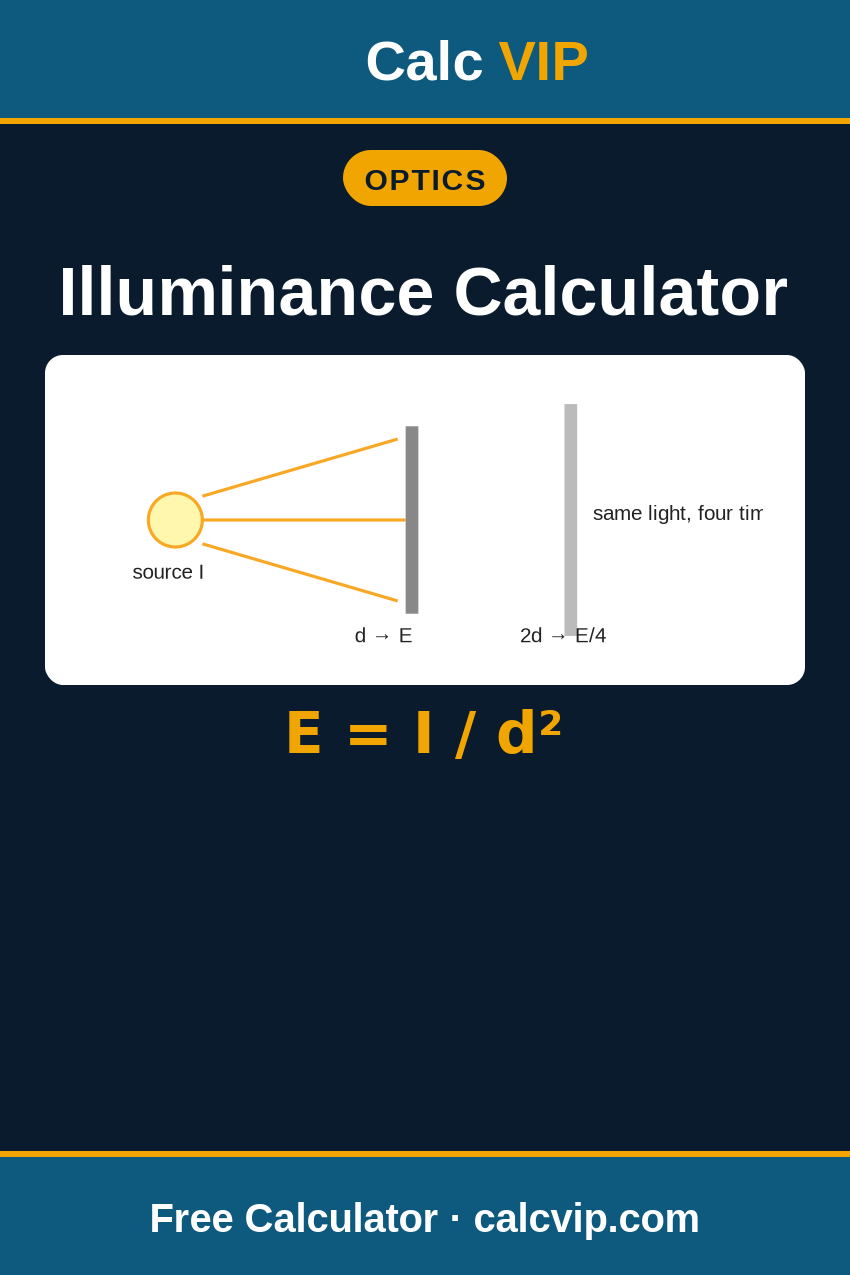
This calculator also prints the fall-off at two and three times your distance, because that table is the law's personality in miniature: 1, 1/4, 1/9. Commit those three numbers to memory and you can estimate the lighting of any room, stage or street in your head. The formula assumes a point source aimed squarely at the surface; the depth sections below handle the two real-world corrections — tilted surfaces (the cosine law) and sources too big or too near to count as points.
Formula
E = I / d² • E in lux (lx), I in candelas (cd), d in metres (m) • rearranged: I = E × d² and d = √(I / E) • tilted surface: E = (I / d²) × cosθ
This assumes a point source shining perpendicularly onto the surface. Because the same light spreads over an area that grows with d², doubling the distance quarters the illuminance and tripling it cuts it to one ninth — the inverse-square fall-off shown in the result table. The rearrangements are the design forms: I = E × d² tells a lighting engineer how strong a source a target brightness demands at a given mounting height, and d = √(I/E) tells a photographer how close a lamp of known intensity must come to deliver a chosen exposure. The cosine factor corrects for surfaces that meet the light at an angle θ from perpendicular — light spread over a tilted surface is diluted by exactly cosθ.
| Symbol | Meaning | Units |
|---|---|---|
| E | illuminance — light arriving per unit area | lux (lx) = lumens per m² |
| I | luminous intensity — light sent per unit solid angle, in your direction | candelas (cd) = lumens per steradian |
| d | distance from source to surface | metres (m) |
| θ | angle between the light's direction and the surface normal | degrees; cosθ factor |
Why the square? Geometry, not decay
Nothing is lost on the journey — that is the first thing to understand about the inverse-square law. Every lumen the source emits is still in flight at any distance (in clean air); it is simply spread over the surface of a growing sphere, whose area is 4πd². The density on that sphere — lumens per square metre, which is lux — therefore falls as 1/d². The same geometry governs gravity, electric fields and sound intensity, and for the same reason: whenever something radiates uniformly into three-dimensional space, its influence is diluted by the area of the sphere it has reached. Illuminance is the photometric member of physics' great inverse-square family.
The candela hides a matching piece of geometry. Intensity is quoted per steradian — per unit of solid angle — because a source does not send its light equally in all directions once reflectors and lenses are involved. A bare 800-lumen bulb spreads its output over all 4π steradians, a modest I ≈ 64 cd in any direction. The same 800 lumens collimated by a spotlight into a tenth of the sky multiplies its intensity in that direction tenfold and more. Lux is where the two geometries meet: the source's per-steradian generosity, diluted by the square of the journey.
How to use
- Enter the luminous intensity of the source in candelas (a typical candle ≈ 1 cd; a bright torch or headlamp can be 100 cd or more in its beam direction).
- Enter your distance from the source in metres.
- Click "Calculate Illuminance" to get E at your distance, plus a fall-off table for 2× and 3× that distance.
- Working the other way — you know the lux you need and the distance — use I = E × d² from the Formula section to size the source before you buy it.
Worked examples
Example 1 — the lamp and the desk. A lamp has a luminous intensity of 100 cd in the direction of a desk 2 m away.
E = I ÷ d² = 100 ÷ 2² = 100 ÷ 4 = 25 lux.
Move the desk to 4 m and the illuminance drops to 100 ÷ 16 = 6.25 lux; at 6 m it is only 100 ÷ 36 = 2.78 lux — the same lamp feels dramatically dimmer just a few steps away.
Example 2 — the original candle. The candela is defined by the candle: I ≈ 1 cd.
At 1 m, E = 1 ÷ 1 = 1 lux. Lean in to half a metre and E = 1 ÷ 0.25 = 4 lux. Even quadrupled, candlelight is two orders of magnitude below office lighting — romance is a low-lux phenomenon, and reading by candlelight strained eyes for millennia for exactly this arithmetic.
Example 3 — a car headlamp. A headlamp's beam peaks around I = 30,000 cd. On the road 25 m ahead:
E = 30,000 ÷ 625 = 48 lux — about living-room brightness, projected a street away. The enormous intensity is not extravagance; it is the inverse-square tax on lighting a road from a bumper.
Example 4 — designing to a target. An office desk should receive 500 lux from a pendant 1.5 m above it. How intense must the source be?
I = E × d² = 500 × 2.25 = 1,125 cd in the downward direction. That number, not the wattage on a box, is the specification a lighting designer works to — and why two "60 W-equivalent" lamps can light the same desk so differently.
Example 5 — placing the lamp. A studio light delivers I = 800 cd in its beam. The photographer wants 100 lux on the subject. How far away should it stand?
d = √(I ÷ E) = √(800 ÷ 100) = √8 = 2.83 m. Closer would overexpose (at 2 m, 200 lux); the square root is the photographer's tape-measure formula, and softboxes exist to soften the contrast this steep gradient creates across a face.
Example 6 — two lamps add. Two lamps of 100 cd each both shine on a desk 2 m from each.
Each alone gives 25 lux (Example 1); together, E = 25 + 25 = 50 lux. Illuminances add — intensities do not merge into one source, but their arrivals at a surface simply sum, which is why lighting design proceeds lamp by lamp and adds the column.
Illuminance in real life
Lighting standards and building codes. Offices are specified at 300–500 lux on the desk plane, corridors near 100 lux, operating theatres far higher with focused sources. Inspectors verify with a lux meter — this equation, embodied in a handheld sensor — and mounting heights are chosen by running I = E × d² for the available fittings.
Photography and film. The inverse-square gradient is the portrait photographer's sculpting tool: a lamp close to the face gives dramatic fall-off across it (near cheek bright, far cheek in shadow) precisely because d changes by a large fraction across the subject. Move the lamp back and the light "flattens" — relative distances converge, and so do the lux values.
Street lighting. The pools of light and dark between street lamps are this equation drawn on tarmac: directly under a lamp the road may see 20 lux while midway between two lamps it dips sharply. Lamp spacing is set by simulating exactly these sums along the road.
Plant growing. Grow lights obey the same law (in its photon-counting cousin, PPFD): halving the lamp-to-canopy distance quadruples the light the leaves receive, which is why indoor growers obsess over hanging height and why a few centimetres of plant growth towards the lamp can scorch the top leaves.
Stage and theatre. Follow-spot operators live inside Example 3: to keep an actor lit at constant brightness while they move, intensity must be ridden continuously against the changing throw — the dimmer curve of a good operator is an analogue inverse-square computer.
Emergency and safety lighting. Escape-route standards demand a minimum of about 1 lux along the centre line of a corridor — the candle's own value from Example 2 — because that is roughly the threshold at which unfamiliar obstacles remain visible to dark-adapted eyes.
Quick reference: fall-off of a 100 cd source
| Distance | Illuminance | Comparable to |
|---|---|---|
| 1 m | 100 lux | comfortable living room |
| 2 m | 25 lux | dim corridor |
| 3 m | 11.11 lux | well-lit street |
| 5 m | 4 lux | twilight feel |
| 10 m | 1 lux | emergency lighting level |
Ten metres costs a factor of a hundred — the whole table is the number 1/d² wearing different distances, and it is why "just move the lamp closer" outperforms almost every other lighting intervention.
Tilted surfaces and big sources: the two corrections
Real surfaces rarely face their lamps squarely. Light arriving at angle θ from the normal spreads over 1/cosθ times the area, so E falls by cosθ — Lambert's cosine law. The desk of Example 1 (25 lux square-on) tilted to 60° receives 25 × cos60° = 12.5 lux; at grazing angles the illuminance dies away entirely, which is why low sun barely lights a vertical wall it shines along. The second correction concerns the source's size: E = I/d² assumes a point. A large panel at close range is better modelled as many points whose contributions sum to a gentler fall-off — near a big softbox or a fluorescent ceiling the drop is closer to inverse-linear, or slower still. The working rule: the point formula is trustworthy once you are about five times farther away than the source is wide; inside that range, treat its answers as upper estimates and measure with a lux meter.
From lux to camera exposure
Photographers meet illuminance through the exposure value. An incident-light meter is a lux meter with a logarithmic scale: at ISO 100, the exposure value satisfies E ≈ 2.5 × 2EV lux. Bright sunlight (EV 15) therefore corresponds to 2.5 × 32,768 ≈ 82,000 lux — squarely in the daylight range of the diagram above; a heavily overcast day (EV 10) is 2.5 × 1,024 = 2,560 lux; a dim living room (EV 6) is 2.5 × 64 = 160 lux. The chain runs both ways: measure the lux with this equation's logic and the meter hands you shutter and aperture; or read a scene's EV and you know its illuminance to within the accuracy photographers have trusted for a century. It is the same physics wearing a logarithmic coat, because cameras — like eyes — respond to ratios, not differences.
Common mistakes
- Confusing lumens with candelas. A bulb's box quotes total lumens; this formula wants intensity in your direction. An 800 lm bare bulb has I ≈ 64 cd spread over all directions — but the same lumens in a spotlight could be 2,000 cd in the beam. Using 800 as I overstates the lux thirteen-fold in the first case.
- Expecting brightness to halve when distance doubles. It quarters. The square is the whole content of the law; linear intuition is wrong by a factor of two at every doubling, compounding mercilessly.
- Forgetting the surface tilt. A lux figure assumes the surface faces the source. Desks under pendants are fine; sloped drafting boards, walls and roads at glancing angles need the cosθ factor.
- Applying the point-source formula at point-blank range. Half a metre from a metre-wide panel, the formula overestimates wildly. Respect the five-times-size rule, or measure.
- Adding intensities instead of illuminances. Two lamps do not make one lamp of summed candelas at a surface unless they share a position and direction; what adds at the surface is each lamp's own E, computed with its own distance (Example 6).
FAQ
How many lux do I actually need?
Rough guides: a living room feels comfortable around 100–200 lux, office desks and reading are usually lit to 300–500 lux, and detailed work may use 750 lux or more. Full daylight outdoors is 10,000 lux and up — indoor lighting is far dimmer than we tend to assume.
What is the difference between candelas, lumens and lux?
Lumens measure the total light a source emits in all directions. Candelas measure how concentrated that light is in one direction (lumens per steradian). Lux measure what actually arrives: lumens landing on each square metre of surface. This calculator links the last two through distance.
Does the formula work for a big light panel close up?
Only approximately. E = I/d² assumes a point source, which is a good model once you are several times farther away than the source's own size. Very close to a large panel the fall-off is gentler than inverse-square.
How do I convert a bulb's lumens into candelas?
For a bulb radiating equally in all directions, divide the lumens by 4π (the steradians in a sphere): an 800 lm bulb gives I ≈ 800 ÷ 12.57 ≈ 63.66 cd, hence about 15.92 lux at 2 m. For directional lamps, the manufacturer's beam candela figure is the honest input — reflectors break the equal-spread assumption completely.
Why does the Sun not follow "dimmer with distance" in daily life?
It does — but Earth's orbit changes d by only about ±1.7% across the year, a ±3.4% illuminance wobble lost under weather and seasons. Across planetary distances the law is naked: sunlight at Mars is under half Earth's strength, and at Neptune about a thousandth.
What is a lux meter actually measuring?
The same quantity this calculator computes: lumens per square metre arriving at its sensor, weighted by the human eye's sensitivity curve (that weighting is what makes photometric units — lux, lumens, candelas — "perceived" rather than raw radiometric watts).
Does illuminance depend on the surface colour?
No — E describes the light arriving, not what the surface does with it. What you see is luminance, which folds in the surface's reflectance: a white desk and a black desk under the same 500 lux differ enormously in brightness while receiving identical illuminance.
How far away is "far enough" for the point-source rule?
About five times the source's largest dimension is the standard rule of thumb. Beyond it, errors shrink below a few percent; the calculator's fall-off table then describes reality closely, as anyone who has paced a corridor with a lux meter can confirm.
Can illuminance be too high?
Yes — glare is excessive illuminance arriving at the eye from the wrong direction, and over-lit spaces waste energy and flatten modelling. Good lighting design specifies a target band, not a maximum: the standards behind Example 4's 500 lux desk exist at both ends.
Why do photographers say "inverse-square" like a warning?
Because it punishes small errors near the lamp: at 1 m, stepping 25 cm closer raises E from I to I ÷ 0.75² — a 78% jump. Close lights are powerful and treacherous in equal measure; distant lights are weak but forgiving. The whole craft of lighting ratios is negotiating with this equation.