 Calc
Latent Heat Calculator – Q = mL for Melting, Boiling & Condensing
 Created by Anna Kowalski · Physics Editor · Heat & Atoms · Last updated: November 2026
Use this free Latent Heat Calculator to find the energy needed to melt, freeze, boil or condense a substance without changing its temperature, using Q = mL. Pick a change of state to fill in the latent heat, or type your own value.
Latent means hidden, and the heat on this page is exactly that: energy that flows into a substance and produces no rise in temperature at all. Warm ice and it climbs steadily to 0 °C — then stops, thermometer frozen, while joule after joule pours in, until the last crystal melts. Only then does the temperature resume its climb. The hidden heat has not vanished; it has been spent on the architecture of the material itself, prising particles out of the rigid lattice of the solid into the loose company of the liquid. Q = mL is the price list for that demolition: m kilograms, at L joules per kilogram, for whichever change of state you are buying.
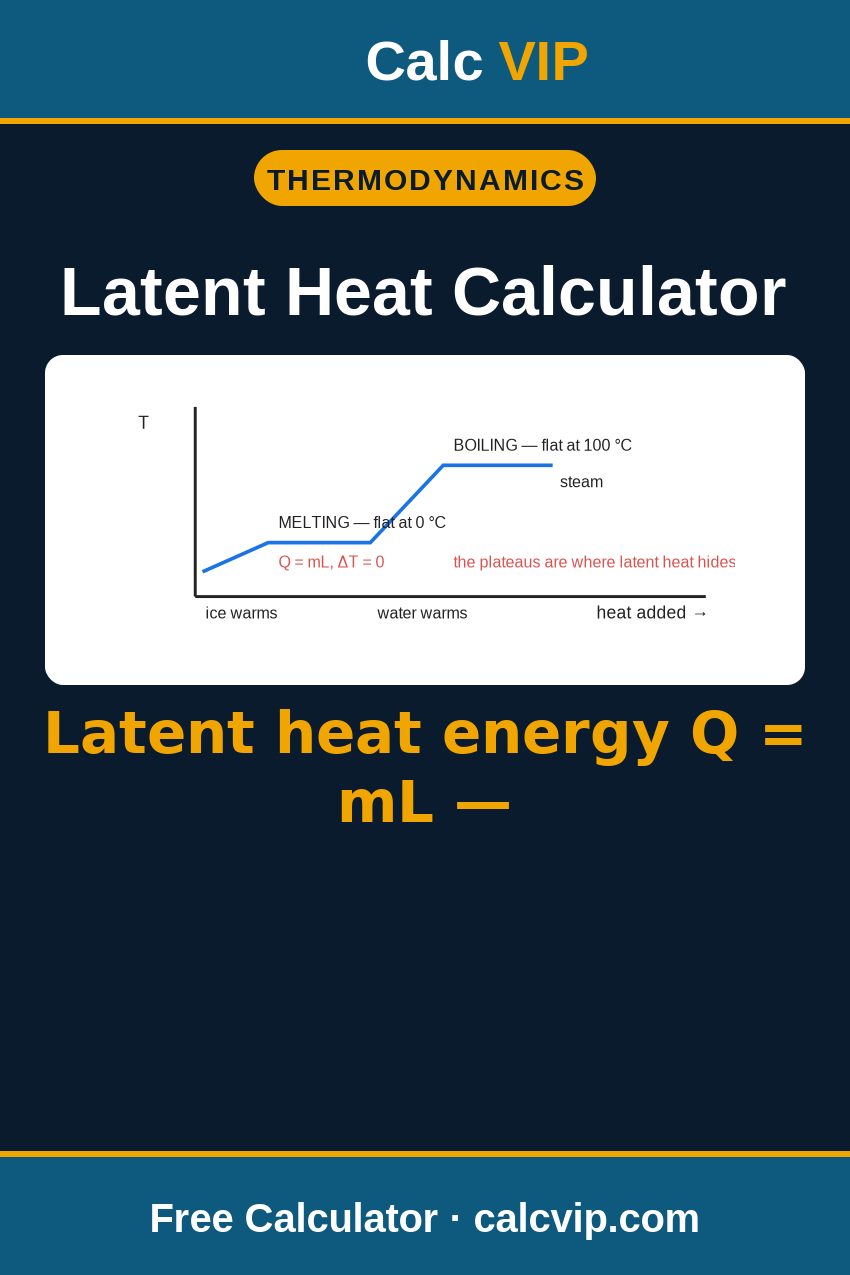
The two great price tags differ enormously, and the difference runs much of the weather and most of cooking. Melting merely loosens: particles keep their neighbours but gain the freedom to slide. Boiling evicts: every particle must be torn completely away from its fellows and launched into the gas, and for water that costs 2,260,000 J/kg — about 6.8 times the 334,000 J/kg charged for melting ice. It takes more energy to boil a kilogram of water away than to heat that same water from freezing to boiling five times over. Latent heat is not a footnote to heating; for phase changes it is the main event, and this calculator exists because the sensible-heat formula Q = mcΔT is blind to it — at a plateau, ΔT is zero while the energy bill is enormous.
Every transaction on this page runs in both directions at the same price. Freezing water releases exactly the 334,000 J/kg that melting absorbed, which is why orchardists spray water on blossoms before a frost — the freezing water pays out latent heat and holds the buds at 0 °C. Condensing steam releases the full 2,260,000 J/kg, which is why steam scalds so cruelly and why condensing boilers and power-station condensers move such rivers of energy. Choose a preset or type any L of your own, give the calculator a mass, and it returns the energy absorbed — or, read backwards, released — by the change of state.
Formula
Latent heat energy Q = mL — where m is the mass (kg) and L is the specific latent heat (J/kg): the energy needed to change the state of 1 kg of the substance at constant temperature. Use the fusion value for melting/freezing and the vaporisation value for boiling/condensing.
Two rules govern the formula's use. First, it applies only while the change of state is actually happening — the substance must be sitting at its melting or boiling point; before and after the plateau, temperature changes are charged separately by Q = mcΔT, and a complete journey from cold solid to hot gas is a sum of alternating mcΔT slopes and mL plateaus, as the heating-curve diagram above shows. Second, L is a property of the substance and the change, not of the occasion: the same 334,000 J/kg melts ice in a drink, a glacier or a laboratory. Rearranged, the formula also runs a laboratory: measure the energy a change of state absorbs and L = Q/m identifies the substance, and given a heater's power, the time a plateau will last is t = mL/P — which is why a kettle takes so long to boil dry.
| Symbol | Meaning | Units |
|---|---|---|
| Q | energy absorbed (or released) by the change of state | J |
| m | mass changing state | kg |
| L | specific latent heat of the substance for that change | J/kg |
| Lf | specific latent heat of fusion (melting/freezing) | J/kg |
| Lv | specific latent heat of vaporisation (boiling/condensing) | J/kg |
Where the heat hides: paying for separation
Temperature measures the kinetic energy of particles — how fast they jiggle. Potential energy, the energy stored in the attractions between particles, is the thermometer's blind spot, and a change of state is a pure potential-energy transaction. In ice, every water molecule is locked into a crystal by hydrogen bonds, each bond a small debt of energy. Melting pays off part of that debt: the lattice collapses, molecules tumble past one another, but they remain close, still loosely holding hands. The kinetic energy — the temperature — need not change at all while the debt is settled, which is precisely why the thermometer stalls on the plateau: every joule is being banked as potential energy, invisible to any instrument that reads only motion.
Boiling settles the entire account. To become a gas, a molecule must escape its neighbours completely, ending up hundreds of molecular diameters from the nearest companion, all attractions stretched to nothing. That full separation is what the 2,260,000 J/kg buys, and it explains at a glance why Lv dwarfs Lf for every substance: melting is a rearrangement of the furniture, boiling is an eviction. It also explains the enormous volume change — the same kilogram that filled a litre as water fills some 1,600 litres as steam at atmospheric pressure — and why a sealed container of boiling liquid is a pressure hazard: the evicted particles batter the walls from a space far too small for them.
Run the film backwards and the accounting reverses with it. Condensing steam settles back into the liquid and the separation energy is refunded, in full, as heat dumped into whatever the steam touched — skin, a radiator, a power station's cooling water. Freezing refunds the smaller fusion sum the same way. Nothing in Q = mL prefers a direction; the formula is a price, and prices are paid by whichever side is changing state. Much of technology — refrigeration, distillation, heat pipes, even the weather — is the art of scheduling those payments.
How to use
- Pick the change of state to fill in L automatically, or choose Custom and type your own value.
- Enter the mass in kilograms.
- Click "Calculate Latent Heat Energy" to get Q in joules and kilojoules.
- For freezing or condensing, read the same number as energy released rather than absorbed — the price is identical in both directions.
- If the substance must also warm up or cool down before or after changing state, add those parts separately with Q = mcΔT.
Worked examples
Example 1 — melting ice. How much energy is needed to melt 0.5 kg of ice at 0 °C? (L = 334,000 J/kg)
Q = 0.5 × 334,000 = 167,000 J = 167 kJ — and the water formed is still at 0 °C.
Example 2 — boiling water away. A kettle boils off 0.2 kg of water already at 100 °C (L = 2,260,000 J/kg).
Q = 0.2 × 2,260,000 = 452,000 J = 452 kJ — nearly three times the energy of Example 1, for less than half the mass. Vaporisation is the expensive change.
Example 3 — the steam burn, priced. Just 0.05 kg of steam (50 g) condenses on skin.
Q released = 0.05 × 2,260,000 = 113,000 J = 113 kJ — and that is before the condensed water, now at 100 °C, cools further on the skin. Fifty grams delivering 113 kJ is why steam injuries are so disproportionate to the amount of steam involved.
Example 4 — casting aluminium. A foundry melts 2 kg of aluminium already at its melting point (L = 397,000 J/kg).
Q = 2 × 397,000 = 794,000 J = 794 kJ just for the change of state — the energy to heat the cold metal up to the melting point in the first place is a separate mcΔT bill on top.
Example 5 — freezing water for an ice rink. A rink freezes 1.5 kg of water per square metre in its top layer (the arithmetic scales by area).
Q released = 1.5 × 334,000 = 501,000 J = 501 kJ per square metre that the refrigeration plant must carry away — freezing is melting with the energy flowing out, and someone has to pay to remove it.
Example 6 — the full journey, ice cube to steam. Take 0.5 kg of ice at 0 °C and turn it into steam at 100 °C. Melt: 0.5 × 334,000 = 167,000 J. Warm the water 0 → 100 °C: 0.5 × 4186 × 100 = 209,300 J. Boil: 0.5 × 2,260,000 = 1,130,000 J.
Total = 167,000 + 209,300 + 1,130,000 = 1,506,300 J ≈ 1.51 MJ — of which the two plateaus contribute over 86%. Where a journey crosses a phase change, latent heat is the fare; the warming is the small change.
Latent heat in real life
Sweating: your personal phase change. Evaporating sweat is vaporisation run on skin. Each kilogram of sweat that evaporates carries off about 2,260 kJ of body heat — which is why humid days feel so oppressive: when the air is already saturated, the evaporation stalls, the latent heat stays in you, and the cooling system fails with the water still on your skin.
Hurricanes run on condensing vapour. Over warm oceans, water evaporates absorbing latent heat; rising and cooling, it condenses into cloud, refunding that heat into the air and powering the storm's updrafts. A hurricane is, energetically, a machine for moving latent heat from sea surface to upper atmosphere — the phase change is not a detail of the storm, it is the engine.
Frost protection by spraying water. It sounds backwards — wetting crops before a frost — but as the sprayed water freezes on the blossoms it releases 334 kJ/kg, pinning the tissue at 0 °C through the coldest hours. Growers are not insulating the fruit; they are hiring freezing water as a tiny, self-regulating heater, paid in latent heat.
Why ice cools a drink better than cold water. A kilogram of ice at 0 °C and a kilogram of water at 0 °C enter the same warm drink. The water can only warm up, absorbing 4,186 J per degree. The ice must first melt — absorbing 334,000 J before its temperature can move at all — then warm as water too. Ice is not colder; it is carrying a latent-heat reservoir the water has already spent.
Steam heating and district systems. Steam is a superb delivery van for energy precisely because of Lv: a kilogram of steam arriving at a radiator drops off 2,260 kJ by condensing, then leaves as water to be reboiled. Factories and city districts moved heat this way for a century because no pumped hot-water loop carries so much energy per kilogram.
Phase-change materials in buildings. Modern wallboards and ceiling tiles are impregnated with waxes that melt near room temperature (Lf in the hundreds of kJ/kg). Through a hot afternoon the material melts, absorbing heat at constant temperature; overnight it freezes and refunds it. It is Example 1 built into the walls — thermal mass without the mass, courtesy of Q = mL.
The full journey: slopes and plateaus together
Real heating problems are itineraries, and Example 6 is the template: list the legs of the journey in order, charge each warming leg with Q = mcΔT (using the c of the substance in that state — ice 2,100, water 4,186, steam about 2,000 J/kg·°C) and each plateau with Q = mL, then add. For 1 kg taken from ice at −10 °C all the way to steam at 100 °C the bill reads: warm the ice, 1 × 2,100 × 10 = 21,000 J; melt it, 334,000 J; warm the water, 1 × 4,186 × 100 = 418,600 J; boil it, 2,260,000 J — a total of 3,033,600 J ≈ 3.03 MJ, of which the two plateaus are 2,594,000 J, about 86%. The final boil alone costs more than everything before it combined. Any process that crosses a vaporisation plateau — distillation, drying, steam raising — is dominated by that single line, and energy-saving efforts that ignore it are polishing the small change.
Quick reference: specific latent heats
| Substance & change | L (J/kg) | Note |
|---|---|---|
| lead — fusion | 24,500 | melts cheaply — a soft, weakly bonded metal |
| silver — fusion | ≈ 105,000 | jewellers melt it with modest burners |
| copper — fusion | ≈ 209,000 | foundry furnaces budget for this line |
| iron — fusion | ≈ 247,000 | part of steelmaking's huge energy bill |
| water — fusion | 334,000 | high for its mass — hydrogen bonds to break |
| aluminium — fusion | 397,000 | recycling still pays this per kilogram |
| water — vaporisation | 2,260,000 | the giant of the table — weather, steam, sweat |
The pattern in the numbers is the particle story of the concept section: fusion prices cluster within a factor of twenty of each other, because melting is a similar loosening everywhere; vaporisation, the full eviction, costs far more wherever it is charged. Water tops both lists because its hydrogen bonds are unusually strong for such a light molecule.
Common mistakes
- Charging mcΔT during the plateau. While a substance is melting or boiling, ΔT = 0 — yet the energy flow is at its largest. Students who reach for Q = mcΔT at a phase change compute zero and miss the entire bill. Plateaus are priced by mL, slopes by mcΔT; a complete journey needs both, in the right places.
- Using the fusion value for a boiling problem (or vice versa). Water's two L values differ by a factor of about 6.8. Grabbing 334,000 for a boiling calculation understates the energy nearly sevenfold — the difference between a kettle that boils dry in minutes and one that takes the evening.
- Expecting the thermometer to move. A mixture of ice and water stays at 0 °C until the last ice melts, however fierce the flame beneath it — the flame only shortens the plateau, it does not raise the temperature.
- Forgetting the reverse journey releases the heat. Condensation and freezing are not free: the same Q comes back out. Designs that condense steam must dispose of 2,260 kJ/kg somewhere; gardeners who forget the freezing refund misjudge both frost damage and frost protection.
- Mixing joules and kilojoules for L. Tables quote L in J/kg, kJ/kg and sometimes MJ/kg. 334 kJ/kg and 334,000 J/kg are the same price; entering "334" into a joules calculation shrinks the answer a thousandfold. Check the unit on the value before the mass goes anywhere near it.
FAQ
Why doesn't the temperature change during melting or boiling?
All the incoming energy goes into breaking the bonds between particles instead of speeding them up. Only once the change of state is complete does extra heat start raising the temperature again.
Why is the latent heat of vaporisation so much bigger than fusion?
Melting only loosens the particles; boiling must separate them completely against their attractions, which takes far more energy — for water, 2,260,000 J/kg compared with 334,000 J/kg for melting.
Does the same Q = mL work for freezing and condensing?
Yes, with the same L values — but the energy is released by the substance instead of absorbed. That is why steam burns are so severe: condensing steam dumps its huge latent heat into the skin.
What does "latent" actually mean?
Hidden — the word is Latin. The heat is hidden from the thermometer: it flows in (or out) without any temperature change, stored instead in the arrangement of the particles. Joseph Black, who worked the idea out in the 1760s, chose the name because the heat seemed to vanish into the substance and reappear, unchanged in amount, when the change reversed.
Why does ice feel like it cools a drink for so long?
Because melting is slow-motion spending. As long as any ice remains, the drink is pinned near 0 °C and every joule leaking in from the room is consumed by melting at 334 kJ/kg rather than by warming the drink. A big latent reservoir at a fixed temperature is exactly a thermostat — one reason ice, not cold water, is the drink-cooler of choice.
Can a liquid evaporate without boiling — and does it cost latent heat?
Yes and yes. Evaporation is the escape of the fastest surface molecules at any temperature, and each escapee carries the vaporisation price with it, which is why a puddle dries on a cool day and why evaporation cools what is left behind — the average energy of the remaining molecules has fallen. Boiling is the same escape happening throughout the liquid at once, at one fixed temperature.
Does pressure change the latent heat?
Slightly. L values are quoted at atmospheric pressure; squeeze or evacuate and the boiling point moves (down in the mountains, up in a pressure cooker), and L shifts a little with it — water's Lv falls as the boiling temperature rises, vanishing altogether at the critical point (374 °C), where liquid and gas merge and there is no change of state left to pay for. For kitchen and school purposes the standard values stand.
What is sublimation, and what does it cost?
The direct jump from solid to gas — dry ice fogging, frost vanishing on a cold dry morning, freeze-drying coffee. Its latent heat is roughly the sum of fusion and vaporisation, since the particle must pay both the loosening and the eviction in one step. The calculator handles it with a custom L: for dry ice, about 571,000 J/kg.
How long will a kettle take to boil completely dry?
Divide the plateau energy by the power: t = mL/P. For 0.5 kg of water at 100 °C on a 2,000 W element, t = 1,130,000/2,000 = 565 s — about nine and a half minutes of furious boiling after the water reaches 100 °C. It is the same arithmetic that sizes industrial evaporators and explains why a forgotten kettle is a genuine hazard.
Why is water's latent heat so unusually large?
Hydrogen bonds. Each water molecule is gripped by its neighbours with attractions far stronger than the forces in most liquids of similar size, so both loosening (fusion) and eviction (vaporisation) are expensive. The consequences are planetary: oceans buffer climate by absorbing and releasing latent heat on a colossal scale, and storms are powered by it, as the applications above describe.