 Calc
Internal Energy Calculator – U = (3/2)nRT & (5/2)nRT for Ideal Gases
 Created by Anna Kowalski · Physics Editor · Heat & Atoms · Last updated: November 2026
Use this free Internal Energy Calculator to find the internal energy U of an ideal gas. For a monatomic gas U = (3/2)nRT; for a diatomic gas (which also rotates) U = (5/2)nRT. Enter the moles and the temperature in kelvin, using R = 8.314 J/(mol·K).
Internal energy is the gas's private energy account: the sum of every molecule's kinetic energy — flying, spinning and (at high temperatures) vibrating — with nothing else added. Not the motion of the container, not the height of the shelf it sits on, not any flow or pressure energy: just the microscopic commotion inside. For an ideal gas that account has a startlingly simple balance. Because the model molecules exert no forces on each other, there is no potential energy to count, so the entire internal energy is kinetic — and kinetic energy per molecule is fixed by temperature alone. Volume, pressure and history are irrelevant. Temperature is the whole story.
The factor in front of nRT counts the ways a molecule can move. A single atom can only translate — three directions, three degrees of freedom, each holding ½RT per mole — hence (3/2)nRT. A diatomic molecule adds two rotational axes, reaching (5/2)nRT. This is the equipartition theorem at work: at equilibrium, every quadratic degree of freedom holds the same average energy, ½kT per molecule. It is one of the deepest bookkeeping rules in physics, and this calculator is its simplest expression.
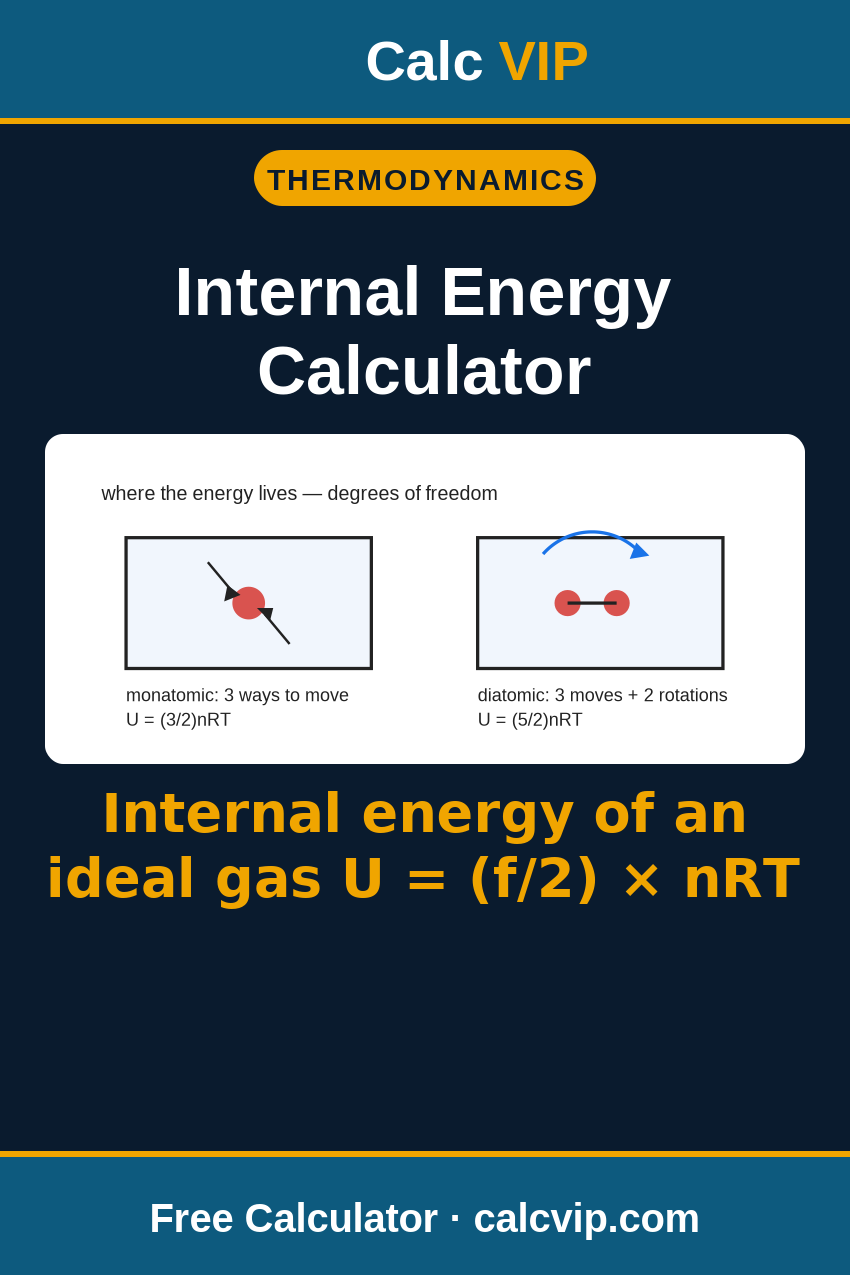
Because U depends only on T for an ideal gas, the change in internal energy is equally simple: ΔU = (f/2)nRΔT. Heat a sealed rigid can of gas and every joule you add shows up here; let the gas expand isothermally and ΔU is exactly zero no matter how much heat flows through. That one fact — ΔU = 0 for any isothermal change of an ideal gas — quietly powers half the reasoning in thermodynamics, from the first law to the efficiency of engines.
Formula
Internal energy of an ideal gas U = (f/2) × nRT • U in joules, n in moles, T in kelvin, R = 8.314 J/(mol·K)
The change form is the one thermodynamics actually uses: ΔU = (f/2)nRΔT. For a monatomic gas f = 3 and the formula becomes U = (3/2)nRT; for a diatomic gas at room temperature f = 5 and U = (5/2)nRT. Per molecule the same statement reads U/N = (f/2)kT with Boltzmann's constant k — the two forms differ only in whether you count molecules or moles. Notice what is absent: no V, no P. Spread an ideal gas into twice the volume at the same temperature and U does not change by a single joule, a fact Joule verified experimentally in 1845 when his freely expanding gas refused to cool. This calculator reports U in joules and kilojoules for the two standard gas types.
| Symbol | Meaning | Units |
|---|---|---|
| U | internal energy — total microscopic kinetic energy | joules (J) |
| f | degrees of freedom — 3 monatomic, 5 diatomic | — |
| n | amount of gas | moles (mol) |
| R | gas constant, 8.314 | J/(mol·K) |
| T | absolute temperature | kelvin (K) |
Degrees of freedom: where the 3/2 and 5/2 come from
Equipartition says that in thermal equilibrium, energy is shared democratically: every independent quadratic way of storing it receives ½kT per molecule on average. A point atom has three — motion along x, y and z. A dumbbell molecule keeps those three and adds rotation about the two axes perpendicular to its bond; spinning about the bond itself counts for almost nothing, because the mass sits nearly on that axis. Five halves make (5/2)kT per molecule, (5/2)RT per mole. The bond can also vibrate, which would add two more shares (kinetic plus potential), but at room temperature quantum mechanics keeps that door mostly shut: the vibrational energy steps are too large for typical collisions to climb, so the mode is "frozen out".
Heat the gas far enough and the picture changes in steps. Hydrogen's rotations freeze below about 85 K, dropping it toward monatomic behaviour; above roughly 1,000 K vibrations wake up and f climbs toward 7. This is why real heat capacities drift with temperature while the textbook values — the ones this calculator uses — hold in the comfortable middle range where most problems live. The degrees-of-freedom count is also the bridge to the heat capacities: CV = (f/2)R, CP = CV + R, and their ratio γ = CP/CV is exactly the γ that governs adiabatic changes — 5/3 ≈ 1.67 monatomic, 7/5 = 1.40 diatomic.
How to use
- Choose the gas type: monatomic (helium, neon, argon — single atoms) or diatomic (nitrogen, oxygen, hydrogen — two-atom molecules, including air).
- Enter the amount of gas in moles.
- Enter the absolute temperature in kelvin (°C + 273.15).
- Click "Calculate Internal Energy" to get U in joules and kilojoules. For a temperature change, compute U at both temperatures and subtract — or equivalently apply ΔU = (f/2)nRΔT directly.
Worked examples
Example 1 — two moles of helium-like gas. Find U for 2 mol of a monatomic gas at 300 K:
U = (3/2) × 2 × 8.314 × 300 = 7,482.6 J = 7.48 kJ. The same amount of a diatomic gas would hold (5/2)nRT = 12,471 J, because its molecules also store energy in rotation — 67% more energy at the very same temperature.
Example 2 — one mole at the freezing point. For 1 mol of monatomic gas at 273 K: U = 1.5 × 1 × 8.314 × 273 = 3,404.58 J. Even at the temperature of melting ice, a mole of gas carries three and a half kilojoules of microscopic motion.
Example 3 — five moles of hot air. Treat air as diatomic: 5 mol at 400 K holds U = 2.5 × 5 × 8.314 × 400 = 41,570 J = 41.57 kJ. That is roughly the energy in a gram of sugar, stored invisibly as molecular motion.
Example 4 — a change, not a state. Heat 3 mol of monatomic gas from 300 K to 500 K at constant volume: ΔU = (3/2) × 3 × 8.314 × 200 = 7,482.6 J. Because the volume is fixed, no work is done, so by the first law all 7,482.6 J must have arrived as heat — this is the working principle of the constant-volume heat capacity.
Example 5 — a little very hot helium. Half a mole of He at 1,000 K: U = 1.5 × 0.5 × 8.314 × 1,000 = 6,235.5 J. A quarter of the gas in Example 1 holds nearly the same energy, because temperature beats quantity: U is proportional to both, and here the 3.3× temperature nearly cancels the 4× reduction in moles.
Example 6 — the air in a room. A 50 m³ room at 293 K and atmospheric pressure holds about n = PV/RT ≈ 2,080 mol of air. As a diatomic gas its internal energy is U = 2.5 × 2,080 × 8.314 × 293 ≈ 12,665,625 J ≈ 12.7 MJ — the energy of about 3.5 kWh of electricity, sitting unnoticed in the air of one room. It cannot be "used" without a colder reservoir, but it is very much there.
Internal energy in real life
Why a bicycle pump warms up. Compressing air quickly is nearly adiabatic: the work you do has nowhere to go but into U, so ΔU = (f/2)nRΔT shows up as a temperature rise you can feel on the barrel.
Pressure cookers and sealed cans. In a rigid container ΔV = 0, so added heat goes entirely into U and temperature — and via the gas law, into pressure. The whole safety design of pressure vessels is this formula with margins.
Weather in a parcel of air. Rising air expands against falling pressure, spends internal energy doing it, and cools — the adiabatic lapse rate that makes mountaintops cold and drives cloud formation is ΔU bookkeeping on a planetary scale.
Calorimetry of gases. Measuring CV is measuring the slope of U against T. The table value for helium, 12.47 J/(mol·K), is (3/2)R to three figures — equipartition you can verify with a heater and a thermometer.
Stars and plasmas. A star's thermal energy content is its (f/2)nRT summed over its whole mass; the balance between that store and radiation losses sets how fast stars evolve. The ideal-gas version is the first estimate astrophysicists reach for.
Why "heat content" is a slippery phrase. A system does not contain heat — it contains internal energy. Heat is the transfer. Keeping the two apart, which this formula forces you to do, prevents a whole family of first-law sign errors.
Beyond gases: internal energy in solids and liquids
The gas formula is a special case of a wider pattern. In a solid, each atom is bound in a lattice and vibrates about its site — three directions of motion, each with kinetic and potential energy, six quadratic shares in all. Equipartition therefore predicts U ≈ 6 × (1/2)nRT = 3nRT per mole of atoms, and a molar heat capacity near 3R ≈ 24.94 J/(mol·K) — the Dulong–Petit rule, which indeed matches most metals at room temperature (aluminium 24.2, copper 24.4, iron 25.1 J/(mol·K)) with embarrassing accuracy for an 1819 law. It fails, instructively, exactly where quantum mechanics bites: diamond's stiff bonds freeze its vibrations and its heat capacity collapses to about 6 J/(mol·K), and at low temperatures every solid's capacity falls toward zero as T³, a fact classical physics could never explain and Einstein's quantum model of the solid first did.
Liquids sit between the two pictures — molecules jostle in temporary cages, translating, rotating and storing potential energy in their attractions — which is why liquid heat capacities are empirical numbers rather than clean fractions of R, and why a liquid's internal energy does depend on volume: pull the molecules apart and you pay their attractions. The ideal gas is the lucky case where the account has one entry. This calculator's restriction to gases is not a limitation of effort; it is the boundary of where a one-line formula can be exact.
From U to heat capacities and γ — one family of numbers
Internal energy is the parent quantity of the whole thermodynamics family tree. Differentiate it at constant volume and you get CV = (f/2)R: 12.47 J/(mol·K) for monatomic gases, 20.79 for diatomic. Add the expansion work a gas does when heated at constant pressure and you get CP = CV + R: 20.79 and 29.10 J/(mol·K). Divide them and γ falls out: 1.67 and 1.40 — the same γ that appears in the adiabatic relation P₁V₁γ = P₂V₂γ and sets the steepness of every adiabatic curve. One integer, f, generates the lot. That is why a measurement of any one of these quantities — a heat capacity, a γ from a sound-speed measurement, an adiabatic exponent — is effectively a measurement of how many ways the molecule can move.
Put the family to work on one concrete comparison. Heat 1 mol of a diatomic gas from 300 K to 400 K. In a rigid vessel, ΔU = (5/2)R × 100 = 2,078.5 J, and every joule arrives as heat: Q = 2,078.5 J. At constant pressure the same ΔU is required — U answers to temperature only — but the gas also expands and does W = nRΔT = 831.4 J of work, so the heat bill rises to Q = ΔU + W = 2,909.9 J. The difference between the two heat bills, 831.4 J, is exactly R per mole per kelvin — the origin of CP − CV = R, computed end-to-end from this page's one formula.
Quick reference: U per mole at common temperatures
| Temperature | Monatomic U (J/mol) | Diatomic U (J/mol) |
|---|---|---|
| 100 K | 1,247.1 | 2,078.5 |
| 273 K | 3,404.58 | 5,674.31 |
| 300 K | 3,741.3 | 6,235.5 |
| 500 K | 6,235.5 | 10,392.5 |
| 1,000 K | 12,471 | 20,785 |
The diatomic column is always exactly 5/3 of the monatomic one — the ratio of the two degree-of-freedom counts, visible in every row.
Use the table for the fastest estimate in the subject: the internal energy of any ideal gas sample is its per-mole figure, scaled by the number of moles and corrected by the ratio of temperatures. Ten moles of argon at 600 K hold 10 × 2 × 3,741.3 = 74,826 J — the 300 K row, doubled for temperature and multiplied by moles, with no new formula required. Proportionality is the whole structure of U, and the table is that structure printed out.
Common mistakes
- Putting volume or pressure into U. For an ideal gas there is no such term. If a problem doubles the volume at constant T, ΔU is zero, however much work or heat flowed.
- Using Celsius. U is proportional to absolute temperature. 27 °C is 300 K; using 27 understates U elevenfold.
- Using f = 5 for helium or f = 3 for air. Single atoms cannot rotate: noble gases are f = 3. Air is diatomic: f = 5. Swapping them changes answers by 67%.
- Calling U "the heat in the gas". U is a state property; heat is a transfer. A gas can gain U by being compressed with no heat flowing at all.
- Forgetting that real gases bend the rule. Real molecules attract each other slightly, so real-gas U depends weakly on volume too. The ideal formula is excellent at ordinary densities and visibly approximate near condensation.
FAQ
Why doesn't the volume appear in the formula?
In an ideal gas the molecules exert no forces on each other, so spreading them out stores no extra potential energy. Only their motion matters, and that is fixed by the temperature alone.
What is a degree of freedom?
An independent way a molecule can store energy. A single atom can move in 3 directions (f = 3). A diatomic molecule can also rotate about 2 axes (f = 5), so it holds more energy at the same temperature.
How is internal energy different from heat?
Internal energy U is energy the gas has; heat Q is energy transferred to or from the gas. Heating a gas raises its U, but U itself is a property of the gas's state.
How much energy does one molecule have?
On average (f/2)kT. For a monatomic molecule at 300 K that is (3/2) × 1.380649 × 10⁻²³ × 300 ≈ 6.21 × 10⁻²¹ J — a tiny figure that only becomes kilojoules when Avogadro-scale crowds of molecules are summed.
What is ΔU for an isothermal expansion?
Zero, always, for an ideal gas — the temperature never changes, and U follows temperature alone. Every joule of work the gas does must be replaced by heat flowing in, which is why Q = W for such a change.
Does U include the energy of the container moving?
No. If the whole gas cylinder rides in a truck, its bulk kinetic energy rises but its internal energy does not — U counts only motion relative to the system's own centre of mass. Temperature agrees: the gas is no hotter for being transported.
Why does the diatomic value fail at very low or high temperature?
Because degrees of freedom freeze out and wake up quantum-mechanically. Rotations of H₂ freeze below ~85 K (f falls toward 3); vibrations wake above ~1,000 K (f rises toward 7). The 3 and 5 are the room-temperature counts.
How is U measured if it depends only on T?
Indirectly, through heat capacities: add a measured quantity of heat at constant volume, record ΔT, and CV = Q/ΔT traces out the slope of U. Absolute U itself is only ever needed as a difference — thermodynamics trades in ΔU.
What about polyatomic gases like CO₂ or methane?
They have more rotational axes and more vibrational modes, so their effective f is larger and temperature-dependent — CO₂ behaves roughly like f ≈ 6–7 near room temperature. The formula still works with the right f; this calculator offers the two textbook cases.
Is internal energy the same as enthalpy?
No. Enthalpy H = U + PV adds the "flow work" term PV, which suits constant-pressure chemistry. For an ideal gas H = ((f/2) + 1)nRT — bigger than U by exactly nRT.