Calc
Molecules Calculator – Count Particles with Avogadro's Constant
 Created by Anna Kowalski · Physics Editor · Heat & Atoms · Last updated: November 2026
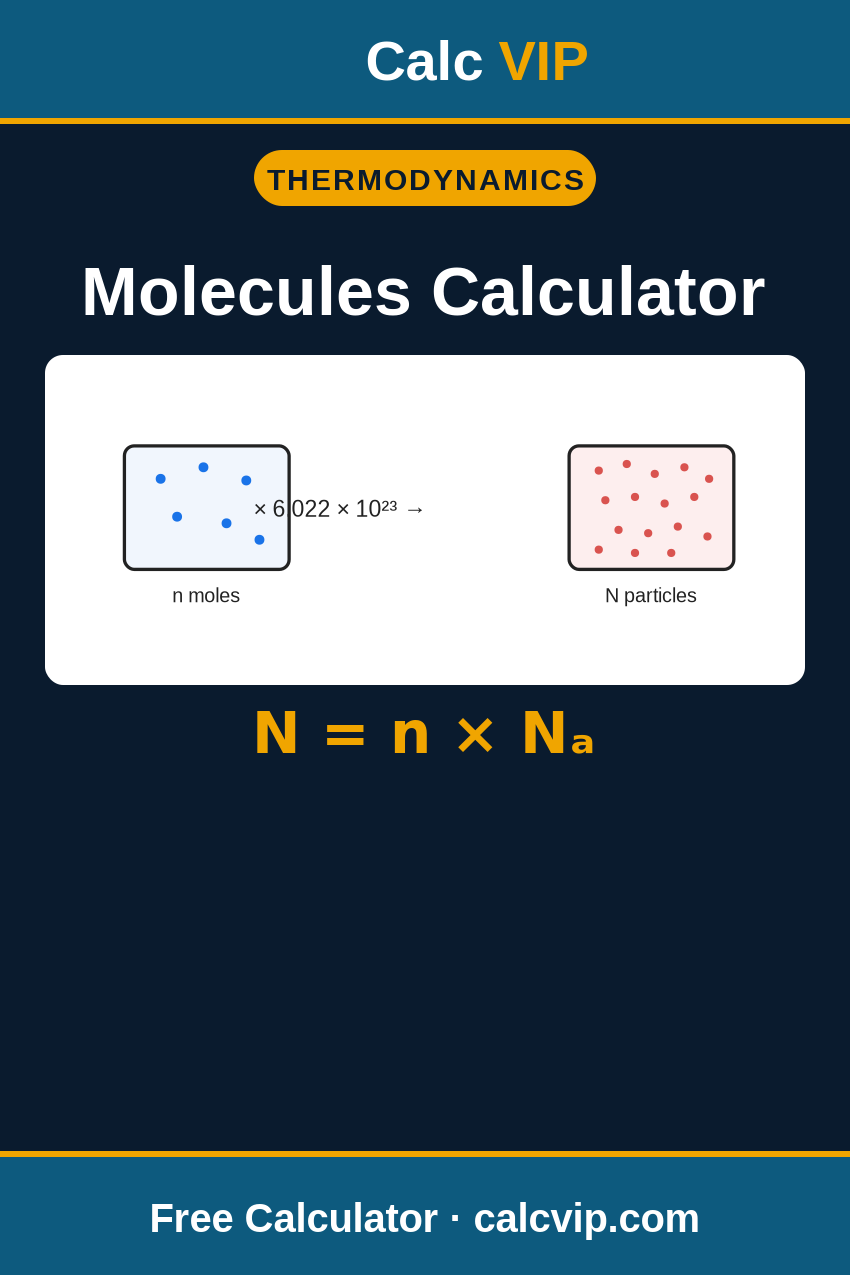
Use this free Molecules Calculator to count the particles in a sample with Avogadro's constant, N = n × 6.022 × 10²³. Either enter the amount in moles directly, or enter a mass and molar mass and let the tool find the moles first.
There is a number so large that chemistry would collapse without a way to package it: the count of molecules in a spoonful of water. Counting particles one by one is not merely impractical — at a billion per second, counting the molecules in a single drop would take longer than the age of the universe by a wide margin. Avogadro's constant is the packaging. One mole of anything contains exactly 6.022 × 10²³ of its particles, so the impossible counting problem becomes a weighing problem: weigh the sample, convert to moles, multiply by the constant, and you hold the census of an invisible crowd.
The constant itself is a bridge between two worlds. On one side is the laboratory world of grams and litres; on the other, the molecular world of atoms too small to see. It is defined so that one mole of carbon-12 weighs exactly 12 grams, which ties the bridge's ends together: the mass of one particle in atomic mass units and the mass of a mole of them in grams are the same number. That is why molar masses read straight off the periodic table can convert a kitchen-scale weighing into a particle count with nothing but multiplication and division.
This calculator walks the bridge in both of the usual ways. If you already know the amount in moles, it multiplies by Nₐ directly. If you know only a mass — the far more common situation — it first divides by the molar mass to find the moles, then multiplies. Either way the answer arrives in scientific notation, the only notation honest enough for numbers with twenty-four digits.
Formula
N = n × Nₐ, with Avogadro's constant Nₐ = 6.022 × 10²³ mol⁻¹. If you start from a mass instead, first find the amount with n = m/M (mass in grams ÷ molar mass in g/mol), then multiply by Nₐ. The result N is the number of atoms, molecules or ions — whichever particle the amount refers to.
The chain runs backwards just as cleanly: n = N/Nₐ recovers the amount from a count, and combining both steps gives the one-line mass-to-particles route N = (m/M) × Nₐ that this calculator's mass mode performs. Keep the particle straight in your mind as you use it: the formula counts whatever the mole was a mole of — molecules for a molecular substance, atoms for an element, formula units for an ionic compound, electrons if the amount was stated in moles of electrons (as it is in electrochemistry, where one mole of electrons carries 96,485 coulombs — Faraday's constant, which is just Nₐ wearing an electric charge).
| Symbol | Meaning | Units |
|---|---|---|
| N | number of particles (atoms, molecules, ions) | a pure count — no unit |
| n | amount of substance | mol |
| Nₐ | Avogadro's constant, 6.022 × 10²³ | per mole (mol⁻¹) |
| m | mass of the sample | g |
| M | molar mass | g/mol |
Why 6.022 × 10²³ is the size it is
Avogadro's constant was not chosen for roundness — it is measured from nature, and since 2019 it is fixed by definition at exactly 6.02214076 × 10²³ mol⁻¹, one of the defining constants of the SI system. Its size is dictated by the gram and the atom: it is the number of carbon-12 atoms in 12 grams of carbon-12, the count that makes the atomic mass unit and the gram fit together. Amedeo Avogadro himself never knew the number; he proposed in 1811 that equal volumes of gas hold equal numbers of particles, and the constant honouring him was pinned down over the following century by everything from Brownian motion to X-ray crystallography.
Feel the scale with comparisons physicists actually use. A mole of ordinary A4 paper sheets stacked would reach not to the Moon but across a noticeable fraction of the observable universe's width in sheet-count terms — better: a mole of sand grains would bury a large country metres deep, and a mole of seconds stretches to over a million times the age of the universe. Yet a mole of water is 18 grams — a mouthful. The constant is huge precisely because atoms are tiny, and the whole of chemistry is the art of doing arithmetic with crowds of 10²³ as if they were dozens.
The constant also explains why chemistry's ratios are exact. Reactions proceed molecule to molecule — two hydrogen molecules to one oxygen molecule, never 1.97 to 1.03 — so the counting unit that respects the reaction must count in whole particles. The mole is that unit scaled to the laboratory: it converts the integer bookkeeping of the microscopic world into the decimal bookkeeping of the balance. Whenever a recipe, a titration or a drug dose is stated in moles, it is this translation — from counted particles to weighed grams and back — that is being used, and N = n × N_A is its dictionary.
How to use
- Pick a mode: moles mode if you already know n; mass mode if you weighed the sample.
- Mass mode: enter the mass in grams and the molar mass (water = 18, CO₂ = 44, glucose = 180 g/mol).
- Click "Count Particles" — big counts are shown in scientific notation, e.g. 1.2 × 10²⁴.
- To count atoms rather than molecules, multiply the result by the number of atoms in one molecule (3 for H₂O, 24 for glucose).
Worked examples
Example 1 — two moles of water, both routes. How many molecules are in 2 mol of water?
N = n × Nₐ = 2 × 6.022 × 10²³ = 1.20 × 10²⁴ molecules.
Mass mode gives the same answer for a real sample: 36 g of water ÷ 18 g/mol = 2 mol → 1.20 × 10²⁴ molecules. Since each water molecule has 3 atoms, that is about 3.61 × 10²⁴ atoms in total.
Example 2 — half a mole of salt. A recipe-scale amount: 0.5 mol of sodium chloride.
N = 0.5 × 6.022 × 10²³ = 3.01 × 10²³ formula units — each one a Na⁺–Cl⁻ pair, so the sample holds 3.01 × 10²³ sodium ions and the same number of chloride ions.
Example 3 — a gram-scale gas sample. 44 g of carbon dioxide (M = 44 g/mol) is exactly 1 mol:
N = 6.02 × 10²³ molecules, and counting atoms (3 per molecule) gives 3 × 6.022 × 10²³ = 1.81 × 10²⁴ atoms.
Example 4 — glucose, the big molecule. 180 g of glucose (M = 180 g/mol) is 1 mol → 6.02 × 10²³ molecules. But each C₆H₁₂O₆ molecule carries 24 atoms, so the atom census is 24 × 6.022 × 10²³ = 1.45 × 10²⁵ atoms — the atoms-per-molecule multiplier matters more as molecules grow.
Example 5 — a single milligram. How many water molecules in 1 mg (0.001 g)?
n = 0.001 / 18 = 5.56 × 10⁻⁵ mol, so N = 5.56 × 10⁻⁵ × 6.022 × 10²³ = 3.35 × 10¹⁹ molecules. Even a speck you can barely see is a crowd of ten billion billion.
Example 6 — running the bridge backwards. A sample is known to contain 3.011 × 10²³ molecules of oxygen. How much is that?
n = N/Nₐ = 3.011 × 10²³ / 6.022 × 10²³ = 0.5 mol — and at M = 32 g/mol, a mass of 0.5 × 32 = 16 g.
Counting particles in real life
Stoichiometry — chemistry's bookkeeping. Every balanced equation is a particle census: "2 H₂ + O₂ → 2 H₂O" says two molecules react with one to make two, and the mole lets factories scale that census to tonnes without ever counting past 6.022 × 10²³ at a time.
Pharmaceutical dosing. A 500 mg paracetamol tablet (M = 151 g/mol) contains 0.5/151 ≈ 0.0033 mol — about 2.0 × 10²¹ molecules of the drug. Pharmacology's dose–response curves are, underneath, statements about how many molecules reach how many receptors.
Electrochemistry and electroplating. One mole of electrons is 6.022 × 10²³ electrons and carries 96,485 C of charge. Platers compute the metal deposited from the current and time by counting electrons in moles — this calculator's arithmetic with charge attached.
Air quality and Loschmidt's number. At STP each cubic centimetre of air holds about 2.69 × 10¹⁹ molecules (Avogadro's constant divided by the 22,414 cm³ molar volume). Pollution limits in "molecules per cm³" and parts-per-million both trace back to that census.
Semiconductor doping. Chip makers dope silicon at levels like one phosphorus atom per million silicon atoms — a particle-count specification. Translating between atoms per cm³ and moles is routine Avogadro arithmetic.
Radiochemistry. A radioactive source's activity connects to its atom count through the decay constant; knowing N (from mass and molar mass, via this page's chain) is how the lifetime inventory of a source is first estimated.
How the constant was measured: from Brownian motion to a silicon sphere
Pinning down 6.022 × 10²³ took a century of ingenuity. Einstein's 1905 theory of Brownian motion turned the jiggling of pollen grains into a counting tool, and Jean Perrin's careful observations of that jiggle produced the first convincing value — work that finally persuaded sceptics that atoms were real. X-ray crystallography later counted atoms by measuring the spacing of crystal lattices: measure a crystal's density and its unit-cell size and Avogadro's constant falls out. The modern endpoint of that line is the Avogadro project, which polished a near-perfect sphere of silicon-28, counted its atoms by X-ray interferometry, and produced a value so precise that in 2019 the constant was promoted to a defined exact number — the mole is now defined as exactly 6.02214076 × 10²³ particles, and it is the kilogram that must be measured against it, not the other way round.
Particles per cubic centimetre: Loschmidt's number
Divide Avogadro's constant by the molar volume of a gas at STP (22,414 cm³) and you get the head-count of an ordinary lungful's building blocks: about 2.69 × 10¹⁹ molecules in every cubic centimetre of air at 0 °C and atmospheric pressure — Loschmidt's number, first estimated by Josef Loschmidt in 1865 in the earliest serious attempt to size molecules. It recalibrates intuition about "empty" space: the air in a sugar cube's volume holds more molecules than there are stars in the observable universe by many orders of magnitude, and even a laboratory vacuum of 10⁻⁹ mbar still leaves billions of molecules per cubic centimetre. There is no emptiness anywhere near everyday life — only crowds too small to notice.
Avogadro's own hypothesis is the silent partner of every count on this page: equal volumes of gases, at the same temperature and pressure, contain equal numbers of particles — which is why the molar volume (22.414 L at STP) is the same for hydrogen and for carbon dioxide despite their wildly different masses. Counting by volume, counting by mass and counting by particles are three doors into the same room, and the mole is the corridor connecting them.
Quick reference: moles to particles
| Amount n (mol) | Particles N | Everyday anchor |
|---|---|---|
| 0.001 | 6.02 × 10²⁰ | 18 mg of water — a droplet |
| 0.01 | 6.02 × 10²¹ | 0.18 g of water |
| 0.1 | 6.02 × 10²² | 1.8 g of water — a sip's remnant |
| 0.25 | 1.51 × 10²³ | a quarter-mole of anything |
| 0.5 | 3.01 × 10²³ | 9 g of water |
| 1 | 6.02 × 10²³ | 18 g of water; 12 g of carbon |
| 2 | 1.20 × 10²⁴ | 36 g of water — a few spoonfuls |
| 5 | 3.01 × 10²⁴ | 90 g of water |
| 10 | 6.02 × 10²⁴ | 180 g of water — a small glass |
The anchors make the point the formula cannot: even the smallest row is a number beyond visualisation, which is exactly why the mole — not the particle — is chemistry's working currency.
At the opposite end of the scale, modern analytical chemistry now works in attomoles and zeptomoles — 10⁻¹⁸ and 10⁻²¹ mol. An attomole of a protein is still some 600,000 molecules, comfortably countable by a good mass spectrometer; a zeptomole is about 600 molecules, near the floor of what detection can mean. Single-cell biology lives in this territory: a bacterium may contain only a few copies of a given transcription factor, a regime where the mole concept still converts correctly but the smooth statistics of bulk chemistry give way to the graininess of small numbers — chemistry becoming demography, a few particles at a time.
Common mistakes
- Counting molecules when atoms were asked for (or the reverse). N = n × Nₐ counts the particle the mole refers to. For atoms inside molecules, multiply by the atoms per molecule — 3 for water, 24 for glucose. Skipping that step understates glucose's atom count 24-fold.
- Using the molar mass of the wrong form. Oxygen as O (16) versus O₂ (32), or a hydrate's mass without its waters of crystallisation — the n from m/M is only as right as the M you feed it.
- Dropping the exponent in scientific notation. 1.20 × 10²⁴ is not "about 1.2". The ×10²⁴ is the answer's size; writing counts in full or rounding the exponent away destroys the result.
- Entering kilograms in a grams box. Mass mode expects grams. A 0.036 kg sample entered as 0.036 (read as grams) understates the count a thousandfold. Convert to grams first.
- Expecting the count to depend on the substance's state. Melting, dissolving or vaporising changes no particle counts: 18 g of ice, water or steam holds the same 6.022 × 10²³ molecules. N tracks the sample, not its phase.
FAQ
What is Avogadro's constant?
Nₐ = 6.022 × 10²³ per mole — the number of particles in exactly one mole of a substance. It is defined so that one mole of carbon-12 atoms has a mass of exactly 12 g.
Is the answer atoms or molecules?
Whichever particle your amount counts. If n is moles of water, N is water molecules; if n is moles of iron, N is iron atoms. To count atoms inside molecules, multiply by the atoms per molecule (3 for H₂O).
How big is 10²⁴, really?
A mole of sand grains (6 × 10²³) would cover a large country metres deep. The water example above — just 36 g, a few spoonfuls — already contains over a million million million million molecules.
Why is the constant defined using carbon-12?
Carbon-12 is the reference isotope of the atomic mass scale: one atom is exactly 12 u, so a mole of them is exactly 12 g. Since 2019 the constant itself is fixed by definition, and carbon-12 remains its historical anchor.
How many molecules are in a drop of water?
A typical drop is about 0.05 g: n = 0.05/18 ≈ 0.0028 mol, giving roughly 1.7 × 10²¹ molecules — more than the number of drops in all the world's oceans, by the usual comparison.
Can I count ions with this calculator?
Yes. For an ionic compound, n counts formula units; each unit then supplies its ions — 1 mol of NaCl is 6.022 × 10²³ Na⁺ ions and the same number of Cl⁻ ions, 1.20 × 10²⁴ ions in total.
Does temperature or pressure change the count?
No. Heating a sealed sample changes how fast its particles move, not how many there are. N changes only if matter enters, leaves, or reacts into different particles.
What is a millimole, and why do labs use it?
A millimole is 0.001 mol = 6.022 × 10²⁰ particles. Laboratory and clinical quantities are often small, so mmol (and the matching mg-scale masses) keep the numbers convenient — blood glucose, for instance, is reported in mmol/L.
How does this relate to Faraday's constant?
Multiply Avogadro's constant by the elementary charge and you get 96,485 C/mol — Faraday's constant, the charge of one mole of electrons. Electrochemistry is particle counting where the particles carry charge.
Who was Avogadro?
Amedeo Avogadro (1776–1856), an Italian physicist whose 1811 hypothesis — equal volumes of gases hold equal numbers of molecules — explained the gas laws' combining ratios. The constant was named for him decades after his death, when its value was first measured.